






TIGHTER TIMBER SUPPLIES, climbing labour costs and wider inflation in the economy are all contributing to increases in the price of a new kitchen.
Prices have soared for many kitchen units at Swedish budget furniture giant Ikea in the past five years, analysis by The Journal has found. The company said this weekend that its price rises were in line with those across the industry.
The price of major kitchen appliances, meanwhile, has increased by a third since 2020 according to data from the Central Statistics Office.
James Crowley, managing director of Modoco, a Limerick and Dublin-based firm that specialises in customising Ikea kitchens with different doors, handles and worktops, told The Journal that one of the biggest areas where he has seen price increases has been in plywood.
“It’s safe to say it’s doubled in the last five years,” Crowley explained, with the latest costing for one sheet of plywood used by the company coming to around €78.
“It depends on the size of kitchen but you’d use ten sheets normally,” he added.
Ukraine was previously a major source of timber for the continental European market, but since the Russian invasion in 2022, the continent has been buying more from the UK – which is also where Ireland sources the material. This has driven up prices in the Irish market.
Labour prices have also increased since the pandemic. Central Statistics Office (CSO) data shows hourly earnings in the construction sector in Ireland have increased from €21.14 in early 2019 to €29 this year.
Companies in the sector who spoke to The Journal estimated that kitchens can range anywhere from €5,000 to north of €30,000, but the vast majority of kitchens end up costing around €15,000.
How prices have risen since 2020
Consumer tastes are also driving up what people can expect to pay, Crowley said. In particular, tastes in countertops have become more expensive. A counter is likely to cost between €1,500 to €4,000 for a mid-market kitchen.
“People used to be happy with fake wood effect or laminated worktops,” Crowley said.
The cheapest worktops can be bought for a sum in the “low hundreds”, but prices “balloon” if you’re going to use stone or install an island in your kitchen. Imitation stone worktops can provide the modern look for less money, he added.
Dublin-based kitchen installation firm Aloco told The Journal that it is increasingly seeing customers now want a kitchen that will maximise the available storage, which also drives up prices.
“[They] will go for all the extras to facilitate this as they want their kitchen to last the test of time,” Wendy Stone from Aloco said.
Ikea’s prices rising since 2021
Ikea told The Journal that “global events and rising costs” have led the company to “adjust prices since 2021″.
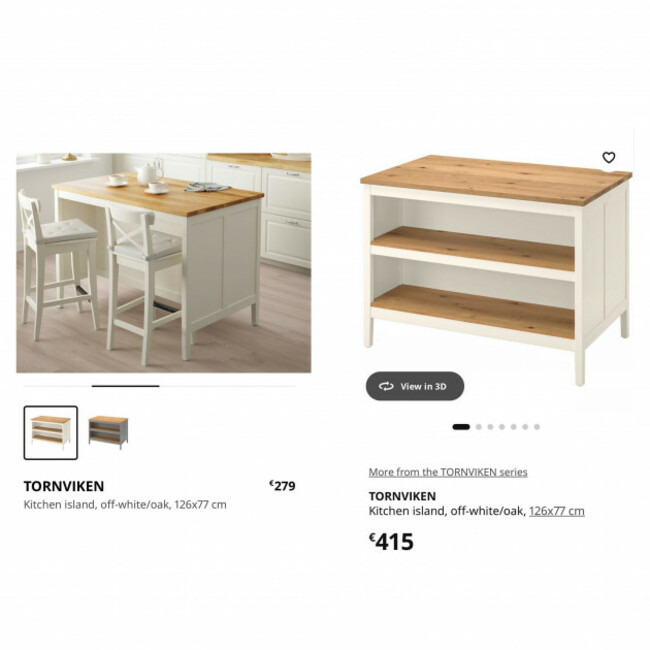
A Tornviken off-white/oak island cabinet cost €279 in 2021, but now costs €415, a jump of 49%.
A sheet of Ekbacken laminate brown walnut effect worktop that cost €55 in 2019 has almost doubled to €105.
Similarly, a Karlby walnut veneer worktop that would have cost €110 seven years ago will now set you back €250.
Ikea stressed that the soaring prices of some items were “in line with increases seen across the entire kitchen industry” and reflect broader market trends.
“Affordability and low prices remain at the heart of IKEA,” the company said.
What costs what?
Aloco – the Dublin-based bespoke firm – said a mid-range kitchen – so neither on a budget nor anything especially fancy – can reach up to €20,000.
The most costly part of the kitchen are the cabinets and carcass, which can come to anywhere between €5,000 to €10,000.
But if you’re trying to keep prices low, a kitchen carcass is estimated to cost €2,000-4,000, while a worktop may come in at between €500 and €1,500.
Other aspects that will cost a chunk of change include appliances – €3,000 to €6,000 on a mid-range budget – to installation, estimated at around €2,500 to €4,000.
Extras such as plumbing and electrics also need to be borne in mind, and can range anywhere from €500 to €4,000 depending on the amount of work needed.
On a tight budget, most of these different critical features can be kept in at around €1,000-1,500, but companies warn that quality may suffer the lower you go.
Stone, from Aloco, said the company saw its suppliers hit with increases to the costs of materials after the pandemic due to shortages.
However, when jams in the supply chain were loosened and returned to normal, the company didn’t see prices of these materials return to earlier, lower costs.
“There were new factors such as electricity and freight cost then taking such an impact on purchase prices,” Stone said.
“Aloco as a company held off for as long as possible in introducing price increases but along with other companies like ourselves we eventually had to increase prices due to the rising purchase costs, electricity and fitting contractor costs.”
Making the plan fit the budget
In the past four years, Crowley, from Modoco, has worked on kitchens with budgets ranging from less than €10,000, to one that managed to hit six figures.
He said many customers struggle to fit their original plans to their budget, especially if the fit-out is part of a bigger renovation project.
“Quite often the kitchen is something that’s bought towards the end of a project, and a lot of money has maybe been set aside to go to the kitchen, but that’s just not there at the end of the project when you’re actually ready,” he said.
“It could be because of construction, or something has happened on site to eat up some of that funding.”
As for what you’d get if you win the Lotto and decide to go the €100,000 kitchen, Crowley cautions that it’s probably not worth it
“You’re going to get a lot of brands, but would you really know the difference unless you’re really into it? Probably not.”