







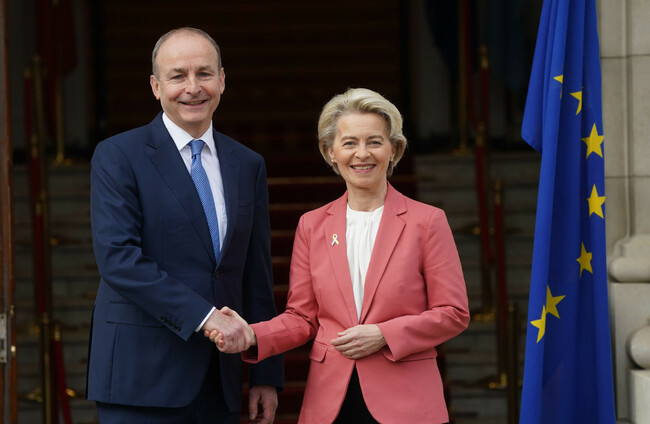
AS IRELAND PREPARES to take the reins of the presidency of the European Union, Taoiseach Micheál Martin is heading to Brussels to take part in the final meeting of the European Council under Cyprus’s presidency.
The 27 EU leaders will take part in the two-day summit on Thursday and Friday. On the agenda is Ukraine, migration, the situation in the Middle East, the EU’s long-term budget for 2028 to 2034, and competitiveness across European markets.
European defence and security will also be discussed – a key issue Irish leaders have faced questions on as it gears up to host world leaders and EU events over the six months from 1 July.
The Taoiseach said in advance of the summit that he intends to push for “concrete EU action in response to egregious Israeli breaches of human rights and democratic principles”, as he said the current situation across the Middle East remains “grim”, particularly in Gaza, the West Bank and Lebanon.
“I wrote to President Costa last month reiterating our position on the EU’s approach and looking for an urgent discussion on this. We have always been clear that we prefer action at EU level, which would have greater impact, and I will continue to make that point,” he said
European leaders will hear from Ukrainian President Volodymyr Zelenskyy about the latest developments in Ukraine, which has been at war with Russia since it was invaded in 2022. It has yet to be confirmed whether Zelenskyy will attend the summit in person.
The Taoiseach said the council “has a busy agenda to work through, with a focus on many areas that Ireland will be seeking to advance when we assume the Presidency of the EU Council in less than two weeks”.
During Ireland’s presidency term, Martin said there will be work carried out to ensure the EU makes “decisive progress” in several areas including reducing energy prices across the bloc.
Martin said he will report to his fellow leaders on the roadmap under Ireland’s presidency at the council meetings in the autumn.
President of the European Council António Costa said in advance of the summit that the EU’s “two-pronged approach” in supporting Ukraine and putting pressure on Russia “is working”.
The enlargement of the union has been a key priority for Ireland. Western Balkan state Montenegro, an EU candidate state, is expected to advance its application over the course of the Irish turn.
Other candidate countries, such as Moldova and Ukraine, will remain close to Ireland during the presidency. Both hope to join the EU by 2030, with the Moldovan Deputy Prime Minister for EU Integration Cristina Gherasimov telling The Journal in February that its bid remains tied to Ukraine’s.
The election of Hungarian prime minister Péter Magyar, replacing Victor Orbán, has seen Hungary drop its objections to the two eastern European countries joining the EU. Both countries are beginning the long accession process.
Martin said: “I welcome the opening of Cluster 1 on Fundamentals with Ukraine and Moldova, and the Irish Presidency will aim to facilitate the opening of all remaining clusters. EU accession is a crucial element in securing Ukraine’s longer-term security and prosperity.
“The announcement that an agreement has been reached between the US and Iran to solidify the ceasefire and reopen the Strait of Hormuz is welcome.
“We hope there can now be a full engagement by all involved to implement this agreement and achieve peace and stability across the region. Re-opening the Strait of Hormuz to international shipping would bring much-needed relief to the global economy.”