






Right now all eyes are on Artemis II, NASA’s historic mission that just sent astronauts around the moon for the first time in more than a half-century. But, as detailed by NASA administrator Jared Isaacman at the space agency’s recent “Ignition” event in Washington, D.C., Artemis II is only the beginning of a larger U.S. effort to populate the moon with astronauts and resource-prospecting robots. If this quest advances at the breakneck pace Isaacman desires, then Earth’s celestial sidekick will also become a place of profound scientific revelations.
Despite the moon being so nearby, we know surprisingly little about it with much certainty. The Apollo astronauts hauled back a bevy of moon rocks and left behind a few short-lived geological experiments, but most of our lunar knowledge today comes from moon-orbiting satellites, telescopic observations from Earth and the handful of sample-return missions undertaken recently by China.
Starved of more in situ data, researchers can’t yet scratch a bigger scientific itch; they wish to study the moon as a Rosetta Stone for the origin and evolution of our world and the solar system at large. Now, thanks to the proposed high cadence of lunar missions—crewed and robotic, by space agencies and private industry alike—it looks like their wish will be granted. Earth’s tectonics, volcanism, oceans, atmosphere and life have all erased the geological records of the planet’s earliest eras. But the moon, lacking such tumult, has preserved them. That makes Earth’s silvery orb “a perfect geological laboratory,” says Sara Russell, a planetary scientist at London’s Natural History Museum.
If you're enjoying this article, consider supporting our award-winning journalism by subscribing. By purchasing a subscription you are helping to ensure the future of impactful stories about the discoveries and ideas shaping our world today.
With that in mind, here are the biggest mysteries moon-focused scientists are now hoping to solve.
The churning heat deep within planets and moons is what gives them geological “life,” from volcanic eruptions and earthquakes to uplifting mountains and excavating ocean basins. But when the heat wanes, a world dies, geologically speaking.
Scientists know of three main ways to keep the metaphorical fires burning: the “primordial” heat left over from impactors slamming together during the world’s collisional formation, the heat from decaying radioactive elements and the frictional heat from tidal forces that can knead a world’s innards like dough.
The moon is much smaller than Earth, so its primordial heat should have leaked into space long ago. Lunar samples and theoretical models suggest it lacks a hidden abundance of radioactive elements. And careful calculations show that Earth’s gravitational pull shouldn’t be causing significant lunar tidal heating. Yet shallow “moonquakes” still shake the moon, while age estimates based on crater counts of its pockmarked surface hint that some volcanism may be 100 million years old—which, on geological timescales, is yesterday.
Scientists, naturally, have questions. “Is the moon still volcanically active?” asks Thomas Watters, a senior scientist in the Center for Earth and Planetary Studies of the Smithsonian Institution’s National Air and Space Museum in Washington, D.C. To find out just how much geological “life” still lingers there—and why—“we need to get a better look at the moon’s internal structure,” Watters says.
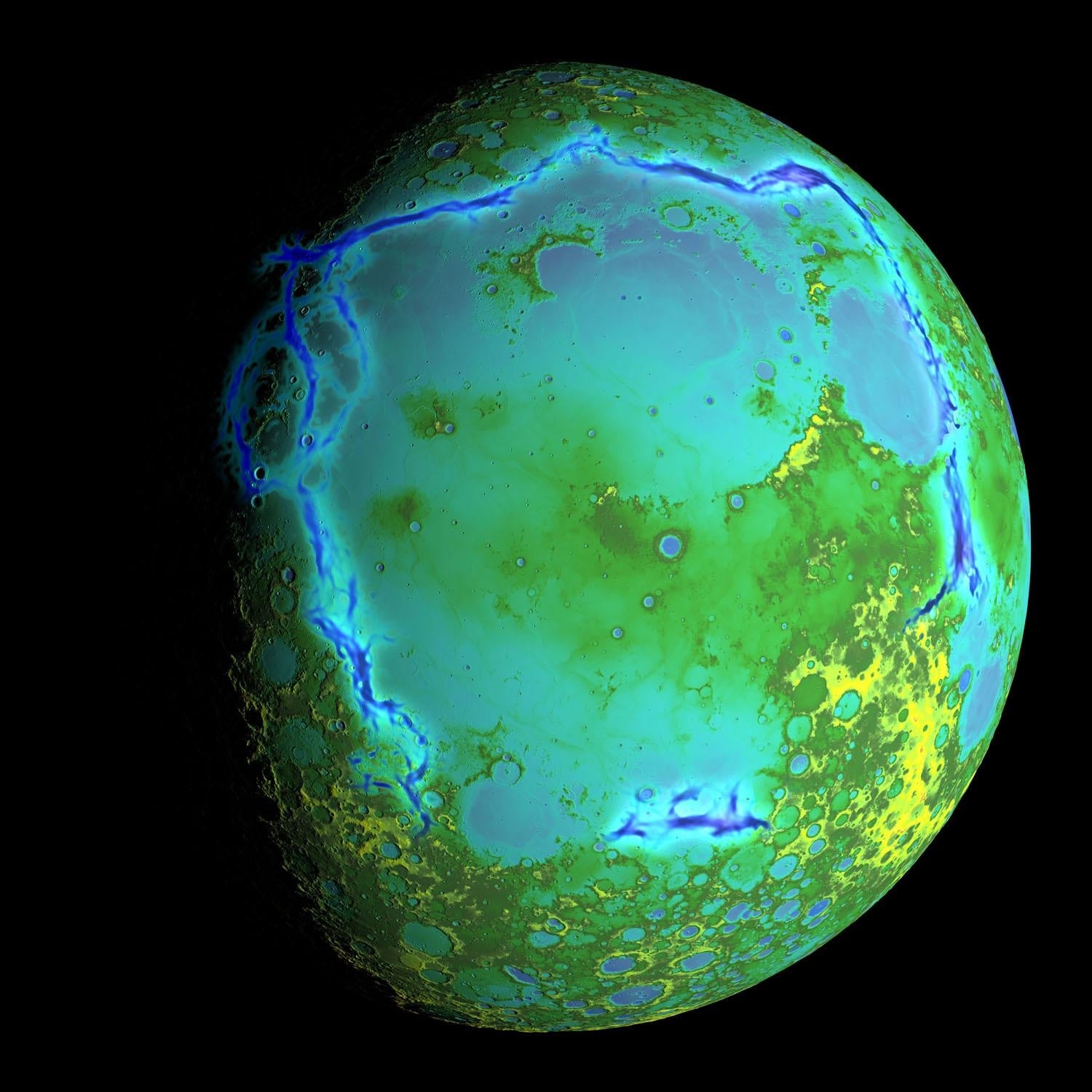
This eerie false-color topographic lunar view is centered on Oceanus Procellarum, the largest expanse of frozen lava on the moon. Based on data from NASA’s Lunar Reconnaissance Orbiter, as well as the space agency’s GRAIL mission, the blue border structures are thought to be ancient, lava-flooded rift zones buried beneath Oceanus Procellarum’s volcanic plains
NASA/Colorado School of Mines/MIT/GSFC/Scientific Visualization Studio
To delve to the (geological) heart of the matter, scientists want to know the moon’s deepest secret—what’s happening at its most abyssal depths. “Does the moon have a solid core or a liquid core?” says Yuqi Qian, a lunar geologist at the University of Hong Kong. “We still don’t know.”
Seismometers offer silver bullets, allowing scientists to use moonquakes (whether homegrown or imported via lunar impacts of errant meteoroids) to effectively perform a CT scan of the deep subsurface. But coverage is currently nonexistent; what we know about the lunar underworld was provided by Apollo-era seismometers that operated until 1977. And these were all placed in just one patch of the moon’s nearside. “We don’t have any seismometers deployed on the farside,” Qian says.
That’s about to change. If current projections are to be believed, the next time anyone lands astronauts on the moon will be the Artemis IV mission, set for 2028. When those crew members reach their landing site near the moon’s south pole, they’ll tote along a cutting-edge seismometer package called the Lunar Environment Monitoring Station, or LEMS. Eventually, as part of NASA’s Commercial Lunar Payload Services, or CLPS, initiative, a network of sensors known as the Farside Seismic Suite will be robotically deployed in the eponymous region. Recent news suggests China may make its first crewed landing somewhere on the moon’s nearside, and those astronauts will likely bring seismometers as well.
In other words, the “Artemis astronauts will be laying down some of the first nodes of a global seismic network,” says Nicholas Schmerr, a seismologist and planetary scientist at the University of Maryland.
Samples, too, will be vital. Rocks nabbed by China’s robotic lunar sample return missions, Chang’e 5 and 6, indicate active volcanism there up until at least two billion years ago. Widening our view to the moon’s more recent epochs requires nabbing more youthful material from the surface. For now, Qian says, “we don’t have samples younger than that.”
Scientists also hope future landings will locate and sample expunged sections of the moon’s mantle—the primeval, less altered underbelly of the lunar crust. If mantle rocks prove to be riddled with byproducts of radioactive decay, this would probably mean the moon’s interior is richer in heat-generating radioisotopes than scientists had thought—thus explaining why it’s still convulsing long past its presumed geological expiry date.
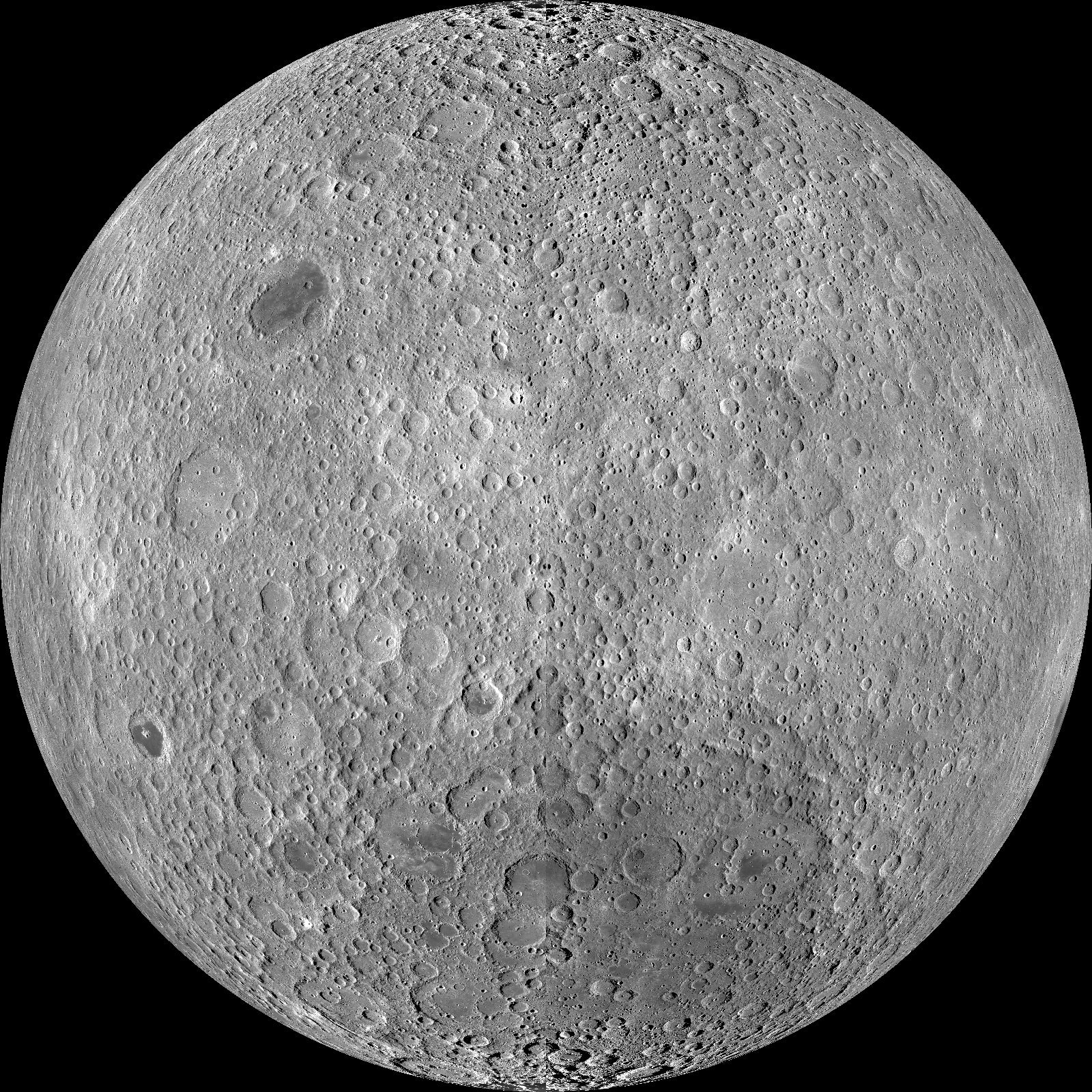
A view of the moon’s crater-pocked far side, based on observations from NASA’s Lunar Reconnaissance Orbiter.
NASA/Goddard/Arizona State University
The most popular origin story involves Theia—a Mars-sized protoplanet—smashing into the primordial proto-Earth, with the debris from both bodies quickly coalescing into the moon. This isn’t just a fable: it’s backed up by robust computer simulations grounded with plenty of geochemical evidence. Samples of the moon’s mantle, though, could further test this theory—while geophysical observations could address the moon’s weirdest feature.
The nearside is covered in vast, dark splotches of cooled volcanic rock named mare (Latin for “sea”). The farside has a dearth of these and instead looks more like Mercury: a crater-filled land of jagged mountain ridges. Why is the moon so two-faced?
One possible explanation comes from an idea dubbed “Earthshine.” Eons ago, when the moon formed, it orbited Earth 15 times closer. At some stage, the moon became tidally locked, meaning one hemisphere (the nearside) always faced Earth. And because our planet back then was a seething ball of magma, the lunar nearside should have been baked like crème brûlée, with the nearside turning molten and bubbly. Streams of vaporized rock whooshed around the moon, cooling and raining out on the farside to create its thick, lumpy crust.
Here, too, seismology offers another silver bullet. A network of seismometers, especially on the farside, could reveal crucial otherwise-hidden clues. “What is the structure of the moon?” Russell asks. “This is important to find out, as it will help us understand how the moon first formed from the debris of a giant impact and how it then evolved.”
NASA really wants to plonk its astronauts down near the lunar south pole (and even build a moon base there) because that’s where permanently shadowed craters harbor some vague amount of water ice—a potential resource for hydrating humans, growing crops and making rocket fuel.
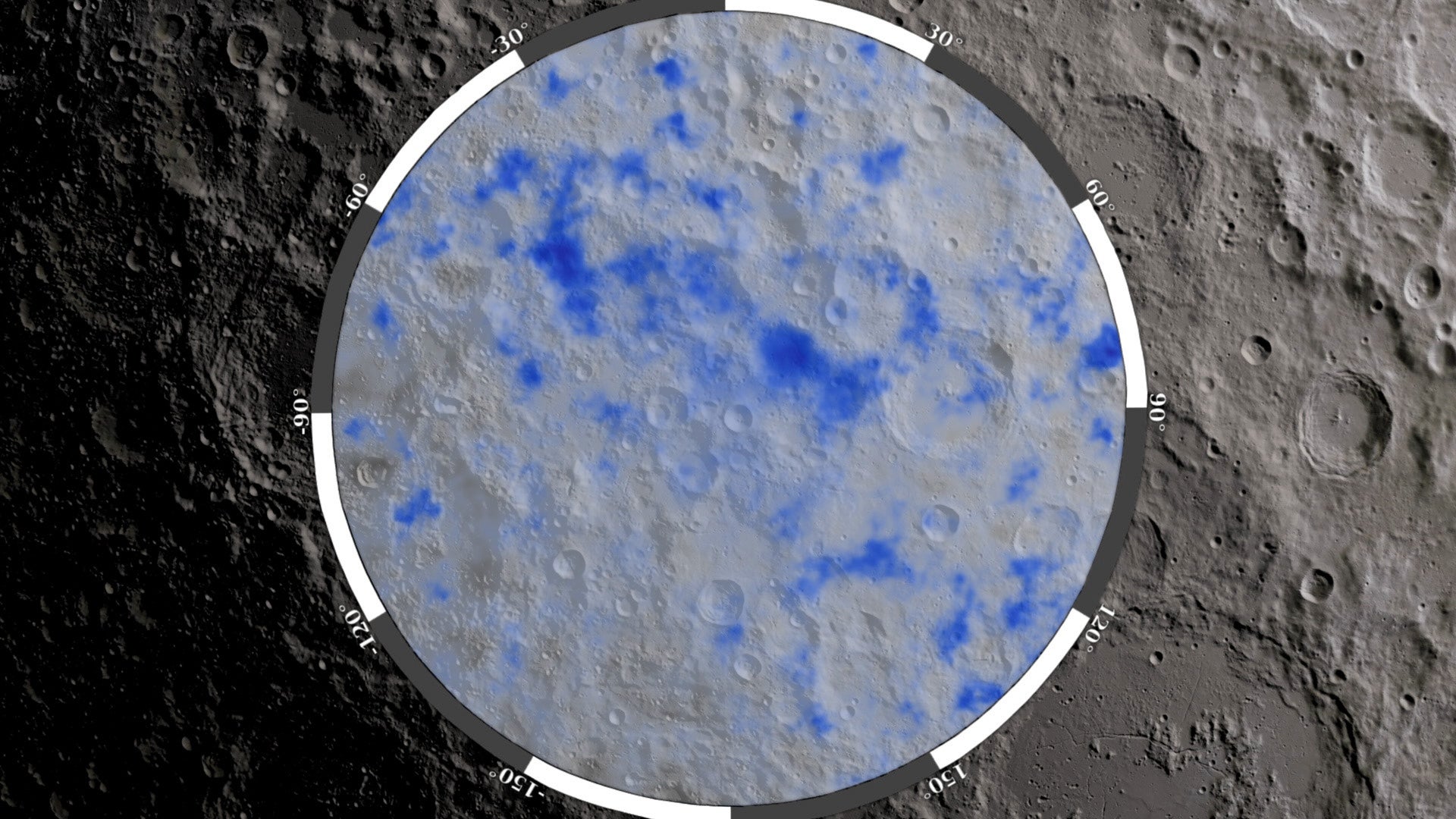
Data from NASA’s Lunar Reconnaissance Orbiter reveals the possible presence of water-ice deposits (blue) at the dark floors of craters around the moon’s south pole.
NASA/GSFC
It’s no coincidence, then, that lunar prospecting was a hot topic at NASA’s Ignition event. Astronauts could, in principle, descend into the treacherously dark and cold craters to look for themselves, but most of this water divining will be conducting by robots.
NASA’s Volatiles Investigating Polar Exploration Rover, or VIPER, will use its instruments to sniff out subsurface water, then use a drill to confirm its suspicions. And NASA’s next-generation moon buggy—or Lunar Terrain Vehicle—will do something similar, whether it’s being piloted by astronauts or (as will likely be the case for most of its lunar tenure) autonomously navigating the surface. And brought along for the ride on an upcoming crewed surface mission will be the Lunar Dielectric Analyzer, an instrument that can detect electrical currents in the ground below, which can reveal the presence of ice. “This will really help us understand where water is on the moon and in what form,” Russell says.
This endeavor isn’t just about being pragmatic. Scientists still don’t really know where Earth’s water came from. Ice-rich comets or drier asteroids are the two prime suspects. Geochemical studies of various meteorites and Earth’s oceans hint at asteroids as the more likely culprit, but the case is far from closed. Consulting the moon’s relatively pristine terrain —much of which has been frozen in time for billions of years—could help finally solve this mystery. “If there’s any water ice on the moon, its signal might be more primitive,” Qian says. And because Earth and the moon have a very similar ancient history, then “the origin of water on the moon is likely the same as the origin of water on the Earth,” Russell says. All scientists need to do now, then, is find it.
此内容由惯性聚合(RSS阅读器)自动聚合整理,仅供阅读参考。 原文来自 — 版权归原作者所有。