





Here’s how scientists drilled 8,000 feet through ice to place the world’s deepest seismometers
By Vanessa Bates Ramirez edited by Sarah Lewin Frasier
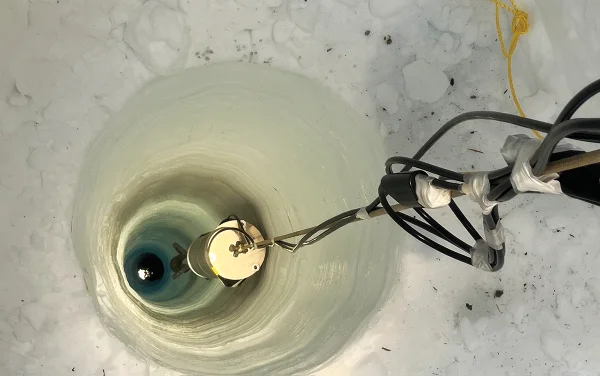
Researchers drilled 8,000 feet into South Pole ice to install two seismometers.
Robert Anthony/USGS
Join Our Community of Science Lovers!
On the surface, Antarctica’s vast ice sheet appears still and unchanging. But deep below, vibrations ripple through the frozen plain, transmitting the movements of Earth’s tectonic plates—and scientists now have a formidable new set of tools to listen in with. The U.S. Geological Survey (USGS), collaborating with the IceCube Neutrino Observatory at the South Pole, has installed the deepest seismometers ever deployed. At 8,000 feet under the ice, the two instruments will record earthquakes of magnitude 5 or greater anywhere on the planet with unprecedented accuracy and help to reveal new details of Earth’s deep interior in the process.
The South Pole is one of Earth’s quietest places because there is very little humanmade infrastructure and no background “noise” from the planet’s rotation, which can distort seismometer data. At their depth, the new seismometers may also be shielded from disruptive changes in atmospheric pressure, says USGS research geophysicist Robert Anthony, the Deep Ice Seismometer project manager.
Engineers “drilled” holes by shooting pressurized hot water into the ice to melt it. “The drill is producing as much energy as the most powerful steam locomotive ever made and channeling it all through an orifice the size of a penny,” Anthony says. At a rate of roughly three feet per minute, the drill can complete a hole in about 50 hours, after which the team has another 50 hours to lower strings of instrumentation before the ice refreezes. To contend with the pressure at a depth of 8,000 feet, the seismometers are encased in a stainless steel vessel built to withstand 10,000 pounds per square inch.
On supporting science journalism
If you're enjoying this article, consider supporting our award-winning journalism by subscribing. By purchasing a subscription you are helping to ensure the future of impactful stories about the discoveries and ideas shaping our world today.
Each seismometer contains a small pendulum suspended within a magnetic field; when a vibration reaches the sensor, a resistor measures the magnetic-field strength required to keep the pendulum stationary. “This lets us record lower-frequency ground motions all the way down to the solid Earth tides driven by the gravitational attraction of the sun, Earth and moon,” Anthony says. Scientists can use these data to quickly characterize how a fault moved to generate an earthquake, which can help them determine whether it also triggered a tsunami. The South Pole station fills a significant gap in global seismic coverage, researchers say, because of its distance from other stations and the lack of interference from Earth’s rotation.
“Earthquake waves don’t just shake the surface; they go in all directions, including down,” says David Wilson, director of the Global Seismographic Network. The deep seismometers will be particularly good at recording long-period seismic waves created by large earthquakes (about magnitude 7 or greater). “These waves can go on for months after a large earthquake because there’s nowhere for the energy to go to dissipate,” Wilson says. “Imagine hitting a bell. It’s going to sit there and ring until the energy completely dies down.”
It’s Time to Stand Up for Science
If you enjoyed this article, I’d like to ask for your support. Scientific American has served as an advocate for science and industry for 180 years, and right now may be the most critical moment in that two-century history.
I’ve been a Scientific American subscriber since I was 12 years old, and it helped shape the way I look at the world. SciAm always educates and delights me, and inspires a sense of awe for our vast, beautiful universe. I hope it does that for you, too.
If you subscribe to Scientific American, you help ensure that our coverage is centered on meaningful research and discovery; that we have the resources to report on the decisions that threaten labs across the U.S.; and that we support both budding and working scientists at a time when the value of science itself too often goes unrecognized.
In return, you get essential news, captivating podcasts, brilliant infographics, can't-miss newsletters, must-watch videos, challenging games, and the science world's best writing and reporting. You can even gift someone a subscription.
There has never been a more important time for us to stand up and show why science matters. I hope you’ll support us in that mission.