




惯性聚合 高效追踪和阅读你感兴趣的博客、新闻、科技资讯
阅读原文 在惯性聚合中打开

推荐订阅源

P
Privacy International News Feed
WordPress大学
WordPress大学
Security Latest
Security Latest
Cyberwarzone
Cyberwarzone
K
Kaspersky official blog
Cisco Talos Blog
Cisco Talos Blog
Microsoft Security Blog
G
GRAHAM CLULEY
N
News | PayPal Newsroom
Apple Machine Learning Research
freeCodeCamp Programming Tutorials: Python, JavaScript, Git & More
V
Visual Studio Blog
美团技术团队
J
Java Code Geeks
I
Intezer
The Cloudflare Blog
SecWiki News
SecWiki News
S
Secure Thoughts
Microsoft Azure Blog
V2EX - 技术
V2EX - 技术
C
Cyber Attacks, Cyber Crime and Cyber Security
奇客Solidot–传递最新科技情报
奇客Solidot–传递最新科技情报
Spread Privacy
Spread Privacy
D
DataBreaches.Net
S
Security Affairs
Help Net Security
Help Net Security
S
Securelist
F
Full Disclosure
C
Check Point Blog
F
Fortinet All Blogs
Know Your Adversary
Know Your Adversary
Exploit-DB.com RSS Feed
Y
Y Combinator Blog
云风的 BLOG
云风的 BLOG
阮一峰的网络日志
阮一峰的网络日志
The Register - Security
cs.CL updates on arXiv.org
人人都是产品经理
人人都是产品经理
博客园_首页
G
Google Developers Blog
Google Online Security Blog
Cyber Security Advisories - MS-ISAC
H
Help Net Security
酷 壳 – CoolShell
酷 壳 – CoolShell
I
InfoQ
Application and Cybersecurity Blog
H
Hacker News: Front Page
L
LINUX DO - 热门话题
Threat Intelligence Blog | Flashpoint
L
LangChain Blog

Scientific American

Former deputy surgeon general Erica Schwartz nominated as new CDC chief NASA Artemis II astronauts say thank you to the world Congress grills RFK, Jr., about vaccines and cuts to health budget How the Grand Canyon formed is a surprisingly messy story. Here's the latest clue Astronomers just finished the biggest, sharpest 3D map of the universe—and it’s beautiful How far from humanity were the astronauts of Artemis II? The answer will surprise you Effect of antiamyloid Alzheimer’s drugs ‘absent or trivial,’ Cochrane review finds The Trump administration is looking to experts to weigh in on peptides When a naked mole rat queen dies, that usually means war—but not for this colony NASA needs nuclear power for its moon base. Here’s the White House plan to get it Why do older people have fewer seasonal allergies? 250-million-year-old fossil proves mammal ancestors laid eggs A face-swapping illusion can unlock childhood memories 30 years of Pokémon—how the Japanese franchise mirrors real-world science Sperm whales may make their own vowel sounds, similar to human language Colombia will euthanize Pablo Escobar’s invasive ‘cocaine hippos’ NASA’s Artemis III will pit SpaceX against Blue Origin The East Coast could see blazing hot temperatures this week. Here’s why Scientists just discovered 5.6 million bees under a New York State cemetery The real science of Pokémon How chemists engineer the signature smells of luxury perfumes How two mathematicians solved a cryptography mystery The engineering marvels hidden inside six-figure watches Expensive versus affordable binoculars—what’s the difference? How physicists found a new type of magnet hiding in plain sight A hot pair of supplements, creatine and methylene blue dye, may not work together Unlikely paths to discovery The baffling ecological disaster that's killing America’s freshwater mussels Poem: ‘How I Became a Spitfire Pilot during My Cataract Operation’ DARPA built an AI to fact-check enemy weapons claims Mathematicians created an ‘impossible’ shape that shouldn’t exist How cosmic rays are helping mining companies find critical minerals underground New evidence links heart disease to inflammation—and drugs can stop it An asteroid extinguished all the dinosaurs except for birds. Here’s why Math Puzzle: A disassembly job May 2026: Science History from 50, 100 and 150 Years Ago Readers respond to the January 2026 issue How to build a space hotel The humble ham sandwich inspired a math theorem for sharing food fairly Imperiled ‘cloud jaguar’ spotted in Honduran mountains for the first time in a decade Person functionally cured of HIV after bone marrow transplant from sibling Dream Chaser space plane faces uncertain future in NASA’s push for the moon Bizarre ‘compleximers’ break the rules of both glass and plastic This method to reverse cellular aging is about to be tested in humans The Artemis II mission worked—but should we really keep returning to the moon? How DNA forensics is transforming studies of ancient manuscripts Beetle larvae mimic flower scents to attract bee hosts See NASA’s Artemis II mission around the moon in 12 stunning photos New study shows how the brain weighs evidence to make decisions What NASA’s Artemis II tells us about the ‘overview effect,’ moon joy and awe New metal with triple copper’s heat conduction challenges fundamental physics NASA’s Artemis II moon mission splashes down The Expanse authors James S. A. Corey explore alien war in new book The Faith of Beasts New particle mass measurement deepens quantum mystery NASA’s Artemis II crew returns today—here’s what to know ahead of splashdown Why bombing Iran’s nuclear power plant could cause an environmental disaster Mysterious heart neurons maintain blood pressure to prevent fainting NASA’s Dragonfly mission will send a nuclear-powered flying drone to Titan This sci‑fi twist on Moby-Dick will blow your mind Medieval aurora poetry provided clues to historic solar storms White House budget puts 54 NASA science missions on the chopping block NASA’s Artemis II moon mission is on track for Friday splashdown Timeline of the Artemis II moon mission’s return to Earth Why can’t humans regenerate limbs? New research offers a clue How the wildlife trade boosts the chance of a disease jumping from animals to humans Two hundred chimpanzees are embroiled in a ‘civil war’ NASA’s Artemis II moon mission preps for its last full day in space How China could still win the new moon race Lyme disease is spreading, but a new vaccine could curb infections No, Shroud of Turin DNA analysis doesn't show relic's origins, experts say What’s the deal with the Artemis II music? The crew finally gave us some answers The world’s deepest sensors will detect earthquakes around the world from far below Antarctica Why Artemis II’s reentry may be the moon mission’s greatest challenge yet NASA’s Artemis II moon mission is focusing on its return to Earth What is the quantum ‘Ghost Murmur’ purportedly used in Iran? Scientists question CIA’s claim of long-range heartbeat detection How well GLP-1 weight loss drugs work may depend on your genetics NASA’s Artemis moon missions are a game changer for astronomy Tracking Artemis II—after its historic lunar flyby, NASA’s moon mission heads home NASA’s Artemis program has sparked a race to land U.S. rovers on the moon Do people see robots as having race? New studies clash as humanoids enter the real world Health experts warn of rising measles cases in undervaccinated communities In a first, Artemis II moon mission astronauts make ‘ship to ship’ call to ISS The mathematically correct way to slice a pizza See NASA’s Artemis II mission’s first incredible photos of the moon, Earth and a total solar eclipse In an echo of Apollo 8, NASA’s Artemis II astronauts witness stunning ‘Earthrise’ and ‘Earthset’ NASA’s Artemis II astronauts celebrate epic lunar flyby with stunning new images NASA’s Artemis era may finally solve three major moon mysteries NASA’s Artemis II ‘free return’ trajectory lets gravity do the driving Trump speaks with NASA's Artemis II astronauts after historic moon flyby NASA’s Artemis II crew experience total solar eclipse from space NASA’s Artemis II moon mission reaches greatest distance from Earth NASA’s Artemis II astronauts break Apollo’s distance record Watch live—NASA’s Artemis II’s moon flyby is underway Bypass the Strait of Hormuz with nuclear explosives? The U.S. studied that option in the 1960s NASA’s Artemis II mission is about to pass behind the moon NASA’s Artemis II, endangered species and oil, low western U.S. snowpack Where is Artemis II? NASA astronauts near the moon for first time in more than 50 years NASA’s Artemis II laser communications system is beaming 4K video from the moon NASA’s Artemis II moon mission is gearing up for its lunar flyby What will NASA’s Artemis II astronauts see on the moon?
NASA’s Artemis II reveals why humans still love the moon
Lee Billings · 2026-04-11 · via Scientific American

April 11, 2026

5 min read

Google Logo Add Us On GoogleAdd SciAm

The triumph of NASA’s first crewed lunar mission in a half-century is a reminder of what the moon really means for Earth—and why we’re going back
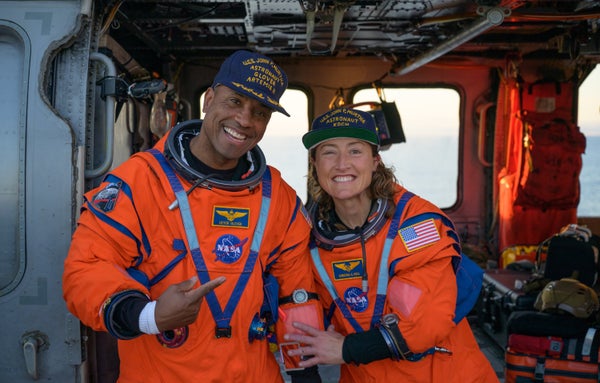
Two Artemis II astronauts, NASA's Victor Glover and Christina Koch, pose together onboard the USS John P. Murtha after a successful splashdown.

NASA’s Artemis II astronauts Victor Glover (left) and Christina Koch (right) pose onboard the flight deck of the USS John P. Murtha on April 10, 2026, after their successful splashdown and recovery in the Pacific Ocean off the coast of California. Glover, Artemis II’s pilot, is the first Black astronaut to fly to the moon; Koch, an Artemis II mission specialist, is the first female lunar explorer.

NASA/Bill Ingalls

NASA has launched four astronauts on a pioneering journey around the moon—the Artemis II mission. Follow our coverage here.

NASA’s Artemis II mission heralds a new era of space exploration. It is not hyperbole to say that, for many, the mission’s astronauts—Reid Wiseman, Victor Glover, Christina Koch and Jeremy Hansen—returned to Earth on Friday as heroes. Their trip around the moon and back transfixed the world as they traveled farther from our planet than any human has gone before.

“It’s a huge moment for everybody,” said NASA Administrator Jared Isaacman during a space agency broadcast shortly after the Artemis II crew’s splashdown off the coast of San Diego, Calif. “This is just the beginning. We are going to get back into doing this with frequency, sending missions to the moon until we land on it in 2028 and start building our base.”

NASA’s 10-day there-and-back voyage around the moon was the make-or-break milestone for U.S. human spaceflight, which has languished in low-Earth orbit ever since Apollo 17 commander Eugene Cernan uttered these parting words on the lunar surface in 1972: “We leave as we came and, God willing, as we shall return, with peace and hope for all mankind.”

Artemis II astronauts Reid Wiseman and Jeremy Hansen converse with NASA Administrator Jared Isaacman and other personnel aboard the U.S.S. John P. Murtha after a successful splashdown and recovery.

NASA astronaut and Artemis II commander Reid Wiseman and Canadian Space Agency astronaut and Artemis II mission specialist Jeremy Hansen (both at left) talk with NASA Administrator Jared Isaacman (right) and other personnel (center) onboard the flight deck of the USS John P. Murtha on April 10, 2026, after the mission’s successful splashdown and crew recovery.

NASA/Bill Ingalls


On supporting science journalism

If you're enjoying this article, consider supporting our award-winning journalism by subscribing. By purchasing a subscription you are helping to ensure the future of impactful stories about the discoveries and ideas shaping our world today.


It has taken more than 50 years to get back. The reason why is as cultural as it is political or technical. Peace and hope aside, the Apollo program was created by conflict, born out of the technological advances of World War II and the cold war era’s extreme anxiety over the terrifying prospect of nuclear annihilation. Without competition from the Soviet Union, which had launched the first human into space and was pursuing its own lunar program, Apollo might have been abandoned—or never even existed. Apollo 11, the U.S. mission that first landed humans on the moon, was the program’s high-water mark. With the Soviet Union outmatched, Americans, momentarily satisfied, moved on. Inertia kept Apollo going for six more moon missions before the program’s end.

Now collective Western anxiety over the rise of China’s rapidly advancing space program and desire to go farther into space, beyond the moon, are driving Artemis forward. If Artemis II had experienced serious problems or ended in failure, it would have delayed but perhaps not ended the ongoing U.S. lunar push, just as the tragic fire that took the lives of the Apollo 1 astronauts didn’t derail that program.

What remains to be seen is how far Artemis will go. With the program, NASA is aiming to build an enduring human outpost on the moon and even to travel onward to Mars. But none of that is a given.

Much work remains before any astronauts make a 21st-century footfall on the moon. There is no guarantee that either the U.S. timeline of a human landing in 2028 or China’s target of 2030 will be met. But Artemis II is a positive signal. By once again sending crews to the lunar vicinity and returning them safely to Earth, NASA has shown that some of the Apollo era’s faded glory can be rekindled—and may yet be surpassed.

But any geopolitical calculus doesn’t entirely capture all the motivations for going to the moon, which are as myriad as they are subjective.

For one, we go because it’s there—an extraterrestrial Everest to climb. For another, we go because of the thrill of exploration and discovery, feeding the curiosity that makes us human. Or perhaps we go because lawmakers—chief among them recent U.S. presidents and congressional appropriators—perceive the powerful pull of history, realizing they can become names for the ages while bolstering the aerospace industry in the process. Indeed, perhaps we go because of industry, to mine the moon or otherwise exploit its resources for profit, unlikely as it may be that this would be of equal benefit to everyone’s lives on Earth.

But I keep coming back to a reason so fundamental that it’s almost ineffable, a pull as sure as the moon’s gravity that compels the rise and fall of Earth’s tides.

It must be said: our lunar companion is, today, as much a part of our living world as every organism on Earth—and always has been.

Many cultures throughout history have declared as much in ways both mystical and spiritual. Yet the lunar rocks hauled back by Apollo astronauts confirm this truth in the cold light of scientific rigor: Earth and its moon share an astronomically unlikely origin. A Mars-sized protoplanet, Theia, by chance slammed into the proto-Earth 4.5 billion years ago, and the moon coalesced from a mix of each body in orbit around our wounded world. You and all life on Earth eventually spun out of that epochal collision, too. This means, among a great many other things, that atoms from Theia—essentially, from what became the moon—are in every cell of your body.

In this deep-space image from NASA's Artemis II mission, a sliver of Earth peeks over the limb of the moon, which dominates the foreground.

A sliver of the distant Earth peeks over the limb of the moon in this view captured by the Artemis II crew during their record-setting lunar flyby on April 6, 2026, in NASA’s Orion spacecraft.

NASA

Earth without the moon would not be Earth as we know it but a different planet entirely, perhaps devoid of life. Our lunar companion still stirs the oceans, stabilizes our seasons and sets our days, marking the rhythms for our biosphere. Eons of otherwise-lost cosmic history can be found in its craters, their silent secrets never scrubbed away by earthly wind and rain.

There may yet be myriad other ways, scarcely realized, in which the moon shapes life on Earth and our planet’s grand cycles of history. Perhaps, much like the rockhounding crews of Apollo before them, American and Chinese astronauts alike will spark another era of world-changing discoveries with whatever they find in their lunar explorations.

Perhaps, indeed, the unifying message of this wondrous moment of “moon joy” is the multiplicity of explanations for its existence—the fact that the beautiful complexity of the moon’s influence on all of us is too great yet too subtle for any single answer to suffice.

The astronauts of Artemis II know this. Gazing on the moon from the closest anyone has seen it in a half-century, they all spoke of their sense of awe, wonder and joy—and their longing for Earth. Glimpsing the blue-green jewel of our planetary home, so small and distant, after arcing around the far side of the moon—a maneuver that had been set in motion by a six-minute “translunar injection burn” of Orion’s main engines in Earth orbit—mission specialist Christina Koch put it particularly succinctly:

“We hear you can look up and see the moon right now. We see you, too,” she radioed down to NASA’s Houston mission control. “When we burned this burn towards the moon, I said that ‘we do not leave Earth, but we choose it.’ And that is true. We will explore. We will build. We will build ships. We will visit again. We will construct science outposts. We will drive rovers. We will do radio astronomy. We will found companies. We will bolster industry. We will inspire. But ultimately we will always choose Earth. We will always choose each other.”