

惯性聚合 高效追踪和阅读你感兴趣的博客、新闻、科技资讯
阅读原文 在惯性聚合中打开

推荐订阅源

Google DeepMind News
U
Unit 42
Cyber Security Advisories - MS-ISAC
J
Java Code Geeks
D
DataBreaches.Net
B
Blog RSS Feed
D
Docker
L
LangChain Blog
aimingoo的专栏
aimingoo的专栏
F
Fortinet All Blogs
Y
Y Combinator Blog
A
About on SuperTechFans
V
V2EX
罗磊的独立博客
WordPress大学
WordPress大学
宝玉的分享
宝玉的分享
MongoDB | Blog
MongoDB | Blog
博客园 - 【当耐特】
Last Week in AI
Last Week in AI
S
SegmentFault 最新的问题
月光博客
月光博客
Vercel News
Vercel News
H
Hackread – Cybersecurity News, Data Breaches, AI and More
阮一峰的网络日志
阮一峰的网络日志

Scientific American

Former deputy surgeon general Erica Schwartz nominated as new CDC chief NASA Artemis II astronauts say thank you to the world Congress grills RFK, Jr., about vaccines and cuts to health budget How the Grand Canyon formed is a surprisingly messy story. Here's the latest clue Astronomers just finished the biggest, sharpest 3D map of the universe—and it’s beautiful How far from humanity were the astronauts of Artemis II? The answer will surprise you Effect of antiamyloid Alzheimer’s drugs ‘absent or trivial,’ Cochrane review finds The Trump administration is looking to experts to weigh in on peptides When a naked mole rat queen dies, that usually means war—but not for this colony NASA needs nuclear power for its moon base. Here’s the White House plan to get it Why do older people have fewer seasonal allergies? 250-million-year-old fossil proves mammal ancestors laid eggs A face-swapping illusion can unlock childhood memories 30 years of Pokémon—how the Japanese franchise mirrors real-world science Sperm whales may make their own vowel sounds, similar to human language Colombia will euthanize Pablo Escobar’s invasive ‘cocaine hippos’ NASA’s Artemis III will pit SpaceX against Blue Origin The East Coast could see blazing hot temperatures this week. Here’s why Scientists just discovered 5.6 million bees under a New York State cemetery The real science of Pokémon How chemists engineer the signature smells of luxury perfumes How two mathematicians solved a cryptography mystery The engineering marvels hidden inside six-figure watches Expensive versus affordable binoculars—what’s the difference? How physicists found a new type of magnet hiding in plain sight A hot pair of supplements, creatine and methylene blue dye, may not work together Unlikely paths to discovery The baffling ecological disaster that's killing America’s freshwater mussels DARPA built an AI to fact-check enemy weapons claims Mathematicians created an ‘impossible’ shape that shouldn’t exist
Poem: ‘How I Became a Spitfire Pilot during My Cataract O...
2026-04-14 · via Scientific American

April 14, 2026

1 min read

Google Logo Add Us On GoogleAdd SciAm

Science in meter and verse

By Roger Camp edited by Dava Sobel & Clara Moskowitz

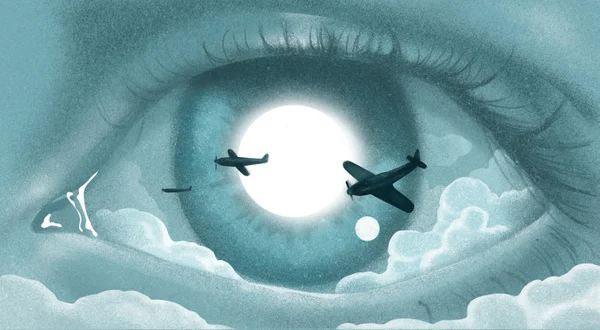
Illustration of an eye with planes passing in front of the iris.

Masha Foya

Join Our Community of Science Lovers!

For Lawrence J. Geisse, M.D.

Entering the operating theater,
 I climbed onto the gurney
resting my head
      on the mock headrest

a geisha dreaming
 on a woodblock.
The whine of the machine’s descent
            distracted me


On supporting science journalism

If you're enjoying this article, consider supporting our award-winning journalism by subscribing. By purchasing a subscription you are helping to ensure the future of impactful stories about the discoveries and ideas shaping our world today.


the crosshairs locking in
 on its target
finding myself a fighter pilot
          inside a cockpit canopy.

An exhale of pressure,
 slight as a concubine
kissing an eyelid,
      followed by an ultrasound impact.

My lens spidered, a shattered windshield,
 each fragment of the cataract
dutifully vacuumed
       just as Dr. Ridley

tweezered the splinters of plexiglass
 from the Spitfire pilot’s eyes,
an ace returning from the European theater
               of operations.

The lack of infection
 sparked Ridley’s mind, the man who
would unmask the blind with his invention
               a plastic lens

uncurling inside the eye
 for all to see.

English ophthalmologist Harold Ridley, driven by the need to treat the novel injuries of World War II fighter pilots, pioneered the 1949 solution that earned him global recognition as “father of the intraocular lens.”

It’s Time to Stand Up for Science

If you enjoyed this article, I’d like to ask for your support. Scientific American has served as an advocate for science and industry for 180 years, and right now may be the most critical moment in that two-century history.

I’ve been a Scientific American subscriber since I was 12 years old, and it helped shape the way I look at the world. SciAm always educates and delights me, and inspires a sense of awe for our vast, beautiful universe. I hope it does that for you, too.

If you subscribe to Scientific American, you help ensure that our coverage is centered on meaningful research and discovery; that we have the resources to report on the decisions that threaten labs across the U.S.; and that we support both budding and working scientists at a time when the value of science itself too often goes unrecognized.

In return, you get essential news, captivating podcasts, brilliant infographics, can't-miss newsletters, must-watch videos, challenging games, and the science world's best writing and reporting. You can even gift someone a subscription.

There has never been a more important time for us to stand up and show why science matters. I hope you’ll support us in that mission.