










It’s NASA tradition to wake up astronauts with a song. Here are the Artemis II crew’s favorites
By Jackie Flynn Mogensen edited by Lee Billings
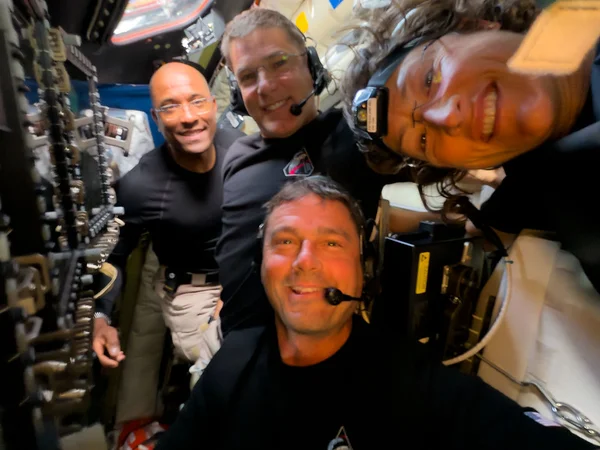
Midway through their lunar observation period, the Artemis II crew members pause to turn the camera around for a selfie inside the Orion spacecraft. From left to right: Victor Glover, Jeremy Hansen, Reid Wiseman and Christina Koch.
NASA
NASA has launched four astronauts on a pioneering journey around the moon—the Artemis II mission. Follow our coverage here.
Each day of the Artemis II mission around the moon, per NASA tradition, the Orion crew has woken up to a different song. So far that’s included everything from softer tunes such as Young & Sick’s cover of “Sleepyhead,” by Passion Pit, to CeeLo Green’s upbeat “Working Class Heroes (Work)” and the pop hit “Pink Pony Club,” by Chappell Roan. The songs were selected by “the moon crew,” according to NASA. And on Wednesday, the four Artemis II astronauts finally gave some insight into the stories behind the songs.
“My family suggested the one this morning—‘Under Pressure’ [by Queen and David Bowie]—and so that’s been my my favorite so far,” said Canadian Space Agency astronaut Jeremy Hansen during a live conversation with Canadian prime minister Mark Carney, who had called in to the Orion spacecraft on Wednesday night.
NASA astronaut Victor Glover revealed that his wife replaced one of his songs with “Good Morning,” by Mandisa and TobyMac. “It was actually really pleasant to wake up to, and so I give her a shout-out,” he said. “That was my favorite one.” (You can follow NASA’s official Spotify playlist for the Artemis II mission here.)
If you're enjoying this article, consider supporting our award-winning journalism by subscribing. By purchasing a subscription you are helping to ensure the future of impactful stories about the discoveries and ideas shaping our world today.
Meanwhile “Tokyo Drifting,” by Glass Animals and Denzel Curry, is a song that NASA astronaut Reid Wiseman listens to “every year” on vacations to Florida with his daughters, he said. “That one meant the most to me.”
NASA astronaut Christina Koch selected “Sleepyhead” because it played after a four-hour nap on the first day of the mission. “After being awake for—I’m not sure how long but many, many, many, many hours, I knew that we would need a little backup on that,” she said.
“The wake-up songs have been absolute perfection,” Koch said. “However, they did cut off ‘Pink Pony Club’ before the chorus,” she added, referring to the crew's all-too-short Saturday wake-up song. “I really was just singing it all day after that.”
The tradition of waking astronauts from their slumber with music dates back to at least 1965, according to a NASA report by Colin Fries, a now retired historian at the agency. The Gemini VI mission that year, for instance, included “Hello Dolly,” by Jack Jones, while Gemini VII played composers Ludwig van Beethoven and Johann Sebastian Bach, records show.
In 1969 the Apollo 10 mission astronauts were reportedly blessed by the sounds of Frank Sinatra (“It’s Nice to Go Trav’ling”) and Tony Bennett (“The Best Is Yet to Come”). On the space shuttle, which ferried astronauts to space between 1981 and 2011, crews were treated to songs that included “On the Road Again,” by Willie Nelson (in 1982), Steppenwolf's “Born to Be Wild” (1990) and “Son of a Son of a Sailor,” by Jimmy Buffett (1992). In 2005 Paul McCartney performed “English Tea” and “Good Day Sunshine” live for the International Space Station crew.
Looking to the final days of the Artemis II mission, Hansen said his “second favorite” song after “Under Pressure” will be on landing day. “I’ll let you wait to see what that one is,” he said. “It’s appropriate for the day.”
If you enjoyed this article, I’d like to ask for your support. Scientific American has served as an advocate for science and industry for 180 years, and right now may be the most critical moment in that two-century history.
I’ve been a Scientific American subscriber since I was 12 years old, and it helped shape the way I look at the world. SciAm always educates and delights me, and inspires a sense of awe for our vast, beautiful universe. I hope it does that for you, too.
If you subscribe to Scientific American, you help ensure that our coverage is centered on meaningful research and discovery; that we have the resources to report on the decisions that threaten labs across the U.S.; and that we support both budding and working scientists at a time when the value of science itself too often goes unrecognized.
In return, you get essential news, captivating podcasts, brilliant infographics, can't-miss newsletters, must-watch videos, challenging games, and the science world's best writing and reporting. You can even gift someone a subscription.
There has never been a more important time for us to stand up and show why science matters. I hope you’ll support us in that mission.
此内容由惯性聚合(RSS阅读器)自动聚合整理,仅供阅读参考。 原文来自 — 版权归原作者所有。