




Queen Caroline Murat of Naples, a younger sister of Napoleon Bonaparte, is credited with wearing the world’s first wristwatch: an oval-shaped face with a silver dial, attached to a bracelet made of hair and golden threads. Presented to the queen by Swiss watchmaker Abraham-Louis Breguet in 1812, the watch (which has since been lost) would look underwhelming alongside today’s timekeeping masterpieces. As watches have become more complicated (yes, in the world of timepieces that could require a mortgage to purchase, it pays to be complicated), materials science and engineering have become ever more critical. Take the first silent vibrating alarm developed for a mechanical watch that debuted in 2019. Watchmaking company Richard Mille spent five years creating a watch with 816 parts whose two bezels of carbon fiber and titanium, respectively, shuttled vibrations originating from an oscillating mass to the wearer’s wrist.
Those parts were tucked in what would be considered haute horology and embody a recurring theme throughout the years: luxury watches represent the confluence of art and science, fashion and sentimentality, precision engineering and aesthetic distinctiveness. “Nobody spends six figures on a mechanical watch because it is the most efficient way to know the time,” says Nicholas Manousos, executive director of the Horological Society of New York. “People buy fine watches for the same reason they buy art or classic cars. They are drawn to craftsmanship, beauty, engineering, rarity, history, and the emotional power of an object made by human hands.”
TanTan Wang, an editor at well-known watch-news site Hodinkee, adds that the beauty of these watches is that art and science go hand in hand. “Some of the most incredibly technical watches might also have every single part exquisitely decorated and finished by hand.”
If you're enjoying this article, consider supporting our award-winning journalism by subscribing. By purchasing a subscription you are helping to ensure the future of impactful stories about the discoveries and ideas shaping our world today.
Scientific American spoke with Manousos and Wang about advances in watchmaking and why watch nerds have become obsessed with collecting these accessories.
An edited transcript of the interviews follows.
Modern smartphones have made wristwatches largely pointless. So why do you think people continue to spend tens or hundreds of thousands of dollars on them?
Wang: Watches are appealing because they tap into the basic human desire for personal expression. From one angle, sure, people might be drawn to luxury watches because they are recognized as status symbols. But when you talk to the watch nerds, the conversation is very different. The exciting part about watches is that so many people can approach them in dramatically different ways. Some people come to them because of the history, some because of a fascination with micromechanics, and some for design and fashion.
At the same time, as our society becomes increasingly digital and online, wristwatches offer a respite from all this. Mechanical watches are little, miraculous pieces of engineering that still draw on many of the same techniques developed hundreds of years ago. Well-made watches can be passed down for generations, and that’s something that feels rare for any product these days.
Manousos: The human aspect of mechanical watchmaking is also incredibly powerful. In a world dominated by digital systems, a watch is honest. You can see the gears, springs, escapement and finishing. It reminds people that ingenuity can be elegant, tangible and poetic, not just efficient.
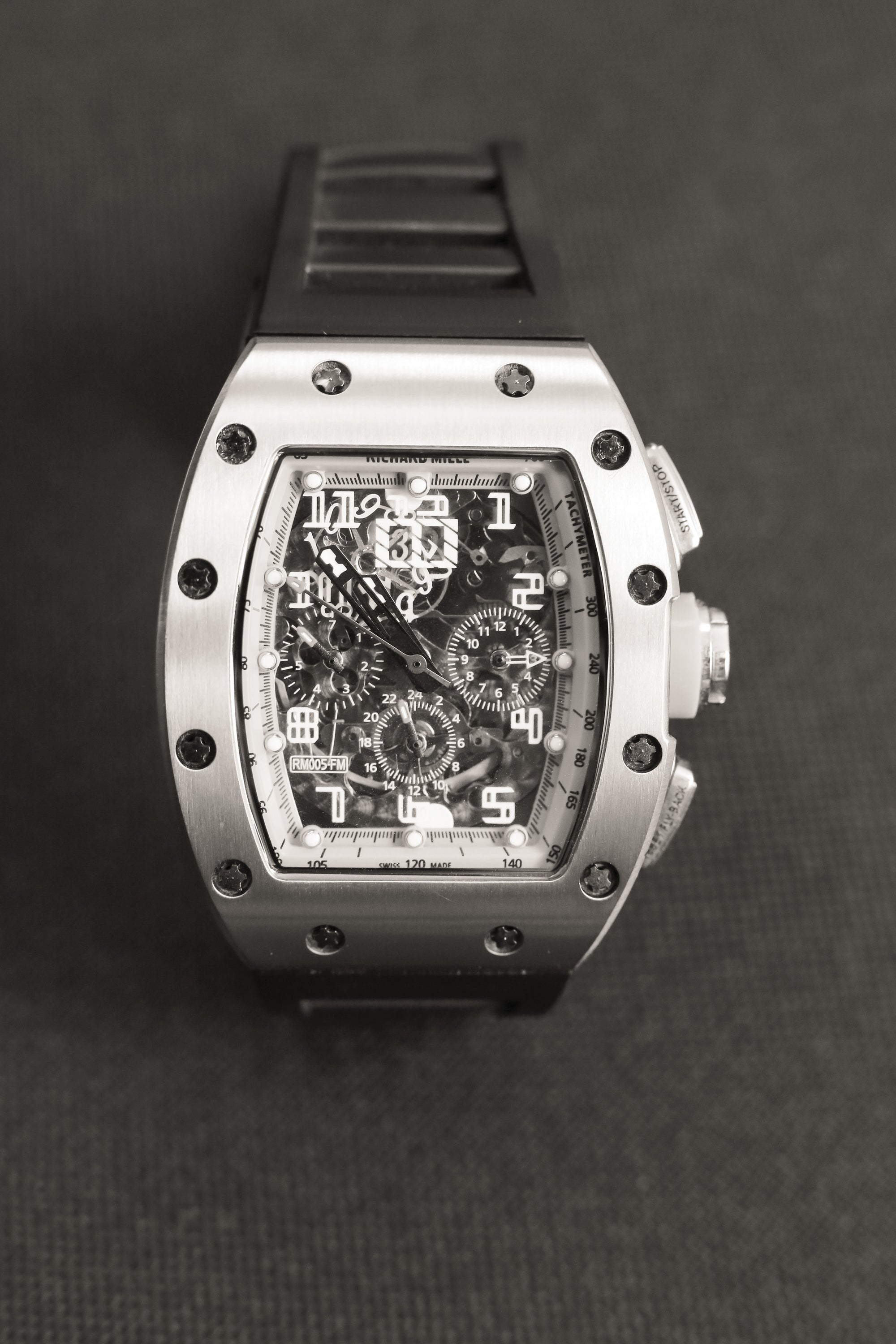
A luxury Richard Mille watch can measure speed based on distance traveled.
South China Morning Post/Edmond So/Getty Images
Is watchmaking more art or science?
Manousos: To me, watchmaking is at its best when art and science are inseparable. The science is obvious. A watch has to solve real engineering problems: how to store energy, regulate it and transmit it efficiently; compensate for shocks, temperature, friction and wear; and package that into a tiny object that can run reliably. The technical side is relentless. But the art is just as important. Finishing a bridge [which secures the moving parts] by hand, shaping a case so it wears beautifully, designing a dial, tuning the sound of a minute repeater—all of that is artistic judgment.
Wang: There’s also a much more literal version of watches as art. Many decorative disciplines exist in watchmaking, especially with the dial as a canvas. Grand feu enameling is a popular form where glass enamel powder is crushed up and mixed with water, hand-painted onto dials and then fired at high temperatures layer by layer. Delicate arts such as enameling often have painfully high failure rates, making the final product that much more special to the final owner.
What do horologists and others consider the greatest achievements in watchmaking in the past decade?
Manousos: One of the most important achievements has been the widespread adoption of silicon in key movement components, especially the hairspring and parts of the escapement [the feature that underlies a watch’s ticking]. It might not sound as exciting as a new grand complication [a watch with several nontimekeeping elements], but from a horological standpoint it’s incredibly significant. Silicon is nonmagnetic and extremely light, and it can be manufactured with extraordinary precision, which means watches are far more resistant to magnetism and generally more stable in their timekeeping.
Wang: This one’s hard to answer! One of the most interesting battles we saw a few years back between different watch brands was a competition to make increasingly thin time-only watches. We’re talking about each new record shaving off literal tenths of a millimeter. Absolutely mind-blowing stuff. For context, the thickness of these watches is just a little more than that of two credit cards stacked on top of each other.
“[A watch] reminds people that ingenuity can be elegant, tangible and poetic, not just efficient.” —Nicholas Manousos, Horological Society of New York
I’m also interested in tool watches, such as the Omega Speedmaster worn by astronaut Buzz Aldrin on his moon mission and the Rolex Explorer created specifically for use in extreme environments. What made these possible, and are advances still being made in this arena?
Manousos: Tool watches were developed to meet very practical needs in these kinds of environments, where people such as pilots, divers, mountaineers and astronauts required instruments that were reliable, durable and easy to read quickly. Their success came from thoughtful engineering and purpose-driven design: robust movements, cases that could withstand pressure or shock, clear high-contrast dials, luminous materials for low light, and useful complications such as chronographs or timing bezels.
Advances are still being made today, largely through improved materials and engineering, including better antimagnetic components, stronger case materials, improved lubricants and more effective luminous compounds. Even though many of these mechanical watches are now worn as everyday items or collectibles, the core idea of them as reliable field instruments continues to evolve through steady improvements in durability, legibility and precision.
Wang: The Speedmaster Moonwatch is the tool watch with one of the best-known connections to real-life history. When NASA was looking for a watch to equip its astronauts with during its space missions in the 1960s, it had a list of 11 stringent tests. In 1965 Omega’s ST 105.003 was the only one submitted by a brand to pass all of these with flying colors. What makes the watch special and beloved by collectors is that to this day, the current iteration of the Speedmaster Moonwatch is still made very similarly to its original counterpart, offering a very direct connection to that past.
At the same time, tool watches are continuing to be advanced. When it comes to dive watches, say, depth ratings are getting pushed deeper and deeper even though the depth ratings of many watches today are far deeper than any human could possibly go unscathed. If you ever find yourself at 20,000 feet underwater, the watch won’t be your first concern. Also, tool watches are a great testing ground for advancements in the movements. Many brands are working to make their movements increasingly antimagnetic through the increased usage of silicon components, for example.
Are complications an area where you foresee engineering advances?
Wang: Complications are certainly a huge point of focus when it comes to pushing the boundaries of watchmaking. Even in the past year or so we’ve seen an emphasis on maximalist watchmaking, and in my mind great horological feats are what will push the idea of a luxury watch forward for the next 100 years. But I’d love to see a push toward making these high-end complications more accessible in price. A mechanical minute repeater that chimes out the current time on demand, for example, is expected to cost in the low to mid six figures. But some brands have figured out inventive solutions for bringing down the cost of other complications. It might be wishful thinking, but perhaps we’ll see a repeater that mere mortals can afford.
此内容由惯性聚合(RSS阅读器)自动聚合整理,仅供阅读参考。 原文来自 — 版权归原作者所有。