



惯性聚合 高效追踪和阅读你感兴趣的博客、新闻、科技资讯
阅读原文 在惯性聚合中打开

推荐订阅源

P
Proofpoint News Feed
T
Troy Hunt's Blog
奇客Solidot–传递最新科技情报
奇客Solidot–传递最新科技情报
C
CXSECURITY Database RSS Feed - CXSecurity.com
小众软件
小众软件
S
Securelist
The Cloudflare Blog
博客园 - 司徒正美
D
Darknet – Hacking Tools, Hacker News & Cyber Security
酷 壳 – CoolShell
酷 壳 – CoolShell
美团技术团队
博客园 - Franky
V
V2EX
钛媒体:引领未来商业与生活新知
钛媒体:引领未来商业与生活新知
Latest news
Latest news
V
Vulnerabilities – Threatpost
雷峰网
雷峰网
G
GRAHAM CLULEY
罗磊的独立博客
J
Java Code Geeks
C
Cisco Blogs
Scott Helme
Scott Helme
Spread Privacy
Spread Privacy
宝玉的分享
宝玉的分享
T
The Blog of Author Tim Ferriss
OSCHINA 社区最新新闻
OSCHINA 社区最新新闻
Microsoft Azure Blog
T
Tor Project blog
GbyAI
GbyAI
C
CERT Recently Published Vulnerability Notes
A
Arctic Wolf
博客园_首页
D
DataBreaches.Net
freeCodeCamp Programming Tutorials: Python, JavaScript, Git & More
Cyber Security Advisories - MS-ISAC
Threat Intelligence Blog | Flashpoint
Stack Overflow Blog
Stack Overflow Blog
K
Kaspersky official blog
Google DeepMind News
P
Proofpoint News Feed
aimingoo的专栏
aimingoo的专栏
SecWiki News
SecWiki News
V
Visual Studio Blog
Jina AI
Jina AI
S
Schneier on Security
T
Threat Research - Cisco Blogs
Project Zero
Project Zero
有赞技术团队
有赞技术团队
P
Privacy & Cybersecurity Law Blog
Help Net Security
Help Net Security

Sanity.io

A Board Game agent built using Sanity Context and Vercel's AI SDK | Sanity Build a prototype with Claude Code that your whole team can edit | Sanity What’s New - May 2026 | Sanity I built a London pub guide with v0 and the Sanity MCP in six hours. Here's what I learned. | Sanity Build a conference concierge with Agent Context and Anthropic | Sanity Build a content-aware Telegram agent with Vercel AI SDK and Chat SDK | Sanity How I used Agent API to generate photos for my family’s recipes | Sanity What’s New April - 2026 | Sanity Better context, better matches: An AI love story (for dogs) | Sanity How to write for an agent | Sanity Content Agent, meet Slack: AI content operations in your workflow | Sanity Structure powers intelligence | Sanity Your agent needs better content. Here's how to give it. | Sanity How to serve content to agents (a field guide) | Sanity Sanity TypeGen GA: Automatic TypeScript types for content and GROQ | Sanity Sanity is now available on the Vercel Marketplace | Sanity The logo soup problem (and how to solve it) | Sanity Content Releases: From scattered updates to coordinated publishing | Sanity What's New - February 2026 | Sanity How we solved the agent memory problem | Sanity v0 Builder Challenge: The winners | Sanity Introducing: Sanity Agent Skills | Sanity Content Agent: Days of work in one conversation | Sanity Our Sanity Values | Sanity Open Source Pledge 2025: Stepping up when it matters | Sanity v0 builder challenge: $3000 in prizes | Sanity Why AI Breaks Without Structured Content Operations | Sanity What’s New January - 2026 | Sanity BFCM 2025: What teams built when infrastructure stopped being the problem | Sanity How AI shaped holiday shopping and what it means for content in 2026 | Sanity Sanity Studio v5: Embracing React 19 | Sanity You’ll need a CMS eventually. Let your agent set it up. | Sanity AI Content Operations: A 30-Day Implementation Guide | Sanity What’s New December - 2025 | Sanity Scheduled Drafts: Stop manually publishing content at midnight | Sanity What’s New November - 2025 | Sanity Everything *[NYC] 2025 recap: A day of AI, Content Operations, and Culture | Sanity Clankers and content operations | Sanity Content Agent: AI that understands your structured content is here | Sanity Why design-driven content modeling creates technical debt, not velocity | Sanity What's New October - 2025 | Sanity From studio to inbox: How Kevin Green eliminated email campaign friction | Sanity The content editor's guide to content operations [E-commerce edition] | Sanity styled-components maintenance mode: A 40% faster fork | Sanity From zero code to a live website in 7 hours (thanks, Cursor!) | Sanity First attempt will be 95% garbage: A staff engineer's 6-week journey with Claude Code | Sanity Internationalization is more than translating words | Sanity What's New - September 2025 | Sanity We just deleted our 35k-member community Slack | Sanity What's New - August 2025 | Sanity The engineer's guide to content operations [E-commerce edition] | Sanity SEO for AI: Evolving from Web Pages to the Content Lake | Sanity What's New - July 2025 | Sanity Sanity Studio v4: A major version bump for a minor reason | Sanity What's New - June 2025 | Sanity Dashboard and Insights: Your New Content HQ | Sanity Canvas: AI-accelerated, context-aware, freeform authoring | Sanity Agent Actions: AI building blocks for structured content | Sanity Functions: Life beyond pressing publish | Sanity A new era for content applications with Sanity App SDK | Sanity The end of CMS era and our $85M Series C. | Sanity What's New – May 2025 | Sanity Introducing the Sanity Model Context Protocol (MCP) server | Sanity What's New – April 2025 | Sanity Pushing all the envelopes with ambitious content | Sanity Self-hosting is only free if your time is worth nothing | Sanity Content that lasts: Scaling beyond your frontend | Sanity The Live Content API is now Generally Available | Sanity The future beyond AI chat bots | Sanity Learning the new skill of working with AI | Sanity What's New - March 2025 | Sanity Give it in plain text: Making your content AI-Ready | Sanity No More 'DO NOT PUBLISH': Introducing Content Releases | Sanity React in 2025, what's next? | Sanity The final boss of front-end: block editors | Sanity Introducing Sanity for Startups | Sanity A block content editor that loves you back | Sanity A Black Friday Snooze Fest: Massive Traffic, No Drama | Sanity How to make a recipe site that scales well | Sanity The Sanity Winter Release 2024 | Sanity AVIF Arrives, Sanity’s Promise Fulfilled | Sanity Sanity joins the Open Source Pledge | Sanity Your content is now Live by default | Sanity Begin Team to Join Sanity | Sanity Sanity Digest - September '24 Edition | Sanity Sanity partners with Google. Now live on the Google Cloud Marketplace. | Sanity Sanity Digest - August ‘24 Edition | Sanity Now playing: the latest Mux Video Input plugin for Sanity | Sanity Community Digest - June ‘24 Edition | Sanity Community Digest - May ‘24 Edition | Sanity Guide to Sanity's newest product announcements | Sanity AI and Content Creation: A Leader's Guide | Sanity Of course, you should be able to type your content quickly! | Sanity New to AI Assist: translation, reference suggestions, image generation | Sanity Speak the language of your editors: Sanity Studio UI localization | Sanity Introducing the new Sanity Growth plan to serve collaborative teams | Sanity Presentation: Work faster than ever with structured content | Sanity Goodbye Feedback Frenzy, Hello Sanity Studio Comments! | Sanity Easing into the App Router with the Sanity Toolkit for Next.js | Sanity Making website updates easier with structured content | Sanity
“You should never build a CMS” | Sanity
Knut Melvær · 2025-12-14 · via Sanity.io

We're just going to call it: up until recently, cursor.com was powered by Sanity as its CMS.

Then Lee Robinson sat down and spent 344 agent requests and around $260 to migrate the content and setup to markdown files, GitHub, Vercel, and a vibe-coded media management interface.

He did a great write-up of the process on his blog. He was classy and didn't name us.

Of course, when a high-profile customer moves off your product and the story resonates with builders you respect, you pay attention.

The weird twist here is that we sort of agree with Lee’s take. He has a lot of great points. The conversation around complexity and abstractions that a headless CMS brings reflects real frustration. The way things have been done for the past decade deserved criticism.

But Lee's post doesn't tell the full story. We see what people are trying to solve when it comes to content every day. We live and breathe this CMS stuff. So let us add some context.

What Lee got right

The headless CMS industry built complexity that didn't deliver proportional value for many. This is true.

Preview workflows are clunky. Draft modes, toolbar toggles, account requirements just to see what your content looks like before it goes live. Having to add data attributes everywhere to connect front ends with backend fields feels unnecessary. Real friction for something that feels it should be simple.

Auth fragmentation is annoying. CMS login. GitHub login. Hosting provider login. Three systems to get a preview working.

Their CDN costs was largely caused by hosting a video from our file storage. It’s not an ideal way to host videos in front of Cursor’s massive audience. We should have made it more obvious that there are better and cheaper ways, like using the Mux plugin.

332K lines of code was removed in exchange for 43K new ones. That sounds a great win. We love getting rid of code too.

And here's the one that actually matters: AI agents couldn't easily reach content behind authenticated APIs. When your coding agent can grep your codebase but can't query your CMS, that's a real problem. Lee felt this friction and responded to it. (We did too, and the new very capable MCP server is out).

These complaints are valid. We're not going to pretend otherwise.

What Lee actually built (spoiler: a CMS)

Here's the thing though. Read his post carefully and look at what he ended up with:

  • An asset management GUI (built with "3-4 prompts," which, to be fair, is impressive)
  • User management via GitHub permissions
  • Version control via git
  • Localization tooling
  • A content model (markdown frontmatter with specific fields)

These are CMS features. Distributed across npm scripts, GitHub's permission system, and Vercel's infrastructure.

The features exist because the problems are real. You can delete the CMS, but you can't delete the need to manage assets, control who can publish what, track changes, and structure your content for reusability and distribution at scale.

Give it six months. The bespoke tooling will grow. The edge cases will multiply. Someone will need to schedule a post. Someone will need to preview on mobile. Someone will want to revert a change from three weeks ago and git reflog won't cut it. The "simple" system will accrete complexity because content management is complex.

Even with agents. Who were mostly trained within the constraints of these patterns.

What breaks at scale

Lee's model is clean: one markdown file equals one page. Simple. Grep-able.

This works until it doesn't.

The content === page trap

What happens when your pricing lives in three places? The pricing page, the comparison table, the footer CTA. In markdown-land, you update three files. Or you build a templating system that pulls from a canonical source. At which point you've invented content references. At which point you're building a CMS.

What happens when legal needs to update the compliance language that appears on 47 pages? You grep for the old string and replace it. Except the string has slight variations. Except someone reworded it slightly on the enterprise page. Except now you need to verify each change because regex can't understand intent. Now you are building a CMS.

What happens when you want to know "where is this product mentioned?" You can grep for the product name. You can't grep for "content that references this product entity" because markdown doesn't have entities. It has strings.

Suddenly you’re parsing thousands of files on every build to check for broken links (that you can’t query). And yes, you are building a CMS.

Structured content breaks the content = page assumption on purpose. A product is a document. A landing page document references that product and both are rendered together on the website. And in an app. And the support article for that product. When the product information changes, that changes is reflected in all these places. When you need to find every mention, you query the references, not the strings.

Engineers understand this. It's normalization. It's the same reason you don't store customer_name as a string in every order row. You store a customer_id and join.

Markdown files are the content equivalent of denormalized strings everywhere. It works for small datasets. It becomes a maintenance nightmare at scale.

Git is not a content collaboration tool

Git is a version control system built for code. Code has specific properties that make git work well:

  • Merge conflicts are mechanical. Two people edited the same function. The resolution is structural.
  • Line-based diffing makes sense. Code is organized in lines that map to logical units.
  • Branching maps to features. You branch to build something, then merge when it's done.
  • Async is fine. You don't need to see someone else's changes until they push.

Content has different properties:

  • Merge conflicts are semantic. Two people edited the same paragraph with different intentions. The "correct" merge requires understanding what both people meant.
  • Line-based diffing is arbitrary. A paragraph rewrite shows as one changed line that actually changes everything. If you have block content (like Notion) this breaks apart even more.
  • Branching doesn't map to content workflows. "I'm working on the Q3 campaign" isn't a branch. It's 30 pieces of content across 12 pages with 4 people contributing.
  • Real-time matters. When your content team is distributed, "I'm editing this doc" needs to be visible now, not after a commit and push. Even more so with AI automation and agents in the mix.

None of this is git's fault. Git solved the problem it was built for brilliantly. Content collaboration isn't that problem.

We know this because every team that scales content on git builds the same workarounds:

  • Lock files or Slack conversations to prevent simultaneous editing
  • "I'm working on X, don't touch it" announcements
  • Elaborate PR review processes that become bottlenecks
  • Content freezes before launches because merge complexity is too high

Sound familiar? These are the problems CMSes were built to solve. Real-time collaboration. Conflict-free editing. Workflow states that aren't git branches.

Why "Agents can grep" only works up to a point

Lee's core argument: AI agents can now grep the codebase, so content should live in the codebase.

This sounds reasonable until you think about what grep actually does. It's string matching. Pattern finding. It's great for "find all files containing X."

It's not great for:

  • "All blog posts mentioning feature Y published after September"
  • "Products with price > $100 that are in stock"
  • "Content tagged 'enterprise' that hasn't been translated to German yet"
  • "The three most recent case studies in the finance category"

Here's what that last one looks like in GROQ:

Try writing that as a grep command against markdown files. You can't. You'd need to parse frontmatter, understand your date format, resolve the category references, handle the sorting, limit the results. At which point you've built a query engine.

Structured content with a real query language is what agents actually need to reason about content. Markdown files are less queryable than a proper content API, not more.

The irony here is thick. Lee's argument for moving to code is that agents can work with code. But agents are better at working with structured data and APIs than they are at parsing arbitrary file formats and grepping for strings. That's not a limitation of current AI. That's just how information retrieval works.

Here's what we think Lee got backwards: the solution to "my agent can't access my CMS" isn't "delete the CMS." It's "give your agent access to the CMS."

It was also bad timing. Our MCP server wasn't good enough when Lee tried it.

But we fixed it. Our new MCP server is out now.

Your coding agent can now create new content projects, query your content, create documents, update schemas, and manage releases. All through the same interface you're already using to build everything else. You never have to see any CMS UI unless you want to.

Schema, queryable content. From prompts. In about 10 minutes from start to deployed. You can ask it to generate images of those cars too.
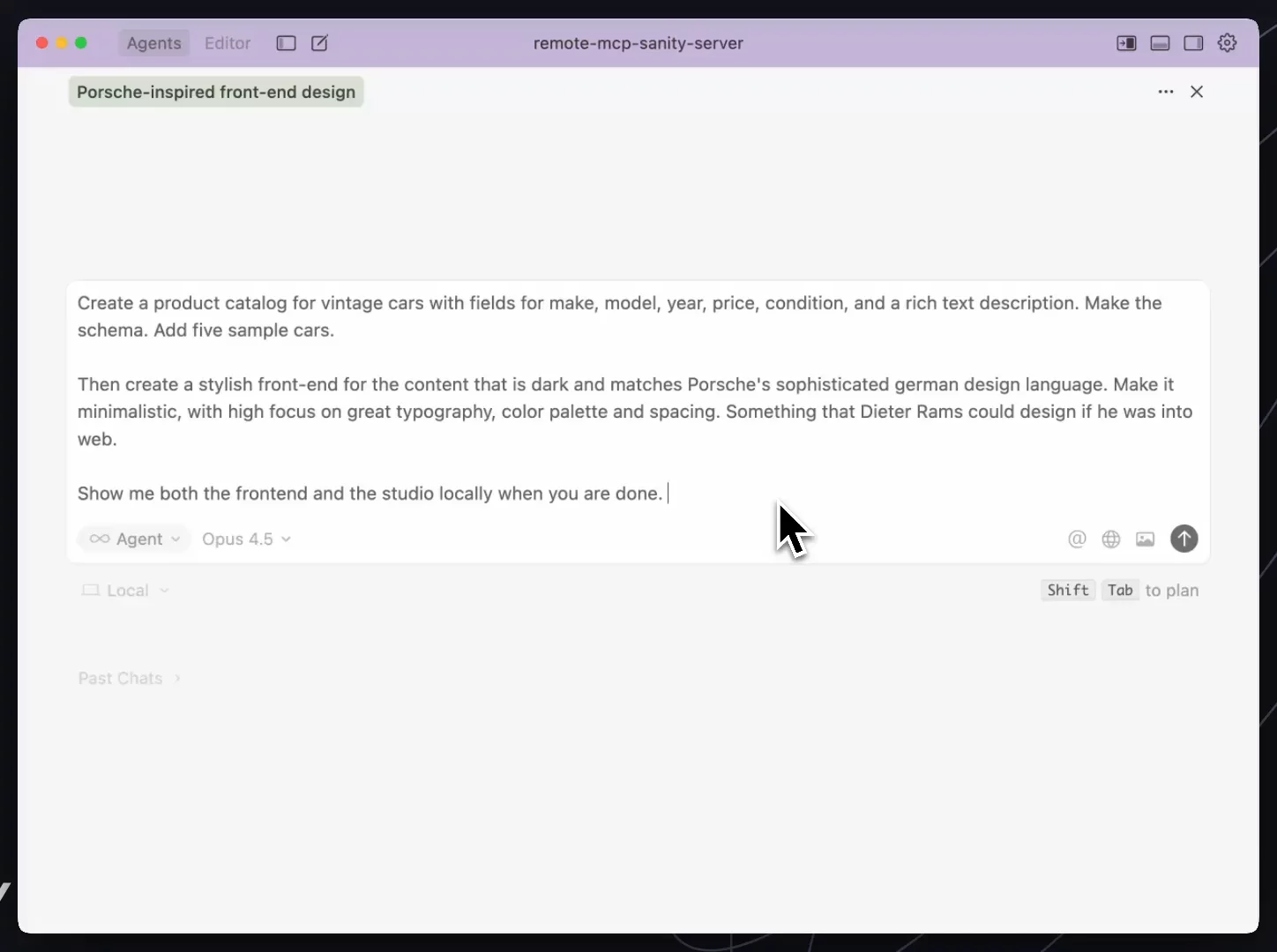
You can also use it for content inquires like this:

The agent queries your actual schema and returns actionable results. Not string matches. Actual documents with their field states.

The agent checks your existing schema, generates compatible additions, and can deploy them. No tab-switching to documentation. No copy-pasting boilerplate.

This is what "agents working with content" actually looks like. Not grep. A query language. Not editing markdown. Operating on structured data through proper APIs. Not string matching. Semantic understanding of your content model.

Markdown is nice for LLMs. That’s not the point

Here’s something we should acknowledge: LLMs are good at markdown. They were trained on massive amounts of it. The format is token-efficient compared to JSON and XML. When you ask an agent to write or edit prose, markdown is a reasonable output format.

This is real. It’s part of why Lee’s migration worked.

But there is a difference between “good format for LLM I/O” and “good format for content infrastructure.”

LLMs are also good at SQL (they even know GROQ fairly well when you remind them). That doesn’t mean you should store your database as .sql files in git and have agents grep them. The query language and the storage layer are different concerns.

I wrote about this three years ago in Smashing Magazine, before LLMs changed everything. The arguments still hold: you can’t query markdown, structured content is more tinker-able, and hosting content in a database doesn’t mean you own it less.

What’s changed is that we now have agents that can work with both formats. The question is which architecture sets them up to do more.

Cursor’s context isn’t everyone’s context

Let's be fair about scope. Cursor’s setup works for cursor.com right now because:

  • Their entire team writes code. "Designers are developers" at Cursor.
  • Content has one destination: the website.
  • They ship infrequently enough that git workflows are fine.
  • They don't need approval chains, compliance audits, or role-based permissions beyond what GitHub provides.
  • Localization is "AI at build time."

If your company looks like this, maybe markdown in git is fine. Genuinely.

But most companies don't look like this.

This is what we are seeing every day:

  • Content needs to flow to apps, email systems, AI agents, personalization engines. Not just one website.
  • You need structured data, not just prose. Product specs. Pricing tables. Configuration. Things that need to be queryable and validated.
  • You have governance requirements. "Who changed this and when" needs actual audit trails, not git blame.
  • You need real-time collaboration. Multiple people and agents working on the same content simultaneously. Git merge conflicts on prose are miserable for humans and wasteful for agents.
  • Content operations need to scale independently of engineering. Not because your team can’t learn git, but because content velocity shouldn’t be bottlenecked by PR review cycles.

Cursor is ~50 developers shipping one product website. That context matters.

What a CMS built for AI looks like

The debate shouldn't be "CMS vs. no CMS."

There are definitely parts of the traditional CMS we should nuke into the sun with fire:

  • WYSIWYG editors that produce garbage HTML soup
  • Page builders that store content as layout blobs (you can't query "all hero sections" if hero sections are just JSON fragments in a page blob)
  • Webhook hell for basic content updates
  • "Content modeling" that's really just "pick from these 15 field types and good luck"
  • Revision history that tells you something changed but not what or why

We can leave these things behind without resorting to git and markdown.

Rather, the question should be: is your content infrastructure built for AI to be both author and consumer?

That means:

  • Structured, not flat files. AI that can reason about typed fields and relationships, not arbitrary strings.
  • Queryable, not grep-able. Real query languages that understand your schema, not regex pattern matching.
  • Real-time, not batch. Content changes shouldn't require a deployment to be visible.
  • Presentation-agnostic. No hex colors in your content model. No assumptions about where content renders. Separation of concerns.

Lee's frustration was valid: "I don't want to click through UIs just to update content."

The answer is content infrastructure that works the way modern development does. Agents that understand your schema. Queries that express intent. APIs that don't require you to build a query engine out of grep and find.

Where this leaves us

Lee's post went viral because it resonated. Developers have real frustrations with content management tools that were built for a different era.

We know. We literally built Sanity because we were angry at the CMS industry (a.k.a “spite-driven development”)

The answer isn't to retreat to 2002 and plain text files for agents to parse. It's to build what actually solves the problem: content infrastructure that AI can read, write, and reason about.

You shouldn't build a CMS from scratch with grep and markdown files. You probably shouldn't have to click through forms to update content either. Both of these can be true.

The tools exist to have it both ways. Structured content that agents can actually query. Editorial interfaces that don't require git. Real-time collaboration that doesn't involve merge conflicts on prose.

That's what we're building. Lee's post is a good reminder of what happens when we don't get it right.