









In 2024, we joined the Open Source Pledge, committing to pay $2,000 per year per full-time developer directly to open source maintainers. We're proud to announce we're not just continuing that commitment: we're expanding it to $146,000 (we hired more developers since then, and are still).
But first, we need to talk about Tailwind.
Some days ago, Adam Wathan announced that Tailwind Labs had to lay off 75% of their engineering team. The reason? Despite Tailwind CSS being more popular than ever, used by over 617,000 websites and downloaded 75 million times per month, their revenue dropped 80%.
According to Adam, the culprit is AI. As developers increasingly use tools like Claude, ChatGPT, and Cursor to generate Tailwind CSS directly, traffic to the official documentation dropped 40% since early 2023. That documentation was how developers discovered Tailwind's commercial products: the revenue that funded framework development.
"There's just no correlation between making Tailwind easier to use and making development of the framework more sustainable," Adam writes on GitHub. "If I can't fix that this project is going to become unmaintained abandonware when there is no one left employed to work on it."
This is the paradox we're now living in: a project can be wildly successful and completely unsustainable at the same time.
Tailwind CSS isn't just popular, it's essential to how we build at Sanity. From our marketing sites to our documentation to internal tools, Tailwind gives us a fast path to delightful UI/UX.
We use it. Our customers use it. It makes developers productive.
Earlier in 2025, we'd already committed $30,000 to Tailwind as part of our Open Source Pledge. When we learned about the layoffs, we doubled that to $60,000 total: the largest single sponsorship in our pledge. (Yes, we’re currently writing this in 2026, but Sanity budgets operates in the fiscal year that ends at Jan 31).
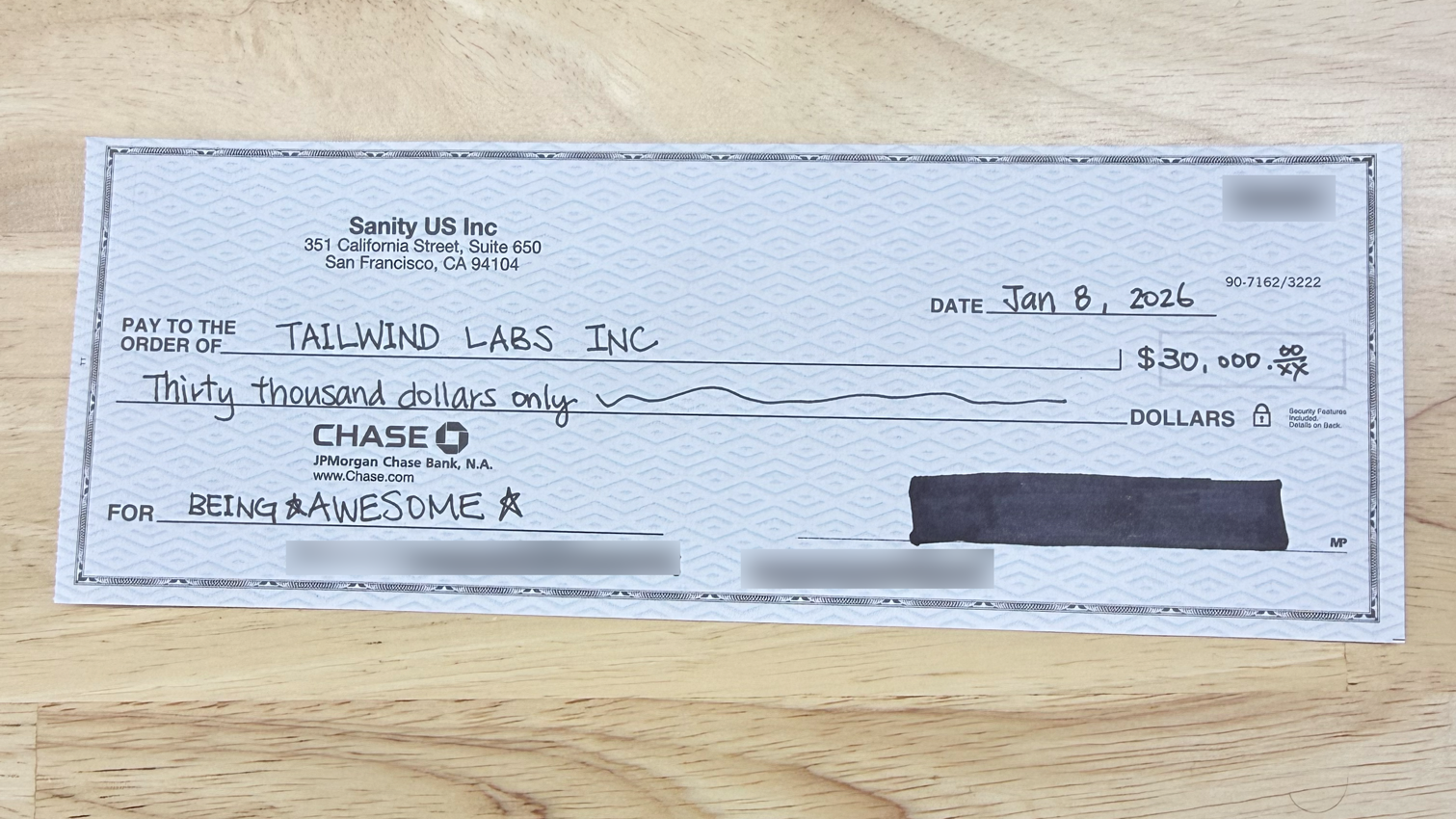
This isn't charity. It's recognizing that the tools we depend on need sustainable business models, especially as AI reshapes how developers discover and use software. If companies that benefit from open source don't step up, the projects we rely on won't survive.
For 2025, we pledged $146,000 across projects that power Sanity and our community. Here's where the money is going: Tailwind, Motion, Vite, Tanstack, Zod, Babel, libvips, pnpm, Rollup, markdown-it, go-chi, eslint, Vitest, Storybook, pmndrs, Prettier, XState, and Simon Willison.
We're proud to stand on the shoulders of these projects (and many more). Each one represents countless hours of work by maintainers who often don't get the recognition, or compensation, they deserve.
Beyond financial support, we continue to contribute to open source in other ways:
The Tailwind situation is a warning for our entire industry. Documentation isn't going away - if anything, it's more important than ever as the source of truth that AI tools learn from and reference. But the business model that sustained open source through documentation seems to be breaking. Developers still benefit from well-documented projects, but they're not visiting the sites where discovery happened.
We don't have all the answers. But we know that companies benefiting from open source need to fund it directly - not because it feels good, but because it's the only way these projects survive the transition to whatever comes next.
If your company uses Tailwind, or Vite, or any of open source projects that make modern development possible, consider joining the Open Source Pledge. The maintainers building your infrastructure need you.
We urge other companies to join the Open Source Pledge and examine how they can support the open source ecosystem in a meaningful way. The future of the tools we depend on depends on it.
此内容由惯性聚合(RSS阅读器)自动聚合整理,仅供阅读参考。 原文来自 — 版权归原作者所有。