




惯性聚合 高效追踪和阅读你感兴趣的博客、新闻、科技资讯
阅读原文 在惯性聚合中打开

推荐订阅源

Hacker News: Ask HN
Hacker News: Ask HN
O
OpenAI News
Cloudbric
Cloudbric
Attack and Defense Labs
S
Secure Thoughts
J
Java Code Geeks
Help Net Security
Help Net Security
罗磊的独立博客
博客园 - 三生石上(FineUI控件)
有赞技术团队
有赞技术团队
Security Archives - TechRepublic
Hugging Face - Blog
Hugging Face - Blog
钛媒体:引领未来商业与生活新知
钛媒体:引领未来商业与生活新知
GbyAI
GbyAI
Exploit-DB.com RSS Feed
www.infosecurity-magazine.com
博客园 - 司徒正美
T
The Blog of Author Tim Ferriss
人人都是产品经理
人人都是产品经理
H
Help Net Security
Google DeepMind News
Apple Machine Learning Research
B
Blog RSS Feed
W
WeLiveSecurity
Stack Overflow Blog
Stack Overflow Blog
The GitHub Blog
The GitHub Blog
N
Netflix TechBlog - Medium
Jina AI
Jina AI
S
Security @ Cisco Blogs
月光博客
月光博客
Google Online Security Blog
P
Proofpoint News Feed
C
Cyber Attacks, Cyber Crime and Cyber Security
TaoSecurity Blog
TaoSecurity Blog
MongoDB | Blog
MongoDB | Blog
WordPress大学
WordPress大学
F
Fortinet All Blogs
S
Securelist
M
MIT News - Artificial intelligence
V
Vulnerabilities – Threatpost
小众软件
小众软件
T
Tenable Blog
Y
Y Combinator Blog
T
Threat Research - Cisco Blogs
博客园 - 叶小钗
N
News | PayPal Newsroom
A
About on SuperTechFans
C
CERT Recently Published Vulnerability Notes
Cyberwarzone
Cyberwarzone
L
Lohrmann on Cybersecurity

Sanity.io

A Board Game agent built using Sanity Context and Vercel's AI SDK | Sanity Build a prototype with Claude Code that your whole team can edit | Sanity What’s New - May 2026 | Sanity I built a London pub guide with v0 and the Sanity MCP in six hours. Here's what I learned. | Sanity Build a conference concierge with Agent Context and Anthropic | Sanity Build a content-aware Telegram agent with Vercel AI SDK and Chat SDK | Sanity How I used Agent API to generate photos for my family’s recipes | Sanity What’s New April - 2026 | Sanity Better context, better matches: An AI love story (for dogs) | Sanity How to write for an agent | Sanity Content Agent, meet Slack: AI content operations in your workflow | Sanity Structure powers intelligence | Sanity Your agent needs better content. Here's how to give it. | Sanity How to serve content to agents (a field guide) | Sanity Sanity TypeGen GA: Automatic TypeScript types for content and GROQ | Sanity Sanity is now available on the Vercel Marketplace | Sanity The logo soup problem (and how to solve it) | Sanity Content Releases: From scattered updates to coordinated publishing | Sanity What's New - February 2026 | Sanity How we solved the agent memory problem | Sanity v0 Builder Challenge: The winners | Sanity Introducing: Sanity Agent Skills | Sanity Content Agent: Days of work in one conversation | Sanity Our Sanity Values | Sanity Open Source Pledge 2025: Stepping up when it matters | Sanity v0 builder challenge: $3000 in prizes | Sanity Why AI Breaks Without Structured Content Operations | Sanity What’s New January - 2026 | Sanity BFCM 2025: What teams built when infrastructure stopped being the problem | Sanity How AI shaped holiday shopping and what it means for content in 2026 | Sanity Sanity Studio v5: Embracing React 19 | Sanity You’ll need a CMS eventually. Let your agent set it up. | Sanity “You should never build a CMS” | Sanity AI Content Operations: A 30-Day Implementation Guide | Sanity What’s New December - 2025 | Sanity Scheduled Drafts: Stop manually publishing content at midnight | Sanity What’s New November - 2025 | Sanity Everything *[NYC] 2025 recap: A day of AI, Content Operations, and Culture | Sanity Clankers and content operations | Sanity Content Agent: AI that understands your structured content is here | Sanity Why design-driven content modeling creates technical debt, not velocity | Sanity What's New October - 2025 | Sanity From studio to inbox: How Kevin Green eliminated email campaign friction | Sanity The content editor's guide to content operations [E-commerce edition] | Sanity styled-components maintenance mode: A 40% faster fork | Sanity From zero code to a live website in 7 hours (thanks, Cursor!) | Sanity First attempt will be 95% garbage: A staff engineer's 6-week journey with Claude Code | Sanity Internationalization is more than translating words | Sanity What's New - September 2025 | Sanity We just deleted our 35k-member community Slack | Sanity What's New - August 2025 | Sanity The engineer's guide to content operations [E-commerce edition] | Sanity SEO for AI: Evolving from Web Pages to the Content Lake | Sanity What's New - July 2025 | Sanity Sanity Studio v4: A major version bump for a minor reason | Sanity What's New - June 2025 | Sanity Dashboard and Insights: Your New Content HQ | Sanity Canvas: AI-accelerated, context-aware, freeform authoring | Sanity Agent Actions: AI building blocks for structured content | Sanity Functions: Life beyond pressing publish | Sanity A new era for content applications with Sanity App SDK | Sanity The end of CMS era and our $85M Series C. | Sanity What's New – May 2025 | Sanity Introducing the Sanity Model Context Protocol (MCP) server | Sanity What's New – April 2025 | Sanity Pushing all the envelopes with ambitious content | Sanity Self-hosting is only free if your time is worth nothing | Sanity Content that lasts: Scaling beyond your frontend | Sanity The Live Content API is now Generally Available | Sanity The future beyond AI chat bots | Sanity Learning the new skill of working with AI | Sanity What's New - March 2025 | Sanity Give it in plain text: Making your content AI-Ready | Sanity No More 'DO NOT PUBLISH': Introducing Content Releases | Sanity React in 2025, what's next? | Sanity The final boss of front-end: block editors | Sanity Introducing Sanity for Startups | Sanity A block content editor that loves you back | Sanity A Black Friday Snooze Fest: Massive Traffic, No Drama | Sanity How to make a recipe site that scales well | Sanity The Sanity Winter Release 2024 | Sanity AVIF Arrives, Sanity’s Promise Fulfilled | Sanity Sanity joins the Open Source Pledge | Sanity Your content is now Live by default | Sanity Begin Team to Join Sanity | Sanity Sanity Digest - September '24 Edition | Sanity Sanity partners with Google. Now live on the Google Cloud Marketplace. | Sanity Sanity Digest - August ‘24 Edition | Sanity Now playing: the latest Mux Video Input plugin for Sanity | Sanity Community Digest - June ‘24 Edition | Sanity Community Digest - May ‘24 Edition | Sanity Guide to Sanity's newest product announcements | Sanity AI and Content Creation: A Leader's Guide | Sanity Of course, you should be able to type your content quickly! | Sanity New to AI Assist: translation, reference suggestions, image generation | Sanity Speak the language of your editors: Sanity Studio UI localization | Sanity Introducing the new Sanity Growth plan to serve collaborative teams | Sanity Presentation: Work faster than ever with structured content | Sanity Goodbye Feedback Frenzy, Hello Sanity Studio Comments! | Sanity Easing into the App Router with the Sanity Toolkit for Next.js | Sanity
Exporting your structured content as CSV using JQ in the command line | Sanity
Knut Melvær · 2018-09-05 · via Sanity.io

jq is an excellent little tool that lives in your terminal and does useful stuff with JSON-data. It’s a potent tool, but handy for the little things as well. For example, if you pipe JSON data to it, it prints it with syntax highlighting by default:

$ cat some-data.json|jq

You can install jq on most systems (brew install jq on a mac with homebrew / chocolatey install jq on windows with chocolatey). This post presents a more advanced jq technique, but if you want to get the basics, you should check out the tutorial.

jq works with any JSON source, but since I’m spending most of my days working with Sanity.io-based backends, I’ll use that as an example. Also because I think it’s immensely cool what we can do with this combination.

Sanity is a backend for structured content and comes with a real-time API, and a query language called GROQ. The CLI tool that lets you query your backend and output the result in the terminal with $ sanity documents query 'GROQ-expression'.

So if you wanted your documents of the type post, you could put $ sanity documents query '*[_type == "post"]'. Or if you just wanted those with a publish date in 2018 it would be $ sanity documents query '*[_type == "post" && publishedAt > "2018-01-01"]'. This query gives you whole documents, but if you just wanted the titles, and publish dates, you’d write: *[_type == "post"]{title, publishedAt}.

The output from Sanity CLI piped through jq

You can pick out keys and values from JSON data in jq as well, but today we’re going to use it to transform structured content in an JSON array to a CSV file. Because your boss wants stuff in Excel sheets, right? Sit tight, and let’s dive in!

Let’s say you want a list of your blog entries’ titles, slugs and publish dates in a spread sheet. The whole expression would look like this:

You can copy this and run with it or play with it on jqplay.com, but let’s see what’s going on in the jq-expression:

  • -r is for --raw-ouput and makes sure that the output is plain old boring text without colors or special formatting.
  • (map(keys) | add | unique) as $cols iterates (map) through the keys in your object and add unique ones to a variable called $cols. In other words, this ends up as your column headers.
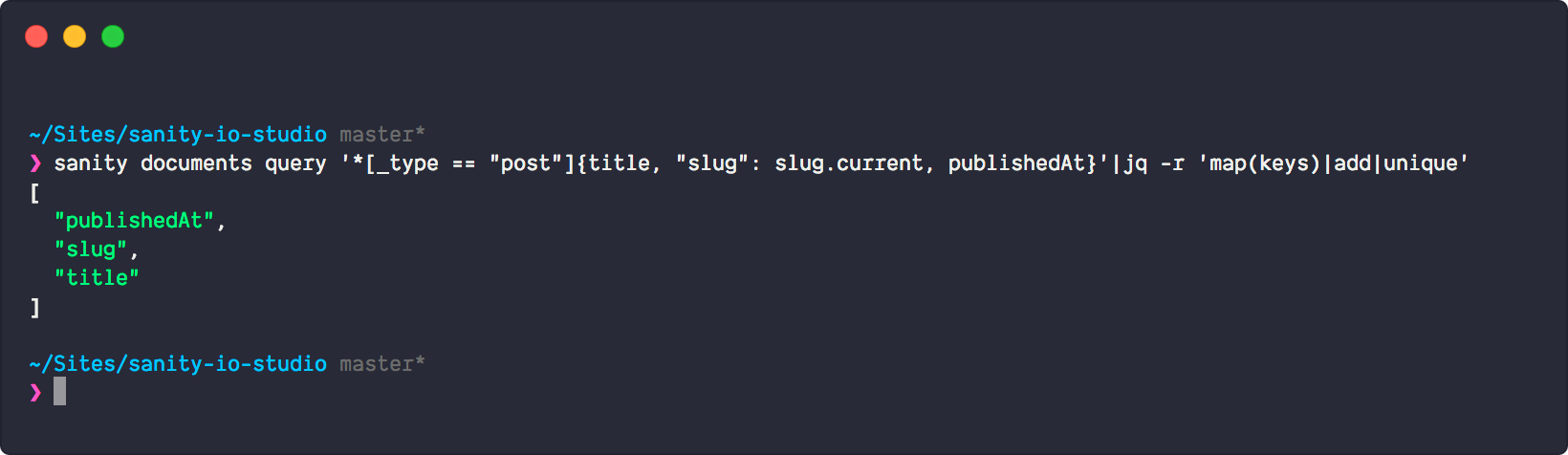
Map out unique keys
Map out unique keys
  • map(. as $row | $cols | map($row[.])) as $rows takes all objects in the outer array, and iterates through all the object keys (title, slug, publishedAt) and appends the values to an array, which gives you an array of arrays with the values, which is what you want when you're transforming JSON into CSV.
  • $cols, $rows[] | @csv puts the column headers first in the array, and then each of the arrays that are transformed to lines by piping them to @csv , which formats the output as… csv.
The final result
The final result

This command prints out the result in the shell, but if you want to write it directly to a file, you can append > filename.csv to it, or e.g. to the clipboard (pipe it to | pbcopy if your on a mac). Or perhaps you'll do something exiting with the csv in pandas in Python? If you found this useful, we'd love to hear about it!