惯性聚合 高效追踪和阅读你感兴趣的博客、新闻、科技资讯
阅读原文 在惯性聚合中打开

推荐订阅源

V
V2EX
V
Vulnerabilities – Threatpost
MongoDB | Blog
MongoDB | Blog
cs.AI updates on arXiv.org
P
Proofpoint News Feed
Know Your Adversary
Know Your Adversary
aimingoo的专栏
aimingoo的专栏
Threat Intelligence Blog | Flashpoint
C
Cisco Blogs
C
CERT Recently Published Vulnerability Notes
T
Tor Project blog
A
Arctic Wolf
L
LangChain Blog
L
LINUX DO - 热门话题
G
Google Developers Blog
Google DeepMind News
T
Threat Research - Cisco Blogs
Stack Overflow Blog
Stack Overflow Blog
I
Intezer
爱范儿
爱范儿
P
Palo Alto Networks Blog
WordPress大学
WordPress大学
H
Hackread – Cybersecurity News, Data Breaches, AI and More
T
The Blog of Author Tim Ferriss
G
GRAHAM CLULEY
S
Securelist
钛媒体:引领未来商业与生活新知
钛媒体:引领未来商业与生活新知
Cisco Talos Blog
Cisco Talos Blog
Security Latest
Security Latest
Martin Fowler
Martin Fowler
AWS News Blog
AWS News Blog
L
Lohrmann on Cybersecurity
C
Cybersecurity and Infrastructure Security Agency CISA
酷 壳 – CoolShell
酷 壳 – CoolShell
Recorded Future
Recorded Future
奇客Solidot–传递最新科技情报
奇客Solidot–传递最新科技情报
C
CXSECURITY Database RSS Feed - CXSecurity.com
Recent Announcements
有赞技术团队
有赞技术团队
Apple Machine Learning Research
V2EX - 技术
V2EX - 技术
CTFtime.org: upcoming CTF events
L
LINUX DO - 最新话题
博客园 - Franky
P
Privacy & Cybersecurity Law Blog
Simon Willison's Weblog
W
WeLiveSecurity
Cyberwarzone
Cyberwarzone
The Hacker News
The Hacker News
A
About on SuperTechFans

Sanity.io

A Board Game agent built using Sanity Context and Vercel's AI SDK | Sanity Build a prototype with Claude Code that your whole team can edit | Sanity What’s New - May 2026 | Sanity I built a London pub guide with v0 and the Sanity MCP in six hours. Here's what I learned. | Sanity Build a conference concierge with Agent Context and Anthropic | Sanity Build a content-aware Telegram agent with Vercel AI SDK and Chat SDK | Sanity How I used Agent API to generate photos for my family’s recipes | Sanity What’s New April - 2026 | Sanity Better context, better matches: An AI love story (for dogs) | Sanity How to write for an agent | Sanity Content Agent, meet Slack: AI content operations in your workflow | Sanity Structure powers intelligence | Sanity Your agent needs better content. Here's how to give it. | Sanity How to serve content to agents (a field guide) | Sanity Sanity TypeGen GA: Automatic TypeScript types for content and GROQ | Sanity Sanity is now available on the Vercel Marketplace | Sanity The logo soup problem (and how to solve it) | Sanity Content Releases: From scattered updates to coordinated publishing | Sanity What's New - February 2026 | Sanity How we solved the agent memory problem | Sanity v0 Builder Challenge: The winners | Sanity Introducing: Sanity Agent Skills | Sanity Content Agent: Days of work in one conversation | Sanity Our Sanity Values | Sanity Open Source Pledge 2025: Stepping up when it matters | Sanity v0 builder challenge: $3000 in prizes | Sanity Why AI Breaks Without Structured Content Operations | Sanity What’s New January - 2026 | Sanity BFCM 2025: What teams built when infrastructure stopped being the problem | Sanity How AI shaped holiday shopping and what it means for content in 2026 | Sanity Sanity Studio v5: Embracing React 19 | Sanity You’ll need a CMS eventually. Let your agent set it up. | Sanity “You should never build a CMS” | Sanity AI Content Operations: A 30-Day Implementation Guide | Sanity What’s New December - 2025 | Sanity Scheduled Drafts: Stop manually publishing content at midnight | Sanity What’s New November - 2025 | Sanity Everything *[NYC] 2025 recap: A day of AI, Content Operations, and Culture | Sanity Clankers and content operations | Sanity Content Agent: AI that understands your structured content is here | Sanity Why design-driven content modeling creates technical debt, not velocity | Sanity What's New October - 2025 | Sanity From studio to inbox: How Kevin Green eliminated email campaign friction | Sanity The content editor's guide to content operations [E-commerce edition] | Sanity styled-components maintenance mode: A 40% faster fork | Sanity From zero code to a live website in 7 hours (thanks, Cursor!) | Sanity First attempt will be 95% garbage: A staff engineer's 6-week journey with Claude Code | Sanity Internationalization is more than translating words | Sanity What's New - September 2025 | Sanity We just deleted our 35k-member community Slack | Sanity What's New - August 2025 | Sanity The engineer's guide to content operations [E-commerce edition] | Sanity SEO for AI: Evolving from Web Pages to the Content Lake | Sanity What's New - July 2025 | Sanity Sanity Studio v4: A major version bump for a minor reason | Sanity What's New - June 2025 | Sanity Dashboard and Insights: Your New Content HQ | Sanity Canvas: AI-accelerated, context-aware, freeform authoring | Sanity Agent Actions: AI building blocks for structured content | Sanity Functions: Life beyond pressing publish | Sanity A new era for content applications with Sanity App SDK | Sanity The end of CMS era and our $85M Series C. | Sanity What's New – May 2025 | Sanity Introducing the Sanity Model Context Protocol (MCP) server | Sanity What's New – April 2025 | Sanity Pushing all the envelopes with ambitious content | Sanity Self-hosting is only free if your time is worth nothing | Sanity Content that lasts: Scaling beyond your frontend | Sanity The Live Content API is now Generally Available | Sanity The future beyond AI chat bots | Sanity Learning the new skill of working with AI | Sanity What's New - March 2025 | Sanity Give it in plain text: Making your content AI-Ready | Sanity No More 'DO NOT PUBLISH': Introducing Content Releases | Sanity React in 2025, what's next? | Sanity The final boss of front-end: block editors | Sanity Introducing Sanity for Startups | Sanity A block content editor that loves you back | Sanity A Black Friday Snooze Fest: Massive Traffic, No Drama | Sanity How to make a recipe site that scales well | Sanity The Sanity Winter Release 2024 | Sanity AVIF Arrives, Sanity’s Promise Fulfilled | Sanity Sanity joins the Open Source Pledge | Sanity Your content is now Live by default | Sanity Begin Team to Join Sanity | Sanity Sanity Digest - September '24 Edition | Sanity Sanity partners with Google. Now live on the Google Cloud Marketplace. | Sanity Sanity Digest - August ‘24 Edition | Sanity Now playing: the latest Mux Video Input plugin for Sanity | Sanity Community Digest - June ‘24 Edition | Sanity Community Digest - May ‘24 Edition | Sanity Guide to Sanity's newest product announcements | Sanity AI and Content Creation: A Leader's Guide | Sanity Of course, you should be able to type your content quickly! | Sanity New to AI Assist: translation, reference suggestions, image generation | Sanity Speak the language of your editors: Sanity Studio UI localization | Sanity Introducing the new Sanity Growth plan to serve collaborative teams | Sanity Presentation: Work faster than ever with structured content | Sanity Goodbye Feedback Frenzy, Hello Sanity Studio Comments! | Sanity Easing into the App Router with the Sanity Toolkit for Next.js | Sanity
The Buzzwordless Three Tenets of the Jamstack | Sanity
Jaden Baptista · 2022-05-27 · via Sanity.io

What is the Jamstack? As it turns out, that’s kind of a loaded question — and one that’s been answered a lot. Perhaps you’ve read some articles describing it as a new approach to building websites (spoiler: it’s not), or a marketing term used by Netlify (spoiler: not that either), or an elitist community of developers (spoiler: still nope), or a term for a set of technologies that isn’t relevant anymore (spoiler: take a wild guess).

It’s evolved so much that it might’ve been some or all of these things at one point, but it’s grown into a set of principles that — when applied in appropriate measure — can make whatever user-facing software you’re building faster, simpler, and easier to maintain. So in this article, let’s investigate some of the key tenets of the Jamstack at a high level, as well as how and when we can incorporate these principles into our development.

Thou shalt prebake thine client views.

Arguably the biggest of the principles of the Jamstack — the one that brought the community together — is a fascination with prerendering. That’s the term for baking content into the views of your application long before it hits the client computers. In the context of websites, that means prebuilding as much as possible into your HTML before it ships out to client browsers.

This is traditional and slow:
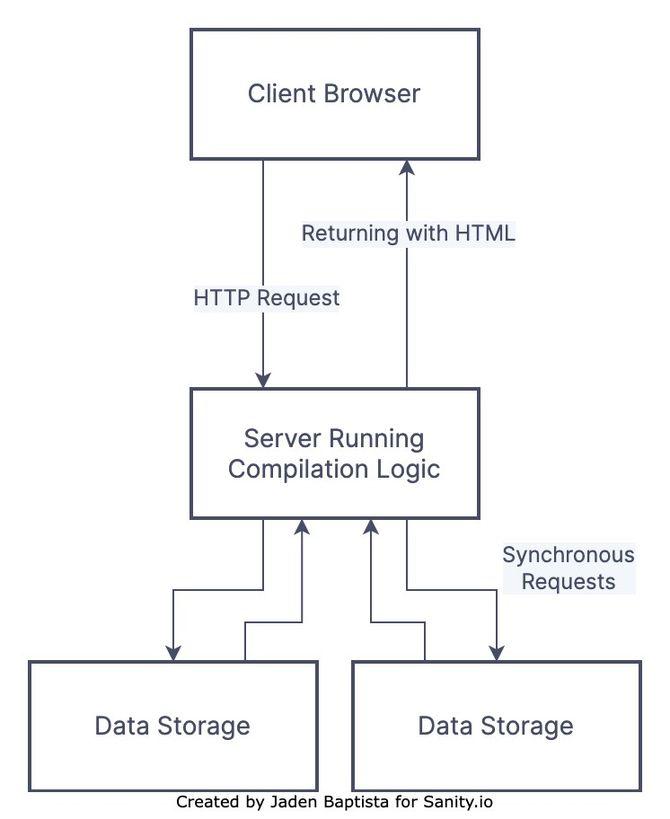
Diagram representing the path of information from data storage to the client browser via synchronous operations run on an always-on server. As soon as it receives an HTTP request, it synchronously checks the database before compiling the response into HTML and passing it back to the client.

And this is modern and speedy:

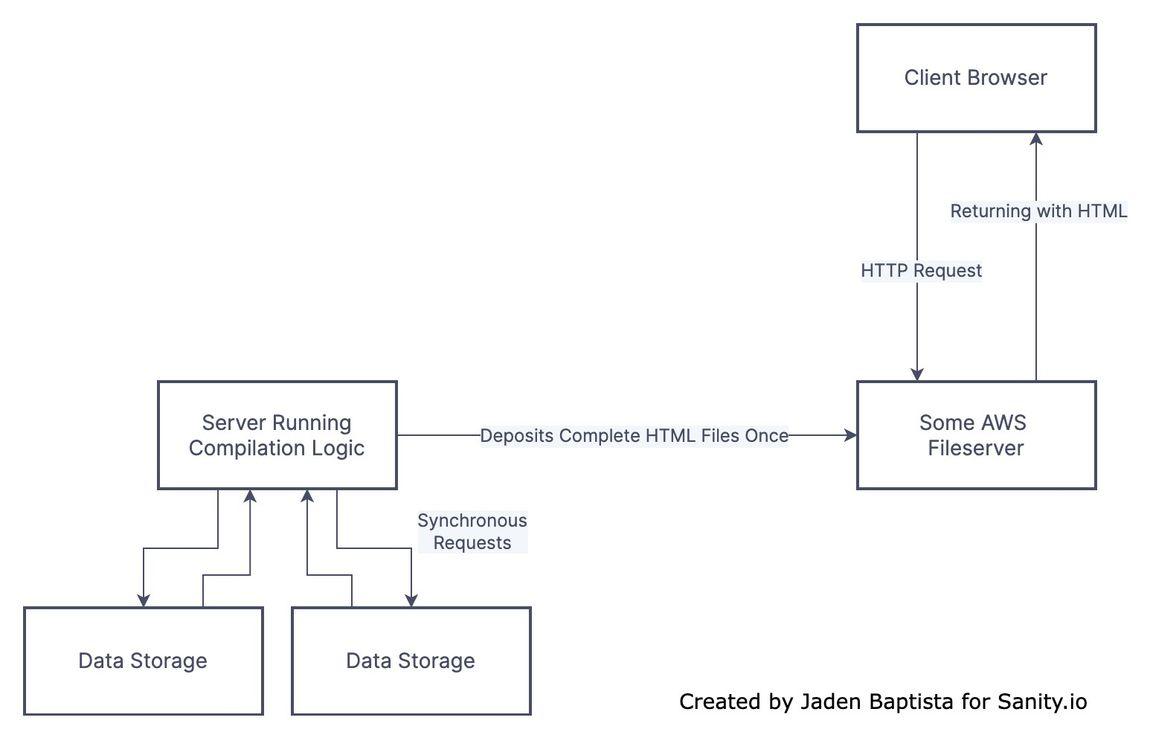
Another diagram similar to the first one, except that the server running compilation logic is run in advance. The HTML it compiles after looking at the database is stored on a simple fileserver, often run by a big cloud company like AWS, which serves that HTML to the client whenever its actually requested.

Note that the only real difference here is that our compilation logic — the code that talks to our databases and fills out our HTML — is running way before it’s actually needed. Then when the client browser requests some page, it’s just sitting on some fileserver waiting to be used, the same way websites were served back in the 90’s.

The rationale behind this is that we don’t want the browser’s request to the server for content to just be hanging around, waiting for the server to fill out a page with info from the database. Those requests, if made sequentially, could lead to very, very slow applications because the delays sum up. 50ms here, 75ms there, another 20ms over there, and soon enough, it’s taking 3 seconds to load our homepage. That directly impacts revenue negatively. Speed is so important in business that it’s worth thinking about your app like an irresponsible kid thinks about their first car — the primary concern is “how fast does it go?”

Note also that this approach isn’t unique to websites. Originally when the Jamstack was coined by Netlify CEO Mathias Biilman, it was seen as the application of existing principles of mobile development to the World Wide Web. Mobile apps often take this approach of prebuilding views to be shipped out to the device, and then handling as much as possible offline without making the app ask a server to do that compilation work every time it needs to display a new page.

But what happens when web and mobile apps need some data that can’t be prebaked into the application? After all, not every site is completely static and unchanging. We’ve got to request data from a server sometimes. How do we do that?

Thou shalt use microservices for rapidly-changing data.

We can use microservices! If that sounds like a buzzword to you, I promise it’s a technical term! According to microservices.io, it’s “an architectural style that structures an application as a collection of services”. Essentially, it’s the concept of splitting out whatever server logic we need into a bunch of tiny, self-contained pieces that can run on their own. Then, we can use, develop, and maintain all of those pieces indepentently, meaning we don’t have to worry about one little change causing a ripple effect somewhere else and breaking our application.

Microservices are also “loosely coupled” — in other words, as much as possible, they’re not dependent on each other. That means that they can be isolated and tested separately from the rest of the application. You can write a test that gives a single microservice some input and check that the output is right. It also means that our microservices can become “organized around business capabilities”, reflecting the priorities of the organization that runs the website.

So now, our architectural diagram looks like this:
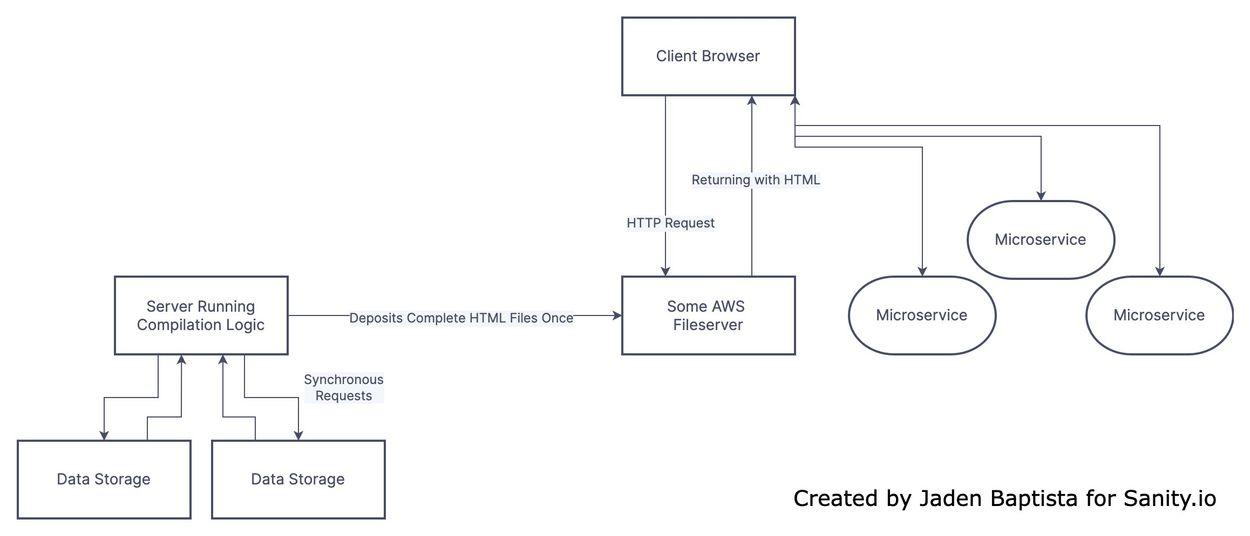
another diagram similar to the last one, but with a representation of microservices as separate objects directly connected to the client browser and not the rest of the diagram.

See those microservices at the right? Because they can stand apart from everything else, they can run separately from the fileserver where our HTML is stored. Services like AWS Lambda are fantastic for this, because they can build out a whole infrastructure to support billions of microservices from all sorts of different websites. That sort of thing is completely impractical for us to set up by ourselves, but AWS can manage it all because they’re running microservices in bulk for a lot of people.

Thou shalt be treated as a frontend developer.

I asked on Twitter what the most important tenet of the Jamstack is, and I got an interesting response from Ishan Anand, who mentioned that the developer experience is different. And it’s true — when we think about the Jamstack, it’s not really about the technologies or even the people that rallied around them.

It’s about how that community is treated.

We’re treated as a bunch of frontend developers, even though many come from other disciplines. That has quite an impact — every major tool that is considered “Jamstack” is geared towards frontend devs.

  • You could write microservices in PHP, but nobody does, because that’s a backend tool.
  • You could store your data in Wordpress, but nobody does, because that’s a backend tool.

Instead, we use Node.JS for microservices, because it feels frontendy. We use headless CMSs for the same reason.

Whatever tools you end up using, just think about how many skills you need to accomplish everything. For single-dev teams, it’s very wise to keep the total number of skills needed to a minimum because nobody is truly good at everything — we all specialize in something, and if you can build an application with only skills you specialize in, you’ll be far more productive. The same holds true for big development teams though, since you’ll be able to hire specialists for each needed skill. They’ll be more likely to communicate effectively with each other, having their expertise in common.

The Jamstack is an ideology that emphasizes the frontend development skillset. If you only know HTML, CSS, and JavaScript, you can make a fully-featured, complex web application by yourself. If you’re on a team, your teammates don’t need a wide range of mutually-exclusive expertises — they can be just like you! This is the defining aspect of the Jamstack.

The Jamstack isn’t a religion

While I jokingly listed these tenets like religious commandments, they’re actually just suggestions that a lot of folks have found helpful. Here’s a recap in a more modern flavor of English:

  • Prebake your client views
  • Use microservices for rapidly-changing data
  • Search out the frontend developer experience

Like the microservices.io site I mentioned earlier said, none of this is a silver bullet. None of these principles will make your site better if you don’t know when to apply them. There’s really no formula to that part of it, only a rule-of-thumb:

Analyze your needs, and fill them as you see fit.

I can feel some people gasping for air at my blasphemy... Unfortunately, our community has had tinges of gatekeeping and extreme dogmatism, but we can change that! One interesting effort is the Good Websites Club, a group of developers who make it their mission to share Good Websites, regardless of the technology they use and if the site earns the “Jamstack” label. So there’s your call-to-action: join us in designing website architectures that fit the needs of the website, and not the other way around — and if you want to chat about your decisions or get advice from unbiased volunteers, join us in the Good Websites Club.