


惯性聚合 高效追踪和阅读你感兴趣的博客、新闻、科技资讯
阅读原文 在惯性聚合中打开

推荐订阅源

阮一峰的网络日志
阮一峰的网络日志
Jina AI
Jina AI
GbyAI
GbyAI
D
DataBreaches.Net
人人都是产品经理
人人都是产品经理
Hugging Face - Blog
Hugging Face - Blog
V
Visual Studio Blog
P
Proofpoint News Feed
The Cloudflare Blog
H
Help Net Security
MyScale Blog
MyScale Blog
T
The Blog of Author Tim Ferriss
量子位
博客园 - 聂微东
Apple Machine Learning Research
T
Tailwind CSS Blog
博客园 - 三生石上(FineUI控件)
钛媒体:引领未来商业与生活新知
钛媒体:引领未来商业与生活新知
让小产品的独立变现更简单 - ezindie.com
MongoDB | Blog
MongoDB | Blog
Last Week in AI
Last Week in AI
大猫的无限游戏
大猫的无限游戏
小众软件
小众软件
月光博客
月光博客

Sanity.io

A Board Game agent built using Sanity Context and Vercel's AI SDK | Sanity Build a prototype with Claude Code that your whole team can edit | Sanity What’s New - May 2026 | Sanity I built a London pub guide with v0 and the Sanity MCP in six hours. Here's what I learned. | Sanity Build a conference concierge with Agent Context and Anthropic | Sanity Build a content-aware Telegram agent with Vercel AI SDK and Chat SDK | Sanity How I used Agent API to generate photos for my family’s recipes | Sanity What’s New April - 2026 | Sanity Better context, better matches: An AI love story (for dogs) | Sanity How to write for an agent | Sanity Content Agent, meet Slack: AI content operations in your workflow | Sanity Structure powers intelligence | Sanity Your agent needs better content. Here's how to give it. | Sanity How to serve content to agents (a field guide) | Sanity Sanity TypeGen GA: Automatic TypeScript types for content and GROQ | Sanity Sanity is now available on the Vercel Marketplace | Sanity The logo soup problem (and how to solve it) | Sanity Content Releases: From scattered updates to coordinated publishing | Sanity What's New - February 2026 | Sanity How we solved the agent memory problem | Sanity v0 Builder Challenge: The winners | Sanity Introducing: Sanity Agent Skills | Sanity Content Agent: Days of work in one conversation | Sanity Our Sanity Values | Sanity Open Source Pledge 2025: Stepping up when it matters | Sanity v0 builder challenge: $3000 in prizes | Sanity Why AI Breaks Without Structured Content Operations | Sanity What’s New January - 2026 | Sanity BFCM 2025: What teams built when infrastructure stopped being the problem | Sanity How AI shaped holiday shopping and what it means for content in 2026 | Sanity
Now you see them, now you don’t. Introducing Conditional ...
Marcus Sarmento · 2021-08-26 · via Sanity.io

We often hear from our community and customers that they love how flexible the Sanity Studio interface is. The open-source editing environment lets you truly tailor the authoring layer to exactly how your team wants to interact with their content. Want special fields, plugins for 3rd party tools, validation warnings, or custom workflows? You can build and implement those yourself or use one of the hundreds of contributions from the community.

But what if you want to customize the interface based on business logic? What if you want to add or remove fields in certain conditions to surface only relevant info and make your editors more productive? After all, as Jakob Nielsen notes in his famous 10 Usability Heuristics for User Interface Design, “interfaces should not contain information which is irrelevant…every extra unit of information in an interface competes with the relevant units of information and diminishes their relative visibility.” Extra information in an interface adds noise and slows your team down, negatively impacting your go-to-market efforts.

Introducing Conditional Fields

This feature has been a long-standing request and we’re thrilled to finally deliver it! Starting today, you can use our new Conditional Fields support to programmatically change your interface to only surface the most relevant information. This lets you simplify the environment for your team, so you can show them only the information they need to see to get their job done.
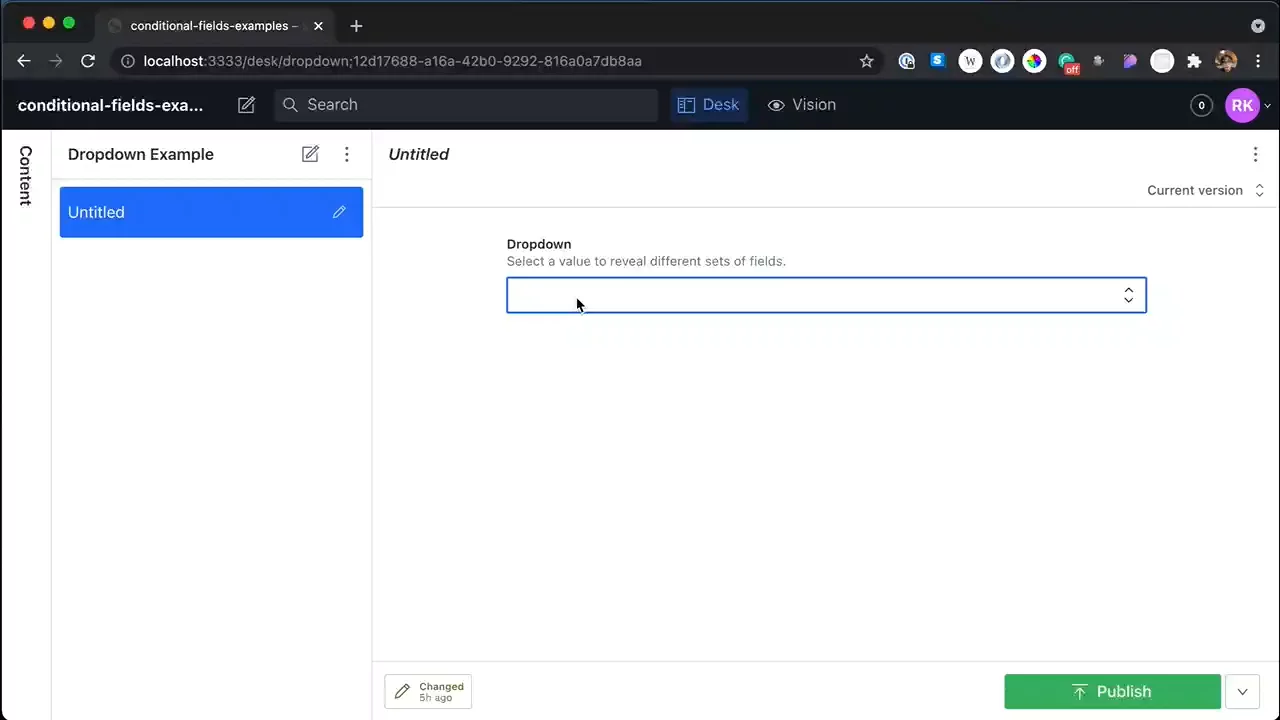
Simply put, conditional fields let you show or hide fields in the content editor based on whatever custom logic you want. We’ve upgraded the ‘hidden’ property that has long been a part of Sanity’s schema, to be able to take a function with contextual data. This gives you more flexibility than ever before to create interfaces tuned precisely to your use case and how your team operates.

Use cases

We asked our community about how they plan on using Conditional Fields and got a wide range of responses. Example use cases include:

  • Marketing organizations can show only the relevant localized fields for their translators
  • E-commerce companies that sell both physical and digital goods can hide fields associated with physical goods like ‘weight’, ‘height, and ‘length’ when accessing digital products
  • Real estate companies can add a ‘sales price’ field if the status of a particular listing is ‘sold’
  • Event companies that sell sponsorship packages can display or remove fields based on sponsorship tier
  • Media companies can add fields for video URLs on all pages that are marked ‘public’

Enhance your editor experience

We are always looking for ways to make the editor experience better and to make it easier for developers to address business needs. Other systems with conditional fields are typically restrictive. They only look for the existence of a value or force you to install a plugin or write your own input from the ground up. Adding first-class support for programmable conditional fields sets Sanity apart from other content systems. You decide what the conditions are, and Sanity Studio does the rest.

We know these examples are just scratching the surface and we can’t wait to see all the streamlined interfaces you’ll build with it. Check out the docs for more information or join the community Slack and let us know what you think!