

惯性聚合 高效追踪和阅读你感兴趣的博客、新闻、科技资讯
阅读原文 在惯性聚合中打开

推荐订阅源

Jina AI
Jina AI
C
Cybersecurity and Infrastructure Security Agency CISA
美团技术团队
J
Java Code Geeks
博客园 - 聂微东
罗磊的独立博客
Hugging Face - Blog
Hugging Face - Blog
博客园 - 【当耐特】
小众软件
小众软件
博客园 - 三生石上(FineUI控件)
Apple Machine Learning Research
大猫的无限游戏
大猫的无限游戏
让小产品的独立变现更简单 - ezindie.com
博客园 - 叶小钗
雷峰网
雷峰网
爱范儿
爱范儿
阮一峰的网络日志
阮一峰的网络日志
V
Visual Studio Blog
腾讯CDC
酷 壳 – CoolShell
酷 壳 – CoolShell
有赞技术团队
有赞技术团队
Google DeepMind News
The Cloudflare Blog
博客园 - Franky
Engineering at Meta
Engineering at Meta
IT之家
IT之家
Last Week in AI
Last Week in AI
Recent Announcements
The Register - Security
Application and Cybersecurity Blog
T
The Exploit Database - CXSecurity.com
I
Intezer
V
Vulnerabilities – Threatpost
Simon Willison's Weblog
NISL@THU
NISL@THU
S
Security @ Cisco Blogs
T
Tenable Blog
cs.CV updates on arXiv.org
Project Zero
Project Zero
H
Hacker News: Front Page
SecWiki News
SecWiki News
L
LINUX DO - 最新话题
Hacker News: Ask HN
Hacker News: Ask HN
Forbes - Security
Forbes - Security
C
CERT Recently Published Vulnerability Notes
T
Threatpost
N
News and Events Feed by Topic
Webroot Blog
Webroot Blog
Recent Commits to openclaw:main
V2EX - 技术
V2EX - 技术

Sanity.io

A Board Game agent built using Sanity Context and Vercel's AI SDK | Sanity Build a prototype with Claude Code that your whole team can edit | Sanity What’s New - May 2026 | Sanity I built a London pub guide with v0 and the Sanity MCP in six hours. Here's what I learned. | Sanity Build a conference concierge with Agent Context and Anthropic | Sanity Build a content-aware Telegram agent with Vercel AI SDK and Chat SDK | Sanity How I used Agent API to generate photos for my family’s recipes | Sanity What’s New April - 2026 | Sanity Better context, better matches: An AI love story (for dogs) | Sanity How to write for an agent | Sanity Content Agent, meet Slack: AI content operations in your workflow | Sanity Structure powers intelligence | Sanity Your agent needs better content. Here's how to give it. | Sanity How to serve content to agents (a field guide) | Sanity Sanity TypeGen GA: Automatic TypeScript types for content and GROQ | Sanity Sanity is now available on the Vercel Marketplace | Sanity The logo soup problem (and how to solve it) | Sanity Content Releases: From scattered updates to coordinated publishing | Sanity What's New - February 2026 | Sanity How we solved the agent memory problem | Sanity v0 Builder Challenge: The winners | Sanity Introducing: Sanity Agent Skills | Sanity Content Agent: Days of work in one conversation | Sanity Our Sanity Values | Sanity Open Source Pledge 2025: Stepping up when it matters | Sanity v0 builder challenge: $3000 in prizes | Sanity Why AI Breaks Without Structured Content Operations | Sanity What’s New January - 2026 | Sanity BFCM 2025: What teams built when infrastructure stopped being the problem | Sanity How AI shaped holiday shopping and what it means for content in 2026 | Sanity Sanity Studio v5: Embracing React 19 | Sanity You’ll need a CMS eventually. Let your agent set it up. | Sanity “You should never build a CMS” | Sanity AI Content Operations: A 30-Day Implementation Guide | Sanity What’s New December - 2025 | Sanity Scheduled Drafts: Stop manually publishing content at midnight | Sanity What’s New November - 2025 | Sanity Everything *[NYC] 2025 recap: A day of AI, Content Operations, and Culture | Sanity Clankers and content operations | Sanity Content Agent: AI that understands your structured content is here | Sanity Why design-driven content modeling creates technical debt, not velocity | Sanity What's New October - 2025 | Sanity From studio to inbox: How Kevin Green eliminated email campaign friction | Sanity The content editor's guide to content operations [E-commerce edition] | Sanity styled-components maintenance mode: A 40% faster fork | Sanity From zero code to a live website in 7 hours (thanks, Cursor!) | Sanity First attempt will be 95% garbage: A staff engineer's 6-week journey with Claude Code | Sanity Internationalization is more than translating words | Sanity What's New - September 2025 | Sanity We just deleted our 35k-member community Slack | Sanity What's New - August 2025 | Sanity The engineer's guide to content operations [E-commerce edition] | Sanity SEO for AI: Evolving from Web Pages to the Content Lake | Sanity What's New - July 2025 | Sanity Sanity Studio v4: A major version bump for a minor reason | Sanity What's New - June 2025 | Sanity Dashboard and Insights: Your New Content HQ | Sanity Canvas: AI-accelerated, context-aware, freeform authoring | Sanity Agent Actions: AI building blocks for structured content | Sanity Functions: Life beyond pressing publish | Sanity A new era for content applications with Sanity App SDK | Sanity The end of CMS era and our $85M Series C. | Sanity What's New – May 2025 | Sanity Introducing the Sanity Model Context Protocol (MCP) server | Sanity What's New – April 2025 | Sanity Pushing all the envelopes with ambitious content | Sanity Self-hosting is only free if your time is worth nothing | Sanity Content that lasts: Scaling beyond your frontend | Sanity The Live Content API is now Generally Available | Sanity The future beyond AI chat bots | Sanity Learning the new skill of working with AI | Sanity What's New - March 2025 | Sanity Give it in plain text: Making your content AI-Ready | Sanity No More 'DO NOT PUBLISH': Introducing Content Releases | Sanity React in 2025, what's next? | Sanity The final boss of front-end: block editors | Sanity Introducing Sanity for Startups | Sanity A block content editor that loves you back | Sanity A Black Friday Snooze Fest: Massive Traffic, No Drama | Sanity How to make a recipe site that scales well | Sanity The Sanity Winter Release 2024 | Sanity AVIF Arrives, Sanity’s Promise Fulfilled | Sanity Sanity joins the Open Source Pledge | Sanity Your content is now Live by default | Sanity Begin Team to Join Sanity | Sanity Sanity Digest - September '24 Edition | Sanity Sanity partners with Google. Now live on the Google Cloud Marketplace. | Sanity Sanity Digest - August ‘24 Edition | Sanity Now playing: the latest Mux Video Input plugin for Sanity | Sanity Community Digest - June ‘24 Edition | Sanity Community Digest - May ‘24 Edition | Sanity Guide to Sanity's newest product announcements | Sanity AI and Content Creation: A Leader's Guide | Sanity Of course, you should be able to type your content quickly! | Sanity New to AI Assist: translation, reference suggestions, image generation | Sanity Speak the language of your editors: Sanity Studio UI localization | Sanity Introducing the new Sanity Growth plan to serve collaborative teams | Sanity Presentation: Work faster than ever with structured content | Sanity Goodbye Feedback Frenzy, Hello Sanity Studio Comments! | Sanity Easing into the App Router with the Sanity Toolkit for Next.js | Sanity
A Sitemap is Not a Content Model | Sanity
Carrie Hane · 2023-05-09 · via Sanity.io

Anytime you redesign your website or migrate to a new content management system (CMS), you get an opportunity to rethink your content and its organization for the new site. What can you improve? How can you increase the return on investment?

Many people use content modeling to help them create this new structure. And, since you already have a website, it’s tempting to start out by mapping your existing sitemap to your new content model (and auditing your content, of course). But this approach has some serious limitations.

The problem with using your sitemap

Using your sitemap as a starting point for a content model will capture what content you have right now in its current format. This is fine if all you want to do is inventory what you have.

However, it’s not so good for making your content future-friendly so it can be used across multiple channels and presentations. This is because your content ends up being mapped to how it appears on a webpage, rather than what concept the content represents.

Content model showing a Company content type linked to Job, Contact, News, Awards, Leadership, Press Release, Resources, and Solutions. Solutions are linked to Audience and Industry. Resources are linked to Reports, Events, Whitepapers, Podcast, and Blog. The Blog is linked to Industry.
Sitemap-based content model of a typical service industry company.

When you try to organize these content types into a new sitemap or menu, the choices are limited to the same options you started with. But what if you want to expand or change how you talk about your offerings? Frustrating, right?

The problem at the heart of all of this is that when you base your content model on what’s on a website, the content types lack meaning outside of the website. That can be a problem when your website’s information architecture doesn’t match the mental model visitors bring with them to the site.

This is because sitemaps and content models are not equivalent artifacts.

A sitemap is a hierarchical listing of pages on a single website.

A content model is documentation of an organization’s types of content and their relationships. It represents all the content that your company needs to have to meet the needs of your audience.

How successful you are at meeting these needs—in the short term and long term—depends on whether or not you’re thinking about content before considering how it shows up on a website, or any other digital product or app.

Look beyond technology and interfaces for content models

Turning web content into entities that can be used as a whole (for example, a webpage) or broken into pieces (as components to create multiple different outputs) will create new opportunities for a longer-lasting website, as well as for more efficient content operations and governance.

Instead of starting with a spreadsheet inventory of web content, start by thinking about all the types of content your company has. Put those on a board. These are your potential content types.

Go ahead and start with a web content inventory, if that feels like an easy place to start. But instead of recreating the sitemap, think about what the webpages represent. Some of the pages will be content types. Looking at our sitemap-based model above, we can discern the difference.

Content types (from the sitemap-based model)

These are entities that can stand alone, whether or not they appear on a website.

  • Company
  • Press Release
  • Report
  • Event
  • Whitepaper
  • Industry

NOT content types (from the sitemap-based model)

These are collections of a content type pulled together as a webpage. Break them into entities, or content types, instead. (Content types in bold.)

  • Resources > A category of content types
  • Leadership > People who make up the leadership team, also the people who write the editorial content listed above
  • Jobs > Job Posting is the content type
  • Blog > Blog Post is the content type
  • Solutions > Is this really a Product?
  • Podcast > Podcast Episode
  • Awards > Award
  • News - News Item is the content type

These are part of other content types.

  • Audience - More likely one way to tag other types of content
  • Contact - Likely part of the Company content type

Now we get a content model that could look like this.

Content model showing content types linked through meaningful relationships. Company creates Press Release, Job Listing, and Event, is featured in News Item, and has Contact Info. The News Item could be about and Product and Contact Info are for Industry. Each type of resource - Case Study, Blog Post, Article, Report, Whitepaper, and Podcast Episode - is created by a Person and is about an Industry and a Product. A Testimonial is about a Product.
Entity-based content model of a service industry company.

To get a more complete overview of your content, go hunting for content types in other places: This will help you think about what you could potentially offer in the future, rather than just what you have now.

Stakeholder interviews. Talk to others in the organization to find out what kinds of content they share with their primary audiences. Content could be hiding in plain sight!

  • Marketing collateral – brochures, forms, applications
  • Events – speakers, sessions, tickets, merchandise, presentations, venue information
  • Learning and education – courses, credits
  • Legal – policies, terms and conditions, disclaimers
  • Fundraising – memberships, subscriptions, giving programs
  • Documentation – manuals, customer support, guides
  • Publications – magazines, newsletters, annual reports

Competitors’ or partners’ websites and applications. What are they offering that you could also offer?

User or audience research.What do you hear people asking for?

Many sitemaps can be based on your content model

Remember when we talked about future-proofing for content reuse? Using the entity-based content model, we could create multiple different sitemaps or menus—for example, for a marketing website and a client portal—while using the same set of content.

Think of the content types as cards that can be sorted and categorized. The menu for the marketing website could be sorted like this:
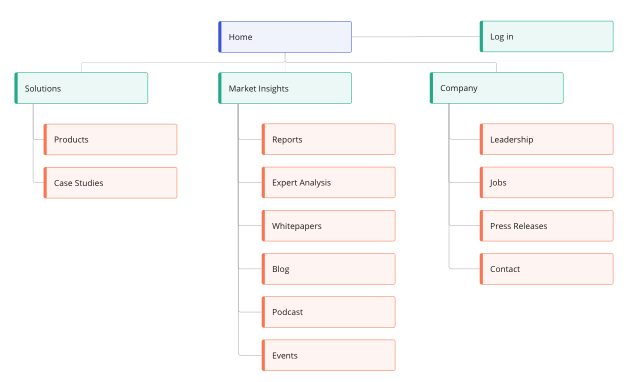
Potential marketing website menu showing first and second level items: Solutions with children Products and Case Studies; Market Insights with children Reports, Expert Analysis, Whitepapers, Blog, Podcast, and Events; Company with children Leadership, Jobs, Press Releases, and Contact; and Login.
Potential marketing site menu showing an overview of the company and what it offers.

While the client portal could have this menu, using the same set of content types:

Potential client portal menu showing first and second level pages: Products with children being all Products the logged in customer has access to; Analysis with children Reports, Expert Analysis, and Whitepapers; Contacts with all the people the logged in customer has direct access to as children.
Potential client portal menu showing what a client has access to that the public does not.

Each page on the site draws from the list of content types.

You’ll notice that the content types in the model get you about 80%-90% of the way to each menu. For context and usability, you’ll need some webpages that provide wayfinding and information that is only applicable to that property.

Sitemaps and content models both provide a representation of content. They feed off each other, but have different purposes.

Ready to explore content modeling?

You can learn more about how to think about content modeling, lay the groundwork for a project, and create a content model. There's even a workbook for a Sanity Studio build!

Get our guide to content modeling