




惯性聚合 高效追踪和阅读你感兴趣的博客、新闻、科技资讯
阅读原文 在惯性聚合中打开

推荐订阅源

博客园 - 聂微东
D
Darknet – Hacking Tools, Hacker News & Cyber Security
P
Privacy International News Feed
NISL@THU
NISL@THU
Know Your Adversary
Know Your Adversary
G
GRAHAM CLULEY
The Hacker News
The Hacker News
P
Privacy & Cybersecurity Law Blog
S
Schneier on Security
T
Troy Hunt's Blog
Attack and Defense Labs
S
Secure Thoughts
S
Security Affairs
WordPress大学
WordPress大学
T
Tailwind CSS Blog
博客园 - Franky
T
The Exploit Database - CXSecurity.com
雷峰网
雷峰网
S
SegmentFault 最新的问题
奇客Solidot–传递最新科技情报
奇客Solidot–传递最新科技情报
让小产品的独立变现更简单 - ezindie.com
P
Proofpoint News Feed
S
Securelist
A
Arctic Wolf
C
Cyber Attacks, Cyber Crime and Cyber Security
有赞技术团队
有赞技术团队
爱范儿
爱范儿
Help Net Security
Help Net Security
Apple Machine Learning Research
cs.CV updates on arXiv.org
博客园 - 三生石上(FineUI控件)
C
CERT Recently Published Vulnerability Notes
C
Cisco Blogs
阮一峰的网络日志
阮一峰的网络日志
C
Cybersecurity and Infrastructure Security Agency CISA
Spread Privacy
Spread Privacy
Last Week in AI
Last Week in AI
S
Security @ Cisco Blogs
博客园 - 司徒正美
博客园_首页
Exploit-DB.com RSS Feed
罗磊的独立博客
博客园 - 叶小钗
K
KPMG report finds enterprise disconnect between AI and its ROI | CIO
大猫的无限游戏
大猫的无限游戏
Jina AI
Jina AI
J
Java Code Geeks
T
Threatpost
钛媒体:引领未来商业与生活新知
钛媒体:引领未来商业与生活新知
量子位

Sanity.io

A Board Game agent built using Sanity Context and Vercel's AI SDK | Sanity Build a prototype with Claude Code that your whole team can edit | Sanity What’s New - May 2026 | Sanity I built a London pub guide with v0 and the Sanity MCP in six hours. Here's what I learned. | Sanity Build a conference concierge with Agent Context and Anthropic | Sanity Build a content-aware Telegram agent with Vercel AI SDK and Chat SDK | Sanity How I used Agent API to generate photos for my family’s recipes | Sanity What’s New April - 2026 | Sanity Better context, better matches: An AI love story (for dogs) | Sanity How to write for an agent | Sanity Content Agent, meet Slack: AI content operations in your workflow | Sanity Structure powers intelligence | Sanity Your agent needs better content. Here's how to give it. | Sanity How to serve content to agents (a field guide) | Sanity Sanity TypeGen GA: Automatic TypeScript types for content and GROQ | Sanity Sanity is now available on the Vercel Marketplace | Sanity The logo soup problem (and how to solve it) | Sanity Content Releases: From scattered updates to coordinated publishing | Sanity What's New - February 2026 | Sanity How we solved the agent memory problem | Sanity v0 Builder Challenge: The winners | Sanity Introducing: Sanity Agent Skills | Sanity Content Agent: Days of work in one conversation | Sanity Our Sanity Values | Sanity Open Source Pledge 2025: Stepping up when it matters | Sanity v0 builder challenge: $3000 in prizes | Sanity Why AI Breaks Without Structured Content Operations | Sanity What’s New January - 2026 | Sanity BFCM 2025: What teams built when infrastructure stopped being the problem | Sanity How AI shaped holiday shopping and what it means for content in 2026 | Sanity Sanity Studio v5: Embracing React 19 | Sanity You’ll need a CMS eventually. Let your agent set it up. | Sanity “You should never build a CMS” | Sanity AI Content Operations: A 30-Day Implementation Guide | Sanity What’s New December - 2025 | Sanity Scheduled Drafts: Stop manually publishing content at midnight | Sanity What’s New November - 2025 | Sanity Everything *[NYC] 2025 recap: A day of AI, Content Operations, and Culture | Sanity Clankers and content operations | Sanity Content Agent: AI that understands your structured content is here | Sanity Why design-driven content modeling creates technical debt, not velocity | Sanity What's New October - 2025 | Sanity From studio to inbox: How Kevin Green eliminated email campaign friction | Sanity The content editor's guide to content operations [E-commerce edition] | Sanity styled-components maintenance mode: A 40% faster fork | Sanity From zero code to a live website in 7 hours (thanks, Cursor!) | Sanity First attempt will be 95% garbage: A staff engineer's 6-week journey with Claude Code | Sanity Internationalization is more than translating words | Sanity What's New - September 2025 | Sanity We just deleted our 35k-member community Slack | Sanity What's New - August 2025 | Sanity The engineer's guide to content operations [E-commerce edition] | Sanity SEO for AI: Evolving from Web Pages to the Content Lake | Sanity What's New - July 2025 | Sanity Sanity Studio v4: A major version bump for a minor reason | Sanity What's New - June 2025 | Sanity Dashboard and Insights: Your New Content HQ | Sanity Canvas: AI-accelerated, context-aware, freeform authoring | Sanity Agent Actions: AI building blocks for structured content | Sanity Functions: Life beyond pressing publish | Sanity A new era for content applications with Sanity App SDK | Sanity The end of CMS era and our $85M Series C. | Sanity What's New – May 2025 | Sanity Introducing the Sanity Model Context Protocol (MCP) server | Sanity What's New – April 2025 | Sanity Pushing all the envelopes with ambitious content | Sanity Self-hosting is only free if your time is worth nothing | Sanity Content that lasts: Scaling beyond your frontend | Sanity The Live Content API is now Generally Available | Sanity The future beyond AI chat bots | Sanity Learning the new skill of working with AI | Sanity What's New - March 2025 | Sanity Give it in plain text: Making your content AI-Ready | Sanity No More 'DO NOT PUBLISH': Introducing Content Releases | Sanity React in 2025, what's next? | Sanity The final boss of front-end: block editors | Sanity Introducing Sanity for Startups | Sanity A block content editor that loves you back | Sanity A Black Friday Snooze Fest: Massive Traffic, No Drama | Sanity How to make a recipe site that scales well | Sanity The Sanity Winter Release 2024 | Sanity AVIF Arrives, Sanity’s Promise Fulfilled | Sanity Sanity joins the Open Source Pledge | Sanity Your content is now Live by default | Sanity Begin Team to Join Sanity | Sanity Sanity Digest - September '24 Edition | Sanity Sanity partners with Google. Now live on the Google Cloud Marketplace. | Sanity Sanity Digest - August ‘24 Edition | Sanity Now playing: the latest Mux Video Input plugin for Sanity | Sanity Community Digest - June ‘24 Edition | Sanity Community Digest - May ‘24 Edition | Sanity Guide to Sanity's newest product announcements | Sanity AI and Content Creation: A Leader's Guide | Sanity Of course, you should be able to type your content quickly! | Sanity New to AI Assist: translation, reference suggestions, image generation | Sanity Speak the language of your editors: Sanity Studio UI localization | Sanity Introducing the new Sanity Growth plan to serve collaborative teams | Sanity Presentation: Work faster than ever with structured content | Sanity Goodbye Feedback Frenzy, Hello Sanity Studio Comments! | Sanity Easing into the App Router with the Sanity Toolkit for Next.js | Sanity
Advantages of Structured Content and Simple Rich Text Editors | Sanity
Knut Melvær · 2021-12-02 · via Sanity.io

Once upon a time, to create a piece of content to share--say a business memo--you slid a blank sheet of paper into a typewriter and started typing. Then came computers and word processing software with all the same affordance: a blank page to type into. Early web pages were the same, with some HTML tags to tell the browser how to display it. Eventually, we got WYSIWYG (what you see is what you get) editors and webmasters rejoiced! Web content was democratized. Everyone could now contribute to an organization’s website.

Today, we live in a connected, digital-first world. The content you create could end up in many different places across your websites, in apps or email, on search engines, or even a third-party website. Starting with a blank slate (or a giant WYSIWYG editor) is a sure way to box yourself into a corner. For content to be flexible and sustainable, it needs to be divided into components to be used anywhere. The content needs to be separate from the presentation.

That’s why you don’t find a bunch of default text formatting buttons in the block content editor. We think text formatting should be intentional and meaningful. Because content is data, down to how you format your words and sentences. We’re past the age where you should think about font-size and color when you create digital content.

The modern way of creating content

Sanity was started as a tool to create and store structured content that could be used in endless different ways for both print and digital media. Structured content is content that is planned, developed, and connected outside of an interface so that it's ready for any interface. It is breaking down content into the smallest reasonable pieces. Each of those pieces holds the characteristics of the thing it represents. In the content platform, you end up with entries that look more like a form than a blank piece of paper.

In a Sanity Studio where content is created and managed, those form-like documents have fields to achieve elegant shapes of data. When a document type is set up in Sanity, the content strategy and development teams define what fields are the smallest meaningful pieces. They can even incorporate editorial guidance to help anyone who enters content to get it right. Things like character limits that correspond to the design system, the purpose of a field, tone guidance, or anything else that makes it fast and easy to get the content into the system without errors can be added as help text to any field.

Sometimes you do need to just write a narrative--like this blog post--and the smallest meaningful piece is many paragraphs, many sections long rather than small, discrete fields.

But this content could end up anywhere, and who knows what language will be used to render the content. Could be HTML, Markdown, DITA, XML, or any number of other languages with its own markup schema. To embed the core principle of content portability, we created the Portable Text Editor (PTE) so that whatever computing systems had to deliver the content could understand the instructions for how to deliver it.

Why we simplified the Portable Text Editor defaults

Not only do we want content to be portable, but we also want it to be able to be managed by anyone. Content creators should not have to be web design experts or make design decisions. They should not have to know how to code. Structured content takes the guesswork out of content creation and entry. The content pieces map to components in the design system, which includes all the specifications and code to display the content across the brand or enterprise.
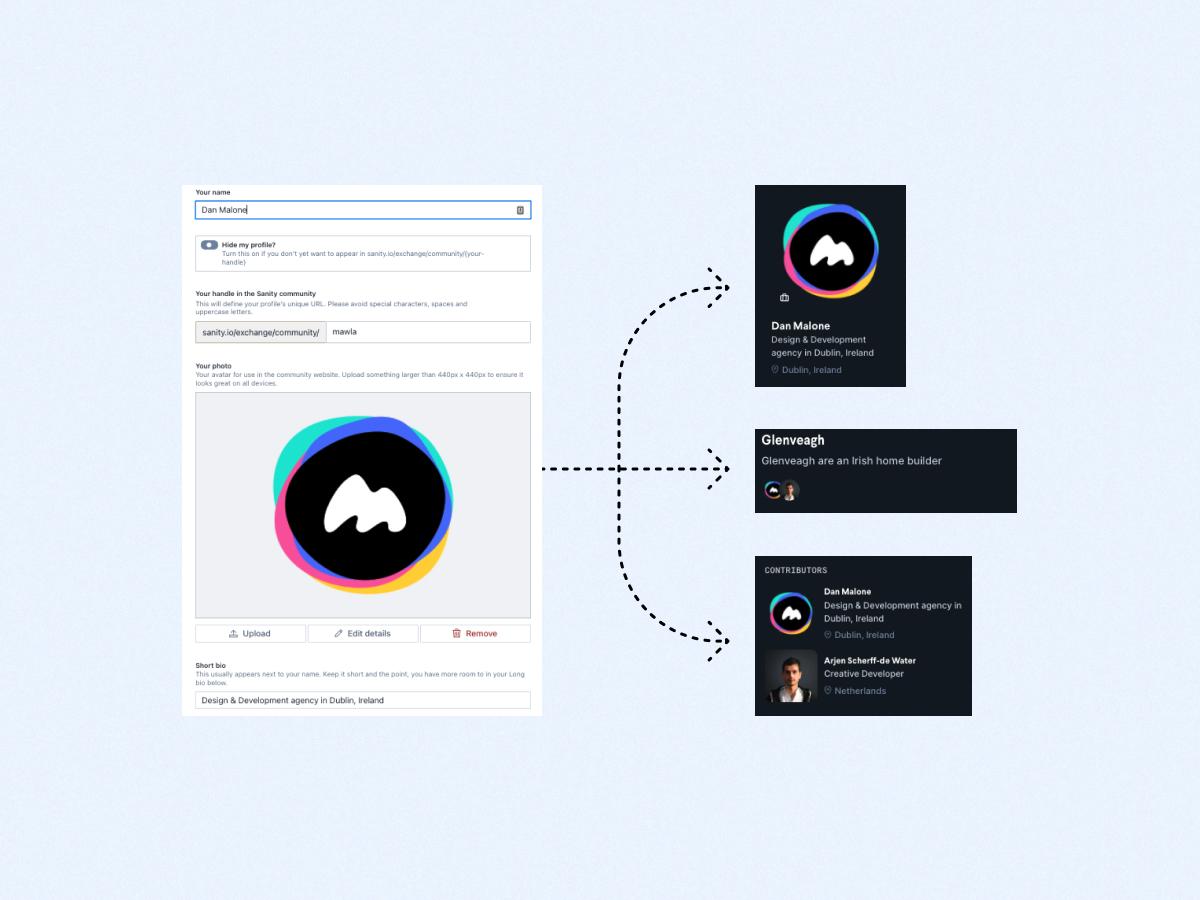
Visualization of a document in Sanity Studio and how the content shows up in three different places with different styles on the website.
In this example, only specific data elements are pulled from the Sanity Document on the left into various styles and displays on the front end.

Because the design system has precise guidelines, the content editor bears no responsibility for getting design elements or code wrong. Heading 2 on one site can be bold, black, Helvetica, 20pt while being regular, pink, Open Sans, 18pt on another site where the content will show up. The only thing the content creator needs to specify is what element a section of content is--in this case, Heading 2.

Dropdown list that shows Normal, Heading 1, and Heading 2 as options, with Heading 2 selected.
The format dropdown allows you to specify the semantic element without any styling assumptions.

It is also important to be able to emphasize certain words (italics) or make them strong (bold). Maybe there is a need to show text has been deleted (strikethrough). Linking is the whole point of the web, so links need to be specified as well. Bulleted and ordered lists are essential to make web content readable. Editors can add those elements too. We debated about whether to keep the underline feature because text should only be underlined if it is a link, even if the ultimate destination is a printed document. Link formatting (which should include an underline) is determined by the visual design specifications and specified in the code. Think twice (or three times) before using the underline style!

Rich text editor ribbon showing format dropdown, bold, italics, code, underline, strikethrough, bulleted list, numbered list, and link.
The default Portable Text Editor ribbon includes only basic semantic elements.

And that’s about it. Missing from the default ribbon are text align and changing font size, weight, and color. No more worrying about not following content usability standards or brand guidelines!

We’re firm believers in WYSIWYM, what-you-see-is-what-you-mean. It may take a little getting used to, but everyone will thank you the next time you plan to do a redesign or expand your content to other places. While we made the out-of-the-box editor a tiny bit simpler, it’s still possible to customize it to add ways of marking up text with additional meaning and intent.

Easy editorial experiences for everyone

We know that people who use a content platform every day are communicators, marketers, or content managers whose expertise lies outside of web design and development. The Studio is for those people. They want to get in and out as quickly as possible. Structured content and a simple text editor help them do that.

The fields that delineate the pieces of the content make it easy to change just one thing at a time--and have it update everywhere. The simple text editor frees them from having to consider the design implications of the changes.

Modern content creation and management is an evolution and convergence of several time-honored professions. But that doesn’t mean it has to be difficult. We can build tools that support anyone who is tasked with creating and maintaining content. Sanity is one of those tools that gets out of the way and lets people publish content quickly so they can get on to fulfilling their mission.