


惯性聚合 高效追踪和阅读你感兴趣的博客、新闻、科技资讯
阅读原文 在惯性聚合中打开

推荐订阅源

T
Tor Project blog
博客园 - 聂微东
Microsoft Azure Blog
博客园 - 【当耐特】
G
Google Developers Blog
J
Java Code Geeks
The Cloudflare Blog
Attack and Defense Labs
宝玉的分享
宝玉的分享
Last Week in AI
Last Week in AI
Cisco Talos Blog
Cisco Talos Blog
酷 壳 – CoolShell
酷 壳 – CoolShell
I
Intezer
Jina AI
Jina AI
T
Tenable Blog
P
Palo Alto Networks Blog
Project Zero
Project Zero
D
DataBreaches.Net
Hugging Face - Blog
Hugging Face - Blog
The Hacker News
The Hacker News
F
Full Disclosure
Cloudbric
Cloudbric
量子位
H
Heimdal Security Blog
K
Kaspersky official blog
有赞技术团队
有赞技术团队
罗磊的独立博客
V
Vulnerabilities – Threatpost
cs.AI updates on arXiv.org
阮一峰的网络日志
阮一峰的网络日志
Vercel News
Vercel News
Recent Announcements
WordPress大学
WordPress大学
GbyAI
GbyAI
S
SegmentFault 最新的问题
M
MIT News - Artificial intelligence
OSCHINA 社区最新新闻
OSCHINA 社区最新新闻
I
InfoQ
Recorded Future
Recorded Future
Security Archives - TechRepublic
AI
AI
Webroot Blog
Webroot Blog
C
CXSECURITY Database RSS Feed - CXSecurity.com
爱范儿
爱范儿
freeCodeCamp Programming Tutorials: Python, JavaScript, Git & More
T
The Exploit Database - CXSecurity.com
Apple Machine Learning Research
C
Cybersecurity and Infrastructure Security Agency CISA
H
Hacker News: Front Page
Latest news
Latest news

Sanity.io

A Board Game agent built using Sanity Context and Vercel's AI SDK | Sanity Build a prototype with Claude Code that your whole team can edit | Sanity What’s New - May 2026 | Sanity I built a London pub guide with v0 and the Sanity MCP in six hours. Here's what I learned. | Sanity Build a conference concierge with Agent Context and Anthropic | Sanity Build a content-aware Telegram agent with Vercel AI SDK and Chat SDK | Sanity How I used Agent API to generate photos for my family’s recipes | Sanity What’s New April - 2026 | Sanity Better context, better matches: An AI love story (for dogs) | Sanity How to write for an agent | Sanity Content Agent, meet Slack: AI content operations in your workflow | Sanity Structure powers intelligence | Sanity Your agent needs better content. Here's how to give it. | Sanity How to serve content to agents (a field guide) | Sanity Sanity TypeGen GA: Automatic TypeScript types for content and GROQ | Sanity Sanity is now available on the Vercel Marketplace | Sanity The logo soup problem (and how to solve it) | Sanity Content Releases: From scattered updates to coordinated publishing | Sanity What's New - February 2026 | Sanity How we solved the agent memory problem | Sanity v0 Builder Challenge: The winners | Sanity Introducing: Sanity Agent Skills | Sanity Content Agent: Days of work in one conversation | Sanity Our Sanity Values | Sanity Open Source Pledge 2025: Stepping up when it matters | Sanity v0 builder challenge: $3000 in prizes | Sanity Why AI Breaks Without Structured Content Operations | Sanity What’s New January - 2026 | Sanity BFCM 2025: What teams built when infrastructure stopped being the problem | Sanity How AI shaped holiday shopping and what it means for content in 2026 | Sanity Sanity Studio v5: Embracing React 19 | Sanity You’ll need a CMS eventually. Let your agent set it up. | Sanity “You should never build a CMS” | Sanity AI Content Operations: A 30-Day Implementation Guide | Sanity What’s New December - 2025 | Sanity Scheduled Drafts: Stop manually publishing content at midnight | Sanity What’s New November - 2025 | Sanity Everything *[NYC] 2025 recap: A day of AI, Content Operations, and Culture | Sanity Clankers and content operations | Sanity Content Agent: AI that understands your structured content is here | Sanity Why design-driven content modeling creates technical debt, not velocity | Sanity What's New October - 2025 | Sanity From studio to inbox: How Kevin Green eliminated email campaign friction | Sanity The content editor's guide to content operations [E-commerce edition] | Sanity styled-components maintenance mode: A 40% faster fork | Sanity From zero code to a live website in 7 hours (thanks, Cursor!) | Sanity First attempt will be 95% garbage: A staff engineer's 6-week journey with Claude Code | Sanity Internationalization is more than translating words | Sanity What's New - September 2025 | Sanity We just deleted our 35k-member community Slack | Sanity What's New - August 2025 | Sanity The engineer's guide to content operations [E-commerce edition] | Sanity SEO for AI: Evolving from Web Pages to the Content Lake | Sanity What's New - July 2025 | Sanity Sanity Studio v4: A major version bump for a minor reason | Sanity What's New - June 2025 | Sanity Dashboard and Insights: Your New Content HQ | Sanity Canvas: AI-accelerated, context-aware, freeform authoring | Sanity Agent Actions: AI building blocks for structured content | Sanity Functions: Life beyond pressing publish | Sanity A new era for content applications with Sanity App SDK | Sanity The end of CMS era and our $85M Series C. | Sanity What's New – May 2025 | Sanity Introducing the Sanity Model Context Protocol (MCP) server | Sanity What's New – April 2025 | Sanity Pushing all the envelopes with ambitious content | Sanity Self-hosting is only free if your time is worth nothing | Sanity Content that lasts: Scaling beyond your frontend | Sanity The Live Content API is now Generally Available | Sanity The future beyond AI chat bots | Sanity Learning the new skill of working with AI | Sanity What's New - March 2025 | Sanity Give it in plain text: Making your content AI-Ready | Sanity No More 'DO NOT PUBLISH': Introducing Content Releases | Sanity React in 2025, what's next? | Sanity The final boss of front-end: block editors | Sanity Introducing Sanity for Startups | Sanity A block content editor that loves you back | Sanity A Black Friday Snooze Fest: Massive Traffic, No Drama | Sanity The Sanity Winter Release 2024 | Sanity AVIF Arrives, Sanity’s Promise Fulfilled | Sanity Sanity joins the Open Source Pledge | Sanity Your content is now Live by default | Sanity Begin Team to Join Sanity | Sanity Sanity Digest - September '24 Edition | Sanity Sanity partners with Google. Now live on the Google Cloud Marketplace. | Sanity Sanity Digest - August ‘24 Edition | Sanity Now playing: the latest Mux Video Input plugin for Sanity | Sanity Community Digest - June ‘24 Edition | Sanity Community Digest - May ‘24 Edition | Sanity Guide to Sanity's newest product announcements | Sanity AI and Content Creation: A Leader's Guide | Sanity Of course, you should be able to type your content quickly! | Sanity New to AI Assist: translation, reference suggestions, image generation | Sanity Speak the language of your editors: Sanity Studio UI localization | Sanity Introducing the new Sanity Growth plan to serve collaborative teams | Sanity Presentation: Work faster than ever with structured content | Sanity Goodbye Feedback Frenzy, Hello Sanity Studio Comments! | Sanity Easing into the App Router with the Sanity Toolkit for Next.js | Sanity Making website updates easier with structured content | Sanity
How to make a recipe site that scales well | Sanity
Dag Stuan · 2024-12-03 · via Sanity.io

Recently, Dag Stuan, engineer at Bekk, shared a cool recipe project in the community with nifty use of Portable Text. We asked him to write about his process to make "Bak & del". The name Bak&del is a playful Norwegian pun that combines "bake" (to bake) and "del" (to share), perfectly capturing the spirit of a baking community. As a cheeky bonus, the word bakdel also means “butt” in Norwegian slang—because who says baking can’t have a little spice?

One of the best things about programming is that you can solve everyday problems all by yourself. With my latest hobby project, I’m doing just that. Meet bakdel.no (or go here for English version via Google Translate)!
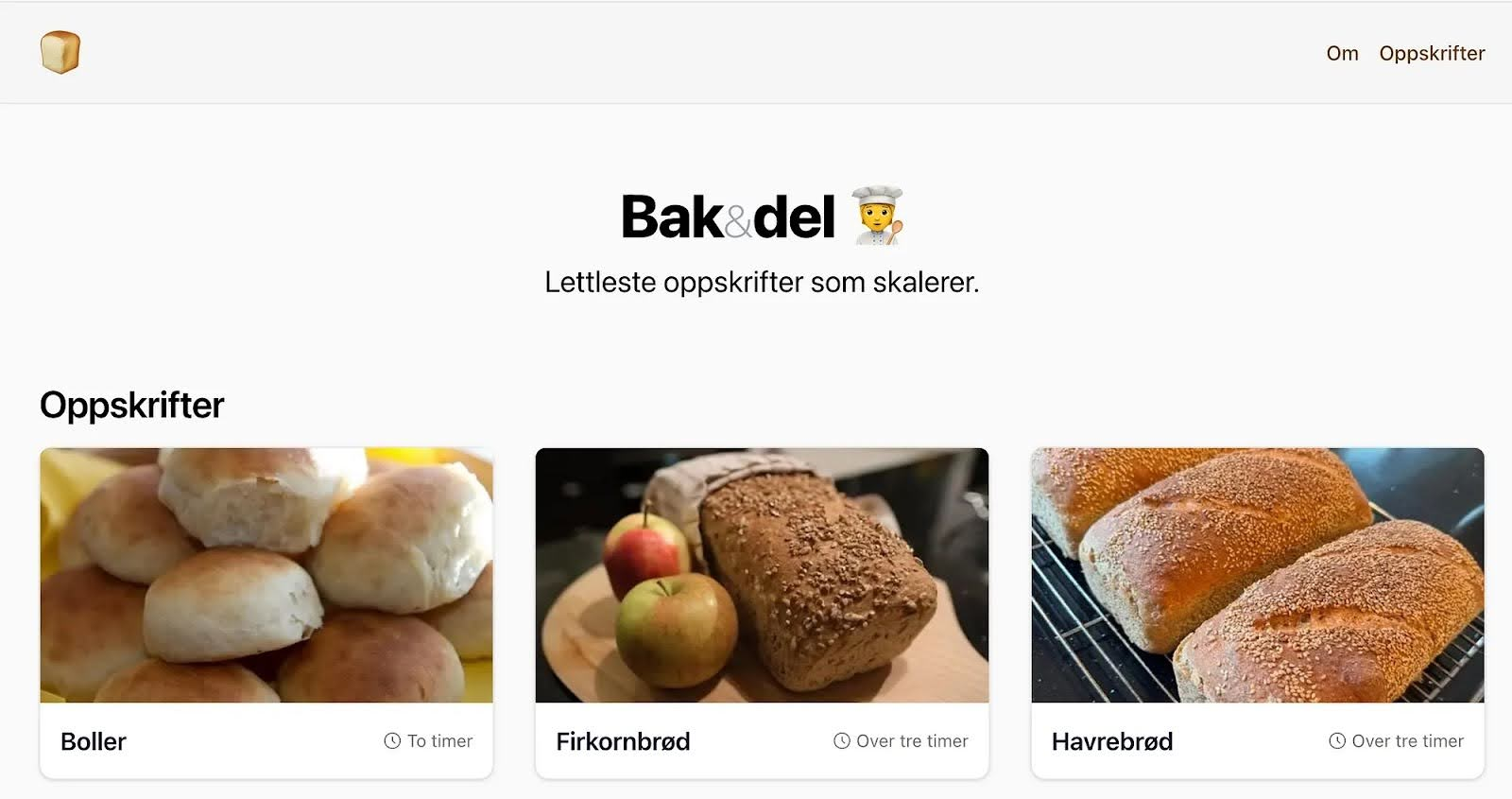
Bak&del website interface showing recipe options: ‘Boller,’ ‘Firkornbrød,’ and ‘Havrebrød,’ each with an estimated preparation time. The tagline reads, ‘Lettleste oppskrifter som skalerer.’

The problem

In recent years, I’ve started baking bread and other yeast-based goods at home. I have a few recipes I’ve used for a long time, and I also look up recipes online when I want to bake a different type of bread or other baked goods

There are countless recipe sources online, so I rarely find recipes in the same place. Many of the sites are “okay” to use, but I often feel there’s more focus on the person publishing the recipe, than on me, the one actually baking. The recipes are filled with the life stories of the bloggers who write them, and packed with ads or affiliate links to things I can buy. Some sites even use a “bait-and-switch” tactic, placing recipes behind a paywall after a while.

Although the actual recipes often are good, I also find them challenging to use. When I’m on my phone, I have to constantly scroll between the ingredient list and the recipe text, and the instructions are often packed with information I don’t need.

But the biggest issue, and the main reason I created Bakdel, is scaling. When I bake bread, I want to make three loaves at a time because that’s what fits in my oven. The recipes I find are often for one or two loaves, so I have to scale them myself. So when I found myself with an Excel spreadsheet just for baking, I thought to myself “there must be a better way…”.

Table displaying ingredients and their quantities for breadmaking, with columns for ingredient names, original amounts, percentages, and scaled quantities for three loaves.
Spreadsheet to scale recipe ingredients.

How could it be better?

What I wanted, was a place where I could:

  • Store recipes I like in an easy-to-read, well-organized format. Without ads or unnecessary information.
  • Avoid scrolling back and forth between the ingredient list and the recipe instructions while baking.
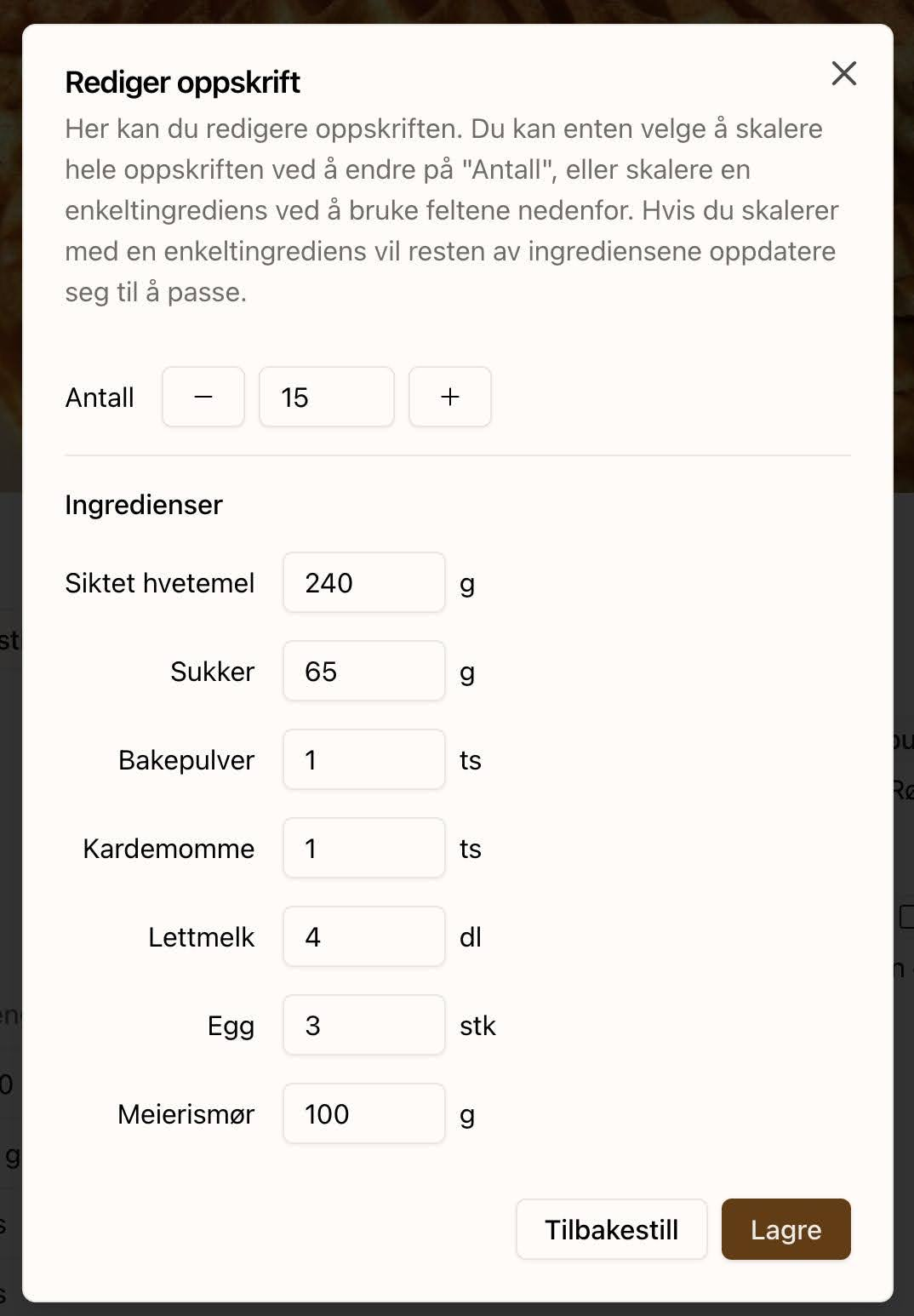
  • Scale recipes so I can bake three loaves instead of two, or make waffles even if I only have two eggs left in the fridge on a Sunday.

The idea

At Bekk Trondheim, we’ve had a few workshop evenings this fall where we learned to use Sanity and completed the Sanity Developer Certification. Sanity is a content operating system that allows me to define content in the form of “documents” or “objects.” Unlike a traditional CMS, content in Sanity isn’t tied to a presentation layer; it’s more akin to a traditional SQL database or other low-level content abstractions.

What sets Sanity apart from other headless CMS solutions is the ability to customize the editor experience. When setting up a project, you’re responsible for configuring Sanity Studio, the user interface for editing content. The studio is very customizable, which makes it relatively easy to tailor an editor experience to the content being created.

When I got familiar with how to set up Sanity, I had an idea; what if I could model recipes and ingredients as content in Sanity, and create references to ingredients within a recipe’s instructions? That way, I could create a content model that made it easy to add recipes and link to the ingredients within the recipe text.

Interface snippet showing an ‘Ingredient Reference’ label with options to edit or delete, highlighting ‘Pizzamel (100%)’ as a selected ingredient.
Caption: Ingredient-reference inside portable text in Sanity.

With a bit more logic, I could scale the ingredients dynamically so that adjusted quantities could appear directly in the text. When I showed a small demo to some colleagues, I got the suggestion to add a feature for checking off ingredients as you go, which was also fairly quick to implement. With that, the core product was in place, and most of the time since has been spent on refinement.
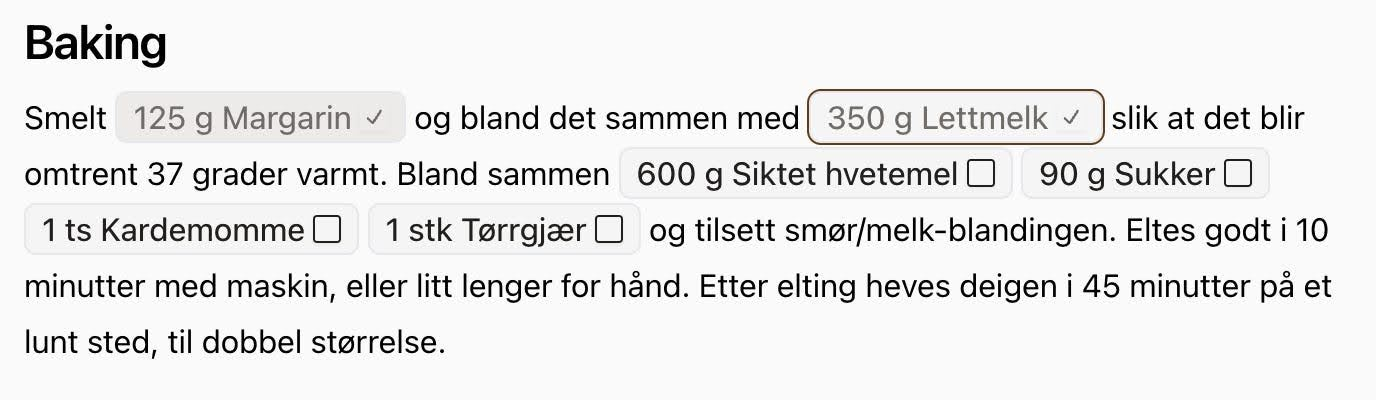
Baking instructions showing interactive ingredient references, including margarine, milk, flour, sugar, cardamom, and yeast, with scalable quantities and input fields for customization.
Recipe with scaled ingredients inside the text.
Recipe editing modal with adjustable quantity and editable ingredient fields, including weight and measurement units, and options to reset or save changes.
Caption: User interface for scaling ingredients

Below is a excerpt of the schema code that defines the Portable Text field for Instructions (find all of the code on GitHub):

Other technology choices

When I code in my spare time, I try to balance using technology I know well, with trying something new. This way, I stay productive with familiar tools while also picking up some new knowledge along the way. Familiar technology and productivity also help me stay motivated to finish a usable product.

Bakdel is built as a Next.js app that includes both the website and the Sanity studio. For styling and UI components, I used Tailwind and Shadcn to speed up the setup. I also hadn’t worked with these before, so it was a great chance to explore a bit of new tech. I also got a bit of a boost from Vercel’s v0 platform to get up and running quickly.

The app is hosted on Vercel, with DNS and proxy managed by Cloudflare. Together, these tech choices helped me get to production in a very short time, and the first version of the app was live after just a week of work.

Next Steps 🛣️

A little over a month later, I have a product I’m quite satisfied with and that I use several times a week when I bake. It’s easy to add new recipes using Sanity Studio, the ingredients are embedded within the instructions, even when the recipe is scaled, and users can scale recipes based on individual ingredients. Plus, there’s minimal unnecessary information, and no ads. 🎉

While I have no plans to compete with larger recipe sites, it’s nice to have at least one place to go when I want to bake, where I can easily store the recipes I like. And if others can benefit from the site as well, that’s an added bonus.

I plan to incorporate even more scaling logic in the future, and recently I have also added the ability to change measurement units in recipes, allowing users to switch from deciliters to grams in the recipes themselves.

If you have a recipe suggestion that’s missing, or if you have any other questions, feel free to reach out with your feedback!

You can find the app at bakdel.no, and the source code is available on GitHub.