







First Monday of the month means 3-2-1 time—here's what happened last month.
If you're using AI coding tools with Sanity, you've probably noticed they're great at writing code that works. But Sanity's flexibility means there are multiple ways to do things—and agents don't always pick the approach that scales. We wanted to do something about that.
Last month, our MCP server became generally available. If you've been using it, you know it exposes a set of agent rules through the list_sanity_rules and get_sanity_rules tools.
Agent Skills take this further: we've packaged what our engineers, architects, and support team know into portable best practices that live in your codebase. The Sanity package alone has 25+ rules, with additional packages covering content modeling, SEO/AEO, and content experimentation.
Read the announcement for more details or head straight to the repo.
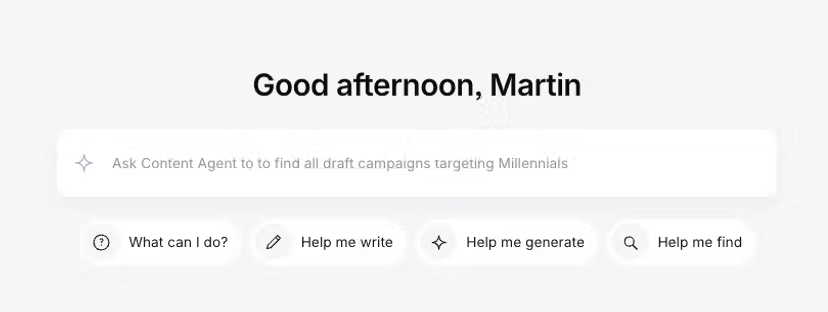
Writing assistants have been around for a while, but Content Agent (now available to everyone!) is something different. It's contextually aware—able to read your Sanity schema (field types, descriptions, references)—and lets content teams query and update through conversation.
Over 40 organizations used it during early access:
All with full control—Content Agent stages changes for review, never making edits without approval.
As with any agent, prompting matters. Our docs team wrote a guide to help you get the most from your AI credits—covering how to find content efficiently, review changes before they're applied, and optimise how you bulk operate.
Previously, when a function didn't run, the why wasn't always clear. Rate limited? Recursion blocked? Project over quota?
Thanks to the runtime team, we've now got automatic system logging that outputs events directly to your log stream, color-coded by severity.
Run npx -y sanity@latest functions logs --watch to track: rate limiting, quota exceeded, max recursions, invocation failures, and successes.
"A core concept is that you can make some pretty cool stuff happen just by being clever about modelling and treating content as data."
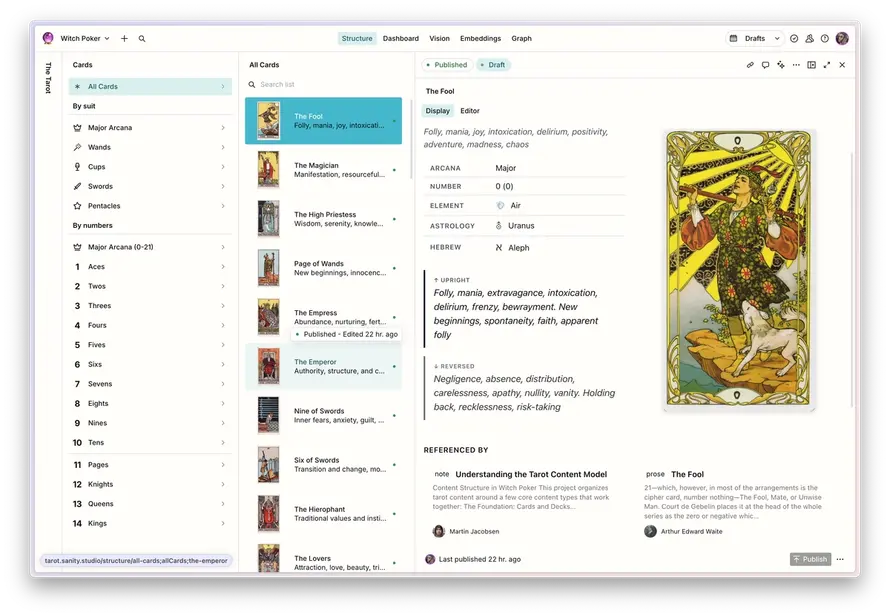
Martin works on our docs team, which means in his words "side projects double as research." When he started collecting tarot decks, he built a Sanity Studio to catalog them. Then he wondered: what if treating cards as structured data could power an actual app?
Read about building Tarotoro—from structuring 78 archetypes to picking the right technology for the job.
"There's just no correlation between making Tailwind easier to use and making development of the framework more sustainable. If I can't fix that this project is going to become unmaintained abandonware when there is no one left employed to work on it."
Despite 75 million downloads per month, Tailwind Labs had to lay off 75% of their team. AI tools now generate Tailwind directly—leading to a 40% drop in traffic to their docs site and people not discovering their commercial products.
AI is changing how we work, but we're committed to continuing our Open Source Pledge this year. So when we heard the news about Tailwind, we doubled our sponsorship.
Read more about our pledge and the projects we support.

Corey Ward saw his bandwidth usage spike, and in his words: "did what a dev does in the age of AI"—built a tiny 1.4mb Rust app that ingests an entire ndjson log file and displays a breakdown of your bandwidth usage.
The Sanity Log Explorer lets you view by asset ID or switch to show by type (GROQ queries, images, or files)—making it easy to spot overage issues and fix them.
Built mostly with OpenAI Codex CLI using Ratatui (a Rust terminal UI library he'd never used before), it's a great example of using AI tools to solve immediate problems without getting bogged down in unfamiliar tech.
That’s it for this month - see you in Discord 👋
此内容由惯性聚合(RSS阅读器)自动聚合整理,仅供阅读参考。 原文来自 — 版权归原作者所有。