


惯性聚合 高效追踪和阅读你感兴趣的博客、新闻、科技资讯
阅读原文 在惯性聚合中打开

推荐订阅源

I
InfoQ
Hugging Face - Blog
Hugging Face - Blog
月光博客
月光博客
量子位
freeCodeCamp Programming Tutorials: Python, JavaScript, Git & More
S
SegmentFault 最新的问题
罗磊的独立博客
Exploit-DB.com RSS Feed
L
LINUX DO - 最新话题
T
Threatpost
Cisco Talos Blog
Cisco Talos Blog
The GitHub Blog
The GitHub Blog
V
V2EX
SecWiki News
SecWiki News
P
Privacy & Cybersecurity Law Blog
Forbes - Security
Forbes - Security
T
Troy Hunt's Blog
S
Security @ Cisco Blogs
Martin Fowler
Martin Fowler
Attack and Defense Labs
A
Arctic Wolf
C
CXSECURITY Database RSS Feed - CXSecurity.com
The Register - Security
Blog — PlanetScale
Blog — PlanetScale
The Last Watchdog
The Last Watchdog
T
Tor Project blog
cs.CL updates on arXiv.org
C
Cisco Blogs
P
Proofpoint News Feed
O
OpenAI News
Hacker News - Newest:
Hacker News - Newest: "LLM"
小众软件
小众软件
雷峰网
雷峰网
H
Heimdal Security Blog
酷 壳 – CoolShell
酷 壳 – CoolShell
Stack Overflow Blog
Stack Overflow Blog
Engineering at Meta
Engineering at Meta
云风的 BLOG
云风的 BLOG
Last Week in AI
Last Week in AI
C
Cyber Attacks, Cyber Crime and Cyber Security
Webroot Blog
Webroot Blog
C
Check Point Blog
Threat Intelligence Blog | Flashpoint
W
WeLiveSecurity
T
Threat Research - Cisco Blogs
人人都是产品经理
人人都是产品经理
Hacker News: Ask HN
Hacker News: Ask HN
The Hacker News
The Hacker News
V
Vulnerabilities – Threatpost
Microsoft Security Blog

Sanity.io

A Board Game agent built using Sanity Context and Vercel's AI SDK | Sanity Build a prototype with Claude Code that your whole team can edit | Sanity What’s New - May 2026 | Sanity I built a London pub guide with v0 and the Sanity MCP in six hours. Here's what I learned. | Sanity Build a conference concierge with Agent Context and Anthropic | Sanity Build a content-aware Telegram agent with Vercel AI SDK and Chat SDK | Sanity How I used Agent API to generate photos for my family’s recipes | Sanity What’s New April - 2026 | Sanity Better context, better matches: An AI love story (for dogs) | Sanity How to write for an agent | Sanity Content Agent, meet Slack: AI content operations in your workflow | Sanity Structure powers intelligence | Sanity Your agent needs better content. Here's how to give it. | Sanity How to serve content to agents (a field guide) | Sanity Sanity TypeGen GA: Automatic TypeScript types for content and GROQ | Sanity Sanity is now available on the Vercel Marketplace | Sanity The logo soup problem (and how to solve it) | Sanity Content Releases: From scattered updates to coordinated publishing | Sanity What's New - February 2026 | Sanity How we solved the agent memory problem | Sanity v0 Builder Challenge: The winners | Sanity Introducing: Sanity Agent Skills | Sanity Content Agent: Days of work in one conversation | Sanity Our Sanity Values | Sanity Open Source Pledge 2025: Stepping up when it matters | Sanity v0 builder challenge: $3000 in prizes | Sanity Why AI Breaks Without Structured Content Operations | Sanity What’s New January - 2026 | Sanity BFCM 2025: What teams built when infrastructure stopped being the problem | Sanity How AI shaped holiday shopping and what it means for content in 2026 | Sanity Sanity Studio v5: Embracing React 19 | Sanity You’ll need a CMS eventually. Let your agent set it up. | Sanity “You should never build a CMS” | Sanity AI Content Operations: A 30-Day Implementation Guide | Sanity What’s New December - 2025 | Sanity Scheduled Drafts: Stop manually publishing content at midnight | Sanity What’s New November - 2025 | Sanity Everything *[NYC] 2025 recap: A day of AI, Content Operations, and Culture | Sanity Clankers and content operations | Sanity Content Agent: AI that understands your structured content is here | Sanity Why design-driven content modeling creates technical debt, not velocity | Sanity What's New October - 2025 | Sanity From studio to inbox: How Kevin Green eliminated email campaign friction | Sanity The content editor's guide to content operations [E-commerce edition] | Sanity styled-components maintenance mode: A 40% faster fork | Sanity From zero code to a live website in 7 hours (thanks, Cursor!) | Sanity First attempt will be 95% garbage: A staff engineer's 6-week journey with Claude Code | Sanity Internationalization is more than translating words | Sanity What's New - September 2025 | Sanity We just deleted our 35k-member community Slack | Sanity What's New - August 2025 | Sanity The engineer's guide to content operations [E-commerce edition] | Sanity SEO for AI: Evolving from Web Pages to the Content Lake | Sanity What's New - July 2025 | Sanity Sanity Studio v4: A major version bump for a minor reason | Sanity What's New - June 2025 | Sanity Dashboard and Insights: Your New Content HQ | Sanity Canvas: AI-accelerated, context-aware, freeform authoring | Sanity Agent Actions: AI building blocks for structured content | Sanity Functions: Life beyond pressing publish | Sanity A new era for content applications with Sanity App SDK | Sanity The end of CMS era and our $85M Series C. | Sanity What's New – May 2025 | Sanity Introducing the Sanity Model Context Protocol (MCP) server | Sanity What's New – April 2025 | Sanity Pushing all the envelopes with ambitious content | Sanity Self-hosting is only free if your time is worth nothing | Sanity Content that lasts: Scaling beyond your frontend | Sanity The Live Content API is now Generally Available | Sanity The future beyond AI chat bots | Sanity Learning the new skill of working with AI | Sanity What's New - March 2025 | Sanity Give it in plain text: Making your content AI-Ready | Sanity No More 'DO NOT PUBLISH': Introducing Content Releases | Sanity React in 2025, what's next? | Sanity The final boss of front-end: block editors | Sanity Introducing Sanity for Startups | Sanity A block content editor that loves you back | Sanity A Black Friday Snooze Fest: Massive Traffic, No Drama | Sanity How to make a recipe site that scales well | Sanity The Sanity Winter Release 2024 | Sanity AVIF Arrives, Sanity’s Promise Fulfilled | Sanity Sanity joins the Open Source Pledge | Sanity Your content is now Live by default | Sanity Begin Team to Join Sanity | Sanity Sanity Digest - September '24 Edition | Sanity Sanity partners with Google. Now live on the Google Cloud Marketplace. | Sanity Sanity Digest - August ‘24 Edition | Sanity Now playing: the latest Mux Video Input plugin for Sanity | Sanity Community Digest - June ‘24 Edition | Sanity Community Digest - May ‘24 Edition | Sanity Guide to Sanity's newest product announcements | Sanity AI and Content Creation: A Leader's Guide | Sanity Of course, you should be able to type your content quickly! | Sanity New to AI Assist: translation, reference suggestions, image generation | Sanity Speak the language of your editors: Sanity Studio UI localization | Sanity Introducing the new Sanity Growth plan to serve collaborative teams | Sanity Presentation: Work faster than ever with structured content | Sanity Goodbye Feedback Frenzy, Hello Sanity Studio Comments! | Sanity Easing into the App Router with the Sanity Toolkit for Next.js | Sanity
How we blog | Sanity
Knut Melvær · 2018-12-17 · via Sanity.io

People have been asking me lately where to blog, and how we reason about how we do it. So instead of copy-pasting my answer around in different Slack groups, I thought I would blog about it here. For there's nothing like blogging about blogging, is there?

What do we blog

I have regularly been blogging since I started working as a developer advocate at Sanity in August, nearly half a year ago. Broadly, our blog efforts fall into three categories:

1. Guest posts on high-quality publications

2. Blogging about product features, news, and new releases

3. Tutorials combining Sanity with technology more or less in vogue

In the first category, we have posts such as the one presenting Sanity’s image pipeline on CSS-Tricks, or our article about “Strategies For Headless Projects With Structured Content Management Systems” on Smashing Magazine. To more general posts for FreeCodeCamp, such as “How to conditionally build an object in JavaScript with ES6”. While such posts don't necessarily give you lots of traffic and conversion, they have been vital for us in establishing a voice of expertise. Moreover, it has to be said, a lot of work has gone into writing them.

Especially the article on strategies for projects involving structured content has been critical for formulating some ideas that have been swirling in our minds for quite a while. Writing for high profile publication like Smashing Magazine also forces you to do some diligence. It forces a different pace than your off the cuff post about familiar topics.

The second and the third category are pretty much given. There is a lot of surface to cover on Sanity, tons of functionality, and all those subtle, nifty things that are useful for all sorts of developers. Did you know that you can live-edit a cloud hosted document in your favourite editor as easily as sanity documents create --id myDocId --watch --replace? No? Well now you do!

There's just so much you can do on landing pages, and you can't really expect people to do a close reading of your documentation. So we blog about tricks you can make the CLI do, what you can do with GROQ, or the awesome video plugin we made for Mux. We also want to tell people that Sanity is really well suited for popular front-end frameworks and give some clues on how to get started. Our tutorial on how to make a blog with Next.js is unsurprisingly one of the most popular posts on our blog.

How do we blog

Of course, our blogging happens in our instance of Sanity. I must admit that I often do some initial drafting in a markdown editor, mainly out of old habit. Doing the writing in Sanity’s editor is excellent "dogfooding" though. We often run pre-release versions of the editor so wrinting becomes a part of the QA process. Once the text is ready, we hit publish, and it's on our site, and present in both our RSS and JSON feeds.

An essential part of the process is the review. It's not just code that goes through peer-review. At Sanity HQ we have made a Slack channel called #marketing-review, where I post a preview link to the post after I've done the primary spell-check. I always get some useful feedback and corrections.

As Sanity uses Portable Text, we made a tiny script that exports the blog posts to Markdown, ready to be syndicated in markdown based blog platforms. Which takes us to the next section.

Where do we blog

A couple of years ago, Medium gained lots of traction, mainly because of its clean editor and polished design. Now though the honeymoon is over, and people realize that they miss a lot of recogniztion from search engines by putting their content elsewhere. In other words, it's terrible for Search Engine Optimization aka SEO. Tempting as those claps 👏 on Medium might be, in the long run hosting your content under your own domain seems to be the best strategy. Provided that you also please the Google algorithm by having a fast, user-friendly site.

That's why we always make sure to publish our blog posts on sanity.io first. Once we have done that we typically syndicate those blog posts to the wonderful dev.to site, and to Medium where we submit it to the HackerNoon publication (which interestingly also moving off of Medium soon). It's important to make sure that these places set a canonical url tag, telling Google and other search engines that the duplicated content has a home elsewhere and is legit.

The canonical URL interface on dev.to

On dev.to it's relatively easy (bless their hearts!). It also lets you automatically import content via RSS, which is nice, but I prefer using our markdown export script. On Medium you have to find the super subtle “Import a story” button.
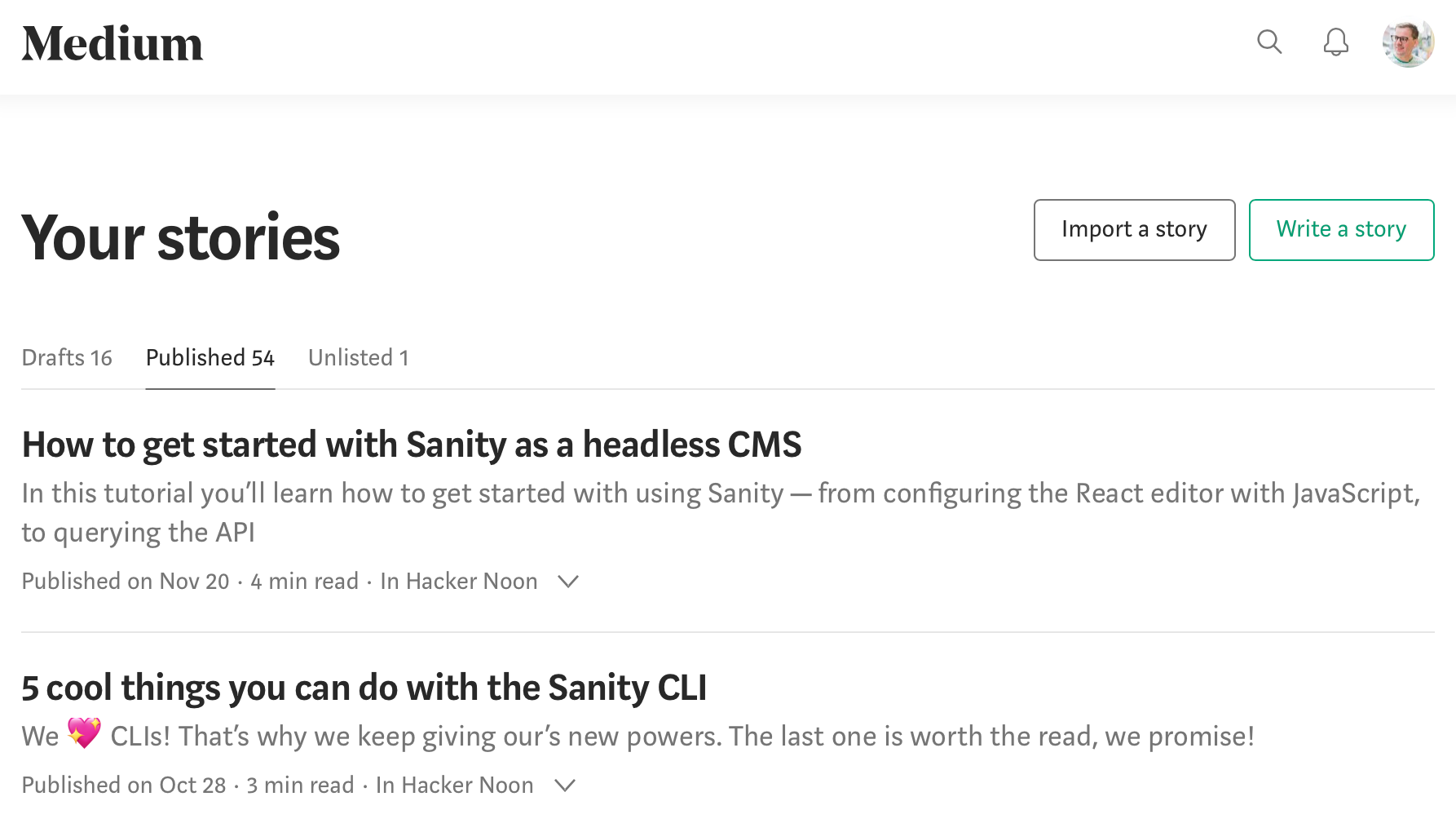
The import story button on Medium

You give it your URL, and it fetches your content and sets the original URL as canonical. Note that you can't change this later, so you'll have to be sure that you got it right. I tend to have a lot of code snippets, which in Medium tend to get totally borked, so I often have to go through the text and fix those manually.

Once I have published, I'll compose a text for social media often with some illustration or animated GIF if there's some functionality we want to visualize. This message is also peer-reviewed before it goes out on Twitter, Facebook, and LinkedIn. I usually don't repeat these messages, which I am reconsidering. Especially on Twitter you're easy to miss in the stream.

Why do we blog

Blogging is ubiquitous, and pretty much everyone attempting to get the word out does it. That also unfortunately means that there's a lot of noise. So we are dependent on social media, link list sites, and organic search to be heard. There's a high bar for your words to really make difference. This blog post seems to support that notion. When figuring out the economics of * cough *, content production, you find yourself wondering about quality vs. quantity or insight vs. listicle if you will. When running the numbers on this it would be tempting to hire out and go for volume.

But in promoting Sanity, we're not just trying to sell a product. We're also trying to talk about how we fit into a changing landscape of software literacies and digital production. The way we see it, we make it a lot easier for developers to use content as a pure digital resource, to deploy relational data structures and customize editing experiences. We fit into optimal workflows for interdisciplinary teams where a clean separation of concerns lets you bootstrap projects in parallell. Even though our technology is persuasive in itself, changing how people reason about their craft and how they go about it doesn't happen overnight.

So blogging is not “just marketing” for us; it is also a great way to think about your product, and the problems we're trying to solve. It is in itself rewardning to put into writing all the delightful and useful things we experience Sanity can do for you. It's like Merlin Mann & John Gruber pointed out almost ten years ago (their talk is worth the listen by the way): great blogging is recognized by your obsession on a topic combined by your ability to develop a voice. We've nailed the former, and we dare to hope that we sometimes achieve the latter. So should you.