


惯性聚合 高效追踪和阅读你感兴趣的博客、新闻、科技资讯
阅读原文 在惯性聚合中打开

推荐订阅源

V2EX - 技术
V2EX - 技术
Threat Intelligence Blog | Flashpoint
T
Threat Research - Cisco Blogs
T
The Exploit Database - CXSecurity.com
S
Schneier on Security
S
Securelist
P
Privacy & Cybersecurity Law Blog
Scott Helme
Scott Helme
T
Threatpost
C
Cybersecurity and Infrastructure Security Agency CISA
L
LINUX DO - 热门话题
Cyberwarzone
Cyberwarzone
Cisco Talos Blog
Cisco Talos Blog
量子位
博客园 - Franky
cs.CL updates on arXiv.org
Latest news
Latest news
T
Troy Hunt's Blog
N
News | PayPal Newsroom
Google Online Security Blog
Apple Machine Learning Research
N
Netflix TechBlog - Medium
小众软件
小众软件
P
Palo Alto Networks Blog
Spread Privacy
Spread Privacy
C
Cyber Attacks, Cyber Crime and Cyber Security
C
Check Point Blog
aimingoo的专栏
aimingoo的专栏
WordPress大学
WordPress大学
L
Lohrmann on Cybersecurity
L
LINUX DO - 最新话题
D
Darknet – Hacking Tools, Hacker News & Cyber Security
钛媒体:引领未来商业与生活新知
钛媒体:引领未来商业与生活新知
The Last Watchdog
The Last Watchdog
S
Security @ Cisco Blogs
P
Privacy International News Feed
Last Week in AI
Last Week in AI
Microsoft Security Blog
T
Tailwind CSS Blog
博客园_首页
云风的 BLOG
云风的 BLOG
V
Vulnerabilities – Threatpost
D
DataBreaches.Net
Recent Announcements
酷 壳 – CoolShell
酷 壳 – CoolShell
CTFtime.org: upcoming CTF events
罗磊的独立博客
Engineering at Meta
Engineering at Meta
Forbes - Security
Forbes - Security
T
Tenable Blog

Sanity.io

A Board Game agent built using Sanity Context and Vercel's AI SDK | Sanity Build a prototype with Claude Code that your whole team can edit | Sanity What’s New - May 2026 | Sanity I built a London pub guide with v0 and the Sanity MCP in six hours. Here's what I learned. | Sanity Build a conference concierge with Agent Context and Anthropic | Sanity Build a content-aware Telegram agent with Vercel AI SDK and Chat SDK | Sanity How I used Agent API to generate photos for my family’s recipes | Sanity What’s New April - 2026 | Sanity Better context, better matches: An AI love story (for dogs) | Sanity How to write for an agent | Sanity Content Agent, meet Slack: AI content operations in your workflow | Sanity Structure powers intelligence | Sanity Your agent needs better content. Here's how to give it. | Sanity How to serve content to agents (a field guide) | Sanity Sanity TypeGen GA: Automatic TypeScript types for content and GROQ | Sanity Sanity is now available on the Vercel Marketplace | Sanity The logo soup problem (and how to solve it) | Sanity Content Releases: From scattered updates to coordinated publishing | Sanity What's New - February 2026 | Sanity How we solved the agent memory problem | Sanity v0 Builder Challenge: The winners | Sanity Introducing: Sanity Agent Skills | Sanity Content Agent: Days of work in one conversation | Sanity Our Sanity Values | Sanity Open Source Pledge 2025: Stepping up when it matters | Sanity v0 builder challenge: $3000 in prizes | Sanity Why AI Breaks Without Structured Content Operations | Sanity What’s New January - 2026 | Sanity BFCM 2025: What teams built when infrastructure stopped being the problem | Sanity How AI shaped holiday shopping and what it means for content in 2026 | Sanity Sanity Studio v5: Embracing React 19 | Sanity You’ll need a CMS eventually. Let your agent set it up. | Sanity “You should never build a CMS” | Sanity AI Content Operations: A 30-Day Implementation Guide | Sanity What’s New December - 2025 | Sanity Scheduled Drafts: Stop manually publishing content at midnight | Sanity What’s New November - 2025 | Sanity Everything *[NYC] 2025 recap: A day of AI, Content Operations, and Culture | Sanity Clankers and content operations | Sanity Content Agent: AI that understands your structured content is here | Sanity Why design-driven content modeling creates technical debt, not velocity | Sanity What's New October - 2025 | Sanity From studio to inbox: How Kevin Green eliminated email campaign friction | Sanity The content editor's guide to content operations [E-commerce edition] | Sanity styled-components maintenance mode: A 40% faster fork | Sanity From zero code to a live website in 7 hours (thanks, Cursor!) | Sanity First attempt will be 95% garbage: A staff engineer's 6-week journey with Claude Code | Sanity Internationalization is more than translating words | Sanity What's New - September 2025 | Sanity We just deleted our 35k-member community Slack | Sanity What's New - August 2025 | Sanity The engineer's guide to content operations [E-commerce edition] | Sanity SEO for AI: Evolving from Web Pages to the Content Lake | Sanity What's New - July 2025 | Sanity Sanity Studio v4: A major version bump for a minor reason | Sanity What's New - June 2025 | Sanity Dashboard and Insights: Your New Content HQ | Sanity Canvas: AI-accelerated, context-aware, freeform authoring | Sanity Agent Actions: AI building blocks for structured content | Sanity Functions: Life beyond pressing publish | Sanity A new era for content applications with Sanity App SDK | Sanity The end of CMS era and our $85M Series C. | Sanity What's New – May 2025 | Sanity Introducing the Sanity Model Context Protocol (MCP) server | Sanity What's New – April 2025 | Sanity Pushing all the envelopes with ambitious content | Sanity Self-hosting is only free if your time is worth nothing | Sanity Content that lasts: Scaling beyond your frontend | Sanity The Live Content API is now Generally Available | Sanity The future beyond AI chat bots | Sanity Learning the new skill of working with AI | Sanity What's New - March 2025 | Sanity Give it in plain text: Making your content AI-Ready | Sanity No More 'DO NOT PUBLISH': Introducing Content Releases | Sanity React in 2025, what's next? | Sanity The final boss of front-end: block editors | Sanity Introducing Sanity for Startups | Sanity A block content editor that loves you back | Sanity A Black Friday Snooze Fest: Massive Traffic, No Drama | Sanity How to make a recipe site that scales well | Sanity The Sanity Winter Release 2024 | Sanity AVIF Arrives, Sanity’s Promise Fulfilled | Sanity Sanity joins the Open Source Pledge | Sanity Your content is now Live by default | Sanity Begin Team to Join Sanity | Sanity Sanity Digest - September '24 Edition | Sanity Sanity partners with Google. Now live on the Google Cloud Marketplace. | Sanity Sanity Digest - August ‘24 Edition | Sanity Now playing: the latest Mux Video Input plugin for Sanity | Sanity Community Digest - June ‘24 Edition | Sanity Community Digest - May ‘24 Edition | Sanity Guide to Sanity's newest product announcements | Sanity AI and Content Creation: A Leader's Guide | Sanity Of course, you should be able to type your content quickly! | Sanity New to AI Assist: translation, reference suggestions, image generation | Sanity Speak the language of your editors: Sanity Studio UI localization | Sanity Introducing the new Sanity Growth plan to serve collaborative teams | Sanity Presentation: Work faster than ever with structured content | Sanity Goodbye Feedback Frenzy, Hello Sanity Studio Comments! | Sanity Easing into the App Router with the Sanity Toolkit for Next.js | Sanity
What composable means (to us) | Sanity
Knut Melvær · 2023-08-17 · via Sanity.io

Recently, I came across this tweet (or is it “xeet”?), which initially piqued my interest because it reminded me that so much content work still happens in spreadsheets. That train of thought led me down a path where I started thinking about the true value of composability.

In the tweet, Akuya explained that he was trying to bring content from Google Sheets to the Sanity Content Lake. He found a way to do it with a bit of coding. Having the privilege of being more familiar with the platform, I also found a way to do it without having to write custom code—but by leveraging some shell scripting:

If you aren’t familiar with shell scripting, don't worry, what you see above is a way to connect and run small programs that can take in some information and output it. In the example, we’re seeing:

  1. the spreadsheet data as comma-separated-values (CSV), passing that data on to
  2. a small program that translates CSV into a JSON format, then on to
  3. another program that translates the array of JSON objects into newline delineated objects (NDJSON), and then passes that data on to
  4. the Sanity command line interface that imports the data into individual documents in the Content Lake

You might be thinking, “Wouldn’t it be easier if Sanity had a CSV importer?” —and I don’t disagree, it would be practical. But this example clearly shows that you aren’t dependent on whether or not Sanity has a particular feature in order to get your work done. Because we have the foundational APIs and abstractions, you can do stuff like this with little effort.

The shell environment (what you can access in Terminal.app if you are on a Mac or Command/Power Shell on a Windows) was designed as a composable platform. You can “pipe” information in and out between programs. The shell was a godsend for engineers and computer users, and decades after its conception, it’s still widely used. (For the curious, this episode of Command Line Heroes does a good job of telling the history of “the shell.”)

Not a headless CMS

You might have noticed that Sanity started calling ourselves the “Content Operating System” last year. We’ve never been comfortable with the term “headless CMS,” because we feel we offer something a bit different (and better). Maybe you see this as a marketing ploy, but trust me: the terminology is meaningful and precise. I’ll explain a bit more, and hopefully, you might feel inspired to try new things with our platform.

…but a platform

On the surface, Sanity might look like a CMS. Still, if you look closer, it’s actually a collection of standalone technologies that work well together: Sanity Studio, Content Lake, a range of useful APIs, and supporting libraries and tooling for working with structured content.

This setup is based on the same idea from my original example of the shell environment: with a composable platform, you can quickly and efficiently pass information anywhere you need to. While most headless CMSes (or DXPs) have focused on omnichannel content delivery, we put just as much (if not more!) focus on how you aggregate, store, and manage the content (and data) that gets distributed to any channel.
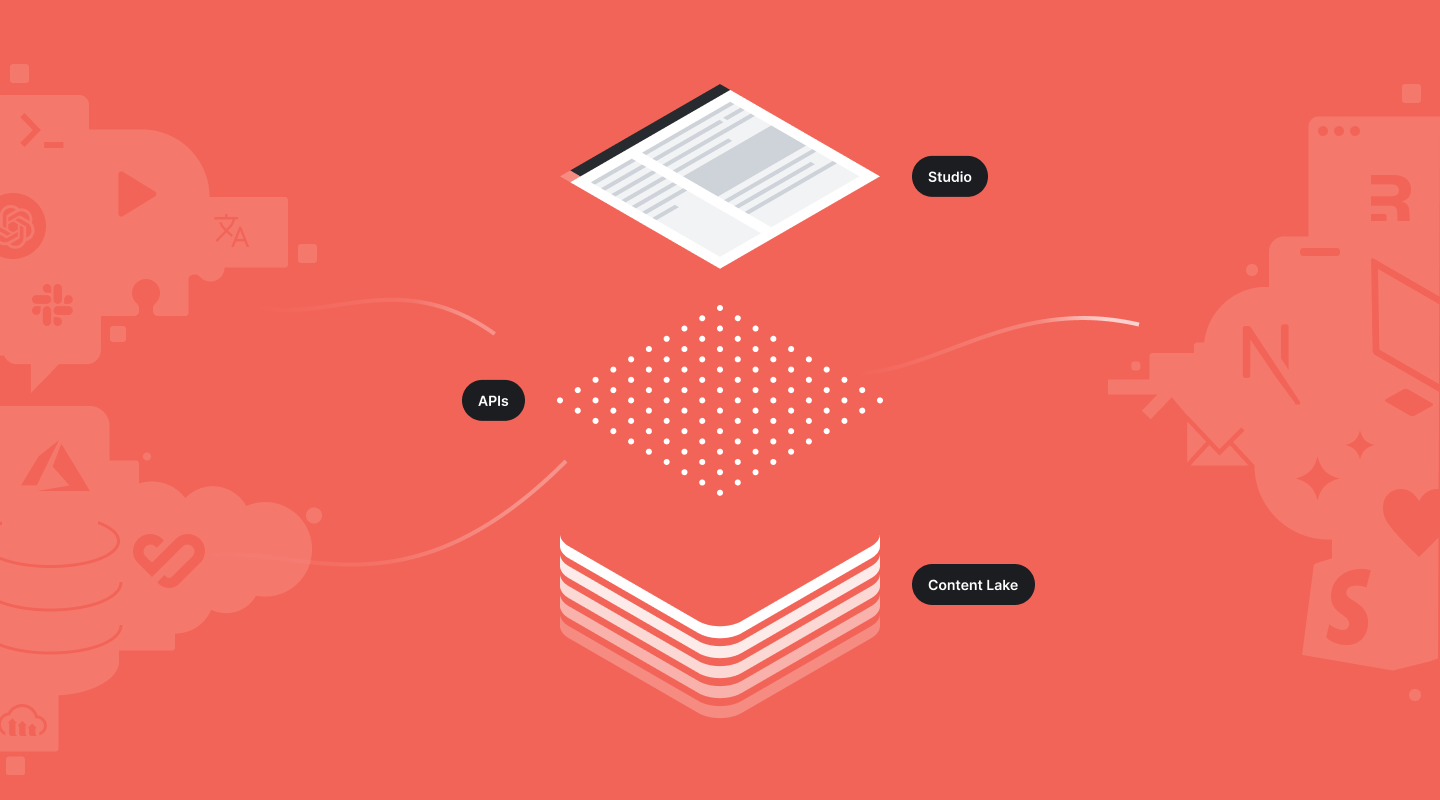
The three layers of Sanity Content Operating System showing Studio, APIs, and Content Lake
The three layers of Sanity Content Operating System

What “composable” means (for us)

What does it take to make a content solution truly composable? If you’re used to thinking about traditional CMSes, these factors might not be obvious:

  • Content Lake, the document store, is schema-less, meaning you can put any piece of structured content in and query it freely with GROQ. That makes it easy to get content the way you want it, where you need it. And it puts less pressure on nailing your content model at the get-go. Migrations are mainly about transforming the shape of documents, not database models.
  • You can freely get content out of Content Lake with GROQ (or GraphQL), but it also has a powerful API for programmatically updating content. We have yet to see a CMS-like system that lets you point to specific content within a nested structure and only change that piece (rather than overwriting the whole document and unintentionally losing someone else's work).
  • Sanity Studio is made to be customized from the ground up, and we designed Studio v3 so that you can compose its built-in functionality with your own components. This means you can give your team the gift of efficiency by creating a workspace that supports their unique content types and workflows.
  • Sanity Studio is also fully decoupled from Content Lake and built on the same APIs you can access. Not only can you change and customize your studio, but you are also free to have multiple studios (or none) that interact with the same collection of content.
  • From its conception, we built the platform for real-time collaboration; you can have humans and programmatic services interact with and update the content without dealing with document locking. This foundational feature is extremely hard to add to a platform later in a meaningful way. For example, our new feature Sanity AI Assist, lets you work in the document alongside it and even navigate away without disrupting its work.
  • Most rich text editors store content as HTML or as a JSON structure with many “HTMLisms.” This confines a huge chunk of your content to web surfaces—not reusable or composable. We made specifications like Portable Text to be presentation agnostic so you can take all of your content with you across the web and its different frameworks as well as into native apps, publishing tools, etc. It also makes it possible to query rich text and block content, create references, and update it programmatically.

The sweet spot

So, that’s what composability means to us. But what does it mean to our customers?

We recently talked to a famous design house and fashion brand in the Nordics, and they had an interesting perspective. They were looking to composable technologies because they occupied a sweet spot between an inflexible monolith that was overly opinionated and an unwieldy range of micro-services that bring high maintenance and development costs.

The composable mindset

When we’re talking about “composable” in the context of content management, I think it’s important to consider whether it’s possible to get the content out of the system and to what degree you are enabled and empowered to integrate and interact with the content inside it. It’s all about how the technology sits between and plays with other technologies.

It’s not enough to simply add “APIs” like many CMSes have done; there must also be enough flexibility in the system itself to accommodate your needs. For example, flexibility to model content in a way that’s more true to how your organization works and more resilient to different needs, channels, and website (re)designs.

Composable technologies like Sanity offered the company mentioned above flexibility and convenience. Thus, they could focus their resources on core business needs. In other words, they (mostly) let us worry about scaling the APIs to be performant during high-traffic times while not blocking them from doing things the way they wanted to.

Remember the shell scripting example from earlier? This mix of flexibility and convenience is similar. I could have written the code by hand, but it would have taken more time. Or I could’ve looked for a CMS that had a direct Google Sheets integration, but chances are it would do other things in a way I didn’t like.

Instead, I could quickly assemble some tools and get the desired result. That’s the magic of composability.