

惯性聚合 高效追踪和阅读你感兴趣的博客、新闻、科技资讯
阅读原文 在惯性聚合中打开

推荐订阅源

K
KPMG report finds enterprise disconnect between AI and its ROI | CIO
T
Troy Hunt's Blog
Schneier on Security
N
News | PayPal Newsroom
Hacker News: Ask HN
Hacker News: Ask HN
cs.CV updates on arXiv.org
Google DeepMind News
www.infosecurity-magazine.com
N
News and Events Feed by Topic
V
Vulnerabilities – Threatpost
Cyberwarzone
Cyberwarzone
K
Kaspersky official blog
P
Privacy & Cybersecurity Law Blog
P
Privacy International News Feed
WordPress大学
WordPress大学
U
Unit 42
PCI Perspectives
PCI Perspectives
S
Schneier on Security
让小产品的独立变现更简单 - ezindie.com
V
Visual Studio Blog
Engineering at Meta
Engineering at Meta
The Cloudflare Blog
I
Intezer
宝玉的分享
宝玉的分享
N
News and Events Feed by Topic
Martin Fowler
Martin Fowler
B
Blog
美团技术团队
T
The Blog of Author Tim Ferriss
C
Cisco Blogs
freeCodeCamp Programming Tutorials: Python, JavaScript, Git & More
酷 壳 – CoolShell
酷 壳 – CoolShell
The Last Watchdog
The Last Watchdog
J
Java Code Geeks
博客园_首页
A
About on SuperTechFans
Vercel News
Vercel News
Attack and Defense Labs
H
Heimdal Security Blog
OSCHINA 社区最新新闻
OSCHINA 社区最新新闻
IT之家
IT之家
小众软件
小众软件
H
Help Net Security
D
Darknet – Hacking Tools, Hacker News & Cyber Security
Exploit-DB.com RSS Feed
T
The Exploit Database - CXSecurity.com
Y
Y Combinator Blog
Recent Commits to openclaw:main
Webroot Blog
Webroot Blog
T
Tenable Blog

Sanity.io

A Board Game agent built using Sanity Context and Vercel's AI SDK | Sanity Build a prototype with Claude Code that your whole team can edit | Sanity What’s New - May 2026 | Sanity I built a London pub guide with v0 and the Sanity MCP in six hours. Here's what I learned. | Sanity Build a conference concierge with Agent Context and Anthropic | Sanity Build a content-aware Telegram agent with Vercel AI SDK and Chat SDK | Sanity How I used Agent API to generate photos for my family’s recipes | Sanity What’s New April - 2026 | Sanity Better context, better matches: An AI love story (for dogs) | Sanity How to write for an agent | Sanity Content Agent, meet Slack: AI content operations in your workflow | Sanity Structure powers intelligence | Sanity Your agent needs better content. Here's how to give it. | Sanity How to serve content to agents (a field guide) | Sanity Sanity TypeGen GA: Automatic TypeScript types for content and GROQ | Sanity Sanity is now available on the Vercel Marketplace | Sanity The logo soup problem (and how to solve it) | Sanity Content Releases: From scattered updates to coordinated publishing | Sanity What's New - February 2026 | Sanity How we solved the agent memory problem | Sanity v0 Builder Challenge: The winners | Sanity Introducing: Sanity Agent Skills | Sanity Content Agent: Days of work in one conversation | Sanity Our Sanity Values | Sanity Open Source Pledge 2025: Stepping up when it matters | Sanity v0 builder challenge: $3000 in prizes | Sanity Why AI Breaks Without Structured Content Operations | Sanity What’s New January - 2026 | Sanity BFCM 2025: What teams built when infrastructure stopped being the problem | Sanity How AI shaped holiday shopping and what it means for content in 2026 | Sanity Sanity Studio v5: Embracing React 19 | Sanity You’ll need a CMS eventually. Let your agent set it up. | Sanity “You should never build a CMS” | Sanity AI Content Operations: A 30-Day Implementation Guide | Sanity What’s New December - 2025 | Sanity Scheduled Drafts: Stop manually publishing content at midnight | Sanity What’s New November - 2025 | Sanity Everything *[NYC] 2025 recap: A day of AI, Content Operations, and Culture | Sanity Clankers and content operations | Sanity Content Agent: AI that understands your structured content is here | Sanity Why design-driven content modeling creates technical debt, not velocity | Sanity What's New October - 2025 | Sanity From studio to inbox: How Kevin Green eliminated email campaign friction | Sanity The content editor's guide to content operations [E-commerce edition] | Sanity styled-components maintenance mode: A 40% faster fork | Sanity From zero code to a live website in 7 hours (thanks, Cursor!) | Sanity First attempt will be 95% garbage: A staff engineer's 6-week journey with Claude Code | Sanity Internationalization is more than translating words | Sanity What's New - September 2025 | Sanity We just deleted our 35k-member community Slack | Sanity What's New - August 2025 | Sanity The engineer's guide to content operations [E-commerce edition] | Sanity SEO for AI: Evolving from Web Pages to the Content Lake | Sanity What's New - July 2025 | Sanity Sanity Studio v4: A major version bump for a minor reason | Sanity What's New - June 2025 | Sanity Dashboard and Insights: Your New Content HQ | Sanity Canvas: AI-accelerated, context-aware, freeform authoring | Sanity Agent Actions: AI building blocks for structured content | Sanity Functions: Life beyond pressing publish | Sanity A new era for content applications with Sanity App SDK | Sanity The end of CMS era and our $85M Series C. | Sanity What's New – May 2025 | Sanity Introducing the Sanity Model Context Protocol (MCP) server | Sanity What's New – April 2025 | Sanity Pushing all the envelopes with ambitious content | Sanity Self-hosting is only free if your time is worth nothing | Sanity Content that lasts: Scaling beyond your frontend | Sanity The Live Content API is now Generally Available | Sanity The future beyond AI chat bots | Sanity Learning the new skill of working with AI | Sanity What's New - March 2025 | Sanity Give it in plain text: Making your content AI-Ready | Sanity No More 'DO NOT PUBLISH': Introducing Content Releases | Sanity React in 2025, what's next? | Sanity The final boss of front-end: block editors | Sanity Introducing Sanity for Startups | Sanity A block content editor that loves you back | Sanity A Black Friday Snooze Fest: Massive Traffic, No Drama | Sanity How to make a recipe site that scales well | Sanity The Sanity Winter Release 2024 | Sanity AVIF Arrives, Sanity’s Promise Fulfilled | Sanity Sanity joins the Open Source Pledge | Sanity Your content is now Live by default | Sanity Begin Team to Join Sanity | Sanity Sanity Digest - September '24 Edition | Sanity Sanity partners with Google. Now live on the Google Cloud Marketplace. | Sanity Sanity Digest - August ‘24 Edition | Sanity Now playing: the latest Mux Video Input plugin for Sanity | Sanity Community Digest - June ‘24 Edition | Sanity Community Digest - May ‘24 Edition | Sanity Guide to Sanity's newest product announcements | Sanity AI and Content Creation: A Leader's Guide | Sanity Of course, you should be able to type your content quickly! | Sanity New to AI Assist: translation, reference suggestions, image generation | Sanity Speak the language of your editors: Sanity Studio UI localization | Sanity Introducing the new Sanity Growth plan to serve collaborative teams | Sanity Presentation: Work faster than ever with structured content | Sanity Goodbye Feedback Frenzy, Hello Sanity Studio Comments! | Sanity Easing into the App Router with the Sanity Toolkit for Next.js | Sanity
Shared Content: Accelerate Content Velocity from a Single Source of Truth | Sanity
Simen Svale · 2022-10-21 · via Sanity.io

Having a single source of truth for every bit of content is the best gift you can give your teams. Enterprise organizations often have different teams working with different content across channels, geographies, and markets.

In other CMSes, teams often create similar pieces of content without communicating with one another, building up content debt. Customers will begin to mistrust your brand as their expectations are not met when navigating your content experience.

In contrast, when content can easily be reused, it helps teams develop experiences faster, unlock creativity, and free up time for people to work on what matters.

Now, enterprise customers have a solution to reduce content debt and enable companies to reuse and deliver content faster to their audiences: Shared Content.

If you are an existing enterprise customer, reach out to your customer success manager to enable this feature on your project(s). Explore our enterprise offering here.

Shared Content in Practice

Let’s take a look at how Shared Content can benefit an enterprise such as a multi-brand, consumer goods company. You may have different digital teams working on individual brands that tie back to the main consumer packaged good conglomerate - a food brand, health brand, lifestyle brand, and other sub-brands. There may also be one to many digital teams responsible for the corporate brand and content, such as common mission statements, logos, and other assets that would be related to the subbrands that the main corporate entity supports.
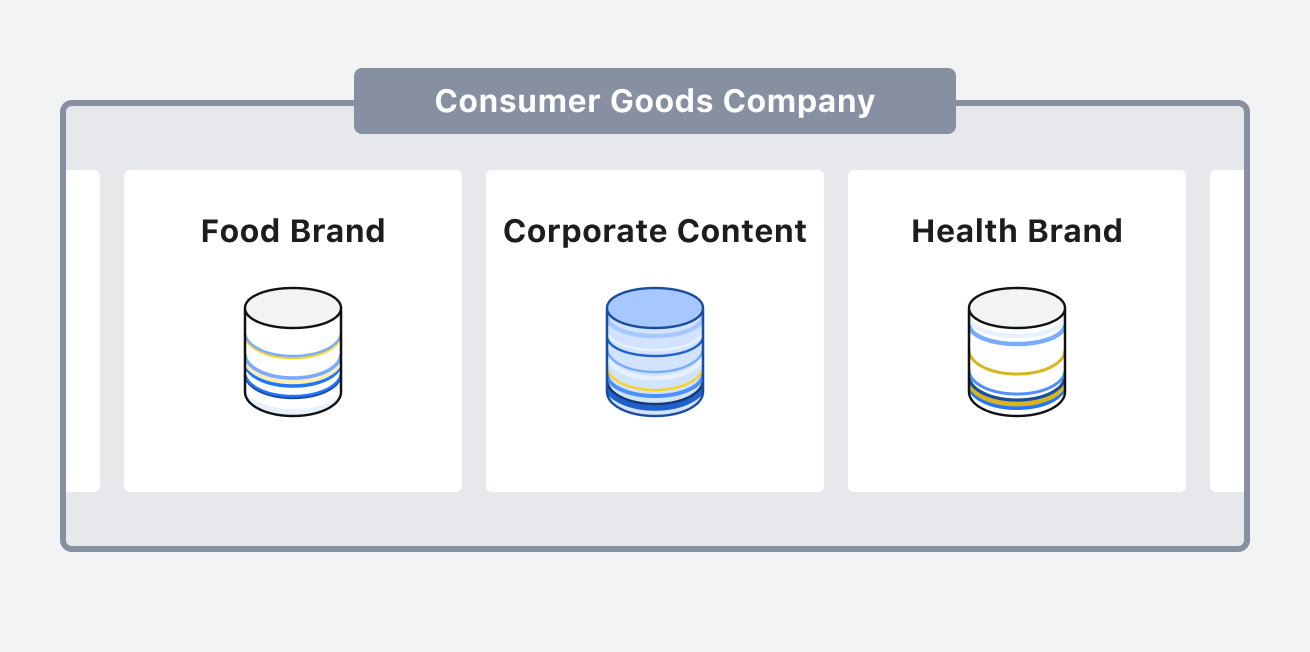
Traditional CMSes lack capabilities to easily leverage content created across teams, resulting in accrual of content debt across a digital experience.

In most CMSes, doing something relatively simple like updating corporate logos or common product information across all the sub-brands and sites which reference that content could wind up taking hours or even days (and risking errors and inconsistency). Teams would wind up searching across many disparate sources of truth, copy-pasting the information over and over again. Checking and double-checking, fixing all the mistakes. For the sake of speed, teams would build up content debt by accepting wording and terminology errors.

With Shared Content, editors can reference content created by other teams within another dataset. This makes it so a legal team can work independently on their projects and changes are kept in sync within products or marketing content.

With Sanity and Shared Content, that slog disappears. Every team is able to pull in and use content from a central source of truth, without copying anything. Change the product information at the source, and it is immediately reflected everywhere you need it to be, across all channels. By default, Sanity will prevent team members from accidentally deleting documents that have references to them. This prevents editors from unintentionally breaking things and allows developers to build with more confidence. With Shared Content, complex copy changes can be done once and shared everywhere within an organization.

As Easy as Making a Reference

Shared Content enables editors to reference content across two different datasets within a Sanity project. You can think of a dataset as a database where all of your content is stored. While most developers opt to designate datasets by environment (development, test, or production), Enterprise organizations may organize datasets by geography (es, no, etc), product area (products, brand, legal), or in some other way. Shared Content enables the team working on product data to make references to legal information that may exist in another dataset.

Organizing content in this way helps larger organizations develop more efficient workflows. For example, developers can mint API keys distinct for access to product data only, or they can create custom roles that only have access to legal copy.

References across datasets (defined as a new schema type called crossDatasetReference) work mostly the same as references within a dataset:
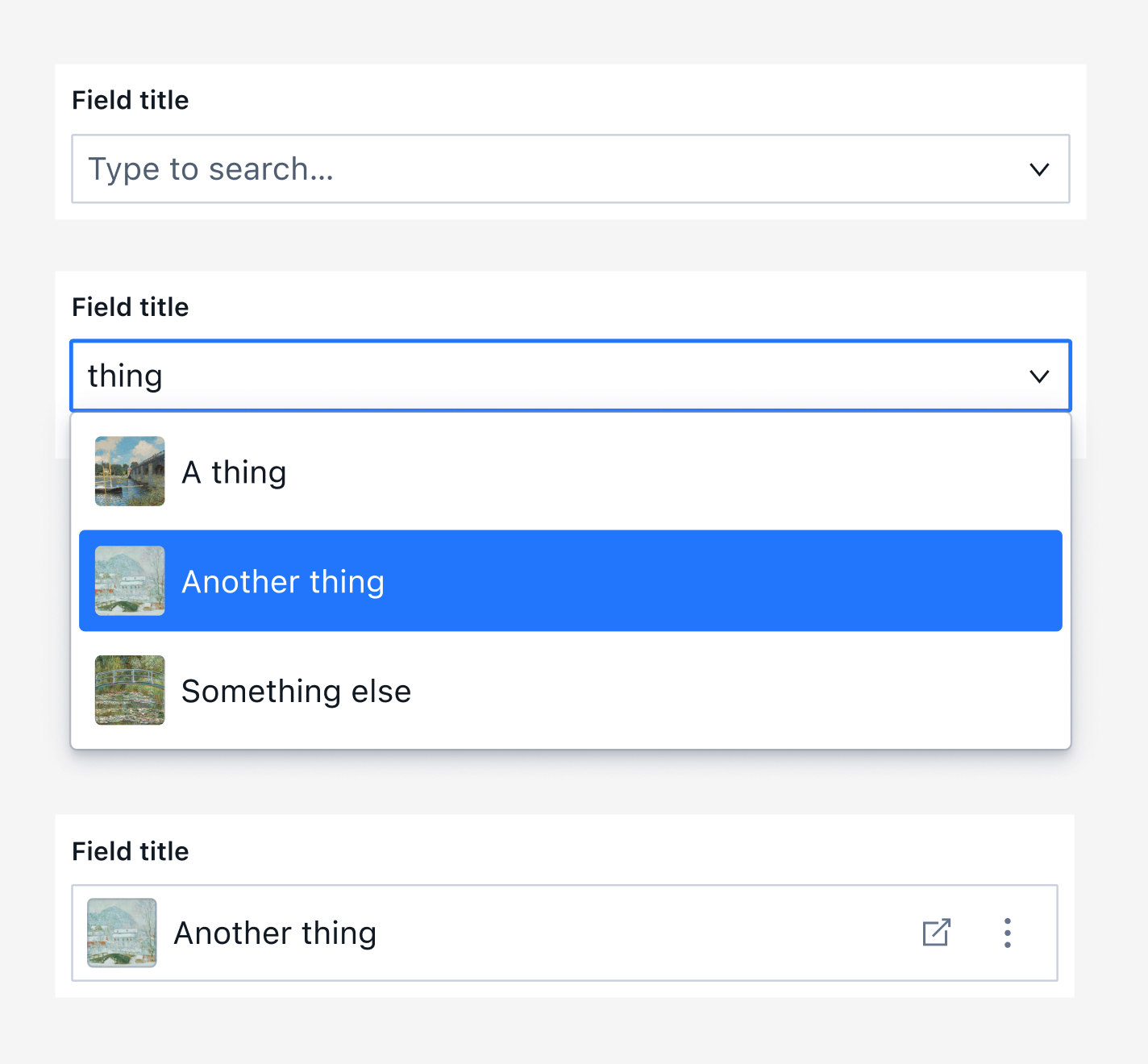
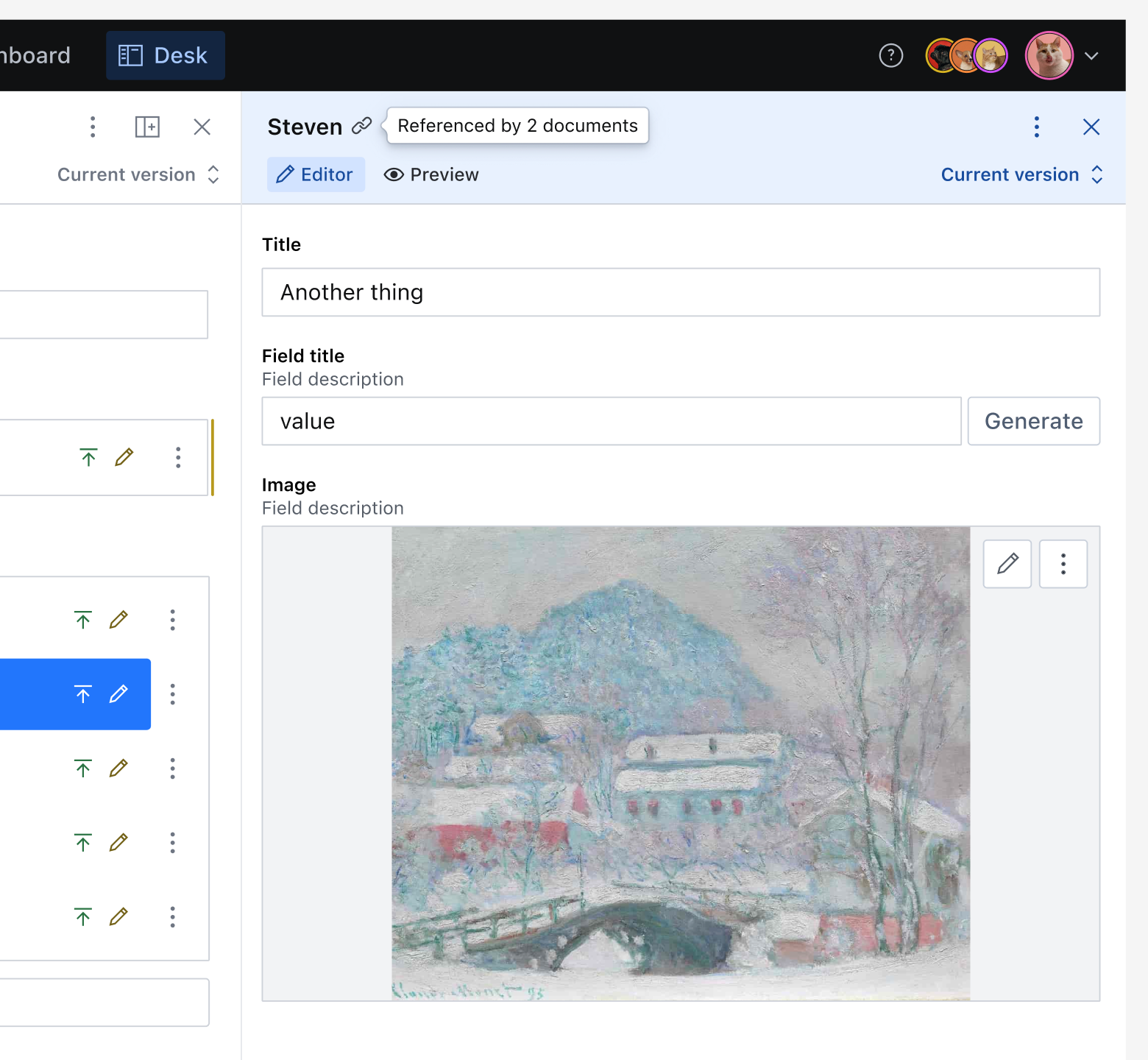
  • Customizable previews: A referenced document within another dataset still renders a preview of the reference within the parent document, including any featured images or subtitles.
References made to shared content act like normal references in the studio. Changes made to shared content are instantly available to any content referencing it.
  • Quick access: Editors can jump to the referenced document and make changes if needed, so long as they have access to the document within that dataset.
  • GROQ de-referencing: You can unpack a Shared Content reference in GROQ. At this time, Shared Content is not supported for GraphQL based schemas.
  • Editor support: If an editor attempts to delete a document that is referenced by another document in a different dataset (via Shared Content), Sanity warns them before allowing the operation to continue.
As with normal references, shared content references appear to editors within the top banner of a document.

Get Started with Shared Content

If you’re currently a Sanity enterprise customer, contact your dedicated customer success manager to learn more on how to enable shared content on your project.

Once it’s been enabled, your developers can implement the new crossDatasetReference type within your project schema. In this first release, you can create reference fields to content within the same project. Read documentation on this new crossDatasetReference type. There are some slight differences as compared to the reference type, which are discussed in the article.

We’ll keep expanding the scope of Shared Content in the future, and we look forward to seeing how you use Structured Content to eliminate content debt within your business.

If you are an existing Sanity customer and want to explore our enterprise offering, which includes capabilities such as custom roles, multi-project invoicing, and dedicated infrastructure, learn more here.