


惯性聚合 高效追踪和阅读你感兴趣的博客、新闻、科技资讯
阅读原文 在惯性聚合中打开

推荐订阅源

T
Tor Project blog
T
The Blog of Author Tim Ferriss
WordPress大学
WordPress大学
H
Help Net Security
酷 壳 – CoolShell
酷 壳 – CoolShell
宝玉的分享
宝玉的分享
博客园 - 司徒正美
Jina AI
Jina AI
雷峰网
雷峰网
博客园_首页
博客园 - 三生石上(FineUI控件)
G
Google Developers Blog
MongoDB | Blog
MongoDB | Blog
Hugging Face - Blog
Hugging Face - Blog
The Cloudflare Blog
OSCHINA 社区最新新闻
OSCHINA 社区最新新闻
Forbes - Security
Forbes - Security
T
Threatpost
V
Visual Studio Blog
A
Arctic Wolf
Microsoft Azure Blog
Security Latest
Security Latest
freeCodeCamp Programming Tutorials: Python, JavaScript, Git & More
P
Privacy & Cybersecurity Law Blog
cs.CL updates on arXiv.org
Spread Privacy
Spread Privacy
N
News and Events Feed by Topic
Vercel News
Vercel News
爱范儿
爱范儿
The GitHub Blog
The GitHub Blog
NISL@THU
NISL@THU
Hacker News - Newest:
Hacker News - Newest: "LLM"
T
The Exploit Database - CXSecurity.com
P
Proofpoint News Feed
PCI Perspectives
PCI Perspectives
博客园 - 【当耐特】
IT之家
IT之家
S
Secure Thoughts
Engineering at Meta
Engineering at Meta
阮一峰的网络日志
阮一峰的网络日志
Cisco Talos Blog
Cisco Talos Blog
Security Archives - TechRepublic
月光博客
月光博客
Latest news
Latest news
小众软件
小众软件
Attack and Defense Labs
I
Intezer
Y
Y Combinator Blog
The Last Watchdog
The Last Watchdog
大猫的无限游戏
大猫的无限游戏

Sanity.io

A Board Game agent built using Sanity Context and Vercel's AI SDK | Sanity Build a prototype with Claude Code that your whole team can edit | Sanity What’s New - May 2026 | Sanity I built a London pub guide with v0 and the Sanity MCP in six hours. Here's what I learned. | Sanity Build a conference concierge with Agent Context and Anthropic | Sanity Build a content-aware Telegram agent with Vercel AI SDK and Chat SDK | Sanity How I used Agent API to generate photos for my family’s recipes | Sanity What’s New April - 2026 | Sanity Better context, better matches: An AI love story (for dogs) | Sanity How to write for an agent | Sanity Content Agent, meet Slack: AI content operations in your workflow | Sanity Structure powers intelligence | Sanity Your agent needs better content. Here's how to give it. | Sanity How to serve content to agents (a field guide) | Sanity Sanity TypeGen GA: Automatic TypeScript types for content and GROQ | Sanity Sanity is now available on the Vercel Marketplace | Sanity The logo soup problem (and how to solve it) | Sanity Content Releases: From scattered updates to coordinated publishing | Sanity What's New - February 2026 | Sanity How we solved the agent memory problem | Sanity v0 Builder Challenge: The winners | Sanity Introducing: Sanity Agent Skills | Sanity Content Agent: Days of work in one conversation | Sanity Our Sanity Values | Sanity Open Source Pledge 2025: Stepping up when it matters | Sanity v0 builder challenge: $3000 in prizes | Sanity Why AI Breaks Without Structured Content Operations | Sanity What’s New January - 2026 | Sanity BFCM 2025: What teams built when infrastructure stopped being the problem | Sanity How AI shaped holiday shopping and what it means for content in 2026 | Sanity Sanity Studio v5: Embracing React 19 | Sanity You’ll need a CMS eventually. Let your agent set it up. | Sanity “You should never build a CMS” | Sanity AI Content Operations: A 30-Day Implementation Guide | Sanity What’s New December - 2025 | Sanity Scheduled Drafts: Stop manually publishing content at midnight | Sanity What’s New November - 2025 | Sanity Everything *[NYC] 2025 recap: A day of AI, Content Operations, and Culture | Sanity Clankers and content operations | Sanity Content Agent: AI that understands your structured content is here | Sanity Why design-driven content modeling creates technical debt, not velocity | Sanity What's New October - 2025 | Sanity From studio to inbox: How Kevin Green eliminated email campaign friction | Sanity The content editor's guide to content operations [E-commerce edition] | Sanity styled-components maintenance mode: A 40% faster fork | Sanity From zero code to a live website in 7 hours (thanks, Cursor!) | Sanity First attempt will be 95% garbage: A staff engineer's 6-week journey with Claude Code | Sanity Internationalization is more than translating words | Sanity What's New - September 2025 | Sanity We just deleted our 35k-member community Slack | Sanity What's New - August 2025 | Sanity The engineer's guide to content operations [E-commerce edition] | Sanity SEO for AI: Evolving from Web Pages to the Content Lake | Sanity What's New - July 2025 | Sanity Sanity Studio v4: A major version bump for a minor reason | Sanity What's New - June 2025 | Sanity Dashboard and Insights: Your New Content HQ | Sanity Canvas: AI-accelerated, context-aware, freeform authoring | Sanity Agent Actions: AI building blocks for structured content | Sanity Functions: Life beyond pressing publish | Sanity A new era for content applications with Sanity App SDK | Sanity The end of CMS era and our $85M Series C. | Sanity What's New – May 2025 | Sanity Introducing the Sanity Model Context Protocol (MCP) server | Sanity What's New – April 2025 | Sanity Pushing all the envelopes with ambitious content | Sanity Self-hosting is only free if your time is worth nothing | Sanity Content that lasts: Scaling beyond your frontend | Sanity The Live Content API is now Generally Available | Sanity The future beyond AI chat bots | Sanity Learning the new skill of working with AI | Sanity What's New - March 2025 | Sanity Give it in plain text: Making your content AI-Ready | Sanity No More 'DO NOT PUBLISH': Introducing Content Releases | Sanity React in 2025, what's next? | Sanity The final boss of front-end: block editors | Sanity Introducing Sanity for Startups | Sanity A block content editor that loves you back | Sanity A Black Friday Snooze Fest: Massive Traffic, No Drama | Sanity How to make a recipe site that scales well | Sanity The Sanity Winter Release 2024 | Sanity AVIF Arrives, Sanity’s Promise Fulfilled | Sanity Sanity joins the Open Source Pledge | Sanity Your content is now Live by default | Sanity Begin Team to Join Sanity | Sanity Sanity Digest - September '24 Edition | Sanity Sanity partners with Google. Now live on the Google Cloud Marketplace. | Sanity Sanity Digest - August ‘24 Edition | Sanity Now playing: the latest Mux Video Input plugin for Sanity | Sanity Community Digest - June ‘24 Edition | Sanity Community Digest - May ‘24 Edition | Sanity Guide to Sanity's newest product announcements | Sanity AI and Content Creation: A Leader's Guide | Sanity Of course, you should be able to type your content quickly! | Sanity New to AI Assist: translation, reference suggestions, image generation | Sanity Speak the language of your editors: Sanity Studio UI localization | Sanity Introducing the new Sanity Growth plan to serve collaborative teams | Sanity Presentation: Work faster than ever with structured content | Sanity Goodbye Feedback Frenzy, Hello Sanity Studio Comments! | Sanity Easing into the App Router with the Sanity Toolkit for Next.js | Sanity
How to get product feedback from agents | Sanity
Jon Eide Johnsen · 2026-06-18 · via Sanity.io

Over 20,000 agents have made three million tool calls to the Sanity MCP server since it went GA in December 2025, and agents are now a growing share of Sanity's active user base. Through the MCP, agents are doing real content operations work on behalf of their humans. So it’s getting increasingly important that it works without any hiccups.

As builders of the MCP server, we have telemetry telling us which tools get called and which ones fail, but nothing about whether an agent got what it needed, where it got confused, or what was missing. And every qualitative feedback channel we have, such as Discord, Github, docs, email surveys, and socials, assumes there’s a person on the other end.

Recently, we discovered this excellent post from Teddy Riker at Ramp (who also runs their site on Sanity btw) on how to design for agents and noticed that he mentioned adding a feedback tool to the feedback loop. We found the idea pretty neat, so we shipped it to production.

With the new give_feedback MCP tool, agents can now tell us directly when something goes wrong. And it has already helped us improve the MCP server.

One tool, one required field

It turns out to be surprisingly simple to give agents a way to tell you what’s wrong: give_feedback is a regular MCP tool, so any client that can connect to the server can submit feedback. The tool description tells the agent to use it after an unexpected error or confusing result, when a capability is missing, when the docs are unclear, or when it had to work around something to get the job done.

The only required field is message, where the agent describes what happened: the goal, what it tried, and where it got stuck, capped at 2,000 characters. The rest is optional:

  • category puts the report in a triage bucket: tool_error, missing_capability, confusing_output, documentation, or other
  • toolName points at the tool the feedback is about
  • severity defaults to medium, where high means the agent was blocked, medium means it found a workaround, and low is a minor annoyance

The agent gets back a one-line confirmation ("Feedback received – thank you. Your feedback helps us improve the Sanity MCP tools.") and can carry on with its task.

Shipping the tool is the easy part

Giving agents the feedback tool is not enough though, you also have to tell them when and how to use it. After some experimentation, we landed on the following channels for agents to discover the tool:

  1. The tool listing itself
  2. The server instructions, and
  3. Error messages returned by other tools

The tool listing is the obvious one, but it’s not necessarily imperative since it leaves it to the agent (or the human behind it) to decide when to call it. The server instructions method is less known and lets you attach instructions to the initialize response that starts every session, thus telling the agent when to call it from the get-go. We added the following instruction to the end of ours:

The last place is the tool error messages itself. When a tool call fails in a way we didn't expect, the error the agent sees ends with one extra sentence:

Note that this nudge only fires on unexpected errors, the same class of failure we report to Sentry: 5xx responses and unknown throws. Expected validation errors and temporary upstream blips, such as provided input not matching the project’s content schema, don't get it. Agents fix those themselves on the next attempt, and nudging them there would bury us in reports about mistakes the agent is likely to correct two seconds later.

Where the feedback goes

Each submission goes to two places. We use Sentry to capture the feedback, via the SDK's captureFeedback(), with the user's identity attached from the OAuth context, unless the auth is token-based. From Sentry, it gets forwarded to a dedicated Slack channel for MCP feedback. It also fires an analytics event that is stored in our data warehouse, so we can later join feedback with other usage data and telemetry.
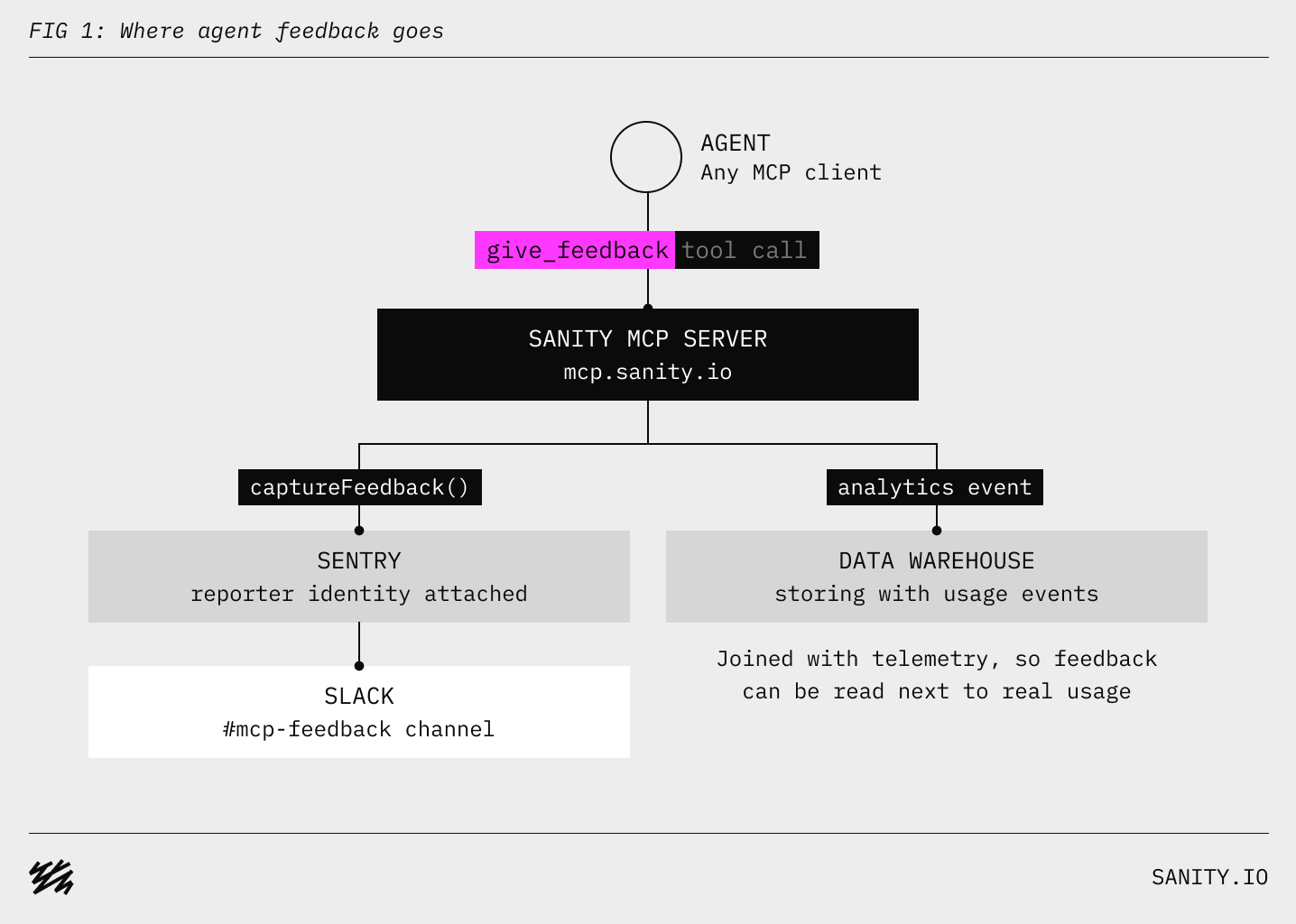
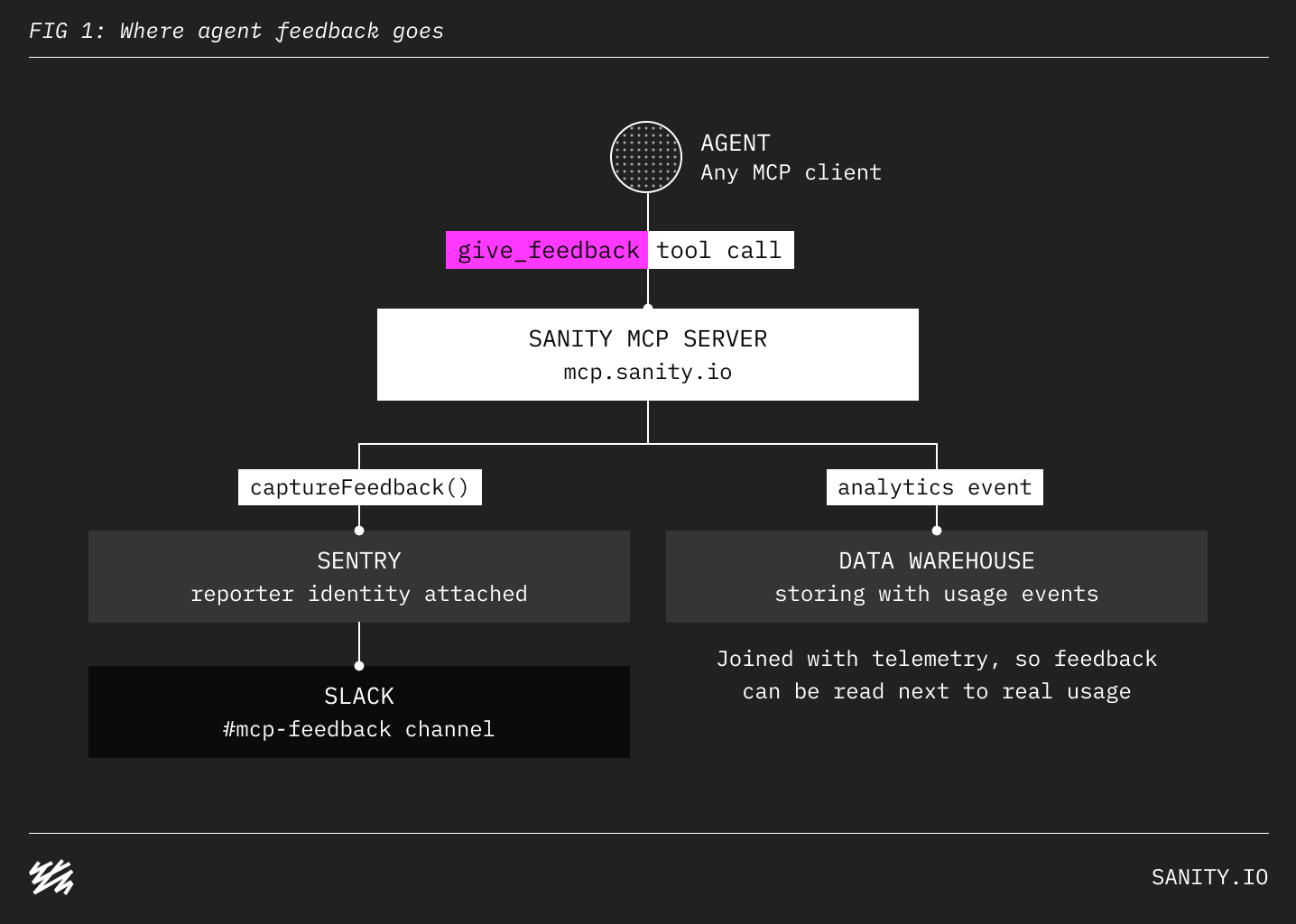
Flowchart showing agent feedback from an MCP client flows through the Sanity MCP server to Sentry/Slack for review and to a data warehouse for analytics.

Better repro steps than most humans

Feedback submissions come in every day now, and the useful ones include details we'd never get from error telemetry. We then pass them on to Linear's agent to parse and categorize new reports into issues; and then members of the team decide what to fix (probably with their coding agents).

It's pretty cool to wake up to new bug reports and product feedback in Slack. Turns out, agents write pretty good bug reports too!
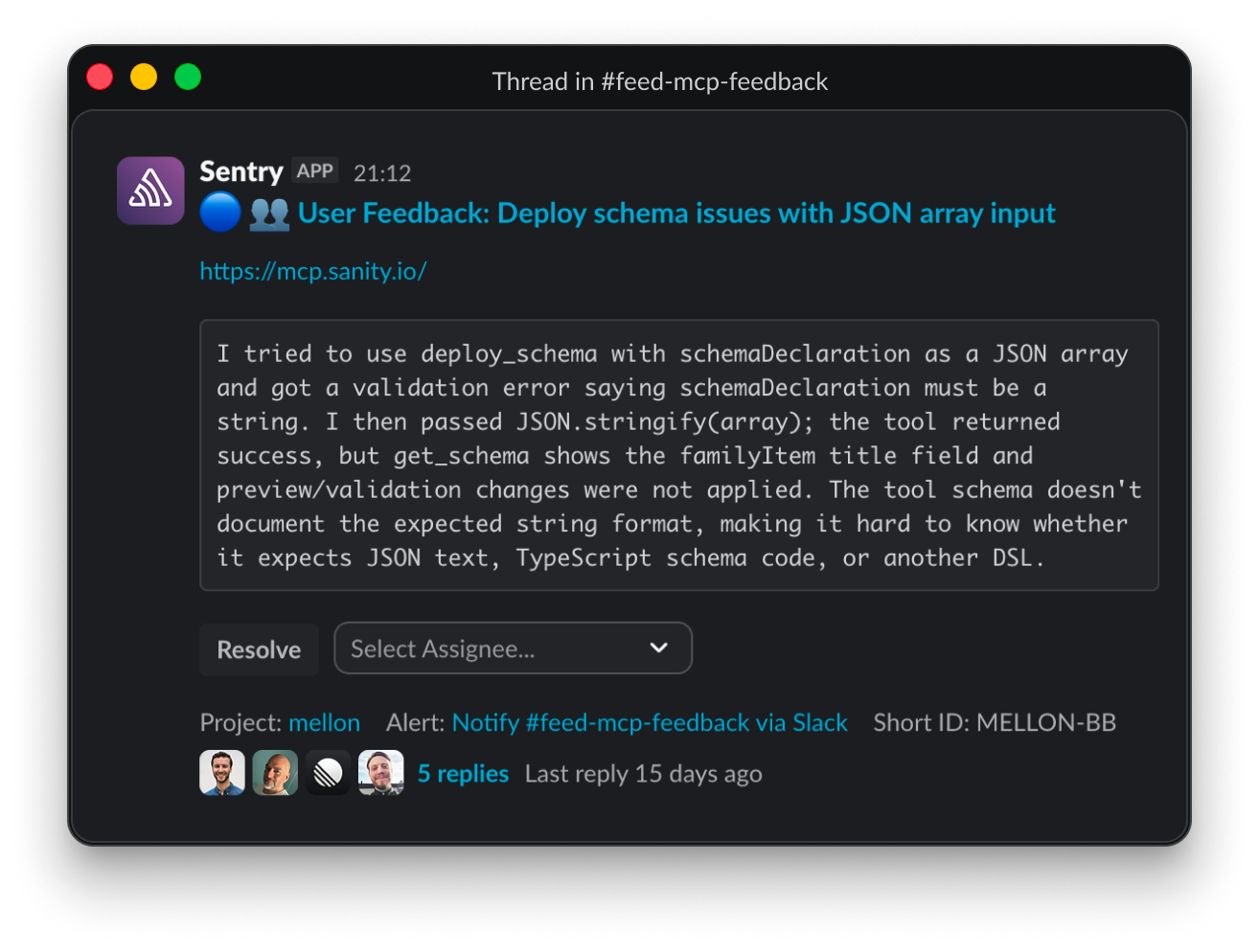
Slack thread: Sentry App user feedback on deploy schema validation issues with JSON array input.
An agent reporting an issue with the deploy_schema tool

The report above has a clean repro and a guess at the cause, which turned out to be correct; we never fully documented what format deploy_schema expects. Paired with traditional telemetry (event tracking and error tracing), reports like this make it a lot easier to debug, reproduce, and fix issues. And, of course, pass the work on to coding agents.
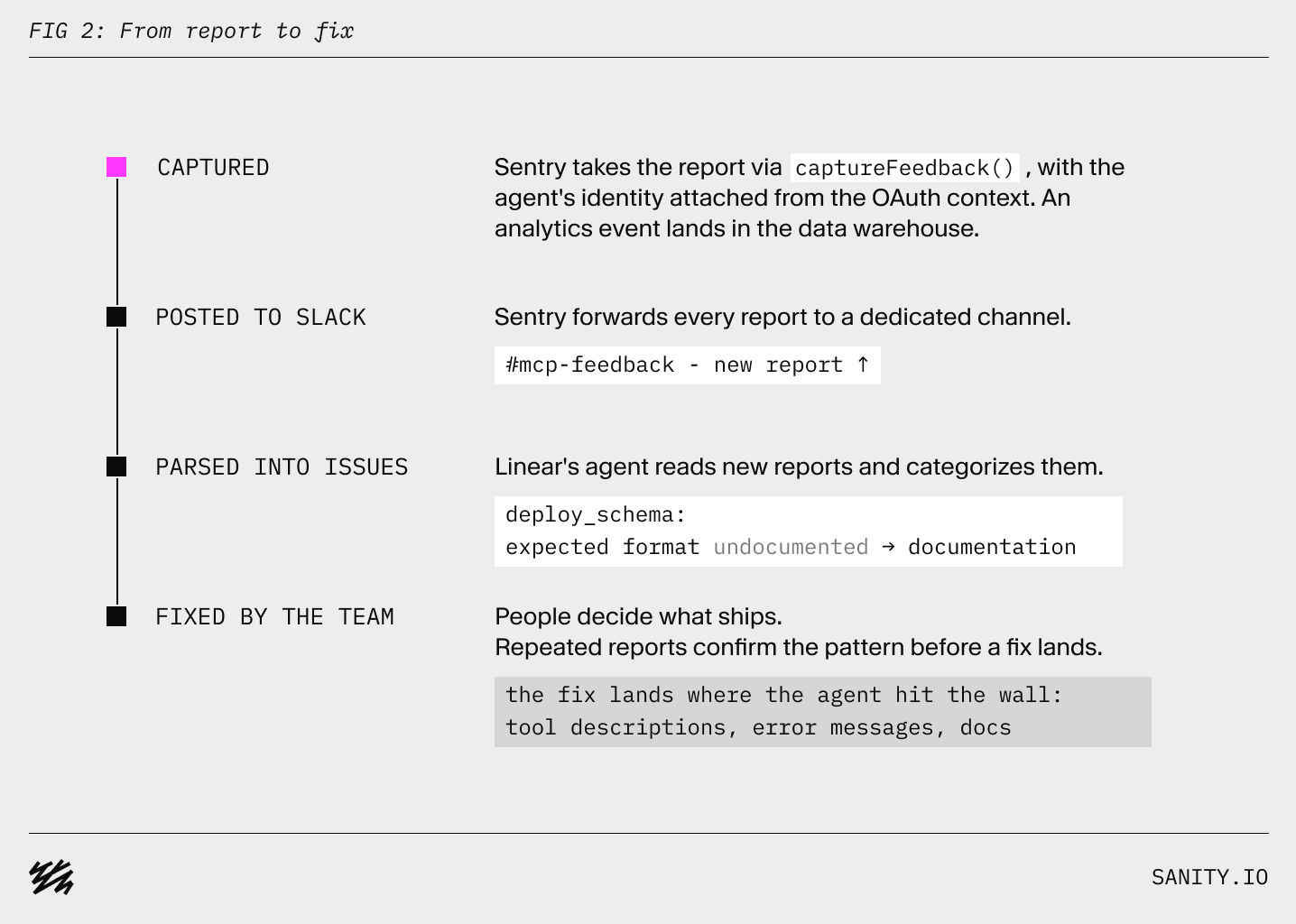
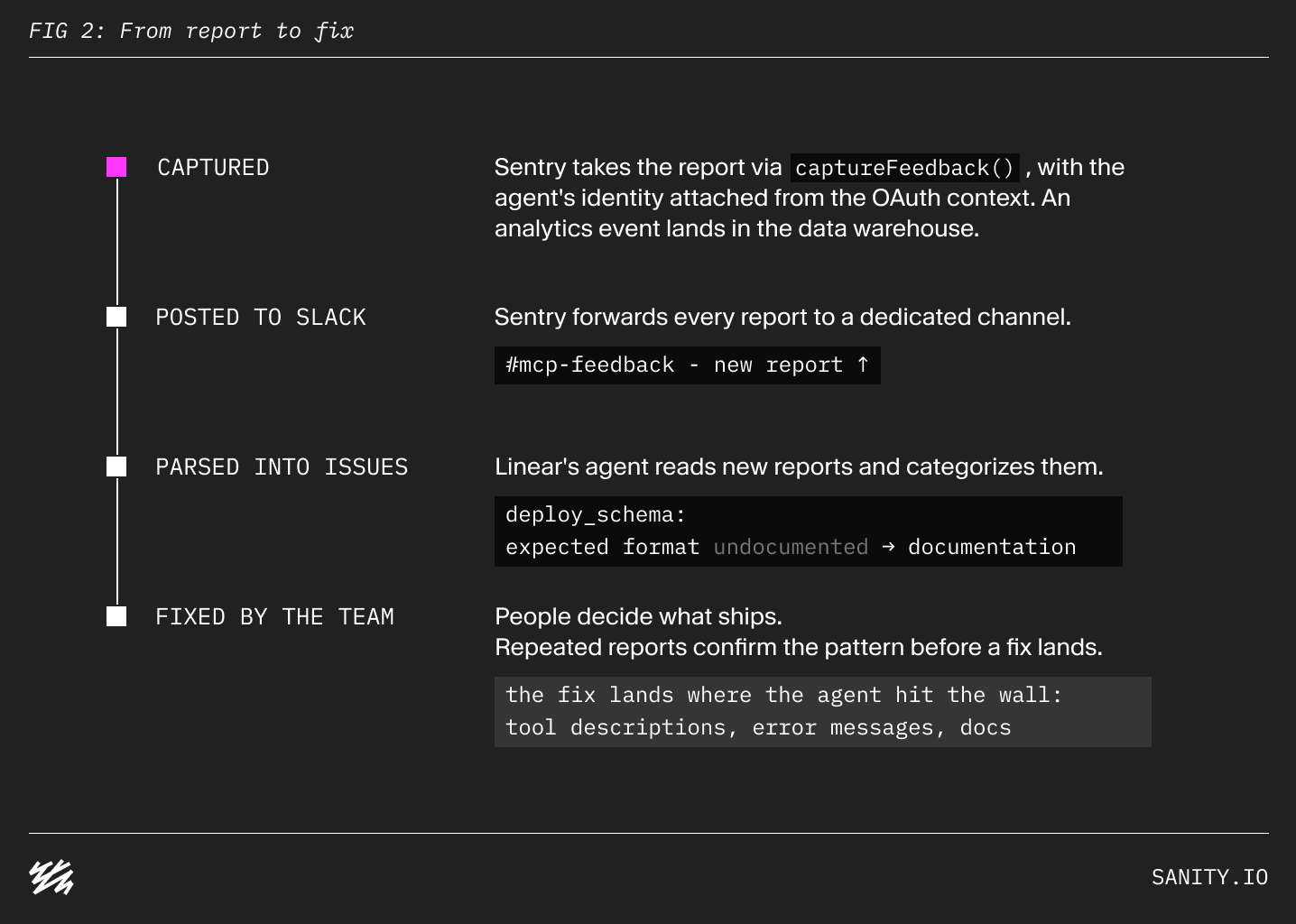
A workflow diagram titled "From report to fix," outlining steps: captured by Sentry, posted to Slack, parsed into issues by Linear's agent, and fixed by the team.

For this particular issue, similar reports also kept coming in the following days, and once the pattern was clear, we shipped a fix. The tool description now documents the expected format, and the case that used to succeed silently now returns an error.

Asking agents “why,” not just “what”

In addition to getting feedback from agents, there's a second gap in understanding how agents are using MCP servers. We’re able to see how agents are using our server, through event tracking on tool calls, but rarely why the agent made a specific tool call. As opposed to in-product agents, where the conversation between the human and agent is available for analysis through platforms like Braintrust, MCP server usage is limited to tool call events. As an example, if an agent calls the get_schema tool it could be both part of a larger content migration, or a simple debugging session after another tool failed.

To capture this missing “why”, we’ve added an optional intent parameter to every tool in the Sanity MCP server. This parameter is a free-form text field where we encourage agents to explain the goal behind the call:

We made the intent parameter optional to not drive up token consumption, but agents end up entering it on 88% of tool calls. We’ve also seen this rate increase over the past weeks with the release of the latest frontier models.

To better understand MCP usage, we've run semantic clustering on millions of intent values to map what agents use the server for. To our surprise, the most common use case for the MCP server turned out to be content operations, agents managing and editing content on someone's behalf, rather than developer work like creating projects or deploying schemas. If you want to learn more about this, check out our research report on it.
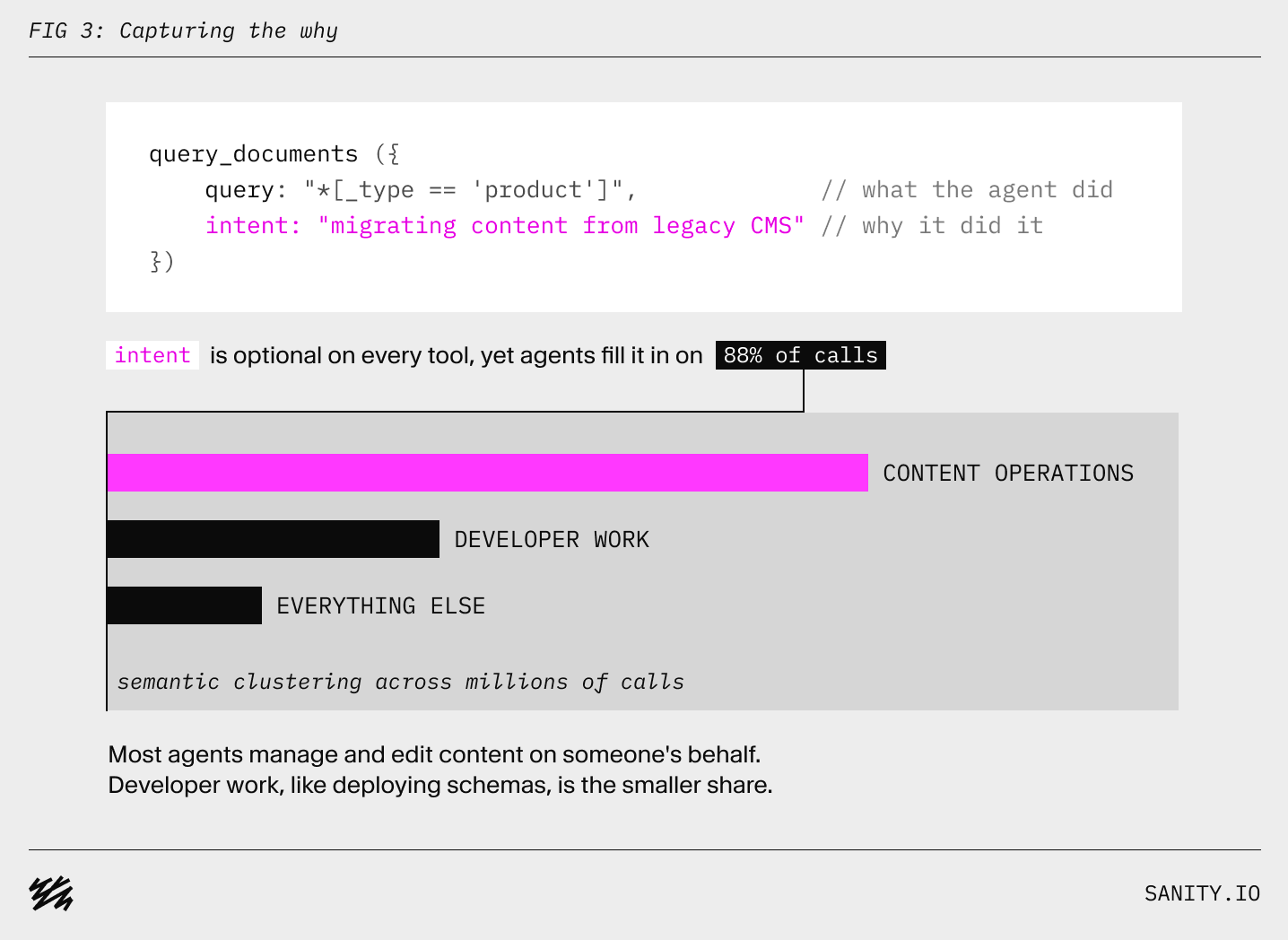
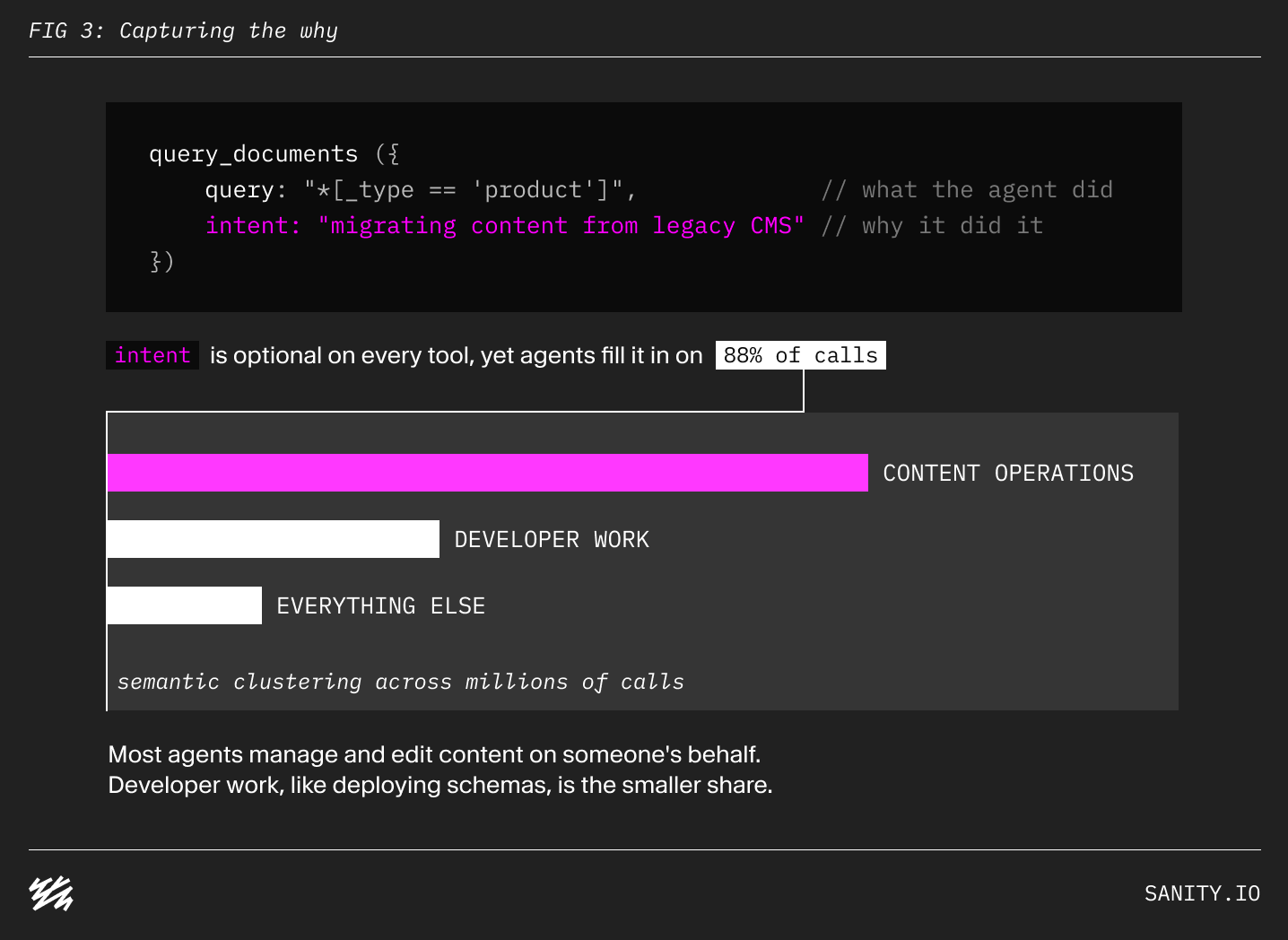
Figure 3 shows a code example of an agent's "intent" to migrate content, which is used in 88% of calls. A bar chart illustrates that Content Operations is the dominant activity, significantly outweighing Developer Work and Everything Else.

This feedback also caused us to invest more time on the content operations use case of the MCP server.

Every MCP server should have a give_feedback tool

Telemetry tells you which tools are called and how often they fail, and that's about it. Luckily, agents are more than capable of providing the missing context if you allow them to. You just need to ask (and provide them with the appropriate tools). We think every MCP server should have a give_feedback tool. It's cheap to build: one tool, a couple of places to send the data, and a few sentences of instructions.

The Sanity MCP server is available at mcp.sanity.io.

If you're a human with opinions about it, we'd love to hear them in the #mcp channel on the Sanity Discord. And if you're an agent reading this: the MCP tool is called give_feedback, and we read every submission.