


惯性聚合 高效追踪和阅读你感兴趣的博客、新闻、科技资讯
阅读原文 在惯性聚合中打开

推荐订阅源

T
Tor Project blog
B
Blog RSS Feed
M
MIT News - Artificial intelligence
WordPress大学
WordPress大学
H
Hackread – Cybersecurity News, Data Breaches, AI and More
罗磊的独立博客
GbyAI
GbyAI
N
Netflix TechBlog - Medium
博客园 - 司徒正美
cs.AI updates on arXiv.org
Threat Intelligence Blog | Flashpoint
宝玉的分享
宝玉的分享
W
WeLiveSecurity
Stack Overflow Blog
Stack Overflow Blog
Y
Y Combinator Blog
SecWiki News
SecWiki News
V
Vulnerabilities – Threatpost
Google DeepMind News
C
CERT Recently Published Vulnerability Notes
T
Tailwind CSS Blog
OSCHINA 社区最新新闻
OSCHINA 社区最新新闻
The Register - Security
Cisco Talos Blog
Cisco Talos Blog
Martin Fowler
Martin Fowler
A
About on SuperTechFans
S
Security @ Cisco Blogs
T
Tenable Blog
C
Check Point Blog
N
News and Events Feed by Topic
S
SegmentFault 最新的问题
The GitHub Blog
The GitHub Blog
C
Cyber Attacks, Cyber Crime and Cyber Security
Attack and Defense Labs
美团技术团队
奇客Solidot–传递最新科技情报
奇客Solidot–传递最新科技情报
C
Cisco Blogs
P
Palo Alto Networks Blog
V
V2EX
博客园 - 聂微东
Project Zero
Project Zero
酷 壳 – CoolShell
酷 壳 – CoolShell
D
Docker
N
News | PayPal Newsroom
Cyber Security Advisories - MS-ISAC
小众软件
小众软件
Application and Cybersecurity Blog
人人都是产品经理
人人都是产品经理
V2EX - 技术
V2EX - 技术
I
Intezer
L
LINUX DO - 最新话题

Sanity.io

A Board Game agent built using Sanity Context and Vercel's AI SDK | Sanity Build a prototype with Claude Code that your whole team can edit | Sanity What’s New - May 2026 | Sanity I built a London pub guide with v0 and the Sanity MCP in six hours. Here's what I learned. | Sanity Build a conference concierge with Agent Context and Anthropic | Sanity Build a content-aware Telegram agent with Vercel AI SDK and Chat SDK | Sanity How I used Agent API to generate photos for my family’s recipes | Sanity What’s New April - 2026 | Sanity Better context, better matches: An AI love story (for dogs) | Sanity How to write for an agent | Sanity Content Agent, meet Slack: AI content operations in your workflow | Sanity Structure powers intelligence | Sanity Your agent needs better content. Here's how to give it. | Sanity How to serve content to agents (a field guide) | Sanity Sanity TypeGen GA: Automatic TypeScript types for content and GROQ | Sanity Sanity is now available on the Vercel Marketplace | Sanity The logo soup problem (and how to solve it) | Sanity Content Releases: From scattered updates to coordinated publishing | Sanity What's New - February 2026 | Sanity How we solved the agent memory problem | Sanity v0 Builder Challenge: The winners | Sanity Introducing: Sanity Agent Skills | Sanity Content Agent: Days of work in one conversation | Sanity Our Sanity Values | Sanity Open Source Pledge 2025: Stepping up when it matters | Sanity v0 builder challenge: $3000 in prizes | Sanity Why AI Breaks Without Structured Content Operations | Sanity What’s New January - 2026 | Sanity BFCM 2025: What teams built when infrastructure stopped being the problem | Sanity How AI shaped holiday shopping and what it means for content in 2026 | Sanity Sanity Studio v5: Embracing React 19 | Sanity You’ll need a CMS eventually. Let your agent set it up. | Sanity “You should never build a CMS” | Sanity AI Content Operations: A 30-Day Implementation Guide | Sanity What’s New December - 2025 | Sanity Scheduled Drafts: Stop manually publishing content at midnight | Sanity What’s New November - 2025 | Sanity Everything *[NYC] 2025 recap: A day of AI, Content Operations, and Culture | Sanity Clankers and content operations | Sanity Content Agent: AI that understands your structured content is here | Sanity Why design-driven content modeling creates technical debt, not velocity | Sanity What's New October - 2025 | Sanity From studio to inbox: How Kevin Green eliminated email campaign friction | Sanity The content editor's guide to content operations [E-commerce edition] | Sanity styled-components maintenance mode: A 40% faster fork | Sanity From zero code to a live website in 7 hours (thanks, Cursor!) | Sanity First attempt will be 95% garbage: A staff engineer's 6-week journey with Claude Code | Sanity Internationalization is more than translating words | Sanity What's New - September 2025 | Sanity We just deleted our 35k-member community Slack | Sanity What's New - August 2025 | Sanity The engineer's guide to content operations [E-commerce edition] | Sanity SEO for AI: Evolving from Web Pages to the Content Lake | Sanity What's New - July 2025 | Sanity Sanity Studio v4: A major version bump for a minor reason | Sanity What's New - June 2025 | Sanity Dashboard and Insights: Your New Content HQ | Sanity Canvas: AI-accelerated, context-aware, freeform authoring | Sanity Agent Actions: AI building blocks for structured content | Sanity Functions: Life beyond pressing publish | Sanity A new era for content applications with Sanity App SDK | Sanity The end of CMS era and our $85M Series C. | Sanity What's New – May 2025 | Sanity Introducing the Sanity Model Context Protocol (MCP) server | Sanity What's New – April 2025 | Sanity Pushing all the envelopes with ambitious content | Sanity Self-hosting is only free if your time is worth nothing | Sanity Content that lasts: Scaling beyond your frontend | Sanity The Live Content API is now Generally Available | Sanity The future beyond AI chat bots | Sanity Learning the new skill of working with AI | Sanity What's New - March 2025 | Sanity Give it in plain text: Making your content AI-Ready | Sanity No More 'DO NOT PUBLISH': Introducing Content Releases | Sanity React in 2025, what's next? | Sanity The final boss of front-end: block editors | Sanity Introducing Sanity for Startups | Sanity A block content editor that loves you back | Sanity A Black Friday Snooze Fest: Massive Traffic, No Drama | Sanity How to make a recipe site that scales well | Sanity The Sanity Winter Release 2024 | Sanity AVIF Arrives, Sanity’s Promise Fulfilled | Sanity Sanity joins the Open Source Pledge | Sanity Your content is now Live by default | Sanity Begin Team to Join Sanity | Sanity Sanity Digest - September '24 Edition | Sanity Sanity partners with Google. Now live on the Google Cloud Marketplace. | Sanity Sanity Digest - August ‘24 Edition | Sanity Now playing: the latest Mux Video Input plugin for Sanity | Sanity Community Digest - June ‘24 Edition | Sanity Community Digest - May ‘24 Edition | Sanity Guide to Sanity's newest product announcements | Sanity AI and Content Creation: A Leader's Guide | Sanity Of course, you should be able to type your content quickly! | Sanity New to AI Assist: translation, reference suggestions, image generation | Sanity Speak the language of your editors: Sanity Studio UI localization | Sanity Introducing the new Sanity Growth plan to serve collaborative teams | Sanity Presentation: Work faster than ever with structured content | Sanity Goodbye Feedback Frenzy, Hello Sanity Studio Comments! | Sanity Easing into the App Router with the Sanity Toolkit for Next.js | Sanity
Making website updates easier with structured content | Sanity
Sarah Beldo · 2023-09-22 · via Sanity.io

Rebrand.

The word alone can spark goosebumps. Goosebumps of anticipation to see an exciting new design, or goosebumps of dread if you are one of the people responsible for changing all the many, many, many places where a new name or logo appears. Because without the right setup, the process of updating content across multiple systems and pages can be truly grueling.

I was reminded of this slog when it was recently announced that the Twitter logo was being retired in favor of X. Amid the chatter about the future of the brand and company, the mundane details of what it takes to make such a switch may have been overlooked.

But we at Sanity empathize with the developers and content managers who are searching, copying, pasting, and verifying changes like these every day. We’re committed to helping content teams reduce chores and burdens like this with intelligent tools like AI Assist.

We’re also long-time proponents of structured content, where you break your content down into its smallest component parts and store it in a central source of truth (like Sanity's Content Lake). From there, your content becomes data that can be queried and displayed across any channel or property.

Making website updates easier with structured content

Thinking about the implications of a rebrand on content operations, Sanity’s Principal Digital Strategist Carrie Hane recently explained:

For company information, a structured content approach means storing global company information as fields in a CMS content type.

You could store the Company Name (plus alternative names), Logo (all versions), Address(es), Phone Number(s), Targeted Emails, Social Media Accounts, and whatever other info that is company canon as data in a content type.

You could then pull that data into wherever you needed it: website header and footer, About Us & Contact pages, apps, product info screens, and anywhere else a content API can feed.

When you get the task of updating any or all of those items, you can update it once and have it repopulate everywhere. The dream!

But to be able to harness this kind of potential, you need to be thinking proactively about how your content is organized and structured. There are many types of content within your organization that can change fast and need to stay consistent. Here are examples of how structured content can make that change much easier.

Product descriptions

For Sanity’s e-commerce customers, this is one of the most common types of updates—and one that can be frustrating if you have an inefficient setup. Imagine an online shoe store. Each pair of shoes has a description, and it appears in many places across a website, mobile app, and potentially other locations, like microsites or landing pages. Having a single place to store and retrieve product description information means that when it needs to be changed, you only need to make the update in one place—and it automatically gets pushed out to all the appropriate places.

Location and/or hours updates

This is a common scenario for any business with a physical location. In our Guide to Structured Content, we use a museum as an example. If you stored your opening hours in an unstructured text body field (like the image below), when you needed to update your opening time, it would be really hard to find all of the places you reference that information.
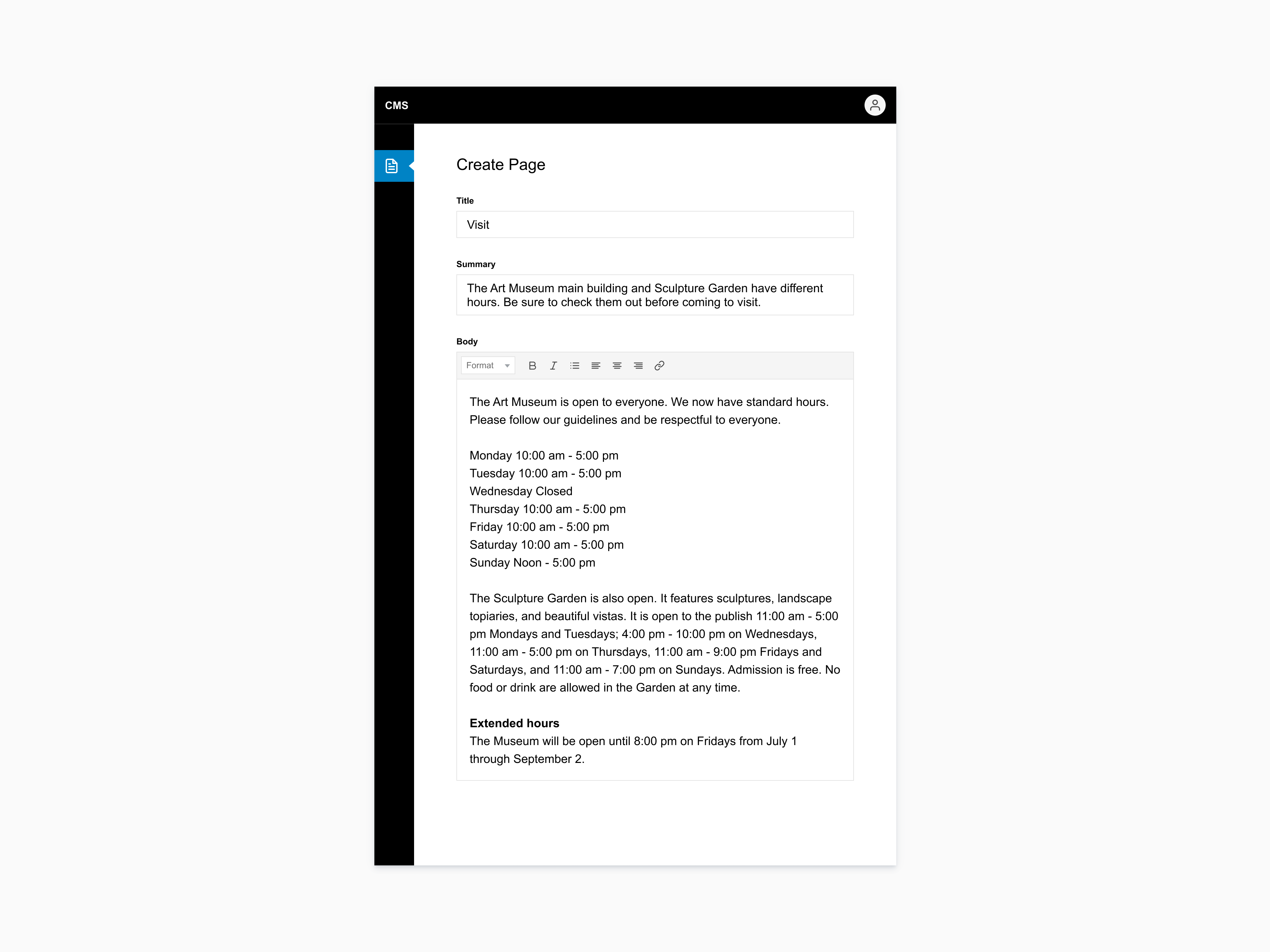
museum hours in an unstructured text block

However, if you break your content into meaningful pieces of data, including “hours,” you can reuse it across your entire site. And, by making a single change to the opening hours in one place, all the places it will appear automatically update in a matter of minutes—removing the risk that the wrong information will show up somewhere.
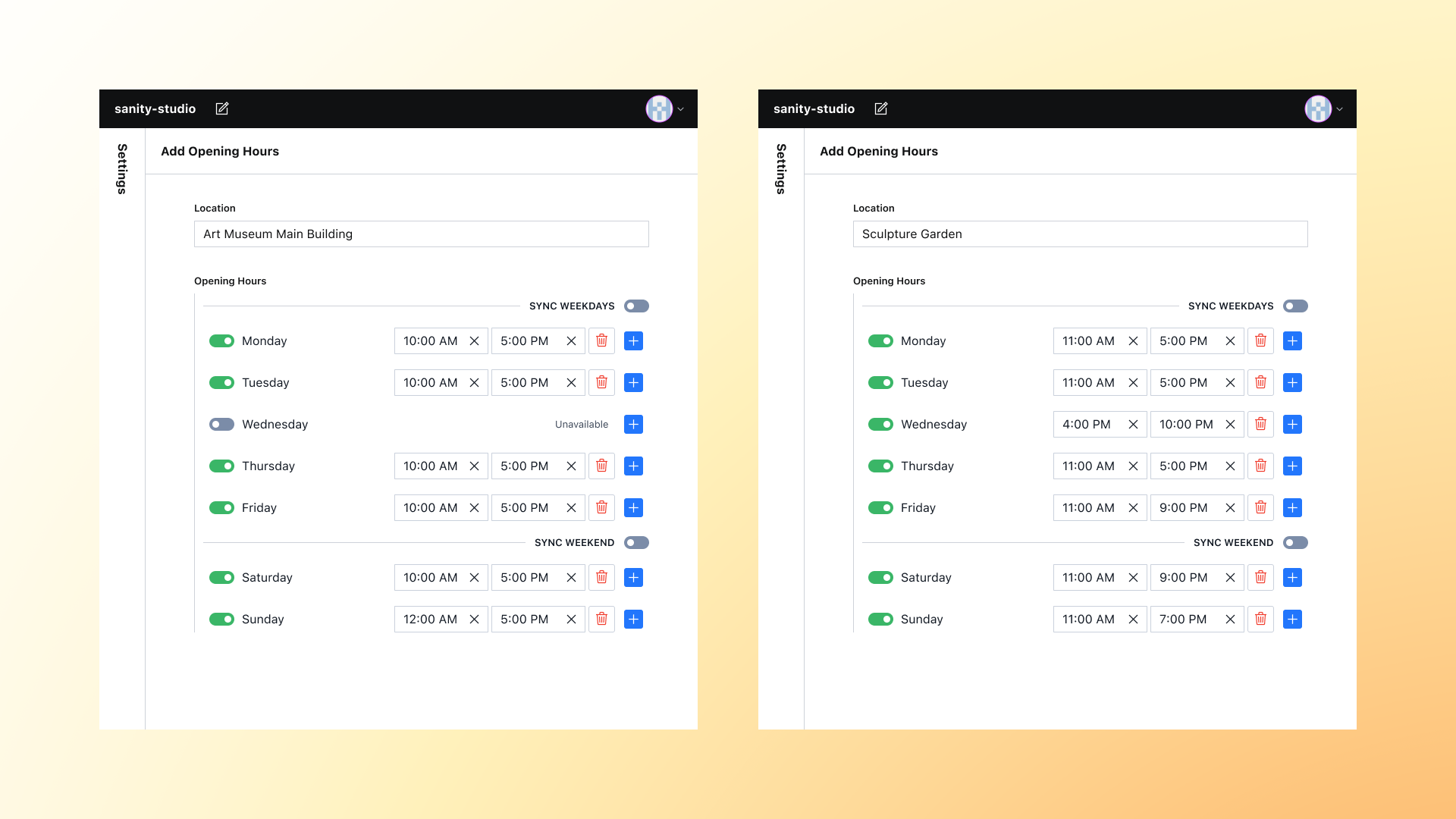
structured content for opening hours

Shipping policies

Shoppers often decide to buy something based on shipping expectations: where purchases can be shipped to, how fast they get there, and how much it costs. But a lesson we’ve learned over the last few years of pandemic-induced volatility is that shipping policies can change at a moment’s notice.

To plan for the inevitability of future updates, you could chunk your policies into pieces like:

  • Shipping methods
  • Shipping times
  • Price by destination country

This allows you to easily add, remove, or update a method, price, duration, or destination in one place and publish it everywhere. And all of that data can be aggregated into a single webpage or app screen—or used in the context of the user’s location.

Incentive or rewards programs

Most retail companies now have incentive or rewards programs for loyal customers.

You probably already consider your customer data to be structured, but the program’s categories, point system, and terms and conditions can also be considered data.

Rather than referring to a spreadsheet to create loyalty program page copy, structured content means you can curate and personalize the loyalty program page for each customer.

Your team's information: titles, names, and tenure

Tired of copying and pasting the basic details about your leadership team or board of directors in many lists? Make a Person content type and store all the information you need there. Pull it in wherever you need it.

Yes, the order of people on any given listing will need to be customized. No problem with a little curation! With structured content, you can use references on your Leadership page to choose the people, order their appearance, and even categorize them with just a few clicks and some dragging and dropping.

This way, when someone gets a new title or photo, you don’t need to hunt down every page where that person appears to update it.

Structured content is an investment for the future

We started out talking about rebranding, which isn’t in the cards for every business. But even if you aren’t taking such a drastic step, there are so many day-to-day tasks that teams are tackling that could be made dramatically easier with structured content and a single source of truth for all of your content.

Sanity: The Platform for Structured Content

Find out how leading brands including AT&T, Burger King, Unilever, and InVision use Sanity to deliver relevant content to their audiences – quickly, across multiple channels.

Request a demo