惯性聚合 高效追踪和阅读你感兴趣的博客、新闻、科技资讯
阅读原文 在惯性聚合中打开

推荐订阅源

Microsoft Azure Blog
Google Online Security Blog
D
Darknet – Hacking Tools, Hacker News & Cyber Security
Threat Intelligence Blog | Flashpoint
Simon Willison's Weblog
T
Threat Research - Cisco Blogs
C
CXSECURITY Database RSS Feed - CXSecurity.com
L
Lohrmann on Cybersecurity
www.infosecurity-magazine.com
Forbes - Security
Forbes - Security
P
Palo Alto Networks Blog
Schneier on Security
S
Schneier on Security
T
Tor Project blog
cs.CL updates on arXiv.org
WordPress大学
WordPress大学
The Hacker News
The Hacker News
Hacker News - Newest:
Hacker News - Newest: "LLM"
罗磊的独立博客
Application and Cybersecurity Blog
F
Fortinet All Blogs
博客园 - 三生石上(FineUI控件)
小众软件
小众软件
C
Check Point Blog
Stack Overflow Blog
Stack Overflow Blog
Blog — PlanetScale
Blog — PlanetScale
雷峰网
雷峰网
S
Security @ Cisco Blogs
PCI Perspectives
PCI Perspectives
Spread Privacy
Spread Privacy
W
WeLiveSecurity
SecWiki News
SecWiki News
A
About on SuperTechFans
H
Help Net Security
博客园 - 司徒正美
Recent Commits to openclaw:main
爱范儿
爱范儿
S
Securelist
M
MIT News - Artificial intelligence
云风的 BLOG
云风的 BLOG
月光博客
月光博客
Jina AI
Jina AI
博客园 - 叶小钗
Vercel News
Vercel News
阮一峰的网络日志
阮一峰的网络日志
Recent Announcements
S
Secure Thoughts
The Cloudflare Blog
美团技术团队
freeCodeCamp Programming Tutorials: Python, JavaScript, Git & More

Sanity.io

A Board Game agent built using Sanity Context and Vercel's AI SDK | Sanity Build a prototype with Claude Code that your whole team can edit | Sanity What’s New - May 2026 | Sanity I built a London pub guide with v0 and the Sanity MCP in six hours. Here's what I learned. | Sanity Build a conference concierge with Agent Context and Anthropic | Sanity Build a content-aware Telegram agent with Vercel AI SDK and Chat SDK | Sanity How I used Agent API to generate photos for my family’s recipes | Sanity What’s New April - 2026 | Sanity Better context, better matches: An AI love story (for dogs) | Sanity How to write for an agent | Sanity Content Agent, meet Slack: AI content operations in your workflow | Sanity Structure powers intelligence | Sanity Your agent needs better content. Here's how to give it. | Sanity How to serve content to agents (a field guide) | Sanity Sanity TypeGen GA: Automatic TypeScript types for content and GROQ | Sanity Sanity is now available on the Vercel Marketplace | Sanity The logo soup problem (and how to solve it) | Sanity Content Releases: From scattered updates to coordinated publishing | Sanity What's New - February 2026 | Sanity How we solved the agent memory problem | Sanity v0 Builder Challenge: The winners | Sanity Introducing: Sanity Agent Skills | Sanity Content Agent: Days of work in one conversation | Sanity Our Sanity Values | Sanity Open Source Pledge 2025: Stepping up when it matters | Sanity v0 builder challenge: $3000 in prizes | Sanity Why AI Breaks Without Structured Content Operations | Sanity What’s New January - 2026 | Sanity BFCM 2025: What teams built when infrastructure stopped being the problem | Sanity How AI shaped holiday shopping and what it means for content in 2026 | Sanity Sanity Studio v5: Embracing React 19 | Sanity You’ll need a CMS eventually. Let your agent set it up. | Sanity “You should never build a CMS” | Sanity AI Content Operations: A 30-Day Implementation Guide | Sanity What’s New December - 2025 | Sanity Scheduled Drafts: Stop manually publishing content at midnight | Sanity What’s New November - 2025 | Sanity Everything *[NYC] 2025 recap: A day of AI, Content Operations, and Culture | Sanity Clankers and content operations | Sanity Content Agent: AI that understands your structured content is here | Sanity Why design-driven content modeling creates technical debt, not velocity | Sanity What's New October - 2025 | Sanity From studio to inbox: How Kevin Green eliminated email campaign friction | Sanity The content editor's guide to content operations [E-commerce edition] | Sanity styled-components maintenance mode: A 40% faster fork | Sanity From zero code to a live website in 7 hours (thanks, Cursor!) | Sanity First attempt will be 95% garbage: A staff engineer's 6-week journey with Claude Code | Sanity Internationalization is more than translating words | Sanity What's New - September 2025 | Sanity We just deleted our 35k-member community Slack | Sanity What's New - August 2025 | Sanity The engineer's guide to content operations [E-commerce edition] | Sanity SEO for AI: Evolving from Web Pages to the Content Lake | Sanity What's New - July 2025 | Sanity Sanity Studio v4: A major version bump for a minor reason | Sanity What's New - June 2025 | Sanity Dashboard and Insights: Your New Content HQ | Sanity Canvas: AI-accelerated, context-aware, freeform authoring | Sanity Agent Actions: AI building blocks for structured content | Sanity Functions: Life beyond pressing publish | Sanity A new era for content applications with Sanity App SDK | Sanity The end of CMS era and our $85M Series C. | Sanity What's New – May 2025 | Sanity Introducing the Sanity Model Context Protocol (MCP) server | Sanity What's New – April 2025 | Sanity Pushing all the envelopes with ambitious content | Sanity Self-hosting is only free if your time is worth nothing | Sanity Content that lasts: Scaling beyond your frontend | Sanity The Live Content API is now Generally Available | Sanity The future beyond AI chat bots | Sanity Learning the new skill of working with AI | Sanity What's New - March 2025 | Sanity Give it in plain text: Making your content AI-Ready | Sanity No More 'DO NOT PUBLISH': Introducing Content Releases | Sanity React in 2025, what's next? | Sanity The final boss of front-end: block editors | Sanity Introducing Sanity for Startups | Sanity A block content editor that loves you back | Sanity A Black Friday Snooze Fest: Massive Traffic, No Drama | Sanity How to make a recipe site that scales well | Sanity The Sanity Winter Release 2024 | Sanity AVIF Arrives, Sanity’s Promise Fulfilled | Sanity Sanity joins the Open Source Pledge | Sanity Begin Team to Join Sanity | Sanity Sanity Digest - September '24 Edition | Sanity Sanity partners with Google. Now live on the Google Cloud Marketplace. | Sanity Sanity Digest - August ‘24 Edition | Sanity Now playing: the latest Mux Video Input plugin for Sanity | Sanity Community Digest - June ‘24 Edition | Sanity Community Digest - May ‘24 Edition | Sanity Guide to Sanity's newest product announcements | Sanity AI and Content Creation: A Leader's Guide | Sanity Of course, you should be able to type your content quickly! | Sanity New to AI Assist: translation, reference suggestions, image generation | Sanity Speak the language of your editors: Sanity Studio UI localization | Sanity Introducing the new Sanity Growth plan to serve collaborative teams | Sanity Presentation: Work faster than ever with structured content | Sanity Goodbye Feedback Frenzy, Hello Sanity Studio Comments! | Sanity Easing into the App Router with the Sanity Toolkit for Next.js | Sanity Making website updates easier with structured content | Sanity
Your content is now Live by default | Sanity
Knut Melvær · 2024-10-31 · via Sanity.io

Ever had the "Error Establishing a Database Connection: Too Many Connections" message when your site is under heavy load or played whack-a-mole with cache invalidation?

You deploy a critical content update, but you're never quite sure when it will actually hit the site. Maybe you have an mystical web of timeouts, webhooks, and revalidation tags; only to still be refreshing the page multiple times for your changes to be live.

This is why we've developed the Live Content API to make it easy to build live-by-default applications that scale to millions of visitors with just a few lines of code. Like three-ish.

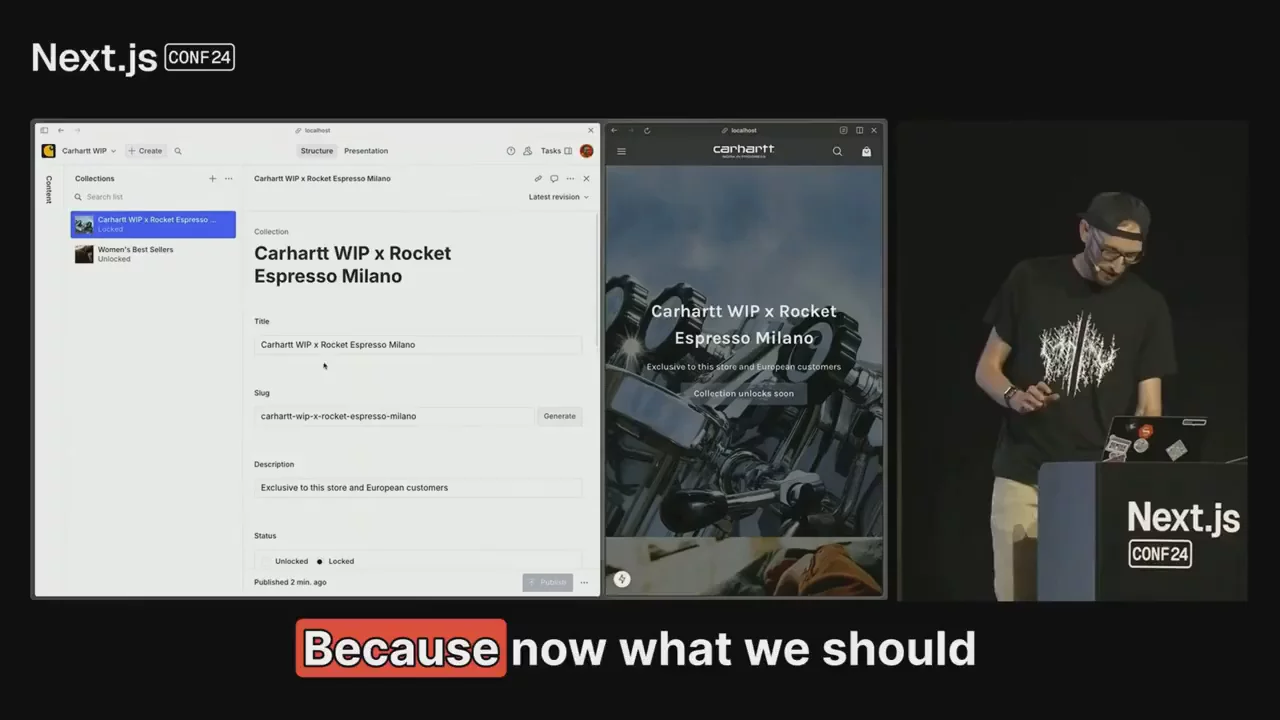
The Live Content API is available in beta, and you can try it now in our Next.js starter, explore the documentation, or watch our recent Next.js Conf talk.

The perfect storm: When caching breaks down

Imagine this scenario: You're running an e-commerce site, and a high-profile entrepreneur called Kim just dropped a instagram post about your latest product. Suddenly, thousands of eager customers flood your site. This is your moment to shine – but it's also when traditional caching solutions start to crumble.

What are your choices?
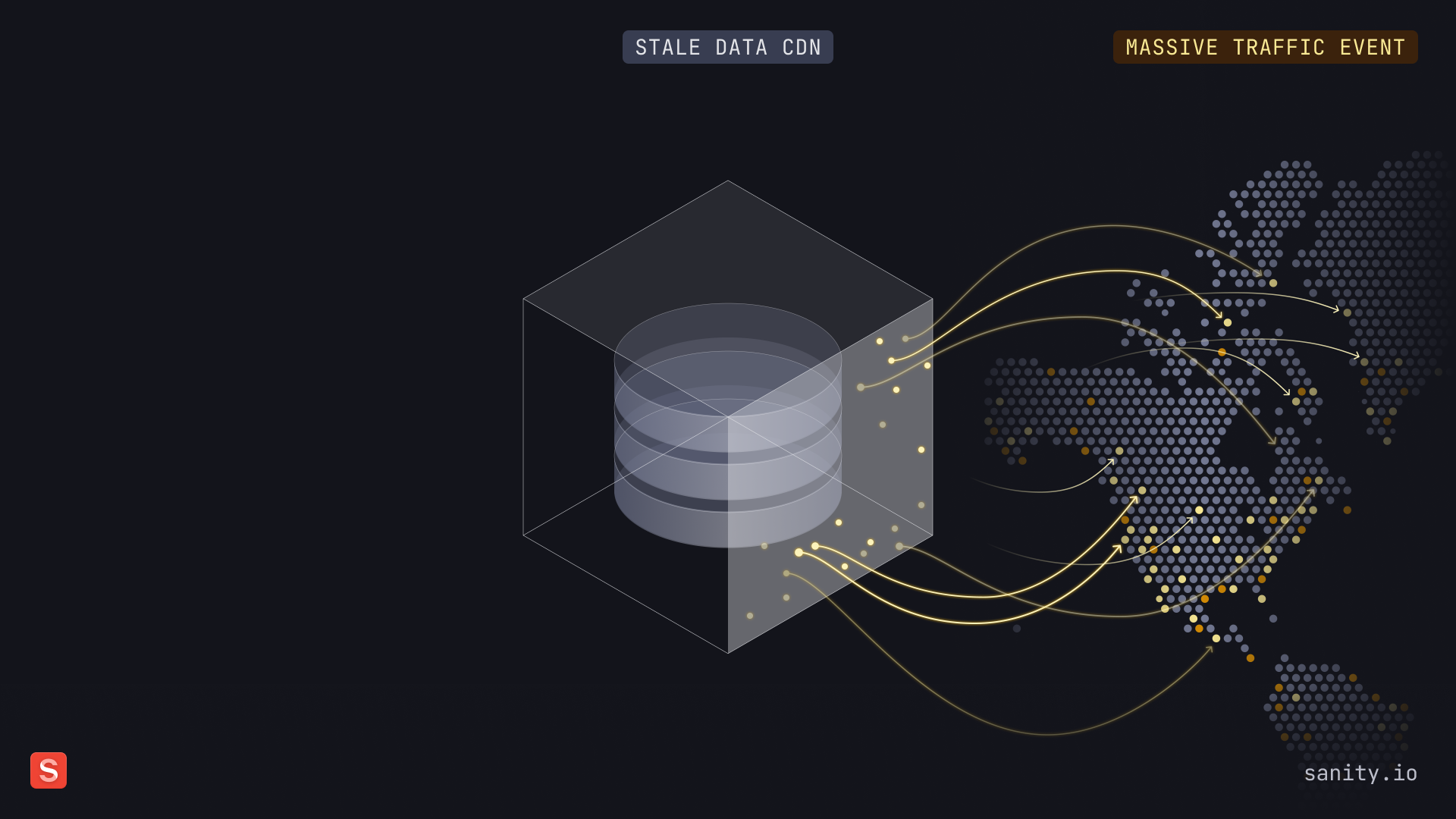
An illustration showing a CDN with stale data and a massive traffic event
Great, you have a lot of traffic! But what if you want to show them fresh content?

You're caught in an impossible situation:

  • If you keep your CDN cached, visitors might see you feature products that are sold out, letting them try to buy things that are already sold out.
  • If you invalidate your cache to ensure fresh content, you're effectively DDOSing on your infrastructure
  • Either way, you're likely pouring money into emergency infrastructure scaling or keeping your team up at night monitoring systems. No bueno.
Applications trying to update a data cdn while there is a massive traffic event
Now you have to figure out how to punch holes in your CDN, wack-a-mole style

To understand why these scenarios are so challenging to handle with traditional approaches, we need to take a step back and look at how content delivery has evolved on the web.

How content delivery actually works

The web has come a long way from its static beginnings, but many of our fundamental patterns for delivering content remain unchanged. Understanding these patterns helps explain why we're still struggling with the same caching problems decades later.

The classic request-response pattern

The request and response pattern is how we fetch content on the web. When you click a link or type a URL, your browser sends a request to the server hosting the website. The server responds with the requested content, which your browser renders. Simple enough!

But here's something to consider: you now have a cached version of that site in your browser. We've been trained to revalidate this cache by hitting the reload button – and as developers, we even use special hotkeys to make extra sure we're bypassing all cache layers. Hopefully, we'll get fresh content from the server. Right?

This pattern worked well for the early web, but as applications became more dynamic and interactive, we needed more sophisticated solutions.

How we got here

The web was built for a simple client/server model. Take your vanilla WordPress install: when a visitor requests a blog post, WordPress runs PHP code on the server for every visitor. The template code makes a database request, generates HTML by inserting content into the template, and returns this as a response.

This model works fine until your site gets popular. With many concurrent visitors, it becomes resource-intensive and can crash your server. The traditional solution? Add caching plugins. But suddenly, your users aren't guaranteed to get fresh content, even with aggressive cache busting.

As these limitations became more apparent, the industry began moving toward more sophisticated architectures and frameworks.

Modern web caching

When we started to build with decoupled frontends consuming API data, frameworks like Next.js introduced sophisticated caching mechanisms. For example, Next.js typically handles data fetching in components and maps that to children components:

Next.js optimizes performance through features like prefetching content for anticipated routes, typically implemented through special Link components that enable quick client-side renders:

For optimal performance, Next.js uses various caching strategies, from static JSON files bundled with the application to specialized data cache layers depending on your hosting environment.

But even these modern solutions come with their own set of challenges and complexities.
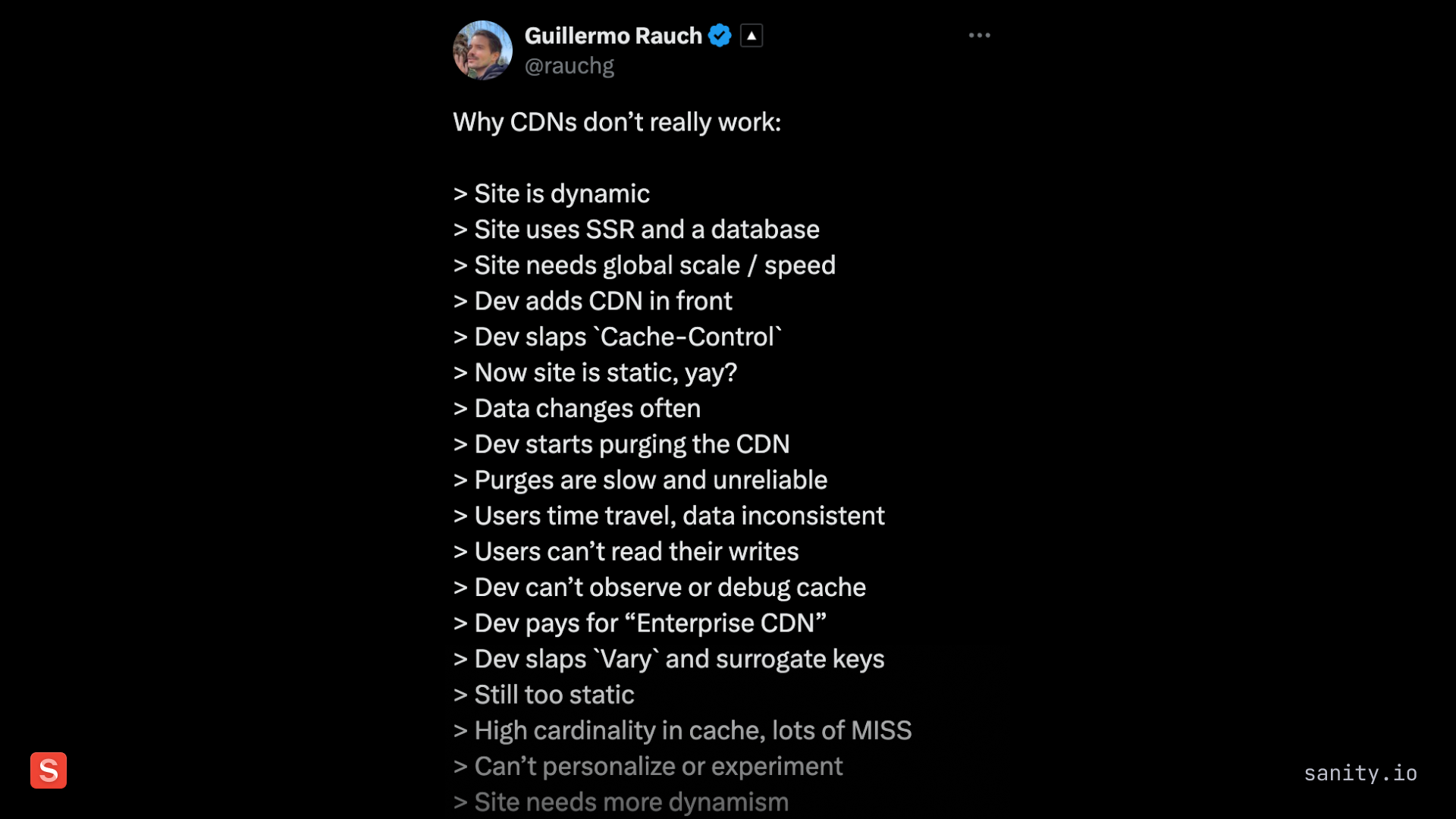
Why CDNs don't really work with a whole bunch of reasons why they don't
This tweet pretty accurately sums up what we're trying to say in this blog post

The caching confusion era

Caching particularly impossible when it breaks our assumptions about how fetching works. Take Next.js 13 (the one with the App router) introducing aggressive default caching on Vercel. The cache lived outside the Next.js app, so you could redeploy without necessarily busting the cache – great for performance, confusing for developers who didn't read the fine print.

This is improved in Next.js 15 with new APIs and progressive disclosure through opt-in caching with the "use cache" directive.

But we're still left with fundamental challenges in ensuring users have the freshest content.

These improvements in framework-level caching are significant, but they don't address the problem of delivering real-time updates at scale.

Traditional CDNs aren't built for real time

Content Delivery Networks excel at distributing static content globally. But they weren't designed for today's dynamic content needs:

  • Live sports scores that change by the second
  • Stock prices that fluctuate continuously
  • Breaking news that needs immediate visibility
  • E-commerce inventory that updates in real-time

This mismatch between traditional CDN capabilities and modern content delivery needs led us to rethink the entire approach to content distribution.

How we solved it: The technical details

After analyzing these challenges, we realized that solving this problem would require innovation at multiple levels of the stack. Here's how we approached it.

Invalidating graph-based content

Content Lake offers a unique NoSQL document store with referential integrity that can be queried with GROQ. While we've always offered CDN caching for GROQ responses, invalidating cache for graph-based content presents unique challenges.

The flexibility of GROQ querying makes cache invalidation non-trivial. Initially, we used a crude but effective approach: invalidate all cached query responses when any document updated. This worked well enough most of the time – except when it didn't, particularly during high-traffic periods with concurrent content updates.

This experience taught us that we needed a more sophisticated approach to handle real-world scale.

The solution: Opaque surrogate keys, delivered in real time

We developed a fine-grained system to precisely map which queries need invalidation on content updates. Queries are tagged to track exactly what an update will affect. We developed this for granular invalidation of our own CDNs, but we've also made available for invalidating other external like caches, like web browsers, it simple through our new syncTags property in query results.

We've also added throttling measures for high-volume update scenarios, strengthening our global infrastructure's resilience. These sync tags are opaque, making them safe to expose in an external API without authentication.

When someone visits your site, you can safely request the Live Content API to open an event stream to their client. The application matches stream syncTags with query result tags, triggering selective content refetching through the CDN. Updates typically appear within seconds, with a maximum delay of a couple of minutes during periods with a lot of mutations to your dataset.

Talk to us if you are interested in even better performance and higher number of concurrent users.

An illustration of the Live Content API handling all the load

The result is a system that combines the performance benefits of CDN caching with the immediacy of real-time updates – all while maintaining scalability and reliability.

Making it work with Next.js: Live by default, static by design

When we say "Live by default," we really mean it – but not at the expense of performance or your infrastructure costs. Our Next.js implementation is built on top of revalidateTag and Next.js caching, which means everything stays Incremental Static Regeneration (ISR) and static unless you explicitly opt into dynamic APIs (like cookies, headers, or search params).

Here's what makes this approach special:

Efficient Runtime Model

  • The live listener runs in the browser, not on your server
  • Updates are push-based, eliminating the need for polling
  • When 500 people are on your site and you push an update, all 500 trigger revalidation and refetch the React Server Component (RSC)
  • Vercel automatically deduplicates identical requests and data fetches to a single request that all clients listen for
  • Content Lake sees just one request, keeping your API costs predictable

Granular Caching

  • If your route uses three GROQ queries and only one gets invalidated, only that query refetches
  • Other components continue using their cached data
  • With Next.js 15's 'use cache' directive, component-level caching becomes even more granular
  • You only pay for the exact compute required to rerender changed content

Versatile Implementation

  • Works seamlessly in layout.tsx
  • Can be used in generateMetadata for live browser titles
  • Even supports dynamic favicon updates through icon.tsx
  • Full compatibility with Next.js ISR

Cost-Effective

  • Eliminates the need for webhooks in high-traffic scenarios
  • Much more efficient than using dynamic SSR as an alternative
  • Minor increase in Vercel runtime seconds, but we'd say that the value far outweighs the cost
  • Three(ish) lines of code to implement

The beauty of this approach is that it's both powerful and pragmatic. You get real-time updates without sacrificing the benefits of static generation, and your infrastructure costs remain predictable and manageable.

Ready to make your app Live by default?

The Live Content API is available in beta on all plans. Here's how you can get started:

Congratulations, the only hard thing left in computer science is now naming things.