



惯性聚合 高效追踪和阅读你感兴趣的博客、新闻、科技资讯
阅读原文 在惯性聚合中打开

推荐订阅源

Recorded Future
Recorded Future
C
Cyber Attacks, Cyber Crime and Cyber Security
D
Darknet – Hacking Tools, Hacker News & Cyber Security
Scott Helme
Scott Helme
Cyberwarzone
Cyberwarzone
C
CERT Recently Published Vulnerability Notes
Threat Intelligence Blog | Flashpoint
P
Palo Alto Networks Blog
Google Online Security Blog
Security Archives - TechRepublic
WordPress大学
WordPress大学
博客园 - 聂微东
L
LINUX DO - 最新话题
月光博客
月光博客
小众软件
小众软件
T
Troy Hunt's Blog
A
Arctic Wolf
量子位
I
Intezer
大猫的无限游戏
大猫的无限游戏
T
Tailwind CSS Blog
S
Schneier on Security
NISL@THU
NISL@THU
T
Threat Research - Cisco Blogs
TaoSecurity Blog
TaoSecurity Blog
酷 壳 – CoolShell
酷 壳 – CoolShell
博客园_首页
有赞技术团队
有赞技术团队
N
News and Events Feed by Topic
美团技术团队
The Cloudflare Blog
P
Privacy International News Feed
S
Security Affairs
K
KPMG report finds enterprise disconnect between AI and its ROI | CIO
奇客Solidot–传递最新科技情报
奇客Solidot–传递最新科技情报
G
GRAHAM CLULEY
N
News | PayPal Newsroom
Apple Machine Learning Research
cs.CV updates on arXiv.org
钛媒体:引领未来商业与生活新知
钛媒体:引领未来商业与生活新知
L
LINUX DO - 热门话题
V
Vulnerabilities – Threatpost
cs.AI updates on arXiv.org
C
CXSECURITY Database RSS Feed - CXSecurity.com
宝玉的分享
宝玉的分享
Application and Cybersecurity Blog
IT之家
IT之家
Hacker News: Ask HN
Hacker News: Ask HN
雷峰网
雷峰网

Sanity.io

A Board Game agent built using Sanity Context and Vercel's AI SDK | Sanity Build a prototype with Claude Code that your whole team can edit | Sanity What’s New - May 2026 | Sanity I built a London pub guide with v0 and the Sanity MCP in six hours. Here's what I learned. | Sanity Build a conference concierge with Agent Context and Anthropic | Sanity Build a content-aware Telegram agent with Vercel AI SDK and Chat SDK | Sanity How I used Agent API to generate photos for my family’s recipes | Sanity What’s New April - 2026 | Sanity Better context, better matches: An AI love story (for dogs) | Sanity How to write for an agent | Sanity Content Agent, meet Slack: AI content operations in your workflow | Sanity Structure powers intelligence | Sanity Your agent needs better content. Here's how to give it. | Sanity How to serve content to agents (a field guide) | Sanity Sanity TypeGen GA: Automatic TypeScript types for content and GROQ | Sanity Sanity is now available on the Vercel Marketplace | Sanity The logo soup problem (and how to solve it) | Sanity Content Releases: From scattered updates to coordinated publishing | Sanity What's New - February 2026 | Sanity How we solved the agent memory problem | Sanity v0 Builder Challenge: The winners | Sanity Introducing: Sanity Agent Skills | Sanity Content Agent: Days of work in one conversation | Sanity Our Sanity Values | Sanity Open Source Pledge 2025: Stepping up when it matters | Sanity v0 builder challenge: $3000 in prizes | Sanity Why AI Breaks Without Structured Content Operations | Sanity What’s New January - 2026 | Sanity BFCM 2025: What teams built when infrastructure stopped being the problem | Sanity How AI shaped holiday shopping and what it means for content in 2026 | Sanity Sanity Studio v5: Embracing React 19 | Sanity You’ll need a CMS eventually. Let your agent set it up. | Sanity “You should never build a CMS” | Sanity AI Content Operations: A 30-Day Implementation Guide | Sanity What’s New December - 2025 | Sanity Scheduled Drafts: Stop manually publishing content at midnight | Sanity What’s New November - 2025 | Sanity Everything *[NYC] 2025 recap: A day of AI, Content Operations, and Culture | Sanity Clankers and content operations | Sanity Content Agent: AI that understands your structured content is here | Sanity Why design-driven content modeling creates technical debt, not velocity | Sanity What's New October - 2025 | Sanity From studio to inbox: How Kevin Green eliminated email campaign friction | Sanity The content editor's guide to content operations [E-commerce edition] | Sanity styled-components maintenance mode: A 40% faster fork | Sanity From zero code to a live website in 7 hours (thanks, Cursor!) | Sanity First attempt will be 95% garbage: A staff engineer's 6-week journey with Claude Code | Sanity Internationalization is more than translating words | Sanity What's New - September 2025 | Sanity We just deleted our 35k-member community Slack | Sanity What's New - August 2025 | Sanity The engineer's guide to content operations [E-commerce edition] | Sanity SEO for AI: Evolving from Web Pages to the Content Lake | Sanity What's New - July 2025 | Sanity Sanity Studio v4: A major version bump for a minor reason | Sanity What's New - June 2025 | Sanity Dashboard and Insights: Your New Content HQ | Sanity Canvas: AI-accelerated, context-aware, freeform authoring | Sanity Agent Actions: AI building blocks for structured content | Sanity Functions: Life beyond pressing publish | Sanity A new era for content applications with Sanity App SDK | Sanity The end of CMS era and our $85M Series C. | Sanity What's New – May 2025 | Sanity Introducing the Sanity Model Context Protocol (MCP) server | Sanity What's New – April 2025 | Sanity Pushing all the envelopes with ambitious content | Sanity Self-hosting is only free if your time is worth nothing | Sanity Content that lasts: Scaling beyond your frontend | Sanity The Live Content API is now Generally Available | Sanity The future beyond AI chat bots | Sanity Learning the new skill of working with AI | Sanity What's New - March 2025 | Sanity Give it in plain text: Making your content AI-Ready | Sanity No More 'DO NOT PUBLISH': Introducing Content Releases | Sanity React in 2025, what's next? | Sanity The final boss of front-end: block editors | Sanity Introducing Sanity for Startups | Sanity A block content editor that loves you back | Sanity A Black Friday Snooze Fest: Massive Traffic, No Drama | Sanity How to make a recipe site that scales well | Sanity The Sanity Winter Release 2024 | Sanity AVIF Arrives, Sanity’s Promise Fulfilled | Sanity Sanity joins the Open Source Pledge | Sanity Your content is now Live by default | Sanity Begin Team to Join Sanity | Sanity Sanity Digest - September '24 Edition | Sanity Sanity partners with Google. Now live on the Google Cloud Marketplace. | Sanity Sanity Digest - August ‘24 Edition | Sanity Now playing: the latest Mux Video Input plugin for Sanity | Sanity Community Digest - June ‘24 Edition | Sanity Community Digest - May ‘24 Edition | Sanity Guide to Sanity's newest product announcements | Sanity AI and Content Creation: A Leader's Guide | Sanity Of course, you should be able to type your content quickly! | Sanity New to AI Assist: translation, reference suggestions, image generation | Sanity Speak the language of your editors: Sanity Studio UI localization | Sanity Introducing the new Sanity Growth plan to serve collaborative teams | Sanity Presentation: Work faster than ever with structured content | Sanity Goodbye Feedback Frenzy, Hello Sanity Studio Comments! | Sanity Easing into the App Router with the Sanity Toolkit for Next.js | Sanity
Creating Custom Content Blocks: Wordpress Gutenberg vs. Sanity | Sanity
Knut Melvær · 2018-12-06 · via Sanity.io

Wordpress 5.0 comes with a brand new rich text editor called Gutenberg. It is highly anticipated and has created both buzz and controversy. The promise of Gutenberg is customizability, especially when it comes to adding custom content blocks. If you want to get started with Gutenberg, you can read this excellent introduction in Smashing Magazine. It is built in React and allow developers to extend the editors basic functionality.

Custom testimonial block type in Wordpress Gutenberg
Custom testimonial block type in Wordpress Gutenberg. Published on smashingmagazine.com

We couldn’t resist though. Since having custom content blocks is in the DNA of Sanity, we wanted to show how easy it is to recreate the testimonials slider that the 12 min read, and 10 part article introduces you to. Like an eleventh of the time easier.

Of course, the comparison only goes so far. Wordpress is a classic CMS with a template engine, whereas you can use Sanity as a headless CMS with the frontend framework you would prefer, be it Vue, React or something else.

If you haven’t tried Sanity yet, it only takes two minutes to get started. To create a project and get an instant real-time hosted content API, and the connected open sourced editor locally, run this line in your terminal:

If you choose the blog template in the CLI tool, you’re pretty much set to go!

The testimonial slider content model

In the tutorial on Smashing Magazine, you learn to make a “testimonial slider” – typically used on marketing pages as a way to visualize social proof for your product.

To re-create the Wordpress testimonial slider for Sanity you only need to define its content model. We’ll take care of the input fields, and the real-time syncing to the datastore.

The content model is pretty straightforward: First, we make the type for a testimonialSlider. It’s an object, with an array (which also holds the order of the testimonials) of testimonial objects with the fields author, image, content, and link to the source. I made the content field be clean text, but we could also have used blockContent if we wanted to have rich text (and a slider within a slider, in case you are into recursive content patterns). If we add options: { hotspot: true } to the image field, your editor can even set custom hotspots and crops for the image, which may be useful for image art direction.

That’s pretty much it. The user interface will be clean and can be used right away.
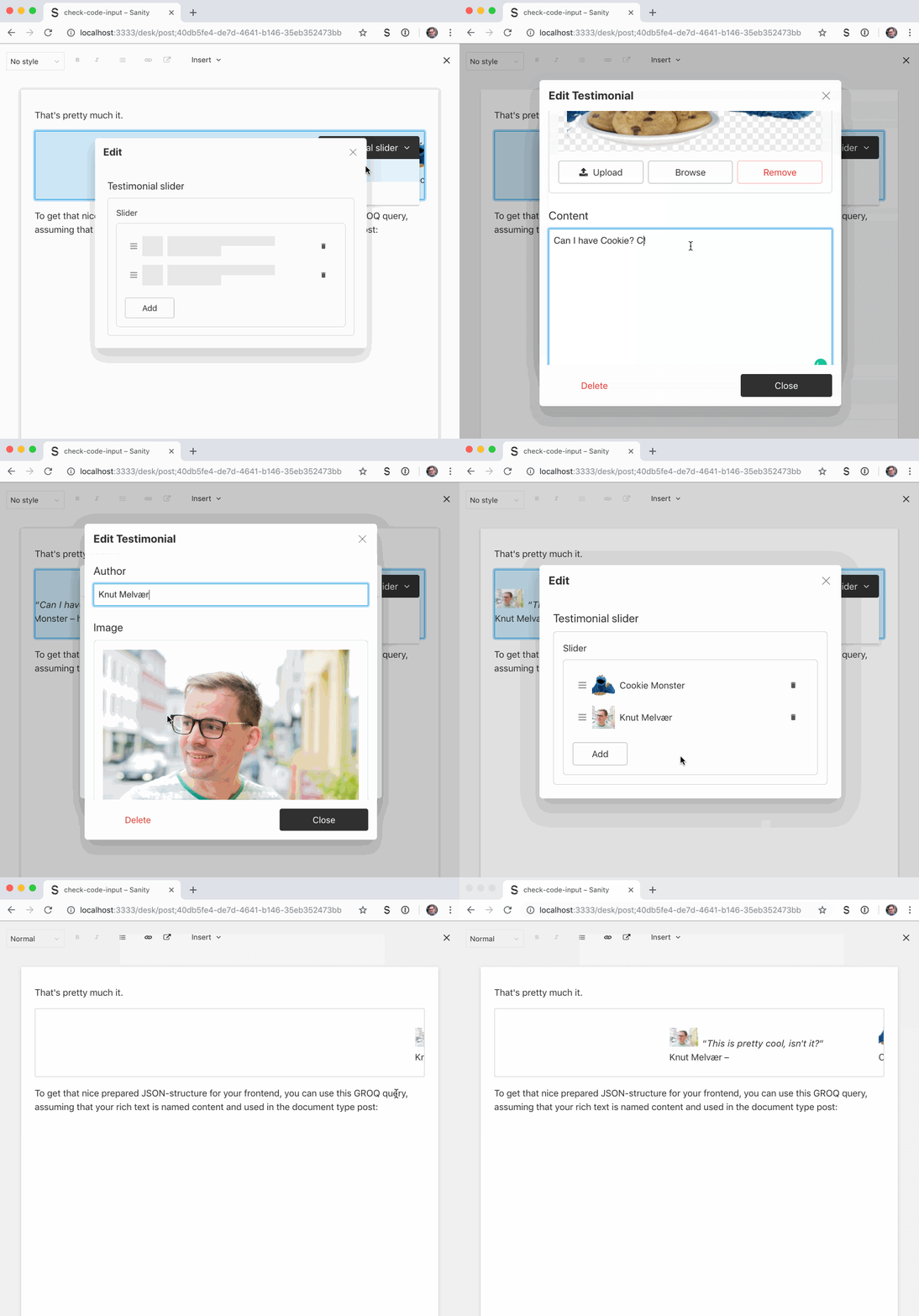
Example of the editing interface

To get that nice prepared JSON-structure for your frontend, you can use this GROQ query, assuming that your rich text is named content and used in the document type post:

Custom preview component

You can also add a custom preview component with some React code:

Include it in your schema by adding this to your testimonialSlider content type schema:

Here I’ve used the good old HTML element marquee to get a scrolling effect; you probably shouldn’t do the same:
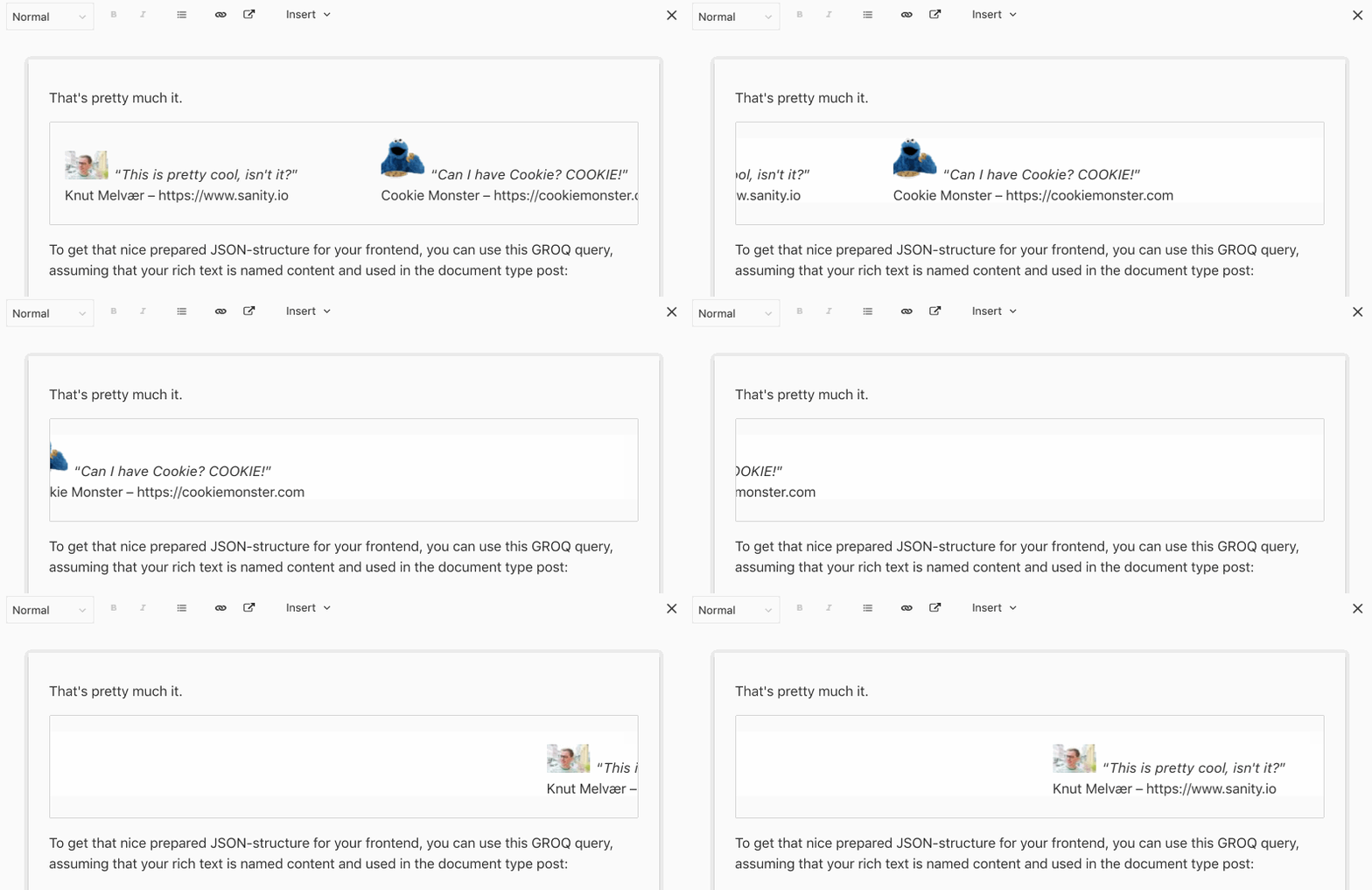
Example of slider preview

Beyond appearances: The advantage of deeply typed content

This testimonial slider example tightly ties to a specific presentation on a webpage, which makes sense in WordPress because it’s built to render and manage a website. WordPress saves the input in Gutenberg as HTML, which is what you eventually also get out of the APIs. HTML in content APIs is generally not what you want if you want to use it in your favorite frontend framework, or in something that should render in something other than a web browser.

Sanity saves the content in the editor as Portable Text, which makes it portable across any markup, but also makes rich text queryable. It should be easy to create custom editorial experiences, with the custom types and inputs that makes sense in your project or organization, and it should be easy to take that content and fit it to whatever form of presentation.