
惯性聚合 高效追踪和阅读你感兴趣的博客、新闻、科技资讯
阅读原文 在惯性聚合中打开

推荐订阅源

让小产品的独立变现更简单 - ezindie.com
Microsoft Azure Blog
大猫的无限游戏
大猫的无限游戏
月光博客
月光博客
V
V2EX
PCI Perspectives
PCI Perspectives
Latest news
Latest news
博客园 - 三生石上(FineUI控件)
C
CERT Recently Published Vulnerability Notes
W
WeLiveSecurity
Last Week in AI
Last Week in AI
奇客Solidot–传递最新科技情报
奇客Solidot–传递最新科技情报
P
Palo Alto Networks Blog
T
The Exploit Database - CXSecurity.com
K
KPMG report finds enterprise disconnect between AI and its ROI | CIO
cs.AI updates on arXiv.org
WordPress大学
WordPress大学
V
Vulnerabilities – Threatpost
H
Heimdal Security Blog
Attack and Defense Labs
cs.CV updates on arXiv.org
Hacker News: Ask HN
Hacker News: Ask HN
博客园 - 叶小钗
V
Visual Studio Blog
Jina AI
Jina AI
P
Proofpoint News Feed
罗磊的独立博客
SecWiki News
SecWiki News
J
Java Code Geeks
freeCodeCamp Programming Tutorials: Python, JavaScript, Git & More
L
LINUX DO - 热门话题
Security Archives - TechRepublic
The Hacker News
The Hacker News
Hugging Face - Blog
Hugging Face - Blog
N
News and Events Feed by Topic
NISL@THU
NISL@THU
T
Tailwind CSS Blog
T
Tenable Blog
Recent Commits to openclaw:main
Recent Announcements
H
Hacker News: Front Page
Exploit-DB.com RSS Feed
T
Tor Project blog
宝玉的分享
宝玉的分享
Help Net Security
Help Net Security
S
Security Affairs
Microsoft Security Blog
Google DeepMind News
F
Fortinet All Blogs
G
GRAHAM CLULEY

Sanity.io

A Board Game agent built using Sanity Context and Vercel's AI SDK | Sanity Build a prototype with Claude Code that your whole team can edit | Sanity What’s New - May 2026 | Sanity I built a London pub guide with v0 and the Sanity MCP in six hours. Here's what I learned. | Sanity Build a conference concierge with Agent Context and Anthropic | Sanity Build a content-aware Telegram agent with Vercel AI SDK and Chat SDK | Sanity How I used Agent API to generate photos for my family’s recipes | Sanity What’s New April - 2026 | Sanity Better context, better matches: An AI love story (for dogs) | Sanity How to write for an agent | Sanity Content Agent, meet Slack: AI content operations in your workflow | Sanity Structure powers intelligence | Sanity Your agent needs better content. Here's how to give it. | Sanity How to serve content to agents (a field guide) | Sanity Sanity TypeGen GA: Automatic TypeScript types for content and GROQ | Sanity Sanity is now available on the Vercel Marketplace | Sanity The logo soup problem (and how to solve it) | Sanity Content Releases: From scattered updates to coordinated publishing | Sanity What's New - February 2026 | Sanity How we solved the agent memory problem | Sanity v0 Builder Challenge: The winners | Sanity Introducing: Sanity Agent Skills | Sanity Content Agent: Days of work in one conversation | Sanity Our Sanity Values | Sanity Open Source Pledge 2025: Stepping up when it matters | Sanity v0 builder challenge: $3000 in prizes | Sanity Why AI Breaks Without Structured Content Operations | Sanity What’s New January - 2026 | Sanity BFCM 2025: What teams built when infrastructure stopped being the problem | Sanity How AI shaped holiday shopping and what it means for content in 2026 | Sanity Sanity Studio v5: Embracing React 19 | Sanity You’ll need a CMS eventually. Let your agent set it up. | Sanity “You should never build a CMS” | Sanity AI Content Operations: A 30-Day Implementation Guide | Sanity What’s New December - 2025 | Sanity Scheduled Drafts: Stop manually publishing content at midnight | Sanity What’s New November - 2025 | Sanity Everything *[NYC] 2025 recap: A day of AI, Content Operations, and Culture | Sanity Clankers and content operations | Sanity Content Agent: AI that understands your structured content is here | Sanity Why design-driven content modeling creates technical debt, not velocity | Sanity What's New October - 2025 | Sanity From studio to inbox: How Kevin Green eliminated email campaign friction | Sanity The content editor's guide to content operations [E-commerce edition] | Sanity styled-components maintenance mode: A 40% faster fork | Sanity From zero code to a live website in 7 hours (thanks, Cursor!) | Sanity First attempt will be 95% garbage: A staff engineer's 6-week journey with Claude Code | Sanity Internationalization is more than translating words | Sanity What's New - September 2025 | Sanity We just deleted our 35k-member community Slack | Sanity What's New - August 2025 | Sanity The engineer's guide to content operations [E-commerce edition] | Sanity SEO for AI: Evolving from Web Pages to the Content Lake | Sanity What's New - July 2025 | Sanity Sanity Studio v4: A major version bump for a minor reason | Sanity What's New - June 2025 | Sanity Dashboard and Insights: Your New Content HQ | Sanity Canvas: AI-accelerated, context-aware, freeform authoring | Sanity Agent Actions: AI building blocks for structured content | Sanity Functions: Life beyond pressing publish | Sanity A new era for content applications with Sanity App SDK | Sanity The end of CMS era and our $85M Series C. | Sanity What's New – May 2025 | Sanity Introducing the Sanity Model Context Protocol (MCP) server | Sanity What's New – April 2025 | Sanity Pushing all the envelopes with ambitious content | Sanity Self-hosting is only free if your time is worth nothing | Sanity Content that lasts: Scaling beyond your frontend | Sanity The Live Content API is now Generally Available | Sanity The future beyond AI chat bots | Sanity Learning the new skill of working with AI | Sanity What's New - March 2025 | Sanity Give it in plain text: Making your content AI-Ready | Sanity No More 'DO NOT PUBLISH': Introducing Content Releases | Sanity React in 2025, what's next? | Sanity The final boss of front-end: block editors | Sanity Introducing Sanity for Startups | Sanity A block content editor that loves you back | Sanity A Black Friday Snooze Fest: Massive Traffic, No Drama | Sanity How to make a recipe site that scales well | Sanity The Sanity Winter Release 2024 | Sanity AVIF Arrives, Sanity’s Promise Fulfilled | Sanity Sanity joins the Open Source Pledge | Sanity Your content is now Live by default | Sanity Begin Team to Join Sanity | Sanity Sanity Digest - September '24 Edition | Sanity Sanity partners with Google. Now live on the Google Cloud Marketplace. | Sanity Sanity Digest - August ‘24 Edition | Sanity Now playing: the latest Mux Video Input plugin for Sanity | Sanity Community Digest - June ‘24 Edition | Sanity Community Digest - May ‘24 Edition | Sanity Guide to Sanity's newest product announcements | Sanity AI and Content Creation: A Leader's Guide | Sanity Of course, you should be able to type your content quickly! | Sanity New to AI Assist: translation, reference suggestions, image generation | Sanity Speak the language of your editors: Sanity Studio UI localization | Sanity Introducing the new Sanity Growth plan to serve collaborative teams | Sanity Goodbye Feedback Frenzy, Hello Sanity Studio Comments! | Sanity Easing into the App Router with the Sanity Toolkit for Next.js | Sanity Making website updates easier with structured content | Sanity
Presentation: Work faster than ever with structured content | Sanity
Even Westvang · 2023-11-17 · via Sanity.io

We’ve seen it again and again: scaling to meet the sprawl of modern digital experiences (and doing so in creative, compelling ways) demands separating content from presentation. Rather than building content for each instance it's used, you need to be able to create content (like product information or a newsletter CTA) once and use it across many instances. It’s the only way to scale content operations, ensure accuracy, and expand to new digital surfaces as easily as your customers.

Sanity supercharges this reuse with our unmatched flexibility for structuring your content. Our customers rely on unlimited content types, unconstrained content modeling, and nested relationships to create cohesive, connected content.

Truth is, the engaging, differentiated customer experiences Sanity users build can lead to complexity on the back end. It requires editors to have expertise in their content model (or how your content is organized in Sanity) to navigate their day-to-day work. They need to think about how content is composed into various end-user experiences rather than simply looking at the front end as a one-to-one map of the content at hand.

“We believe in structured content to our core, that hasn’t changed. But we don’t believe there should be a ‘tax’ editors pay when using structured content.”

- Even Westvang, co-founder, Sanity

So how do we give you your cake and let you eat it, too? Allow us to introduce Presentation: a new way to work with structured content visually, using front-end presentations to navigate your content model and manage content in context. Let’s dive into what you get when you install the new Presentation tool, available now to everyone, regardless of plan.

A bridge to your content structure

Almost any content experience that’s been out in the world for more than a blink has some nuance or complexity to it. A charming quirk (or many quirks) that resulted from a decision to put something somewhere that made sense once, to someone.

Then there are the experiences that require incredibly thoughtful, deeply nested content structures to drive dynamic, connected content. In both scenarios, content managers need to have a fair amount of institutional knowledge to find the right field to edit quickly.

With Presentation, you can greatly reduce this complexity for the teams who manage content. For each end-experience your editors manage, they can navigate the content visually within Studio and edit content directly in context. Clicking any given component that comprises the visual will open the exact bit of structured content that powers it.

Presentation builds on Visual Editing which provides a direct path from your front end experiences into Sanity Studio.

This means editors spend precious time hunting-and-pecking to find source content. Not only is this helpful for existing editors, it makes onboarding new teammates faster, empowering them to contribute with confidence on day one.
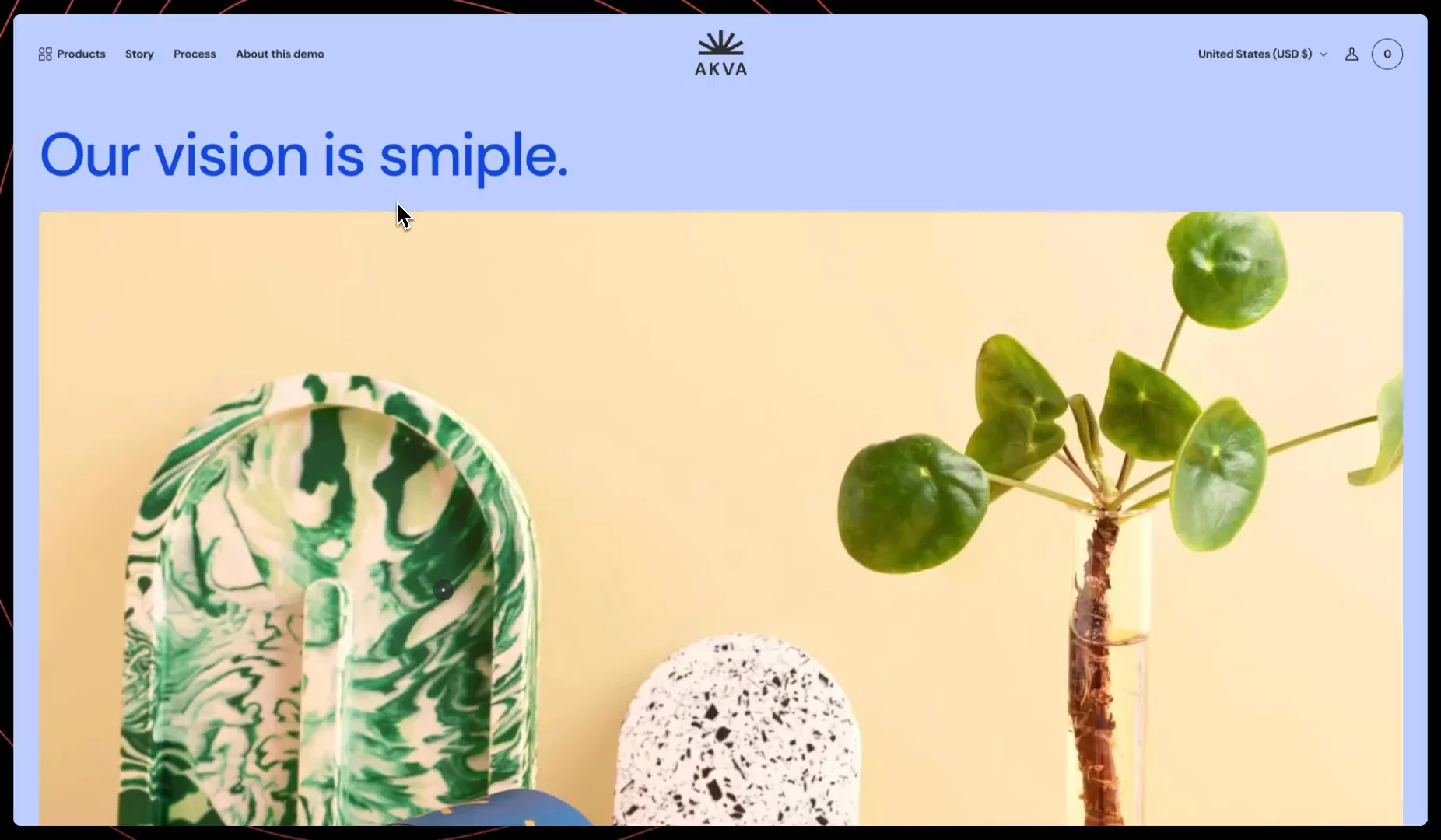
Page building (without “structure wrecking”)

There’s a wide spectrum of no-code (or low-code) page-building solutions available depending on the goals and guardrails of your company. Generally, it’s helpful to think about these by the degree of fine-grained design control you have.

While solutions with heavy design control—for example, fine-grained styling decisions or options to use components from generic libraries—can be great for small teams without design or development resources, they’re not a good fit for most Sanity customers. Why?

  1. They largely support flat website pages where content is tightly coupled to each individual presentation. There’s minimal reuse, which is a deal-breaker for teams who need the scale and fidelity that comes with structured content.
  2. Sanity customers work in teams. Content managers partner with their design and development counterparts, and rely on the design systems and component libraries they create. Guidance (and guardrails) from these teammates helps them move quickly and confidently, rather than losing time to design decisions or fixing mistakes.
“Requests for new landing pages were a huge bottleneck with [our prior no-code page builder]; to meet our design standards, our designer spent hours wrestling with the tool. With Sanity, we’ve defined the elements our teams need to build pages autonomously and confidently.”

-Daisy Longden, Senior Media Operations Manager, WaterBear Network

With Presentation, content teams working in Sanity have the right level of control to configure pages within the design systems their teammates define. This gives them the autonomy they need to move fast, without the risk of running afoul of brand guidelines, UX best practices or worse, degrading their content model and undermining reuse.

What you see is what you edit (and then some)

More efficient editorial workflows give precious time back to content teams for strategic and creative work to drive experimentation and innovation. It’s why Studio customization is so powerful—by tailoring the editing UI to match the unique needs of your teams, you streamline their daily work.

Presentation is yet another visual editing tool to help teams work more efficiently. As editors work, their changes render in real-time so editors know immediately if their changes look great (or if they should try a different tweak). Critically, editors can also quickly see where and how their changes cascade everywhere else the content is used.

“Giving customers clear, easy-to-access understanding of how their changes appear everywhere—to protect their investment in high-scale and strategic content reuse—was a priority in designing this feature.”

- Even Westvang, co-founder, Sanity

And, given Sanity’s next-level support for collaboration, editors see each other's changes live as well. This means a change to content that’s shared across a microsite page and a help article will be reflected in both places instantly, so everyone has the latest context.

This is the power of structured content: every investment in content goes further when you can easily surface across customer touchpoints, without any overhead to manage updates in many places.
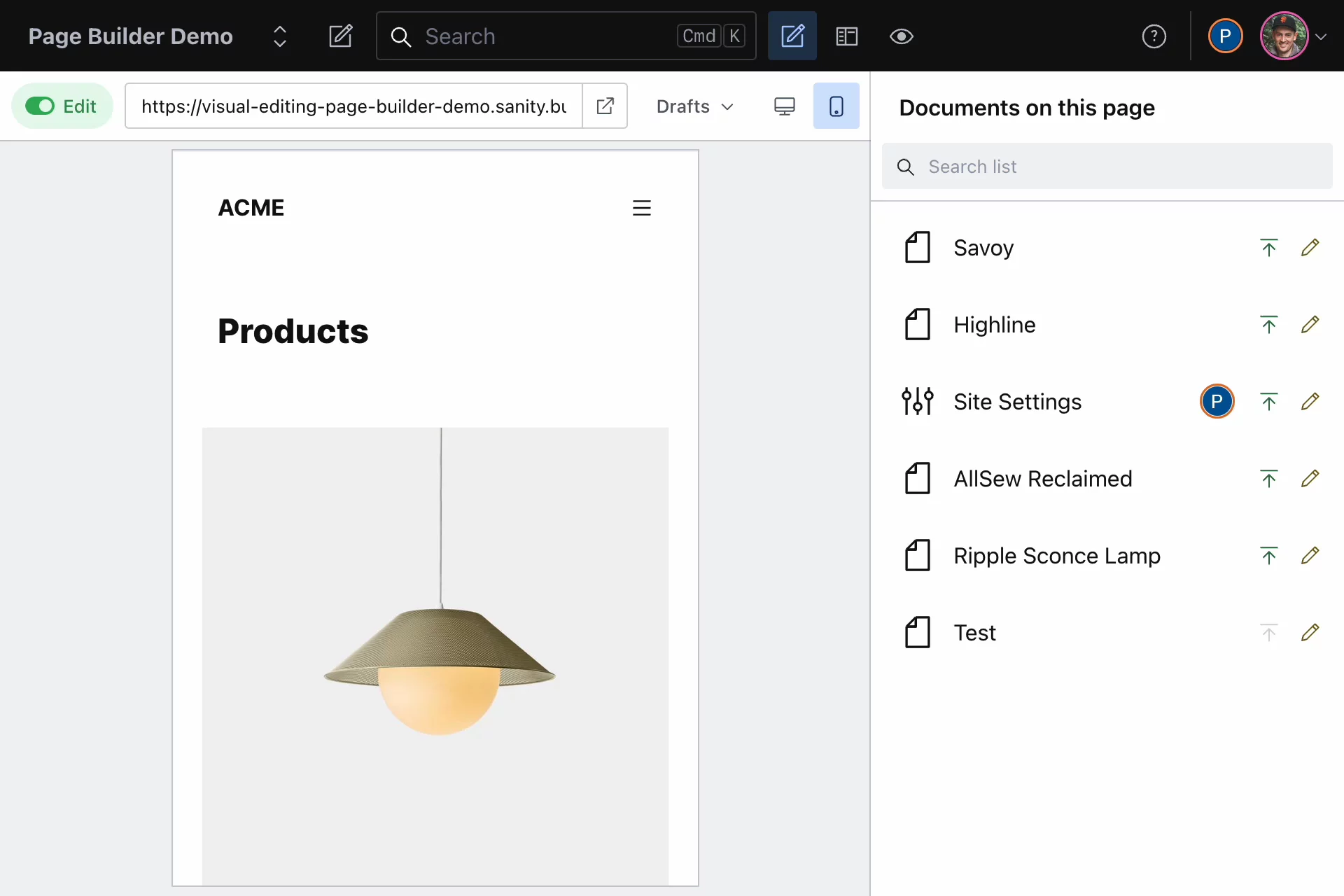
The right tool for the task

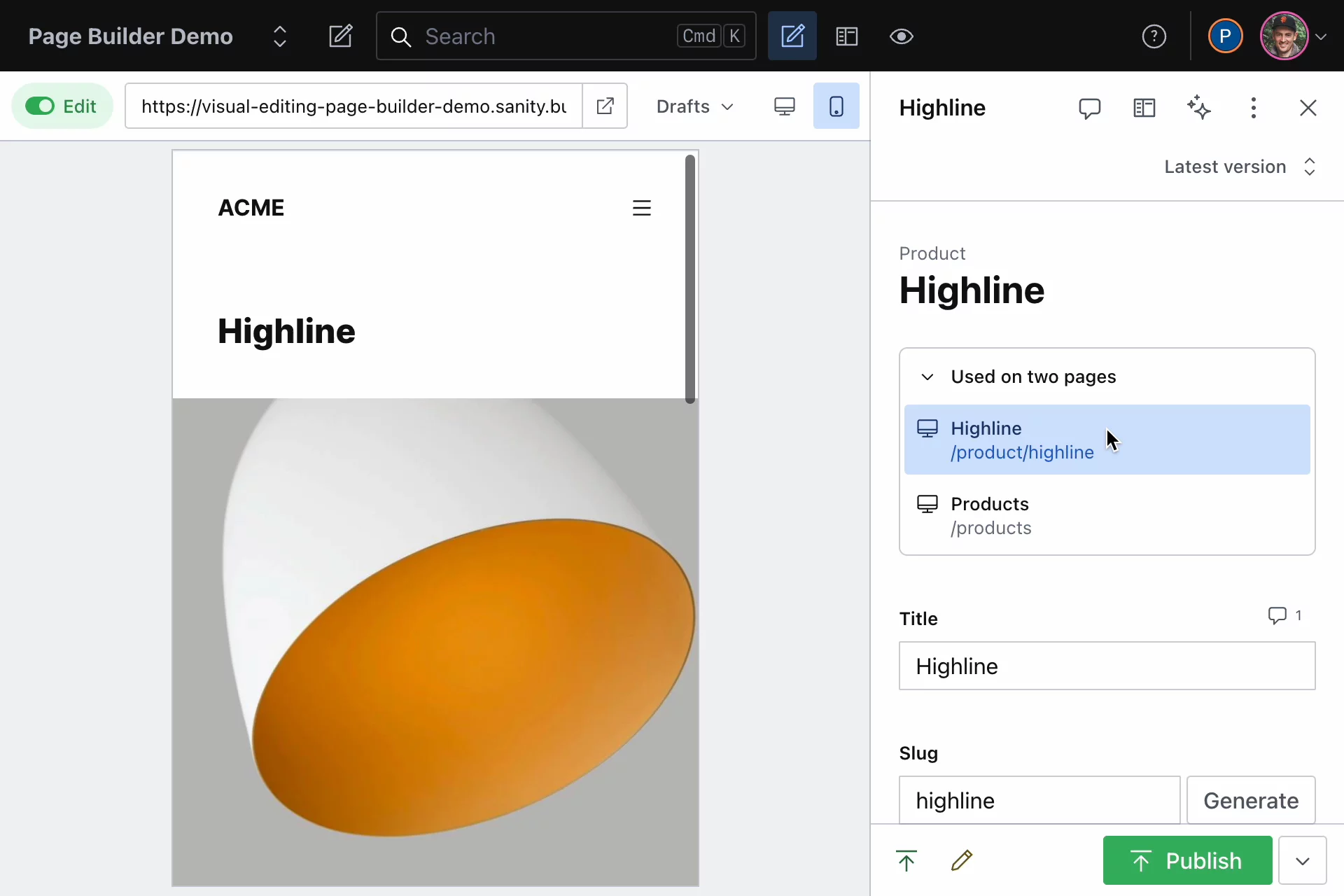
Because Presentation shows how your content renders on, well… specific presentations of your content, teams will still have many reasons to work within the context of your content model.

Within Sanity, this is done via the Desk tool, which is now called “Structure” to better align to its purpose. Structure is the place in Studio where your content is organized based on the types you’ve defined and the relationships between them. For the power editor, working from the vantage of structure is often faster than working visually—especially for repetitive tasks across the same document type.

There are also many use cases for content types in Sanity that don’t actually have an end-presentation (or don't live on a URL that you own). A common example is content for social or paid search. As another example, at Sanity, we use the Studio to ingest and review user-generated feedback on our documentation in our ongoing optimization work.

Then, in a growing and quite inspiring usage pattern (made possible by Sanity’s unlimited content types and support for more complex modeling) many customers use documents in the Studio to power configuration or act as a “control pane” for digital experiences. Within the Studio, teams can create and configure the categories to attach to content types within a blog, or annotate the stage of content readiness as part of their workflow management.

Regardless of the use cases your teams have, switching from Presentation to Structure (and back again!) is seamless so don’t lose time to extra clicks.
Developers: get started with Presentation

Presentation is available now to all Sanity users, regardless of plan. To bring this new capability to your editors within Sanity Studio, start by deciding which front-end experiences you wish to support with Presentation.

Get started with Presentation

At the core of Presentation is giving your editors an instant, clickable preview of end experiences they manage right within Studio. We’ve long offered live preview tooling, but with this release, we’re introducing a new library that makes them way easier to implement.

The Loaders library does this by packaging up the protocols for safe data fetching, instant previews, and the logic for switching between draft and preview perspectives. Loaders are available for Next.js, Svelte, Remix, Nuxt, and vanilla JS.

That said, to give optionality to developers who have set up live previews on projects in the past using Preview-Kit, there’s backwards compatibility with Presentation.