


惯性聚合 高效追踪和阅读你感兴趣的博客、新闻、科技资讯
阅读原文 在惯性聚合中打开

推荐订阅源

S
Security Affairs
WordPress大学
WordPress大学
MongoDB | Blog
MongoDB | Blog
A
About on SuperTechFans
F
Fortinet All Blogs
Hacker News: Ask HN
Hacker News: Ask HN
酷 壳 – CoolShell
酷 壳 – CoolShell
Google DeepMind News
H
Hackread – Cybersecurity News, Data Breaches, AI and More
博客园 - Franky
Hacker News - Newest:
Hacker News - Newest: "LLM"
Security Archives - TechRepublic
T
Tenable Blog
Hugging Face - Blog
Hugging Face - Blog
Recorded Future
Recorded Future
NISL@THU
NISL@THU
SecWiki News
SecWiki News
Cyberwarzone
Cyberwarzone
Stack Overflow Blog
Stack Overflow Blog
K
KPMG report finds enterprise disconnect between AI and its ROI | CIO
V2EX - 技术
V2EX - 技术
Simon Willison's Weblog
云风的 BLOG
云风的 BLOG
Microsoft Azure Blog
Application and Cybersecurity Blog
D
Docker
C
Check Point Blog
CTFtime.org: upcoming CTF events
S
Schneier on Security
博客园 - 【当耐特】
雷峰网
雷峰网
月光博客
月光博客
H
Help Net Security
人人都是产品经理
人人都是产品经理
博客园 - 三生石上(FineUI控件)
Google Online Security Blog
L
LINUX DO - 最新话题
Microsoft Security Blog
Know Your Adversary
Know Your Adversary
The GitHub Blog
The GitHub Blog
H
Hacker News: Front Page
D
Darknet – Hacking Tools, Hacker News & Cyber Security
AI
AI
Cisco Talos Blog
Cisco Talos Blog
G
Google Developers Blog
V
Vulnerabilities – Threatpost
TaoSecurity Blog
TaoSecurity Blog
T
Troy Hunt's Blog
freeCodeCamp Programming Tutorials: Python, JavaScript, Git & More
T
The Blog of Author Tim Ferriss

Sanity.io

A Board Game agent built using Sanity Context and Vercel's AI SDK | Sanity Build a prototype with Claude Code that your whole team can edit | Sanity What’s New - May 2026 | Sanity I built a London pub guide with v0 and the Sanity MCP in six hours. Here's what I learned. | Sanity Build a conference concierge with Agent Context and Anthropic | Sanity Build a content-aware Telegram agent with Vercel AI SDK and Chat SDK | Sanity How I used Agent API to generate photos for my family’s recipes | Sanity What’s New April - 2026 | Sanity Better context, better matches: An AI love story (for dogs) | Sanity How to write for an agent | Sanity Content Agent, meet Slack: AI content operations in your workflow | Sanity Structure powers intelligence | Sanity Your agent needs better content. Here's how to give it. | Sanity How to serve content to agents (a field guide) | Sanity Sanity TypeGen GA: Automatic TypeScript types for content and GROQ | Sanity Sanity is now available on the Vercel Marketplace | Sanity The logo soup problem (and how to solve it) | Sanity Content Releases: From scattered updates to coordinated publishing | Sanity What's New - February 2026 | Sanity How we solved the agent memory problem | Sanity v0 Builder Challenge: The winners | Sanity Introducing: Sanity Agent Skills | Sanity Content Agent: Days of work in one conversation | Sanity Our Sanity Values | Sanity Open Source Pledge 2025: Stepping up when it matters | Sanity v0 builder challenge: $3000 in prizes | Sanity Why AI Breaks Without Structured Content Operations | Sanity What’s New January - 2026 | Sanity BFCM 2025: What teams built when infrastructure stopped being the problem | Sanity How AI shaped holiday shopping and what it means for content in 2026 | Sanity Sanity Studio v5: Embracing React 19 | Sanity You’ll need a CMS eventually. Let your agent set it up. | Sanity “You should never build a CMS” | Sanity AI Content Operations: A 30-Day Implementation Guide | Sanity What’s New December - 2025 | Sanity Scheduled Drafts: Stop manually publishing content at midnight | Sanity What’s New November - 2025 | Sanity Everything *[NYC] 2025 recap: A day of AI, Content Operations, and Culture | Sanity Clankers and content operations | Sanity Content Agent: AI that understands your structured content is here | Sanity Why design-driven content modeling creates technical debt, not velocity | Sanity What's New October - 2025 | Sanity From studio to inbox: How Kevin Green eliminated email campaign friction | Sanity The content editor's guide to content operations [E-commerce edition] | Sanity styled-components maintenance mode: A 40% faster fork | Sanity From zero code to a live website in 7 hours (thanks, Cursor!) | Sanity First attempt will be 95% garbage: A staff engineer's 6-week journey with Claude Code | Sanity Internationalization is more than translating words | Sanity What's New - September 2025 | Sanity We just deleted our 35k-member community Slack | Sanity What's New - August 2025 | Sanity The engineer's guide to content operations [E-commerce edition] | Sanity SEO for AI: Evolving from Web Pages to the Content Lake | Sanity What's New - July 2025 | Sanity Sanity Studio v4: A major version bump for a minor reason | Sanity What's New - June 2025 | Sanity Dashboard and Insights: Your New Content HQ | Sanity Canvas: AI-accelerated, context-aware, freeform authoring | Sanity Agent Actions: AI building blocks for structured content | Sanity Functions: Life beyond pressing publish | Sanity A new era for content applications with Sanity App SDK | Sanity The end of CMS era and our $85M Series C. | Sanity What's New – May 2025 | Sanity Introducing the Sanity Model Context Protocol (MCP) server | Sanity What's New – April 2025 | Sanity Pushing all the envelopes with ambitious content | Sanity Self-hosting is only free if your time is worth nothing | Sanity Content that lasts: Scaling beyond your frontend | Sanity The Live Content API is now Generally Available | Sanity The future beyond AI chat bots | Sanity Learning the new skill of working with AI | Sanity What's New - March 2025 | Sanity Give it in plain text: Making your content AI-Ready | Sanity No More 'DO NOT PUBLISH': Introducing Content Releases | Sanity React in 2025, what's next? | Sanity The final boss of front-end: block editors | Sanity Introducing Sanity for Startups | Sanity A block content editor that loves you back | Sanity A Black Friday Snooze Fest: Massive Traffic, No Drama | Sanity How to make a recipe site that scales well | Sanity The Sanity Winter Release 2024 | Sanity AVIF Arrives, Sanity’s Promise Fulfilled | Sanity Sanity joins the Open Source Pledge | Sanity Your content is now Live by default | Sanity Begin Team to Join Sanity | Sanity Sanity Digest - September '24 Edition | Sanity Sanity partners with Google. Now live on the Google Cloud Marketplace. | Sanity Sanity Digest - August ‘24 Edition | Sanity Now playing: the latest Mux Video Input plugin for Sanity | Sanity Community Digest - June ‘24 Edition | Sanity Community Digest - May ‘24 Edition | Sanity Guide to Sanity's newest product announcements | Sanity AI and Content Creation: A Leader's Guide | Sanity Of course, you should be able to type your content quickly! | Sanity New to AI Assist: translation, reference suggestions, image generation | Sanity Speak the language of your editors: Sanity Studio UI localization | Sanity Introducing the new Sanity Growth plan to serve collaborative teams | Sanity Presentation: Work faster than ever with structured content | Sanity Easing into the App Router with the Sanity Toolkit for Next.js | Sanity Making website updates easier with structured content | Sanity
Goodbye Feedback Frenzy, Hello Sanity Studio Comments! | Sanity
Marissa Ghassemian · 2023-11-17 · via Sanity.io

Have you ever created a piece of content that didn’t benefit from feedback or stakeholder approval? Neither have we! From an initial draft to the final version, feedback is needed at every stage and often from a mix of teammates; collaboration is key.

We’re also betting you can relate to the potential cost if this collaboration isn’t managed well; slow response times, disjointed or lost threads, and confusion from lack of context are all too familiar in the content creation journey. These costs underscore the importance of seamless collaboration—a principle that has guided the development of many of Sanity Studio’s most-loved features like real-time collaboration and clear revision history and version control.

Today we’re announcing Comments as yet another feature to help collaborative teams move faster. Comments lets users converse directly within documents once content is staged in Sanity Studio.

Streamline feedback into Sanity Studio


A strong pattern we’ve identified for many users is to collaborate outside of Sanity during initial content creation. Often this is a first draft of an article in Google Docs or a design mock in Figma. Within these tools, teams rely heavily on comments to trade feedback and keep track of progress right within the context of their work.

Once content is staged to Sanity, however, users lose this affordance, which means any collaboration suddenly needs to happen via email, Slack, or outdated source documents. This can lead to a slowdown in publishing new content or making updates (a slowdown that has also impacted our users whose entire content lifecycle happens in Sanity).

With the introduction of Comments, we’ve solved for this by giving users a more cohesive content creation workflow. Gone are the days of toggling between Sanity and various alternate feedback channels to keep track of the latest threads or action items. Comments bridges the gap from the first brainstorm to the last stamp of approval, ensuring in-context conversations are easy at every step of your content's journey.

Converse with clarity

Comments comes with an array of features to enrich your content development process:

Field-level commenting: Errors can be flagged, improvements suggested, and context provided right where it's needed to minimize confusion.
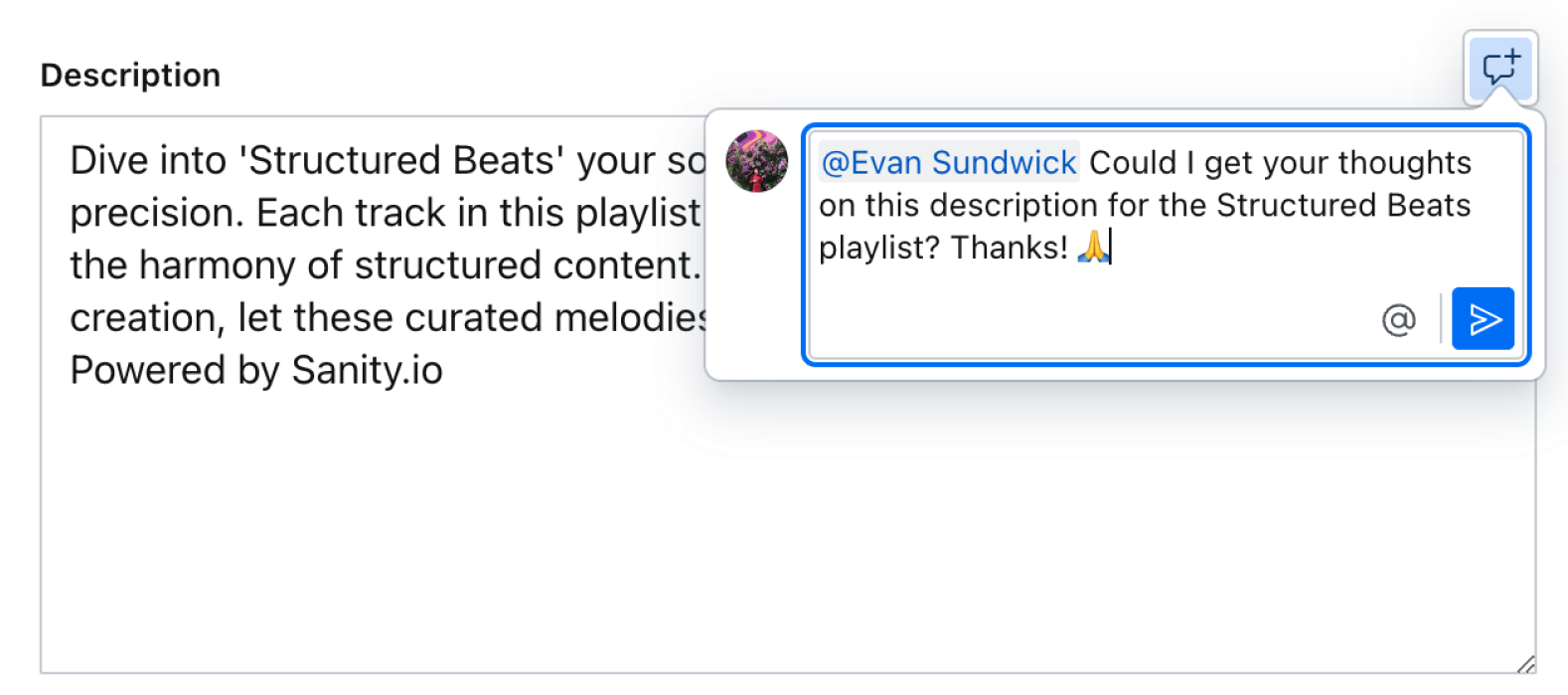
Comment on Description field

User mentions: Responsibilities can be clearly assigned and attention focused where it’s needed by tagging specific teammates, speeding up review cycles and response times.
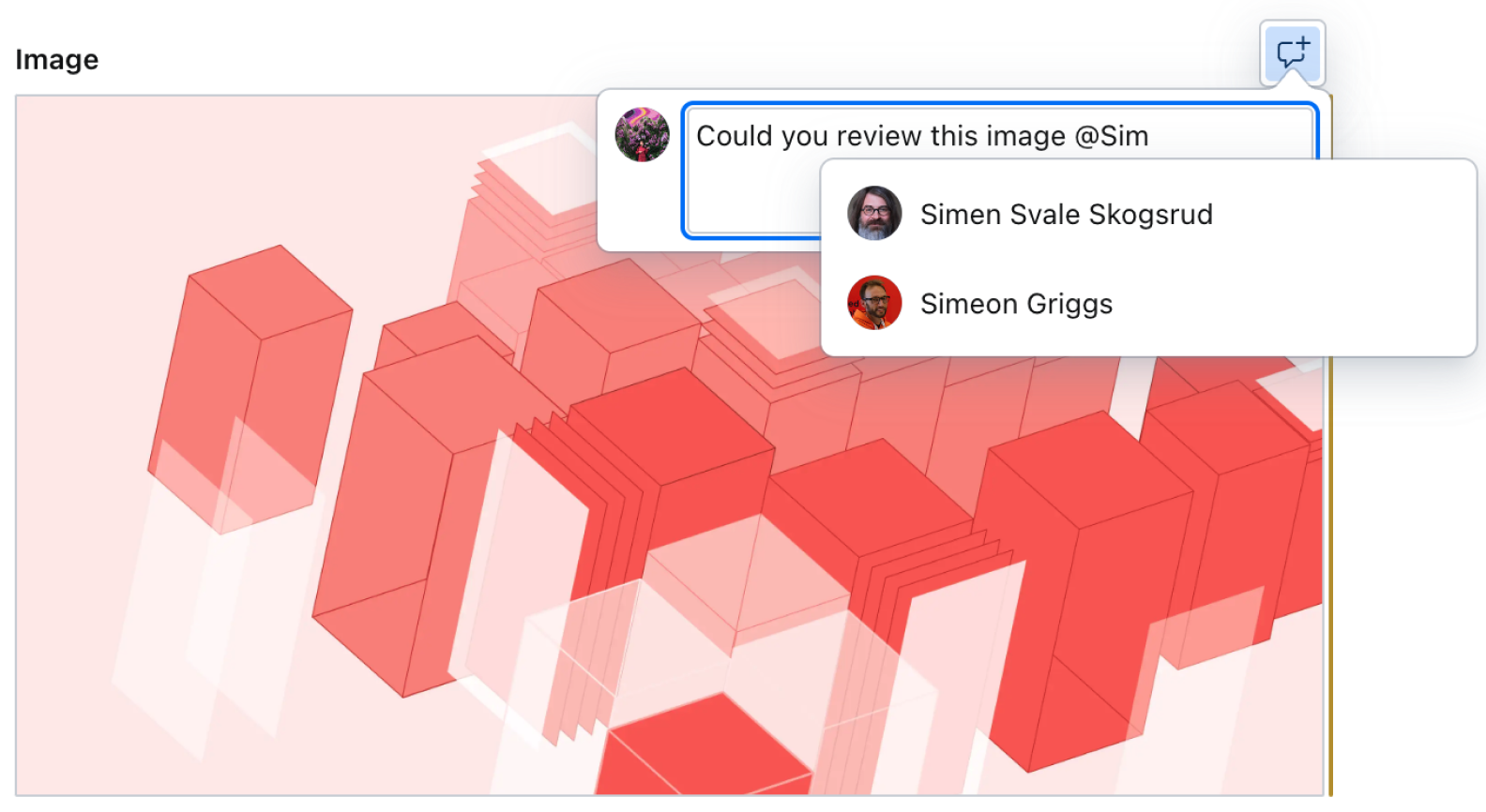
Tag a sanity studio user

Email notifications: Email alerts keep users informed about mentions and replies so no one misses a beat or slows progress down if logged out of the Sanity Studio.
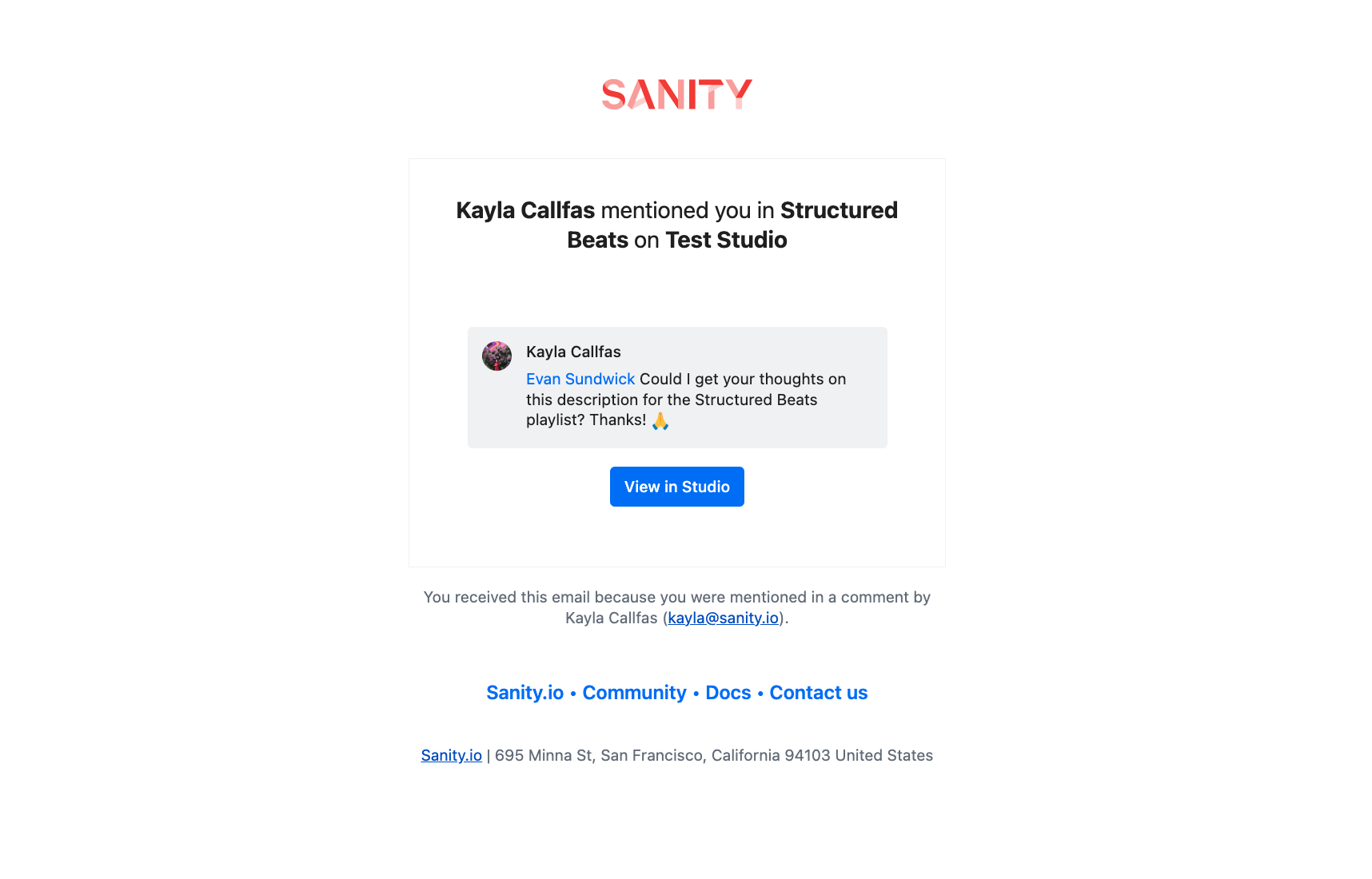
Email notification
Email notification

Threaded replies: Discussions are kept organized and clear, allowing everyone involved to easily track the progression of assignments, ideas, and decisions.
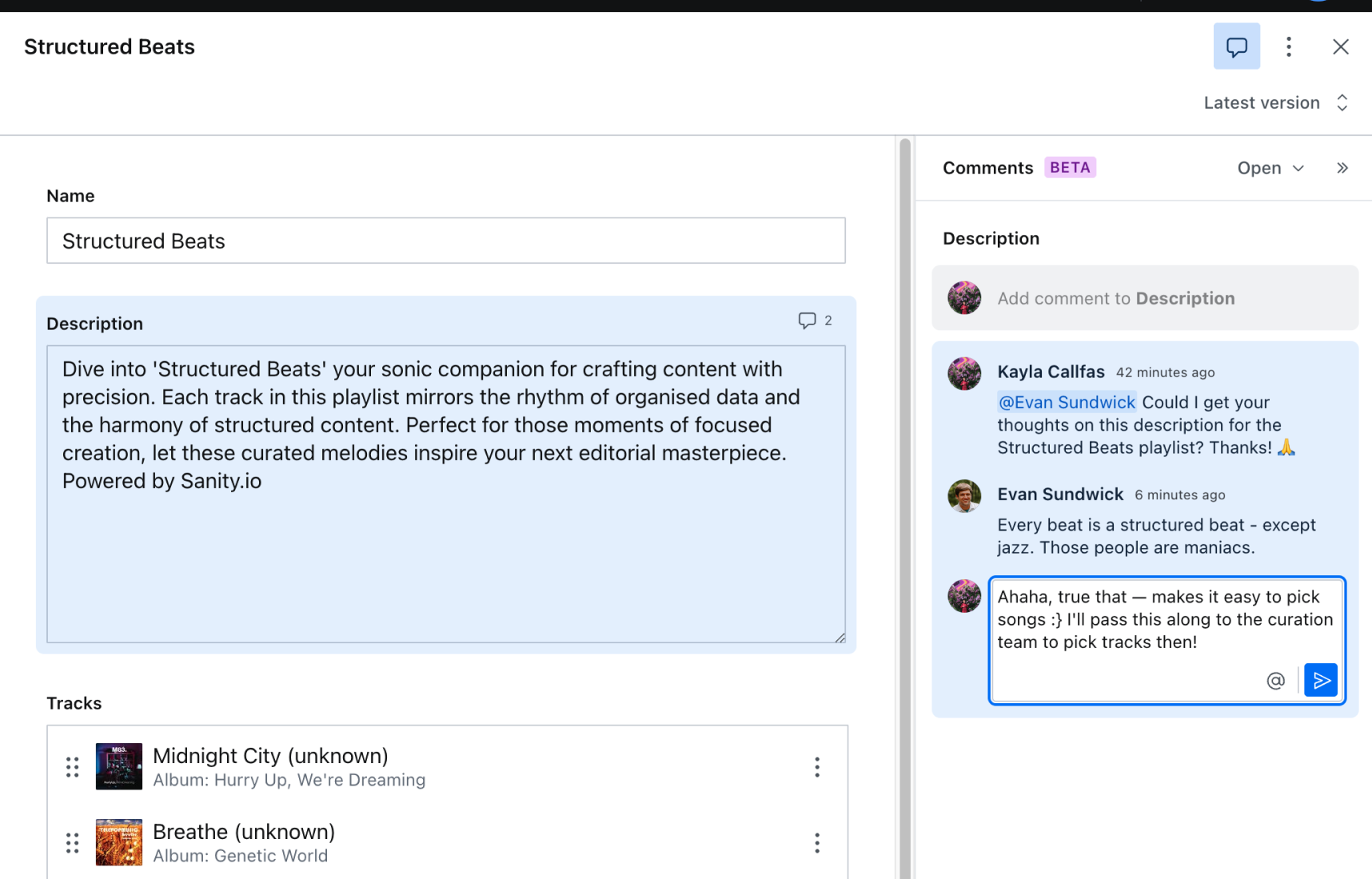
Threaded comment replies

Comment status tracking: Editors can mark comments as open or resolved to easily identify which comments are pending and which have been addressed, maintaining efficiency and focus.
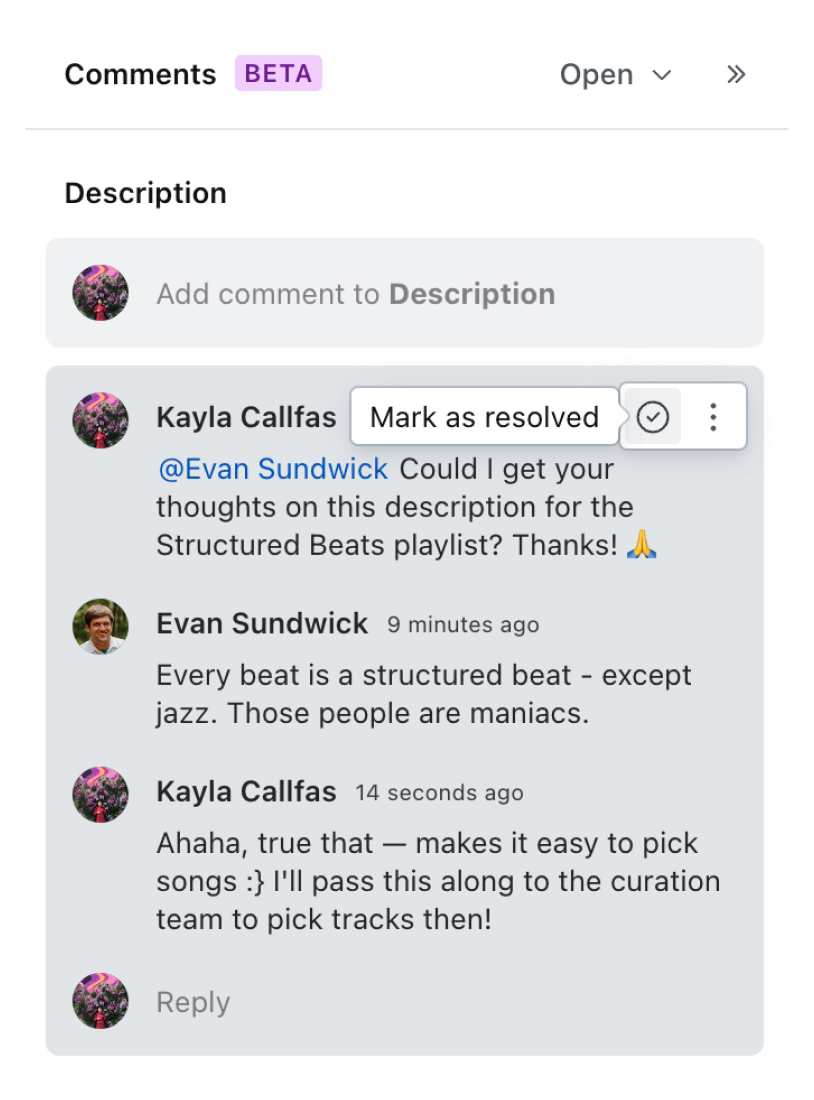
Mark a comment as resolved

Feedback archives: Comments can be viewed even after they’re resolved, providing documentation of the rationale behind changes for future reference.
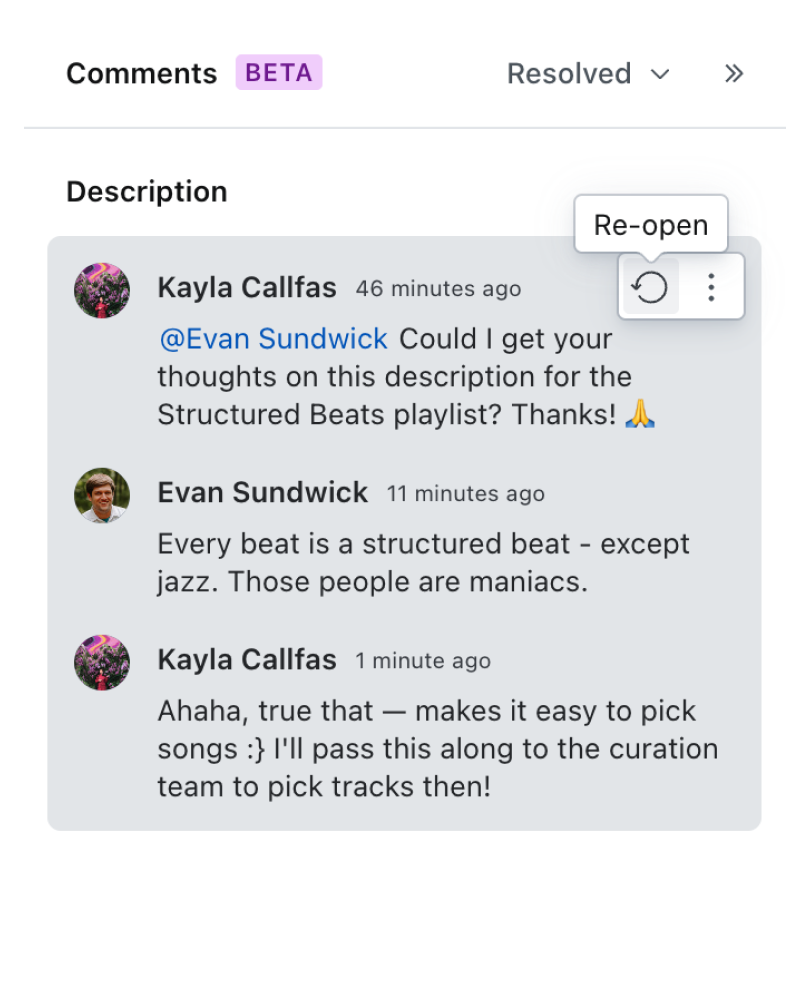
View and re-open resolved comments

Comment navigation: By clicking on a comment, users are directed straight to the relevant section of content in need of review or revision, reducing errors and ensuring that no feedback is misapplied.
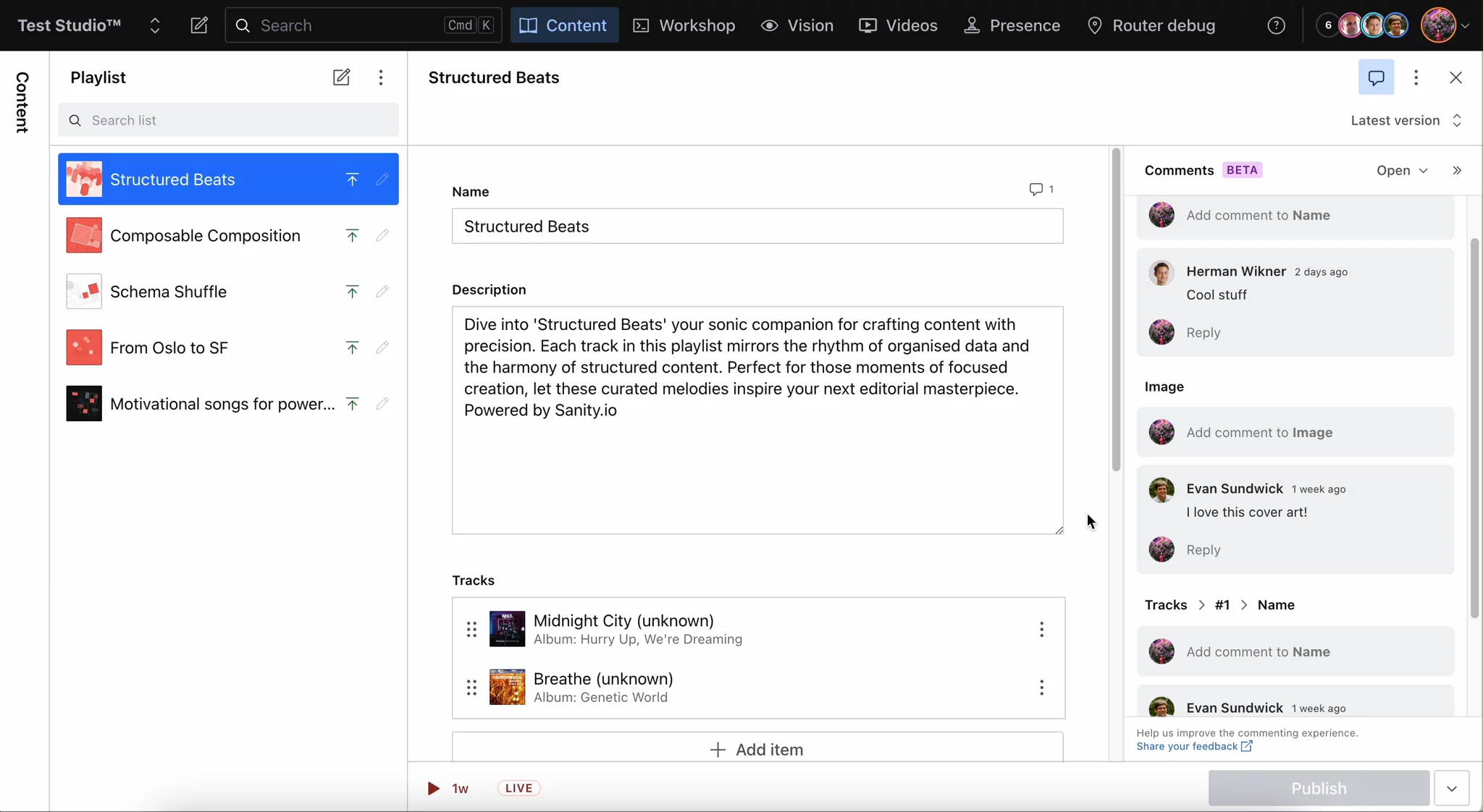
These combined features provide a direct way for team members—from authors to legal teams—to discuss content within the context of a document itself. Not only does this streamline review processes, it makes them more comprehensive by increasing engagement from cross-functional teammates.

How to get started

During open beta, Comments is an opt-in feature. No matter if you have a new or existing project, enabling comments in your studio is quick and easy!

Enabling comments for both new and existing projects is as simple as updating your Studio to ensure you’re on Studio 3.19.0 (or higher) and adding two small lines of code to your Studio config file as noted below:

To view more detailed steps on how to implement Comments into your Studio as well as view additional config options, such as enabling Comments for a specific document type, you can view the documentation here.

Closing the feedback loop

Comments is yet another way Sanity helps teams ship high-impact digital experiences faster. Experience a world where fluid content creation, thorough reviews, and swift updates are seamlessly integrated with the benefits of a Content Operating System.

So, if you're on our Growth plan or above, why wait? Head to our docs to learn more about implementing Comments into your workflows.