





Today, we're welcoming Lucas da Costa to the team.
Before Resend, he was the CEO of Briefer, and before that, he was an engineer at Elastic.
He's also the author of the book Testing JavaScript Applications. He loves command-line interfaces, and vim. In fact, he likes vim so much that he got a :w tattooed on his ankle.
How did you get into software?
When I was a kid, my friends and I used to play an online MMORPG called Ragnarok Online, which was wildly popular in Brazil.
Like most games of its kind, it demanded serious grind. I spent endless hours hunting for swords, armor, and "zeny" (the game's virtual currency) just to stay competitive.
One day, I figured out there was an open-source program I could script to play the game for me. That's when I learned Perl so I could become the most powerful Priest in Rune Midgard.
That's also when it hit me: if writing code feels as fun as playing video games, I should probably be a programmer.
What does your desktop/home screen look like?
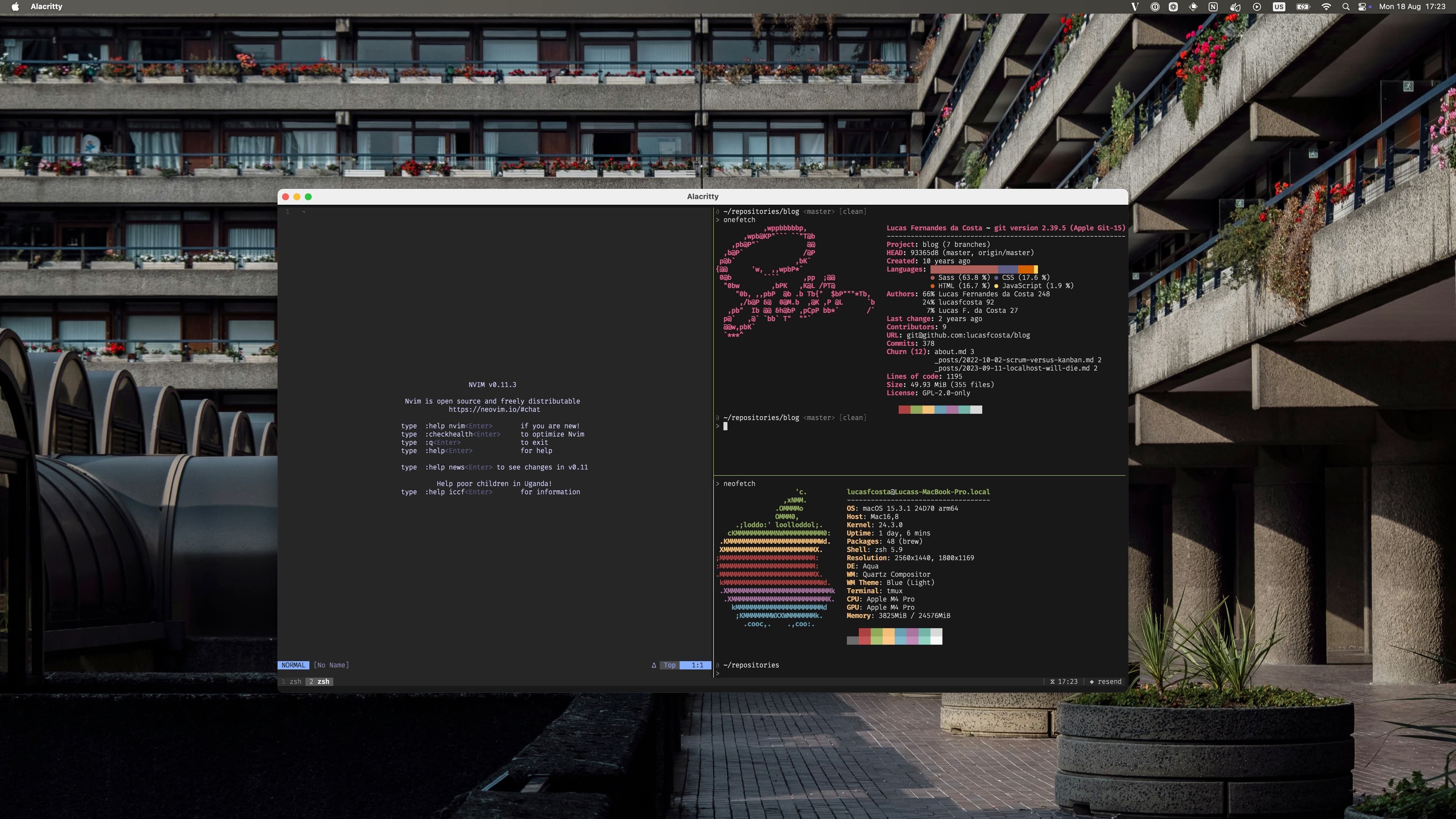
Why are you at Resend?
I've been following Resend closely since its inception. When Zeno and Bu had an initial version ready, I was one of the first to sign up and send over a friction log. I've admired their work ever since, both as a fan and as a customer at Briefer, the company I co-founded.
Resend consistently shipped some of the fastest, highest-quality work I'd seen from any early-stage team. Furthermore, the team's attention to detail is just unparalleled.
When Resend acquired Briefer, I was super excited to join the team I've admired for quite a while.
Where do you find #inspiration?
Most of my inspiration comes from books (all kinds of them). I love reading and writing, and I care a lot about choosing the right words for the moment, even the oddly specific ones. Like apricity, which perfectly describes that quiet warmth you feel on your face during a cold morning walk, when the sun finally breaks through.
I also find inspiration in the built world. My father and my wife are both architects, which means I grew up knowing way more about buildings than I ever planned to. Over time, that just made me enjoy noticing how things are put together and how much care goes into making them feel just right (just like the Resend team does with software).
If you weren't programming, what would you be doing?
My wife sometimes tells me I'd make a great architect, though I suspect she might be a bit biased. In reality, I see myself more as a writer.
I already spend a lot of time writing on my blog and jotting down notes for myself, it's something I do naturally, without even thinking about it, so I think I'd enjoy that way of life.
Favorite tool?
I love vim (and now neovim). I even got a tattoo of :w on my ankle to celebrate my love for it.
Favorite hotkey?
I'm a big fan of <leader>q and :cn/:cp. I use <leader>q to add items to Vim's quickfix list, then :cn and :cp to jump through them and fix everything that needs attention.
That said, <leader>ca is a close second. I rely on it to trigger my LSP's code actions and apply quick fixes as I work through the quickfix list.
Favorite place to visit?
I love visiting London. I've lived there for five years, and I deeply miss all my friends that still live there.

Advice for ambitious software engineers?
Look to understand how software works behind the hood, not just what it does or how to use it.
Once you adopt that curiosity mindset, you realize most problems aren't magic or mystery. Instead, it's always just software!
If you can read and write code, you have everything it takes to fix just about anything that breaks. Sometimes all it takes is to go one layer of abstraction deeper, and suddenly the solution becomes clear.
此内容由惯性聚合(RSS阅读器)自动聚合整理,仅供阅读参考。 原文来自 — 版权归原作者所有。