







Following our Satya podcast from MS Build, we published Loopcraft last week, and over the weekend the Bill-Gates-quoting Microsoft CEO was back with his first ever X article and an extreme (>60 million view) banger on frontier ecosystems over models:
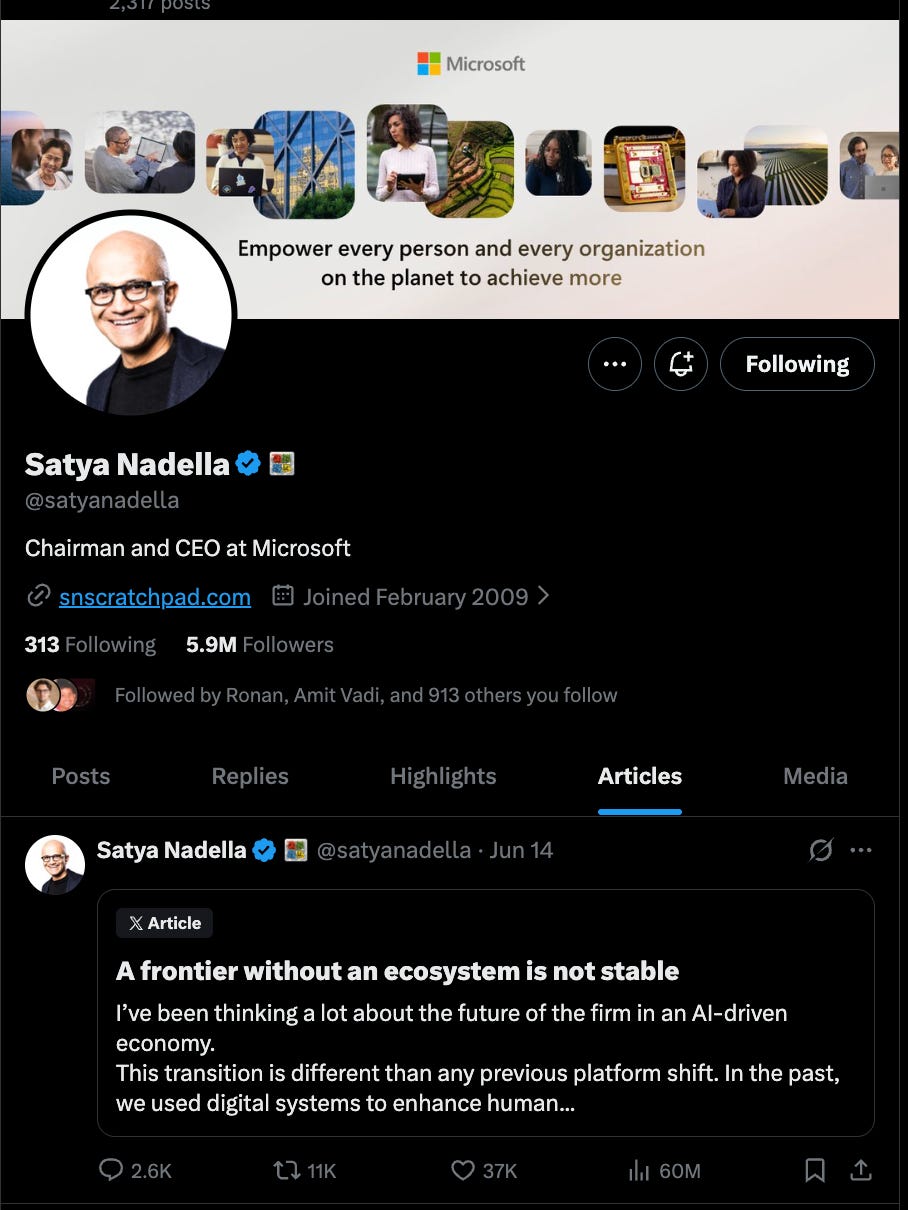
In it, he spells out many of the things he was already saying on our pod, this time with the added terminology of Loopcraft that amounts to a new “theory of the firm”- Loops building the new IP/”token capital” of the company:
This is the first time we can create a real cognitive loop between people and digital systems. That is a mind-bender, because it changes how we even conceptualize work inside an enterprise….
This means the real opportunity is not in picking the best model but instead in building a learning loop on top of models where human capital and token capital compound. You can offload a task, or even a job, but you can never offload your learning…
In my view, our priority has to be building a frontier ecosystem, not just a frontier model, so value flows broadly across every company, every industry, and every country. One where every organization can own the learning loop that encodes its institutional knowledge, compounding its human and token capital.
Of course, to anyone familiar with the language of Big Model vs Big Harness, you’ve all heard some variant of this before, and either view it as “cope” or timeless sage wisdom. What you’ve never heard, til this month in his series of well executed new media appearances, is the CEO of Microsoft so cogently articulating his new AI strategy for the first time since the OpenAI breakup eight months ago.
AI News for 6/10/2026-6/11/2026. We checked 12 subreddits, 544 Twitters and no further Discords. AINews’ website lets you search all past issues. As a reminder, AINews is now a section of Latent Space. You can opt in/out of email frequencies!
Anthropic’s Fable/Mythos Export-Control Crisis and the Push for Transparent AI Risk Governance
Fable 5 remains the defining story of the day: the strongest signal across the tweet set is continued fallout from the U.S. government’s export-control action against Anthropic’s Fable/Mythos models. Multiple posts summarize conflicting accounts: Anthropic says it had coordinated pre-release with agencies and was then hit with a broad directive on short notice, forcing it to suspend access for everyone; administration-side sources frame the issue as a mix of cyber-risk concerns and a severe communication breakdown with the White House (CNBC/Axios summary via @kimmonismus, more Axios framing, Politico reporting via @SophiaCai99, roundup via @TheRundownAI). The upshot for engineers: frontier model access is now visibly entangled with national-security process, not just technical evals.
The technical-policy critique from builders is converging: several technical voices argue the current regime is too opaque and too dependent on ad hoc political intervention. @fchollet calls arbitrary regulatory strikes counterproductive, and separately argues for standardized benchmarks for agentic capabilities instead of “panic-reacting to prompt-engineering parlor tricks” (tweet). @simonw notes the shutdown appears to be dragging on longer than expected, while Epoch AI reported that Claude Fable 5 had just set a new high of 161 on the Epoch Capabilities Index, edging GPT-5.5 Pro. That juxtaposition—state-of-the-art capability plus sudden regulatory unavailability—is pushing more people toward routing, model neutrality, and own-your-stack architecture.
Agent Harnesses, Model Neutrality, and Production Observability
Model neutrality is hardening from philosophy into architecture: a recurring theme is that teams should avoid tying products to a single model vendor. @hwchase17 argues model neutrality matters more than cloud neutrality because models change faster, commoditize selectively, and may need to be mixed within a single run. Complementing that, @nikesharora argues fungibility across models requires building harness, context, memory, and routing into the application layer. @mignano frames this as a new “rebel alliance” stack around open weights, distributed compute, routing, open harnesses, and alignment-preserving infra.
Agent systems are shifting from demos to operational systems: several posts emphasize observability, trace analysis, and eval infrastructure as the difference between toy agents and production. @sauvast and @hwchase17 both make the same point succinctly: if you can’t explain an agent’s behavior, you have a demo, not an architecture. LangChain pushed this theme repeatedly, including LangSmith Engine for surfacing issues from production, and a post-trained judge for detecting production-trace issues at 10–100x lower cost than frontier models (Engine, trace issue model). A useful detail from @rohit4verse: the fine-tuned judge reportedly transfers across apps by focusing on behavioral correction signals rather than app-specific rubrics.
Harnesses themselves are becoming a research object: @dair_ai highlighted HarnessX, which treats the harness as a composable, typed artifact that can evolve from traces rather than being manually rebuilt for each model/task. Related practical tools include @omarsar0’s LLM Council skill and open-source /learn skill for structured agent-assisted learning (tweet). The common idea: traces should become training signal, eval signal, and harness-improvement signal.
Inference and Systems: Speculative Decoding, SSM Replay, Kernelization, and Faster Loading
A strong systems thread today is about inference-time efficiency, especially for long-context and hybrid architectures. @lmsysorg announced DFlash + Spec V2 as the default speculative decoding engine in SGLang, claiming >4.3x baseline throughput and 1.5x native MTP throughput for Qwen 3.5 397B-A17B in some benchmarks. The stack includes a block diffusion drafter, KV injection, and an overlap scheduler.
Hybrid SSM/transformer decoding is getting serious optimization attention: @tri_dao and @zwljohnny describe ReplaySSM, which avoids writing back SSM state every step and instead reconstructs it from cached recent inputs. Claimed gains: roughly 2x on speculative decoding at large batch sizes and up to 1.43x on standard decode for large hybrid models, including Nemotron-Ultra-550B. For engineers building agents atop increasingly hybrid backbones, this matters directly to latency and throughput.
Tooling around kernels and loading also improved: Hugging Face’s kernels work allows layer forward passes to be swapped for hardware-aware optimized variants without forking model code (intro, docs pointer). Elsewhere, @maharshii reported 3.7x faster transformer load from disk to GPU on H100. These are the kinds of under-the-hood wins that matter more as teams operationalize local and self-hosted models.
Commercial Agent and Model Launches: Sakana Marlin, Cartesia Audio, Kimi Local, Factory 2.0
Sakana AI’s first commercial product is a long-horizon research agent: @SakanaAILabs launched Marlin, positioned as a “Virtual CSO” that runs for up to ~8 hours on a research topic and returns slide decks plus long reports. @hardmaru ties it directly to Sakana’s work on AB-MCTS and The AI Scientist, emphasizing inference-time compute and sample-efficient long-horizon reasoning. This is notable as a concrete commercialization path for multi-agent / search-style reasoning beyond chat UX.
Cartesia shipped both sides of real-time voice agents: @krandiash announced Sonic-3.5 (streaming TTS) and Ink-2 (streaming STT), claiming #1 models for both speaking and listening. Additional details from Together AI: sub-90ms latency, 42 languages, and strong handling of structured utterances like IDs/codes. For voice-agent builders, this is one of the more concretely useful launches in the set.
Local/open deployment continues to improve: @UnslothAI says Kimi K2.7 Code can now run locally via dynamic 2-bit quantization, shrinking a 1T model to 325GB and achieving >40 tok/s on 330GB RAM/VRAM setups. Meanwhile Code Arena reported Kimi-K2.7-Code at #3 open model on its frontend coding leaderboard and #19 overall.
Factory 2.0 points toward “software factories” rather than coding copilots: @FactoryAI launched Factory 2.0, with @EnoReyes describing a progression from agents, to surfaces, to automations/infrastructure, now unified into a sovereign software-factory control plane. This fits a broader trend: coding agents are becoming orchestration and operations systems, not just IDE add-ons.
Research Highlights: Distillation Traits, Multi-Agent Memory, Evaluation Awareness, and Training Dynamics
Distillation may preserve undesirable “traits” more than expected: @JoshAEngels reports that odd model behaviors—date confusion, synthetic blackmail tendencies, affect-like responses—appear to be “hereditary traits” that survive distillation and are hard to filter out. Even from a tweet summary, this is a useful caution for anyone assuming distillation is just a benign compression step.
New multi-agent memory work argues against a single shared memory pool: @askalphaxiv summarizes DecentMem, which gives each agent its own reuse and exploration memories. Claimed results include O(log T) regret, up to 23.8% better accuracy, and up to 49% fewer tokens than centralized memory. This aligns well with practical complaints that shared memory collapses specialization.
Evaluation awareness and benchmark gaming remain active concerns: @KatDeckenbach and @jonasgeiping point to work showing that models that know how evaluations are designed can score “safer,” i.e. benchmark literacy itself changes apparent safety performance. Relatedly, @JSchaeff3r introduced CIAware-Bench for measuring whether AIs detect control interventions; detection appears mostly near chance and depends strongly on the agent-monitor-environment triple.
Training dynamics and optimization discussion remains lively: @liulicheng10 highlighted a useful framing of SFT, RL, and OPD as distribution-shaping methods, with on-policy data as the load-bearing ingredient. @haeggee shared Magnitude-Direction Decoupling as an optimizer tweak for efficient scale training, while @eliebakouch offered a detailed thread on why some labs still prefer scaling-law-based hyperparameter selection over muP.
Top Tweets (by engagement, filtered for technical relevance)
Anthropic/Fable saga as infra wake-up call: The most important high-engagement technical conversation was the export-control crisis around Anthropic and what it implies for routing, model neutrality, and sovereign/open alternatives (@theo on Fable still not being back, @kimmonismus on OpenAI coordinating with authorities).
Open source / own-your-stack momentum: @levie, @garrytan, and @ClementDelangue all reinforced the same thesis: open source is the escape hatch, and teams need to own intelligence instead of renting it.
Voice and local inference launches with practical adoption value: Cartesia’s Sonic-3.5 / Ink-2 release and Unsloth’s local Kimi K2.7 Code deployment were among the highest-engagement concretely technical launches.
Hermes Agent adds real orchestration primitives: @NousResearch and @Teknium announced asynchronous subagents, while separately Hermes added Stripe skills for agentic purchasing and SaaS provisioning with safety limits (tweet). This is notable because it moves agents closer to economically useful autonomy rather than chat-only workflows.
此内容由惯性聚合(RSS阅读器)自动聚合整理,仅供阅读参考。 原文来自 — 版权归原作者所有。