


惯性聚合 高效追踪和阅读你感兴趣的博客、新闻、科技资讯
阅读原文 在惯性聚合中打开

推荐订阅源

T
Tailwind CSS Blog
C
CERT Recently Published Vulnerability Notes
P
Proofpoint News Feed
Vercel News
Vercel News
博客园 - 三生石上(FineUI控件)
IT之家
IT之家
Help Net Security
Help Net Security
月光博客
月光博客
N
News and Events Feed by Topic
Cloudbric
Cloudbric
博客园 - 司徒正美
L
LangChain Blog
Recent Commits to openclaw:main
freeCodeCamp Programming Tutorials: Python, JavaScript, Git & More
T
Tenable Blog
The Register - Security
The Hacker News
The Hacker News
I
InfoQ
The Last Watchdog
The Last Watchdog
MyScale Blog
MyScale Blog
Schneier on Security
WordPress大学
WordPress大学
小众软件
小众软件
Threat Intelligence Blog | Flashpoint
宝玉的分享
宝玉的分享
CTFtime.org: upcoming CTF events
K
Kaspersky official blog
L
LINUX DO - 热门话题
N
News | PayPal Newsroom
F
Fortinet All Blogs
Exploit-DB.com RSS Feed
S
Security @ Cisco Blogs
Recorded Future
Recorded Future
大猫的无限游戏
大猫的无限游戏
H
Help Net Security
Google Online Security Blog
S
Schneier on Security
C
Cisco Blogs
N
News and Events Feed by Topic
V2EX - 技术
V2EX - 技术
Latest news
Latest news
PCI Perspectives
PCI Perspectives
T
The Blog of Author Tim Ferriss
P
Palo Alto Networks Blog
T
Tor Project blog
Project Zero
Project Zero
云风的 BLOG
云风的 BLOG
Webroot Blog
Webroot Blog
Attack and Defense Labs
cs.CL updates on arXiv.org

Latent.Space

[AINews] Claude Opus 5: Fable-level performance at Opus price (half Fable) [AINews] Black Forest Labs FLUX 3 - Multimodal Flow Models that beat Seedance 2.0, Gemini Omni and Grok Imagine, and FLUX-mimic video-action robotics model [AINews] "Laguna S 2.1 Released: Cheaper than Deepseek v4 Flash, Better than V4 Pro" Inside the Model Factory — Eiso Kant, Poolside AI [AINews] AI Cybersecurity becomes top of mind [AINews] not much happened today [AINews] not much happened today [AINews] Kimi K3 2.8T-A50B: the largest open model ever released; Opus 4.8-class at Sonnet 5 pricing 🔬 The Lab of the Future Should Feel Like a Data Center — Andy Beam & Rafa Gómez-Bombarelli, Lila Sciences [AINews] Thinky's Inkling: 975B-A41B multimodal, new best American Apache 2.0 open model (with Inkling-Small, 276B-A12B) [AINews] not much happened today 5 Trends That Defined AI Engineering at World’s Fair 2026 [AINews] Codex usage up >10x in 6 months to 7M users, +1M in the past ~day; did Codex overtake Claude Code?? [AINews] not much happened today [AINews] OpenAI launches GPT 5.6 Sol/Terra/Luna, Codex becomes ChatGPT superapp [AINews] SpaceXAI launches Grok 4.5, first Opus-class model post Cursor acquisition Why AI Infrastructure must evolve for Agent Experience — Akshat Bubna, Modal CTO [AINews] Lilian Weng summarizes 35 papers on Harness Engineering for RSI [AINews] The Field Guide to Fable AIEWF Daily Dispatch: The great loops debate and the state of AI engineering Vercel's Andrew Qu on why agents are a new kind of software The website of the future may assemble itself for every visitor Skill engineering and the case against one-shot AI design [AINews] not much happened today AIEWF Daily Dispatch: Autoresearch and the tension between AI and human agency Autoresearch: The feedback loop behind self-improving agents How Cursor deploys AI inside the enterprise 🔬 The Coolest Diffusion Research Isn't in LLMs — Evan Feinberg & Sergey Edunov, Genesis Molecular AI Warp CEO Zach Lloyd on why software factories are the next phase of coding AIEWF Daily Dispatch: Loops, Software Factories & Forward Deployed Engineers [AINews] Sonnet 5 today, and Fable 5 tomorrow Forward Deployed Engineers and the future of software engineering Ahmad Osman on why local AI is catching up [AINews] not much happened today [AINews] OpenAI GPT-5.6 Sol / Terra / Luna — restricted to trusted partners [AINews] OpenAI reports median internal Codex output tokens grew 56x in Research, 32x in Customer Support, 27x in Engineering, and 13x in Legal since November 2025. [AINews] It's Meta-Harness Summer Why the Frontier Ecosystem must be Open — Matei Zaharia and Reynold Xin, Databricks [AINews] Claude Tag: Multiplayer, Proactive, Persistent Agents in Slack [AINews] SpaceX is already a $28B/yr Neocloud Red-Teaming after Mythos — Zico Kolter & Matt Fredrikson, Gray Swan How to AIE Good [AINews] not much happened today [AINews] GLM-5.2 is the real deal; Z.ai forecasts Open Fable by EOY The Professor of Outputmaxxing — Anjney Midha, AMP [AINews] Midjourney Medical: scan your organs like you step on a scale 🔬 The Self-Driving Lab — Joseph Krause, Radical AI [AINews] GLM-5.2: the top Frontend Coding model in the world, IndexShare for Speculative Decoding [AINews] Satya on Loopcraft: Building Frontier Ecosystems [AINews] Fable and Mythos officially too dangerous to release [AINews] Loopcraft: The Art of Stacking Loops [AINews] Loopcraft: The Art of Stacking Loops [AINews] Open Models, Model Labs vs Agent Labs, and What's Untrainable — Sarah Guo [AINews] Anthropic Claude Fable 5 — Mythos but Safe, with Controversial Terms [AINews] FrontierCode: Benchmarking for Code Quality over Slop [AINews] not much happened today How to Stop Shipping Low-Quality RL Environments (with Examples) [AINews] not much happened today Reality: The Final Eval — Lukas Petersson and Axel Backlund of Andon Labs [AINews] Reve 2 and Ideogram 4: Layouts in Imagegen 🔬Scaling Past Informal AI - Carina Hong, Axiom Math ⚡️Satya Nadella: No Priors x Latent Space Crossover Special at Microsoft Build [AINews] Microsoft Build: MAI-Thinking-1 and MAI Family models GitHub's plan for Agents — Kyle Daigle, GitHub [AINews] NVIDIA Cosmos 3, Nemotron 3 Ultra, and RTX Spark Why Video Agent models are next — Ethan He, xAI Grok Imagine [AINews] Founders and Forward Deployed Engineers [AINews] Anthropic raises $965B Series H, releases Opus 4.8 and Dynamic Workflows/ultracode The Age of Async Agents — Cognition's Walden Yan & OpenInspect's Cole Murray [AINews] Cognition raises $1B in $26B Series D 🔬 ESMFold2: The Bitter Lesson is Coming for Proteins - Alex Rives, BioHub [AINews] New AI Infra decacorns: Fireworks, Baseten (with OpenRouter on the way) [AINews] All Model Labs are now Agent Labs [AINews] New AI Infra unicorns: Exa, Modal, TurboPuffer Giving Agents Computers — Ivan Burazin, Daytona [AINews] OpenAI GPT-next disproves 80 year old Erdős planar unit distance problem for under $1000 Railway: The Agent-Native Cloud — Jake Cooper [AINews] Google I/O 2026: Gemini 3.5 Flash, Omni (NanoBanana for Video), Spark (background agents), and Antigravity 2.0 [AINews] How to land a job at a frontier lab (on Pretraining) The Autonomous Drone Tech Stack & Economics of Drones — Yaroslav Azhnyuk, The Fourth Law & Guest Host Noah Smith, Noahpinion [AINews] Cerebras' $60B IPO: Slowly, then All at Once [AINews] Everything is Conductor AI-Native Healthcare: 100M Doctor Visits, 10–20 Hours Saved, Prior Auth in Minutes — Janie Lee & Chai Asawa, Abridge [AINews] Codex Rises, Claude Meters Programmatic Usage [AINews] The End of Finetuning [AINews] Thinking Machines' Native Interaction Models - TML-Interaction-Small 276B-A12B - advances SOTA Realtime Voice and kills standard VAD
🔬Causal Models Need Causal Data - Xaira’s X-Cell model for Drug Discovery (Bo Wang & Ci Chu, Chief Discovery Officer & Chief AI Scientist)
RJ Honicky · 2026-07-22 · via Latent.Space

If test loss flatlines after 1.5B parameters while training loss continues to drop as you scale, that tells you that your model is limited by the amount of information in your data.
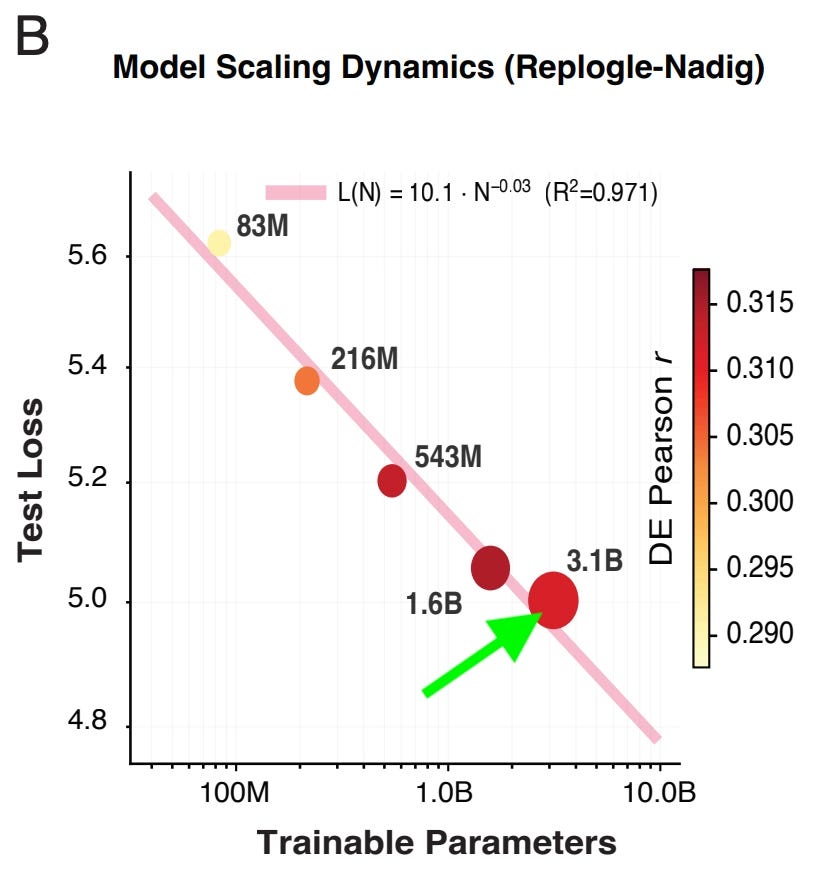
Training on a single, smallish data set exposed an information gap: the 3.1B model falls off the scaling trend. Neither parameters nor compute will improve performance past this wall. For predicting changes to gene expression, you need more information rich data.

This is what Chu and Bo’s teams have done, and here is what ~30x the information buys you:
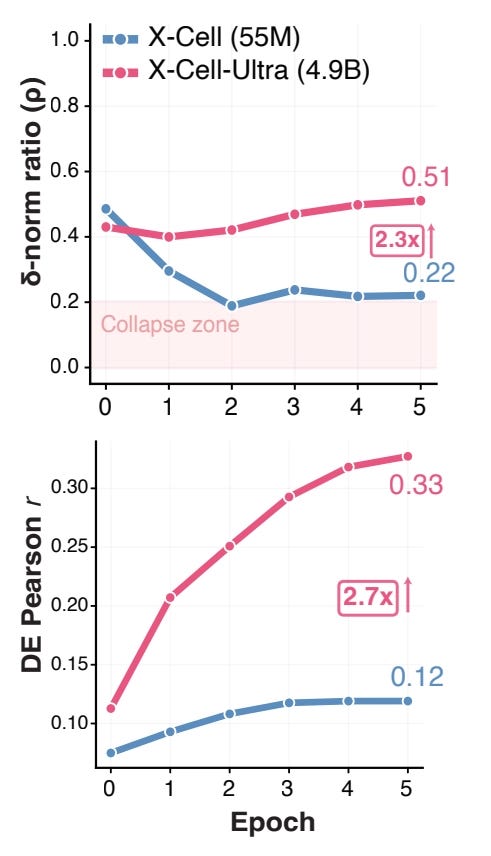
Now we can scale with parameters and training compute! We don’t know how much this effort costed, but we can guess that data collection experiments and infrastructure was a few tens of millions, and compute + headcount + research was a few million. The budget looks like a RL rollout budget, rather than a data rich pre-training one.

We were lucky enough to have the two central figures in this story on our podcast. Taking the lead from Ci Chu and Bo Wang, Xaira Therapeutics is betting that information rich data is the key to AI-driven drug development. Chu was recently promoted to Chief Discovery Officer and Bo to Chief AI Scientist1, underscoring just how strategic Xaira considers this bet.

If you had to figure out how a human cell works, what would you do? A good place to start might be by documenting what genes are expressed (e.g. what RNA is floating around) in different kinds of cells, in different circumstances.

That is CELLxGENE, a database of 168M cells built by Chan Zuckerberg Institute that maps each cell to a count of how many times 20K-30K genes were detected in that cell, plus detailed metadata about every cell. A ~4 trillion-entry matrix.

If the Protein Data Bank (PDB) unlocked structural biology models (Boltz Episode, ESM/BioHub Episode), CELLxGENE has done the same thing for Virtual Cell models. Like PDB, CELLxGENE has inspired a zoo of AI models of RNA expression; so much so that RNA expression models have become synonymous with Virtual Cell models. Bo Wang built one of the most influential, scGPT, that became the starting point for Xaira’s new model.

Models trained on CELLxGENE describe the relationship between cell types and cell states, but they are not good at predicting what will happen if we make changes to RNA expression. Changes in gene expression are highly correlated, and its is difficult (impossible) to figure out what causes what in most cases.

If you could “turn the dial down” on one gene at a time, however, then you would be able to observe what is upstream and downstream of a given gene2. You could tell if A → B & C or B → A & C or B → A, C → B → … If you did this for all of the genes, then maybe you could train a model that could predict what would happen to a cell if you change a gene (e.g. with a drug or a gene edit). Or maybe you could figure out the least invasive way to change a particular gene’s expression.

This is exactly what Chu and Bo’s teams have done. The data set is called X-Atlas and the model is called X-Cell.

In this episode, we discuss:

  • Why the team abandoned autoregression for diffusion

  • The CRISPR-based experiments that run millions of tests in parallel, and generate the raw data for X-Atlas and X-cell

  • Generalization to real lab experiments in real human cells

  • Beating the linear baseline that has outperformed previous models

  • Justifying a kitchen-sink of priors, and how that stacks up vs. data and architecture

Bo also shared with us some of the (major) advantages he has as an academic vs. industry leader, and how his labs keep up with the breakneck pace of AI innovation.

Check out the full episode on YouTube, or your favorite podcasting platform!