惯性聚合 高效追踪和阅读你感兴趣的博客、新闻、科技资讯
阅读原文 在惯性聚合中打开

推荐订阅源

酷 壳 – CoolShell
酷 壳 – CoolShell
H
Hacker News: Front Page
P
Palo Alto Networks Blog
T
ThreatConnect
Apple Machine Learning Research
博客园_首页
T
True Tiger Recordings
P
Privacy & Cybersecurity Law Blog
B
Blog
IT之家
IT之家
Last Week in AI
Last Week in AI
F
Full Disclosure
Hacker News: Ask HN
Hacker News: Ask HN
C
Comments on: Blog
Microsoft Azure Blog
C
Cybersecurity and Infrastructure Security Agency CISA
Microsoft Security Blog
博客园 - 【当耐特】
N
News and Events Feed by Topic
NISL@THU
NISL@THU
腾讯CDC
雷峰网
雷峰网
Security Latest
Security Latest
李成银的技术随笔
M
Microsoft Research Blog - Microsoft Research
L
LangChain Blog
L
Lohrmann on Cybersecurity
cs.CL updates on arXiv.org
C
Check Point Blog
Y
Y Combinator Blog
Recent Announcements
博客园 - Franky
N
News | PayPal Newsroom
V
V2EX
A
About on SuperTechFans
The Register - Security
月光博客
月光博客
奇客Solidot–传递最新科技情报
奇客Solidot–传递最新科技情报
Google Online Security Blog
MyScale Blog
MyScale Blog
Cisco Talos Blog
Cisco Talos Blog
Vercel News
Vercel News
WordPress大学
WordPress大学
C
Cyber Attacks, Cyber Crime and Cyber Security
The Hacker News
The Hacker News
IntelliJ IDEA : IntelliJ IDEA – the Leading IDE for Professional Development in Java and Kotlin | The JetBrains Blog
爱范儿
爱范儿
A
Arctic Wolf
L
LINUX DO - 最新话题
freeCodeCamp Programming Tutorials: Python, JavaScript, Git & More

Datadog | The Monitor blog

How to audit and clean up monitors effectively How we made a SQL query optimization agent 59% more accurate using autoresearch and LLM Observability Reduce CVE noise with OpenVEX assessments in Datadog Diagnose slow PostgreSQL queries faster with explain plan correlation Explore Datadog metrics with Natural Language Queries Attribute AI costs across providers with Datadog Cloud Cost Management Simplify micro-frontend observability with Datadog RUM Toto 2.0: Time series forecasting enters the scaling era Diagnose and resolve database performance issues faster with Database Investigator Datadog for Government achieves FedRAMP® High certification Analyze cloud costs with flexible spreadsheets in Datadog Sheets Inside Datadog’s AI Research Lab: Meet two PhD candidates behind Toto Connect triage and investigation in a single workflow with Datadog Cloud SIEM This Month in Datadog - April 2026 Monitor and optimize Supabase query performance with Datadog Database Monitoring Add dynamically updating context to logs with Reference Tables and Observability Pipelines Introducing ARFBench: A time series question-answering benchmark based on real incidents Test network paths with TCP, UDP, and ICMP in Datadog The product signal latency gap slowing your growth How to investigate cloud credential compromise with Bits AI Security Analyst Evaluate, optimize, and secure your Google Cloud AI stack with Datadog Turn developer feedback into operational insight with Datadog Forms and Sheets Identify and fix code issues faster with Datadog’s Azure DevOps Source Code integration Steganography at scale: Embedding share URLs in Datadog widget screenshots Bringing observability data hosting to the UK on AWS Centralize observability management with Datadog Governance Console Every team should be A/B testing Manage service tracing across hosts with Single Step Instrumentation rules Route OTel data from AI apps to ClickHouse and Datadog using Observability Pipelines Spotting CI/CD misconfigurations before the bots do: Securing GitHub Actions with Datadog IaC Security Detect runtime threats in Python Lambda functions with Datadog AAP Offline evaluation for AI agents: Best practices Introducing our open source AI-native SAST Instrument and monitor Boomi integration flows with OpenTelemetry and Datadog Not all index scans are equal: How we cut query latency by over 99% Platform engineering metrics: What to measure and what to ignore Integrate Recorded Future threat intelligence with Datadog Cloud SIEM CI/CD security: threat modeling using a MITRE-style threat matrix CI/CD security: How to secure your GitHub ecosystem Ingress NGINX is EOL: A practical guide for migrating to Kubernetes Gateway API How we built a real-world evaluation platform for autonomous SRE agents at scale Operating agentic AI with Amazon Bedrock AgentCore and Datadog LLM Observability: Lessons from NTT DATA Introducing the Datadog Code Security MCP Capture and analyze custom heatmaps in Session Replay Understand session replays faster with AI summaries and smart chapters Monitor ClickHouse query performance with Datadog Database Monitoring How we designed empathetic alert sounds for on-call engineers Search and act across Datadog to resolve issues faster with Bits Assistant Measure the business impact of every product change with Datadog Experiments Analyzing round trip query latency Configuring JavaScript caches for better performance Introducing Bits AI Dev Agent for Code Security Datadog achieves ISO 42001 certification for responsible AI Monitor Nutanix clusters, hosts, and VMs with Datadog Monitor Juniper Mist in Datadog A new Host Map for modern infrastructure When upserts don't update but still write: Debugging Postgres performance at scale Annotate traces to improve LLM quality with Datadog LLM Observability Explore Kubernetes with native OpenTelemetry data Monitor Oracle Fusion Cloud Applications with Datadog Announcing the Datadog Terraform provider v4.0.0 Scaling Kubernetes workloads on custom metrics How to design cloud environments for AI-powered threat analysis Monitor Aruba Central in Datadog How we centralize and remediate risks with Datadog Case Management Accelerate incident response with Datadog and ServiceNow Monitor your application and network load balancer logs Understanding Karpenter architecture for Kubernetes autoscaling Tools for collecting metrics and logs from Karpenter Monitor Karpenter with Datadog What your product data is actually saying Key metrics for monitoring Karpenter Securing Datadog's platform in the AI age: The role of observability data Closing the verification loop: Observability-driven harnesses for building with agents Closing the verification loop, Part 2: Fully autonomous optimization When an AI agent came knocking: Catching malicious contributions in Datadog’s open source repos Four ways engineering teams use the Datadog MCP Server to power AI agents Approaching your observability migration with the right mindset Meet the new Bits AI SRE: Deeper reasoning, twice as fast Designing MCP tools for agents: Lessons from building Datadog's MCP server Key learnings from the 2026 State of DevSecOps study Use plain English to query your multi-cloud infrastructure in Resource Catalog Simplifying troubleshooting across the user journey with Datadog Synthetic Monitoring Protect your OCI resources with Datadog Cloud Security This Month in Datadog - February 2026 Fine-tune Toto for turbocharged forecasts Amazon EC2 security: How misconfigured and public AMIs expand your cloud attack surface Enable end-to-end visibility into your Java apps with a single command Measure and improve mobile app startup performance with Datadog RUM Evaluating our AI Guard application to improve quality and control cost Identify untested code across every level of your codebase Make use of guardrail metrics and stop babysitting your releases Monitor Versa Networks SD-WAN performance in Datadog How we reduced the size of our Agent Go binaries by up to 77% Improve performance and reliability with APM Recommendations Remediate transitive vulnerabilities faster with Datadog Software Composition Analysis Generate audit-ready vulnerability and compliance reports with Datadog Sheets Monitor Fortinet FortiManager performance in Datadog Improve test coverage across codebases with Datadog Code Coverage Move fast, don’t break things: Consistent testing standards at scale
What's new in Cloud SIEM: AI-powered investigations, enhanced threat intelligence, and scalable security operations
2026-03-23 · via Datadog | The Monitor blog

Security teams face a threat landscape shaped by AI-driven attacks and identity misuse. Adversaries increasingly rely on compromised identities to blend in as legitimate users, making attacks harder to detect and slower to contain. On average, organizations take 241 days to identify and contain a breach.1

While threats have evolved, legacy SIEMs have not kept pace. They struggle with the scale of modern data, lack sufficient context to prioritize risk, and require manual correlation across systems, which slows response.

At RSA 2026, we’re introducing new capabilities in Datadog Cloud SIEM to address these problems:

Lightning-fast investigations with AI-driven analysis

As attack volume and complexity increase, manual triage and reactive workflows are falling behind. When analysts must manually correlate fragmented signals, context is lost, dwell time increases, and real threats are missed.

Datadog Cloud SIEM now uses AI to automate this process, helping teams confidently move from triaging raw signals to reviewing validated conclusions.

Autonomous investigations at machine speed with Bits AI Security Analyst

Bits AI autonomously investigates signals across cloud control planes, identity providers, endpoints, SaaS applications, and more to surface evidence-based verdicts. By automating correlation and analysis, Bits AI dramatically reduces investigation times by over 90%2, decreasing analyst workloads and helping teams prioritize high-risk threats.

Bits AI Security Analyst is now generally available in Datadog Cloud SIEM. Learn more in the product blog and keep up with our documentation as we support more data sources.
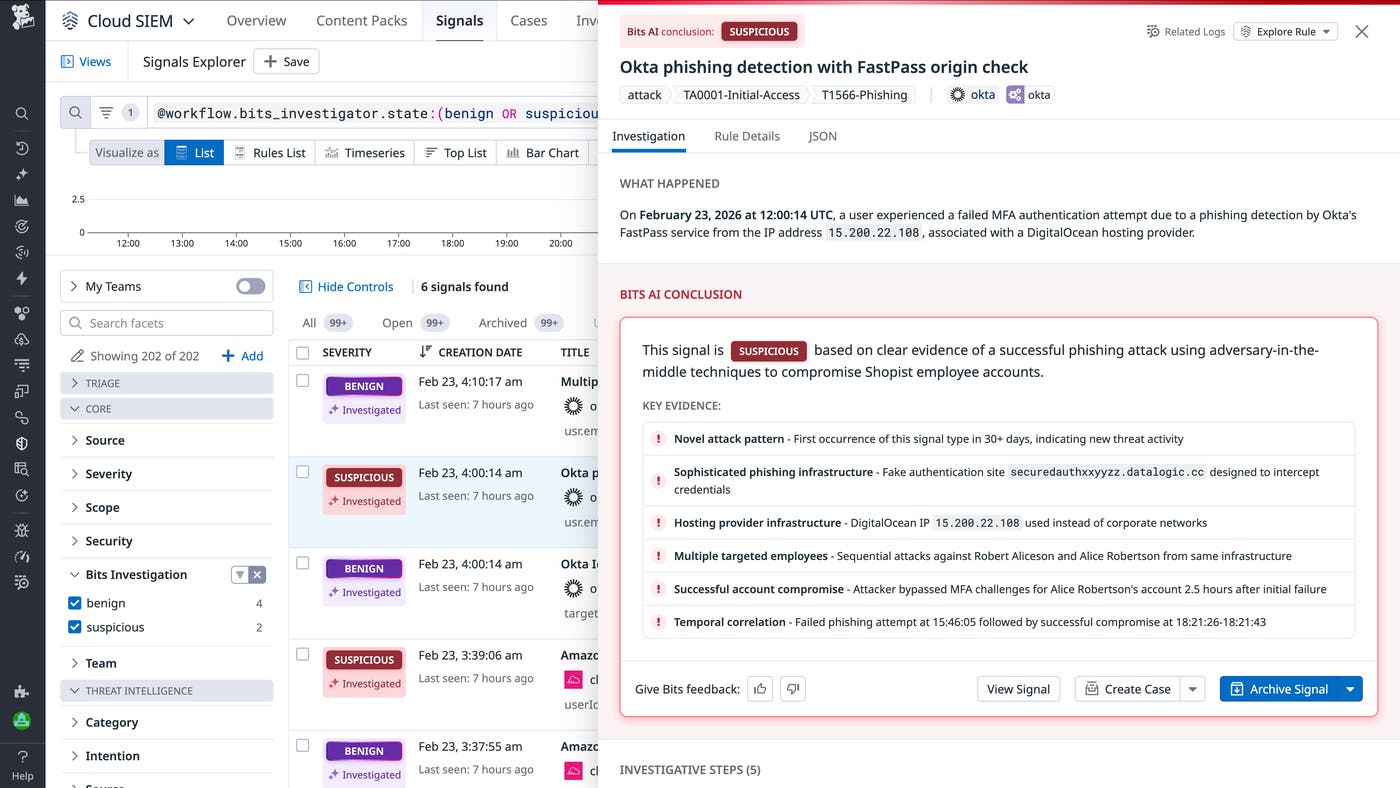
Cloud SIEM signal showing a Bits AI Security Analyst conclusion for an Okta phishing attempt

More actionable threat intelligence, behavioral analytics, and entity risk insights

Threat intelligence is most effective when it reflects your environment. Teams often need to manually piece together external indicators, identity signals, and activity logs across disconnected tools. This limits their ability to understand risk and appropriate next steps.

Datadog Cloud SIEM unifies signals through threat intelligence integrations, a comprehensive explorer for indicators of compromise (IoCs), and risk-based insights and notifications. Together these capabilities enable teams to correlate intelligence with real-time context and identify impacted users and assets more effectively.

New threat intelligence integrations embedded into your security operations

Cloud SIEM integrates with providers like Recorded Future to bring high-fidelity threat intelligence directly into detections and investigations. These integrations enable you to centralize threat intelligence, reduce context switching, and improve response times. Support for additional integrations is coming soon.
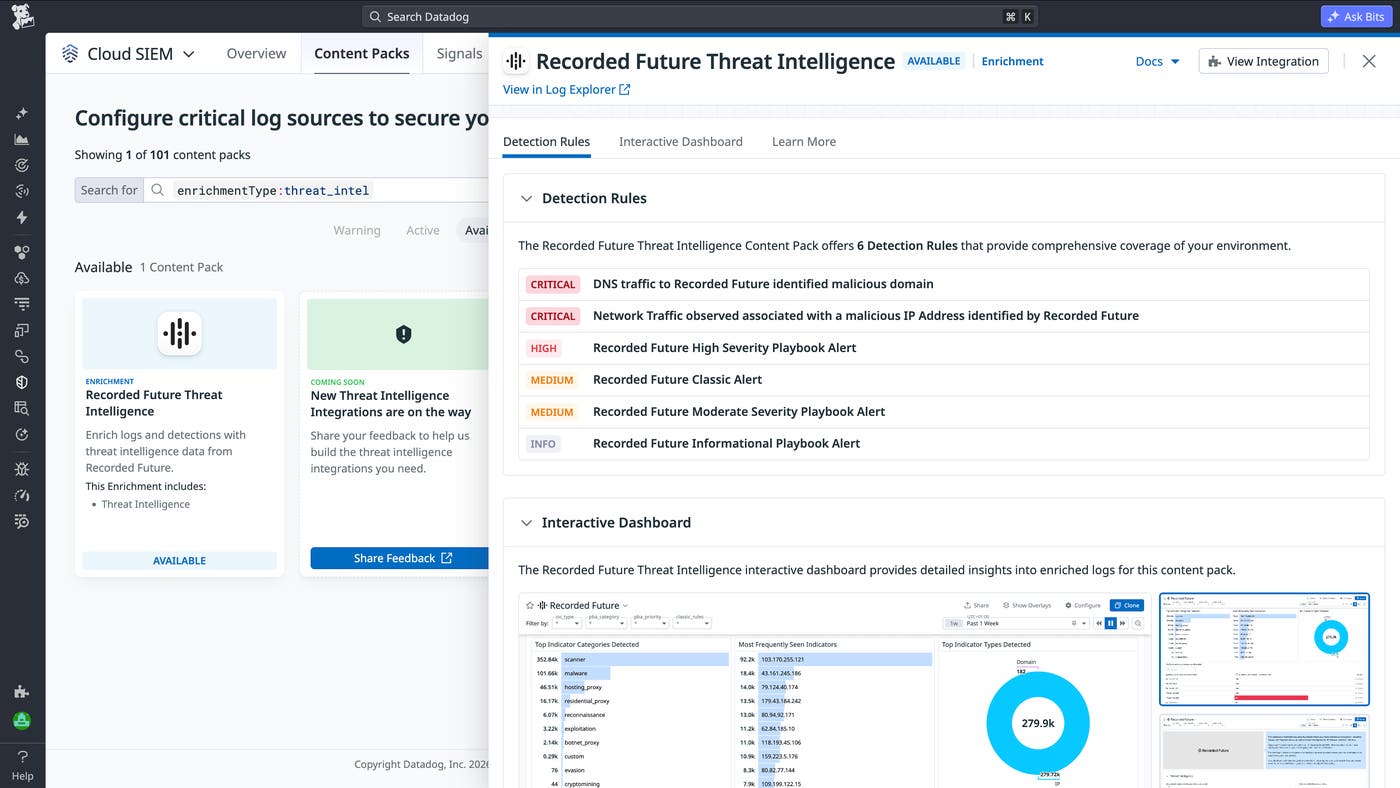
Recorded Future content pack panel showing available detection rules

Turn Cloud SIEM into a threat intelligence hub with the IOC Explorer

Investigating IoCs often requires switching between multiple tools and data feeds. IOC Explorer centralizes threat intelligence sources and correlates them with your environment, enabling teams to assess impact, identify affected entities, and run threat hunts directly within Cloud SIEM.

Read our IOC Explorer documentation to learn more.
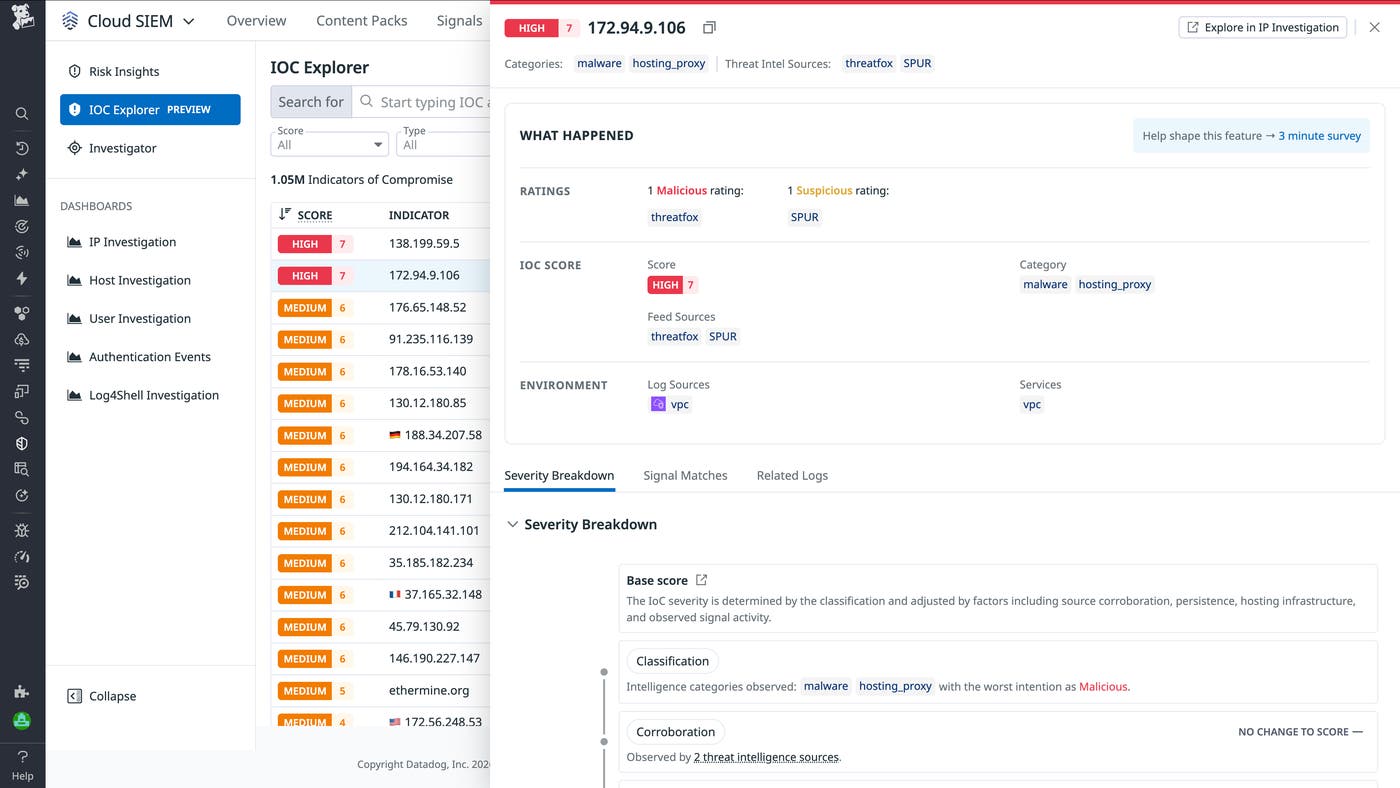
IoC panel showing a risky IP address

Detect signs of compromise before they escalate with User and Entity Behavioral Analytics (UEBA)

Attackers increasingly target identities such as user and service accounts, using credentials and access tokens to blend in and evade detection. UEBA in Datadog Cloud SIEM detects subtle signals of compromise by learning baseline behavior across your cloud users and entities. It surfaces anomalies that traditional detections may miss, helping teams identify insider and credential-based threats, reduce false positives, and respond more quickly.

Interested in early access? Sign up for the preview to help shape UEBA for Datadog.

Turn entity risk into immediate action with Risk Insight Notifications

Prioritizing which entities to investigate requires security teams to constantly monitor risk scores across hundreds or thousands of users and assets. Risk Insight Notifications eliminates manual reviews by notifying teams when entities cross customizable risk thresholds.

For example, combined Okta phishing and MFA fatigue signals—each low priority on their own—can indicate a potential adversary-in-the-middle attack and increase a user’s risk score. Teams are notified in Slack, Microsoft Teams, email, or incident platforms, helping them prioritize and respond more quickly.

Check out our documentation to learn more about Risk Insight Notifications.
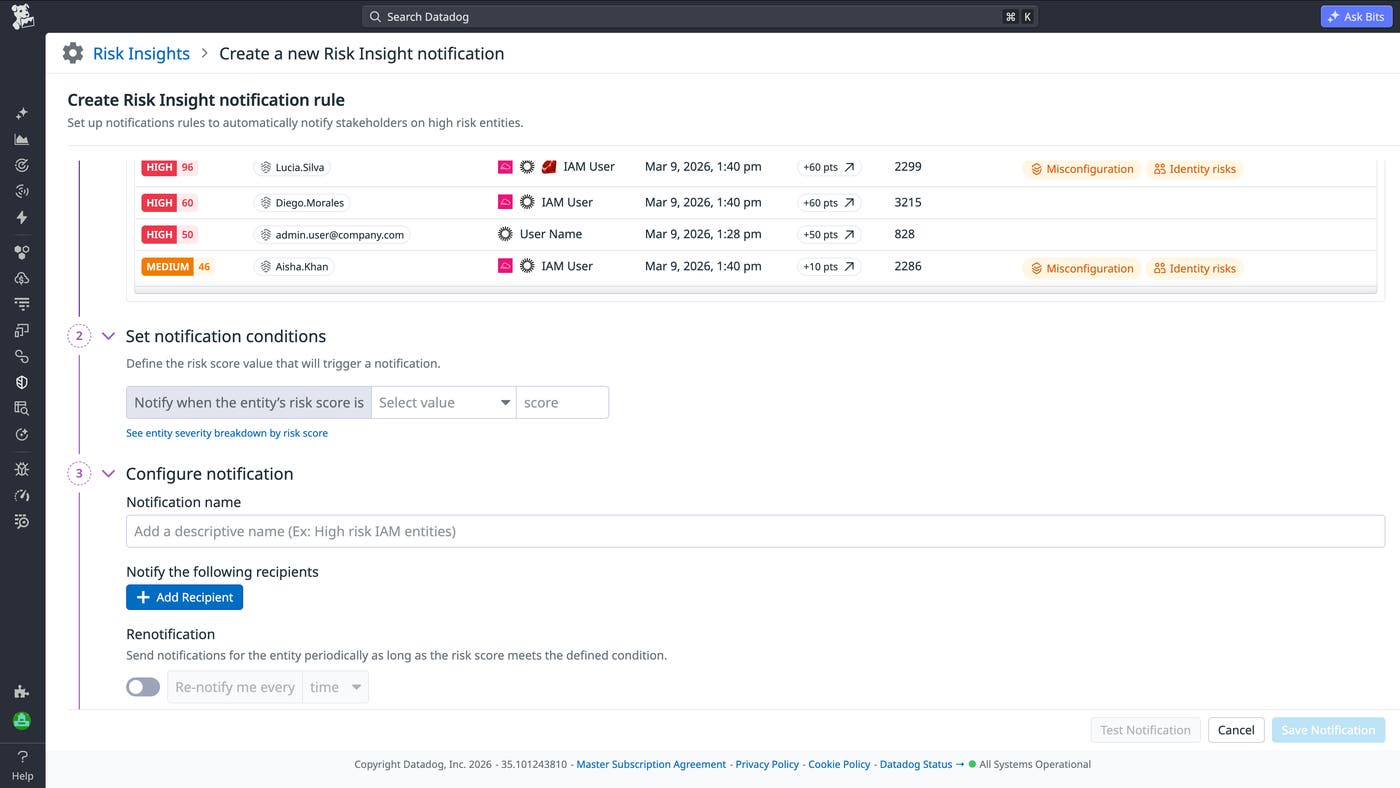
Configuration page for Risk Insights Notifications

Scale security operations for the enterprise

As security programs mature, detection and response must operate like an engineering discipline that is governed, scalable, and measurable. Cloud SIEM now delivers a multi-engine detection platform with SQL-based rule creation and out-of-the-box OCSF datasets for maintaining detection hygiene. These capabilities help teams efficiently build and scale reliable detections.

Accelerate time to value with pre-built detections and dashboards in the latest Content Packs

We’ve doubled the number of Content Packs, adding new detections, dashboards, and investigation workflows to improve deployment and standardize security coverage. These include integrations for Fortinet FortiGate, Next Gen Firewall, Wiz, and Zscaler Private Access.

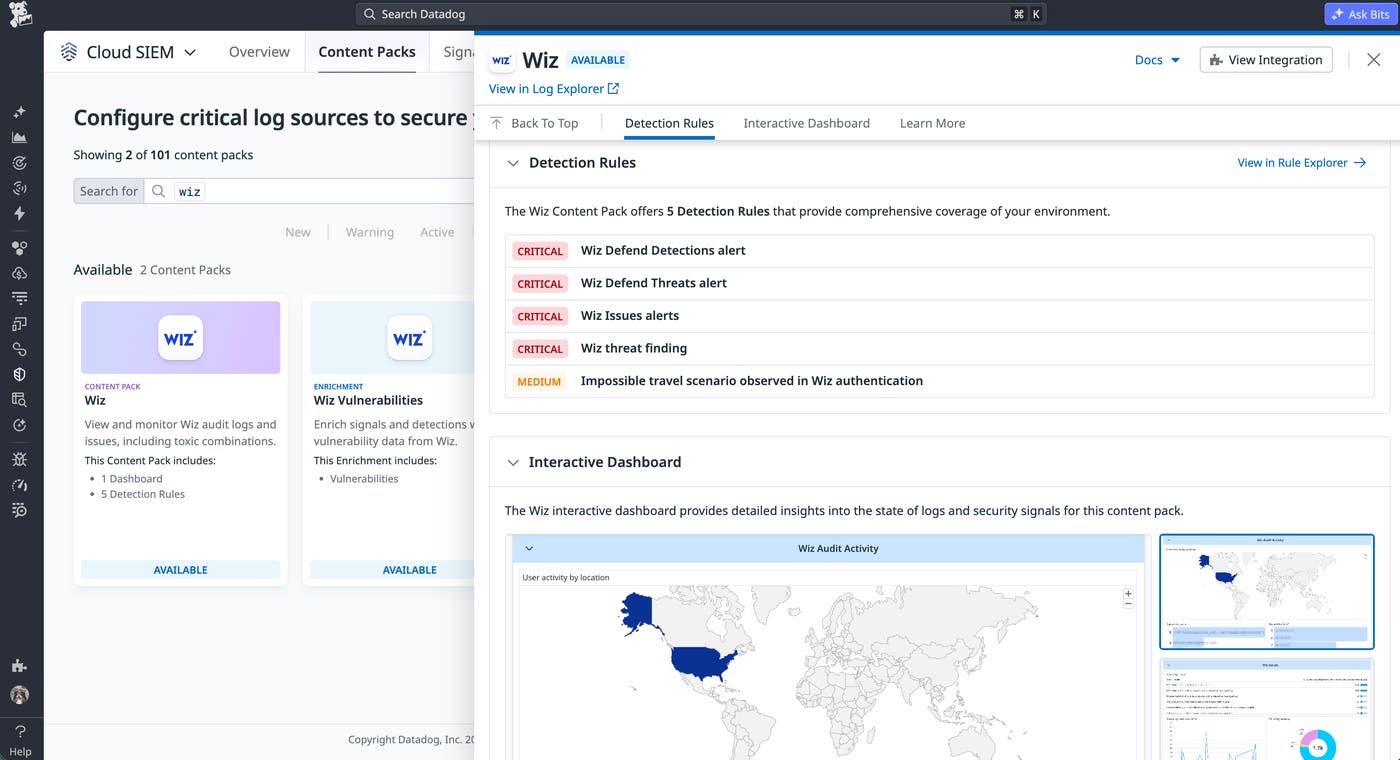
The Wiz Content Pack includes detections for threat findings and authentication anomalies such as impossible travel, along with dashboards and workflows to help teams investigate alerts quickly.

Get started in-app or view our latest Content Packs.

Wix Content Pack side panel showing available detection rules and an interactive dashboard

Build, migrate, and scale detections with SQL-based detections and OCSF

Enterprise SOC teams often struggle to migrate, scale, and govern detection programs as legacy SIEMs accumulate complex rulesets. Datadog Cloud SIEM enables SQL-based detections on normalized OCSF datasets, simplifying migration, rule creation, and governance.
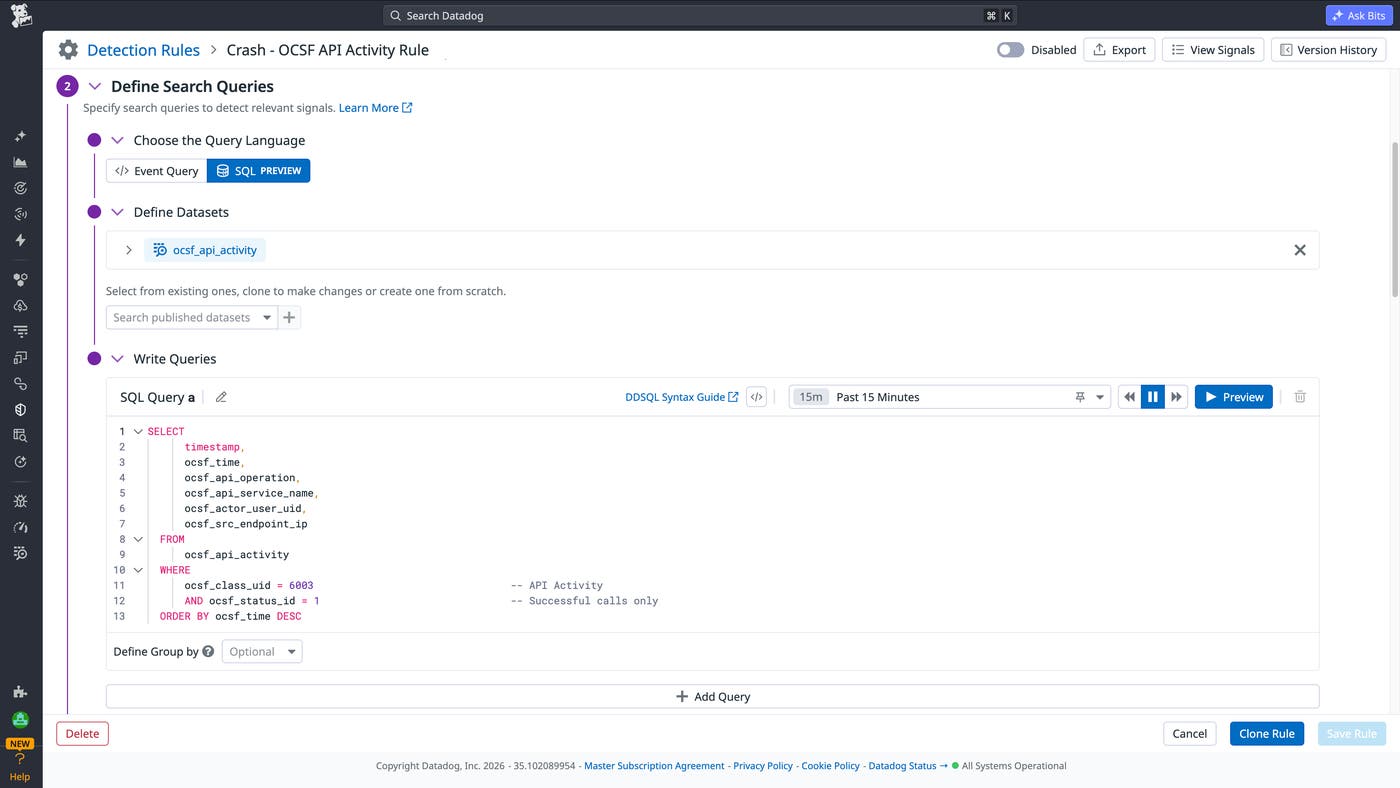
New SQL-based detection rule using OCSF data

Streamline security investigations with integrated Security Case Management in Cloud SIEM

Security investigations often stall as analysts switch between signals and separate case management tools. Cloud SIEM’s integrated Security Case Management links signals directly to structured cases, bringing triage and investigation into a single workflow.

Analysts can assign ownership, track evidence, and collaborate through integrations such as Jira, keeping activity in sync and improving response times.

Learn more about Security Case Management in our documentation.
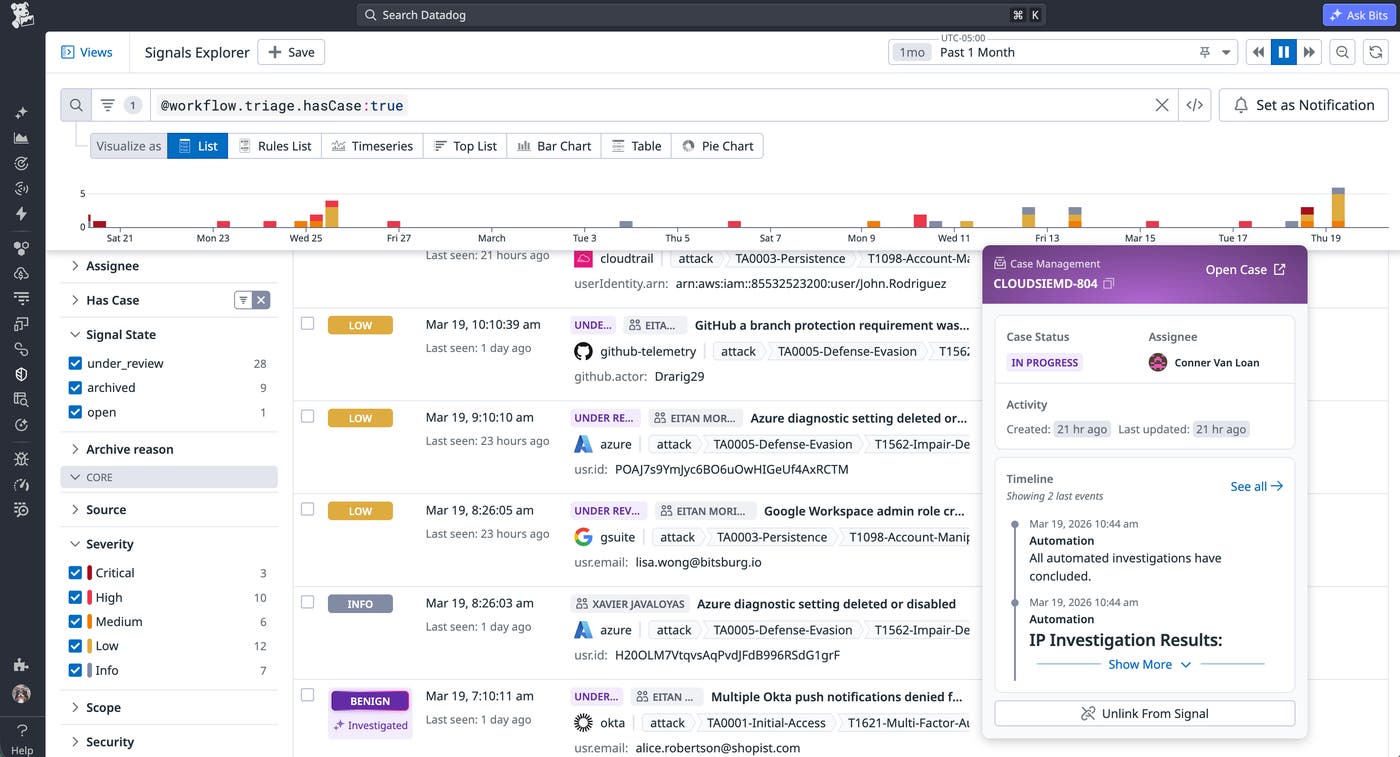
Cloud SIEM signal list showing a linked case

Modernize security operations for speed, actionable insights, and scale

As security operations evolve, the tools that support them must keep pace. Datadog Cloud SIEM brings together AI-driven investigations, identity-aware threat intelligence, and enterprise-scale detection and case management to help teams prioritize risk, automate investigations, and respond with confidence.

See our Cloud SIEM documentation for more information and to get started. If you’re new to Datadog, sign up for a free 14-day trial.

Footnotes

  1. Coker, James. “Data Breach Costs Fall for First Time in Five Years.” Infosecurity Magazine, 30 July 2025

  2. Results from internal data and research from the Bits AI Security Analyst early access program.