


惯性聚合 高效追踪和阅读你感兴趣的博客、新闻、科技资讯
阅读原文 在惯性聚合中打开

推荐订阅源

AI
AI
Cloudbric
Cloudbric
Schneier on Security
V2EX - 技术
V2EX - 技术
N
News and Events Feed by Topic
Hacker News: Ask HN
Hacker News: Ask HN
L
LINUX DO - 最新话题
V
Visual Studio Blog
奇客Solidot–传递最新科技情报
奇客Solidot–传递最新科技情报
freeCodeCamp Programming Tutorials: Python, JavaScript, Git & More
W
WeLiveSecurity
博客园 - 司徒正美
Jina AI
Jina AI
S
Secure Thoughts
罗磊的独立博客
Hugging Face - Blog
Hugging Face - Blog
有赞技术团队
有赞技术团队
WordPress大学
WordPress大学
Security Archives - TechRepublic
博客园 - 三生石上(FineUI控件)
The Last Watchdog
The Last Watchdog
S
Security @ Cisco Blogs
S
SegmentFault 最新的问题
Attack and Defense Labs
Exploit-DB.com RSS Feed
钛媒体:引领未来商业与生活新知
钛媒体:引领未来商业与生活新知
SecWiki News
SecWiki News
Google DeepMind News
T
Troy Hunt's Blog
H
Heimdal Security Blog
C
CXSECURITY Database RSS Feed - CXSecurity.com
N
News and Events Feed by Topic
雷峰网
雷峰网
Last Week in AI
Last Week in AI
IT之家
IT之家
Project Zero
Project Zero
O
OpenAI News
腾讯CDC
The Hacker News
The Hacker News
L
Lohrmann on Cybersecurity
T
Tenable Blog
博客园_首页
C
Cisco Blogs
酷 壳 – CoolShell
酷 壳 – CoolShell
S
Schneier on Security
Scott Helme
Scott Helme
cs.CL updates on arXiv.org
人人都是产品经理
人人都是产品经理
P
Privacy International News Feed
OSCHINA 社区最新新闻
OSCHINA 社区最新新闻

Datadog | The Monitor blog

Introducing our open source AI-native SAST Instrument and monitor Boomi integration flows with OpenTelemetry and Datadog Not all index scans are equal: How we cut query latency by over 99% Platform engineering metrics: What to measure and what to ignore Integrate Recorded Future threat intelligence with Datadog Cloud SIEM CI/CD security: threat modeling using a MITRE-style threat matrix CI/CD security: How to secure your GitHub ecosystem Ingress NGINX is EOL: A practical guide for migrating to Kubernetes Gateway API Operating agentic AI with Amazon Bedrock AgentCore and Datadog LLM Observability: Lessons from NTT DATA Introducing the Datadog Code Security MCP Capture and analyze custom heatmaps in Session Replay Understand session replays faster with AI summaries and smart chapters Monitor ClickHouse query performance with Datadog Database Monitoring How we designed empathetic alert sounds for on-call engineers Search and act across Datadog to resolve issues faster with Bits Assistant Measure the business impact of every product change with Datadog Experiments Analyzing round trip query latency Configuring JavaScript caches for better performance Introducing Bits AI Dev Agent for Code Security Datadog achieves ISO 42001 certification for responsible AI Monitor Nutanix clusters, hosts, and VMs with Datadog Monitor Juniper Mist in Datadog A new Host Map for modern infrastructure Annotate traces to improve LLM quality with Datadog LLM Observability What’s new in Cloud SIEM: AI-powered investigations, enhanced threat intelligence, and scalable security operations Explore Kubernetes with native OpenTelemetry data Monitor Oracle Fusion Cloud Applications with Datadog Announcing the Datadog Terraform provider v4.0.0 Scaling Kubernetes workloads on custom metrics How to design cloud environments for AI-powered threat analysis Monitor Aruba Central in Datadog How we centralize and remediate risks with Datadog Case Management Accelerate incident response with Datadog and ServiceNow Monitor your application and network load balancer logs Understanding Karpenter architecture for Kubernetes autoscaling Tools for collecting metrics and logs from Karpenter Monitor Karpenter with Datadog What your product data is actually saying Key metrics for monitoring Karpenter Securing Datadog’s platform in the AI age: The role of observability data Four ways engineering teams use the Datadog MCP Server to power AI agents Approaching your observability migration with the right mindset Meet the new Bits AI SRE: Deeper reasoning, twice as fast Key learnings from the 2026 State of DevSecOps study Use plain English to query your multi-cloud infrastructure in Resource Catalog Simplifying troubleshooting across the user journey with Datadog Synthetic Monitoring Protect your OCI resources with Datadog Cloud Security This Month in Datadog - February 2026 Amazon EC2 security: How misconfigured and public AMIs expand your cloud attack surface Enable end-to-end visibility into your Java apps with a single command Measure and improve mobile app startup performance with Datadog RUM Evaluating our AI Guard application to improve quality and control cost Identify untested code across every level of your codebase Make use of guardrail metrics and stop babysitting your releases Monitor Versa Networks SD-WAN performance in Datadog Improve performance and reliability with APM Recommendations Remediate transitive vulnerabilities faster with Datadog Software Composition Analysis Generate audit-ready vulnerability and compliance reports with Datadog Sheets Monitor Fortinet FortiManager performance in Datadog Improve test coverage across codebases with Datadog Code Coverage Move fast, don’t break things: Consistent testing standards at scale Enrich logs with ServiceNow CMDB context before routing to any SIEM or logging tool Monitor Lustre with Datadog Make faster, better product decisions with Datadog Product Analytics Surface and remediate runtime posture issues with Workload Protection Findings Protect agentic AI applications with Datadog AI Guard How to optimize JavaScript code with CSS Trace Google Pub/Sub workloads in Cloud Run with Datadog Detect human names in logs with ML in Sensitive Data Scanner How we cut our NLQ agent debugging time from hours to minutes with LLM Observability Debug PostgreSQL query latency faster with EXPLAIN ANALYZE in Datadog Database Monitoring Datadog acquires Propolis Unify and correlate frontend and backend data with retention filters Scale compliance across global frameworks with Datadog Cloud Security Monitor Arista VeloCloud SD-WAN performance with Datadog Building reliable dashboard agents with Datadog LLM Observability Simplify log collection and aggregation for MSSPs with Datadog Observability Pipelines Mitigation for Node.js denial-of-service vulnerability affecting Datadog APM Automate flaky test fixes with the Bits AI Dev Agent and Test Optimization How we built an AI SRE agent that investigates like a team of engineers Datadog integrations 2025 recap: Observability for AI, security, and hybrid cloud Design effective executive dashboards with Datadog Implement dbt data quality checks with dbt-expectations Bring faster visibility into AWS Lambda functions with remote instrumentation Troubleshoot faster with the GitLab Source Code integration in Datadog How Cambia Health Solutions saved $30,000 monthly with Cloud Cost Management and the Datadog Resource Catalog Normalize any logs for Cloud SIEM with Datadog's OCSF processor Optimizing Datadog at scale: Cost-efficient observability at Zendesk Detect, diagnose, and resolve network issues easily with CNM Network Health Connect engineering errors to user impact in early-stage products Cilium configuration for Kubernetes operations at scale Designing feedback loops for progressive delivery Ship features faster and safer with Datadog Feature Flags Choosing the right OpenTelemetry Collector distribution Route your monitor alerts with Datadog monitor notification rules Automate Cloud SIEM investigations with Bits AI Security Analyst Cloud threat detection: How to identify risky activity across control and data planes Collecting Kafka performance metrics Monitoring Kafka with Datadog Monitoring Kafka performance metrics
Securing the AI era: Outpace AI-powered attacks with unified security and observability
Tim Knudsen · 2026-06-09 · via Datadog | The Monitor blog

Security teams are dealing with a fundamentally different operating environment than they were a few years ago. AI-assisted development is rapidly pushing more code and infrastructure into production, and according to Datadog’s 2026 State of DevSecOps report, 40% of running services have an exploitable vulnerability. Meanwhile, AI is giving attackers new ways to automate reconnaissance and accelerate exploits, which has collapsed the window between vulnerability disclosure and active exploitation from months to minutes. 

Attacks are only going to increase in volume and speed. But defenders are still overwhelmed by alerts and disconnected tools, manually reconstructing context during active incidents, and chasing ownership across services. The teams that stay ahead won’t close that gap with more tools or signals—what separates useful data from noise is knowing what is actually happening in your production environments. When you have a clear picture of your attack surface, you can identify what’s truly exploitable and focus on the threats that can actually harm your business. And when a threat surfaces, you can detect, investigate, and contain it faster, with a unified system that makes ownership clear and keeps pace with AI. 

We built the Datadog platform to give security and engineering teams the real-time visibility and context they need to prevent exposure, detect and investigate threats faster, and contain attacks before they cause harm. 

Prevent exposure in dynamic environments

Periodic scans and manual remediation efforts aren’t enough when new services, APIs, and AI agents continuously change your environment’s risk profile. And with vulnerabilities accumulating faster than teams can triage them, knowing which ones matter is the difference between staying ahead of attackers and falling behind. Datadog researchers found that when you apply runtime context, 97% of critical vulnerabilities can be deprioritized because you can see which ones are actually reachable in production.

Today at DASH, we announced the Datadog Runtime Prioritization Engine to give teams real-time visibility into runtime behavior and execution context. The engine uses live APM traces, logs, and observed service dependencies to assess whether a vulnerability is truly business critical. By understanding whether an affected resource is actively running, connected to a crown-jewel application, and exposed in production, teams can focus remediation efforts on the risks that matter most. The engine also identifies the resource owner based on live production data, helping organizations accelerate response and reduce time to remediation.
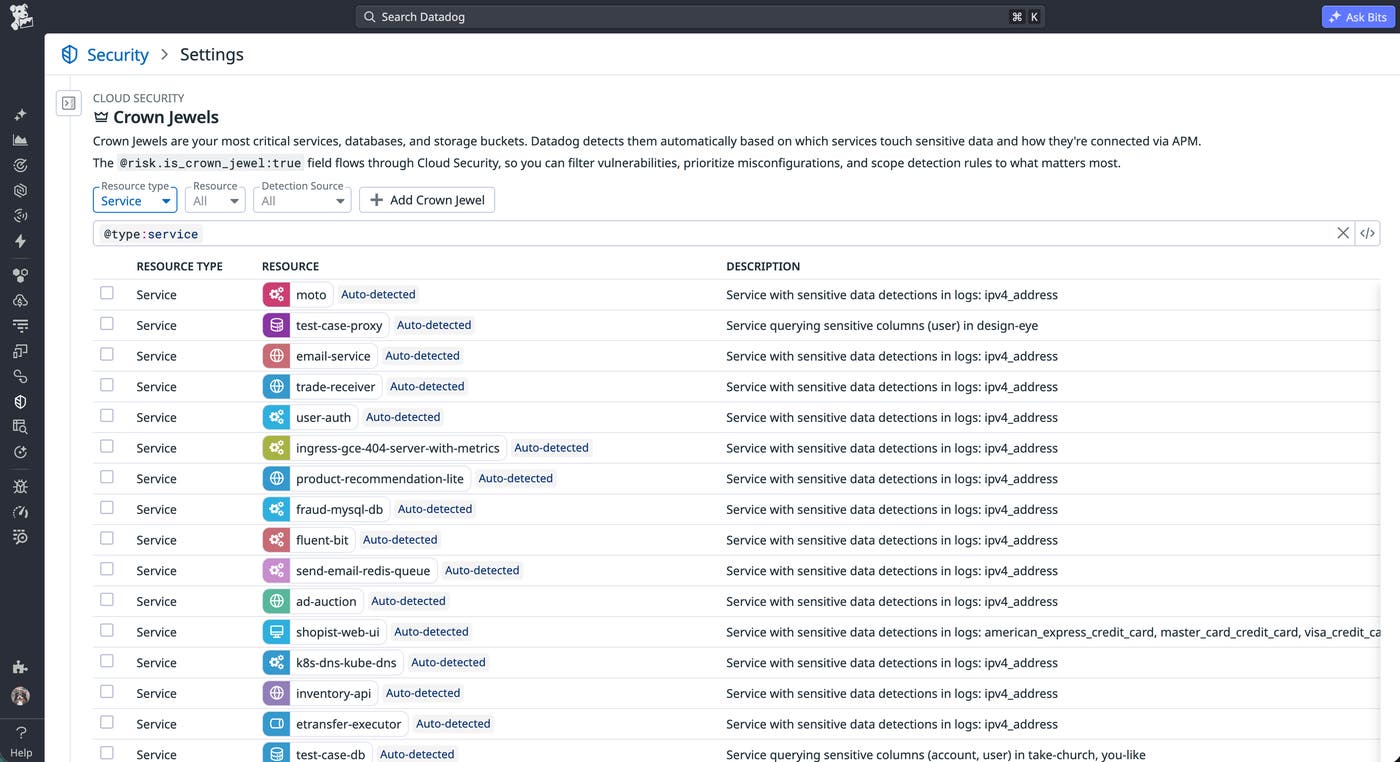
A list of critical services that Datadog Cloud Security will prioritize when generating signals.

This visibility means your team can filter out findings that pose no real risk and focus on what’s both exploitable and relevant to business-critical systems, instead of focusing on static severity scores. In Preview, the engine has already helped customers reduce vulnerability noise by 95%.  

Bits Code and Datadog’s AI-native Static Code Analysis (SAST) capabilities embed that deep visibility into your day-to-day development workflows. AI-native SAST reviews findings in context to assess whether they’re likely true or false positives before they reach your triage queue. To resolve a vulnerability, Bits Code generates code fixes directly, either one at a time or through bulk remediation campaigns. Security findings also surface in the IDE and in pull requests with the details that developers need in order to act, and issues automatically route to the right owners.

Improve visibility into AI agent behavior

As more of our customers deploy AI, we’ve seen firsthand why combining security with observability is so critical for managing AI workloads. Securing AI agents specifically requires full visibility into runtime activity. To carry out their functions, AI agents often access sensitive data, read untrusted content, and communicate with data externally through HTTP calls, file writes, and commands. When those three behaviors converge, it creates conditions that make your agent a prime target for prompt injection, tool misuse, and data exfiltration.

Datadog AI Guard addresses these risks directly by providing runtime protection for agents. It evaluates the real time agent behavior, infrastructure signals, and data flows to discover unprotected agents, flag unsafe actions, and help block attacks in real time. It also maps unprotected agents across your environment with full lineage, surfacing model endpoints, data sources, and infrastructure dependencies that each agent accesses. That context is what helps teams adopt agentic workflows quickly, without security teams sacrificing oversight. 
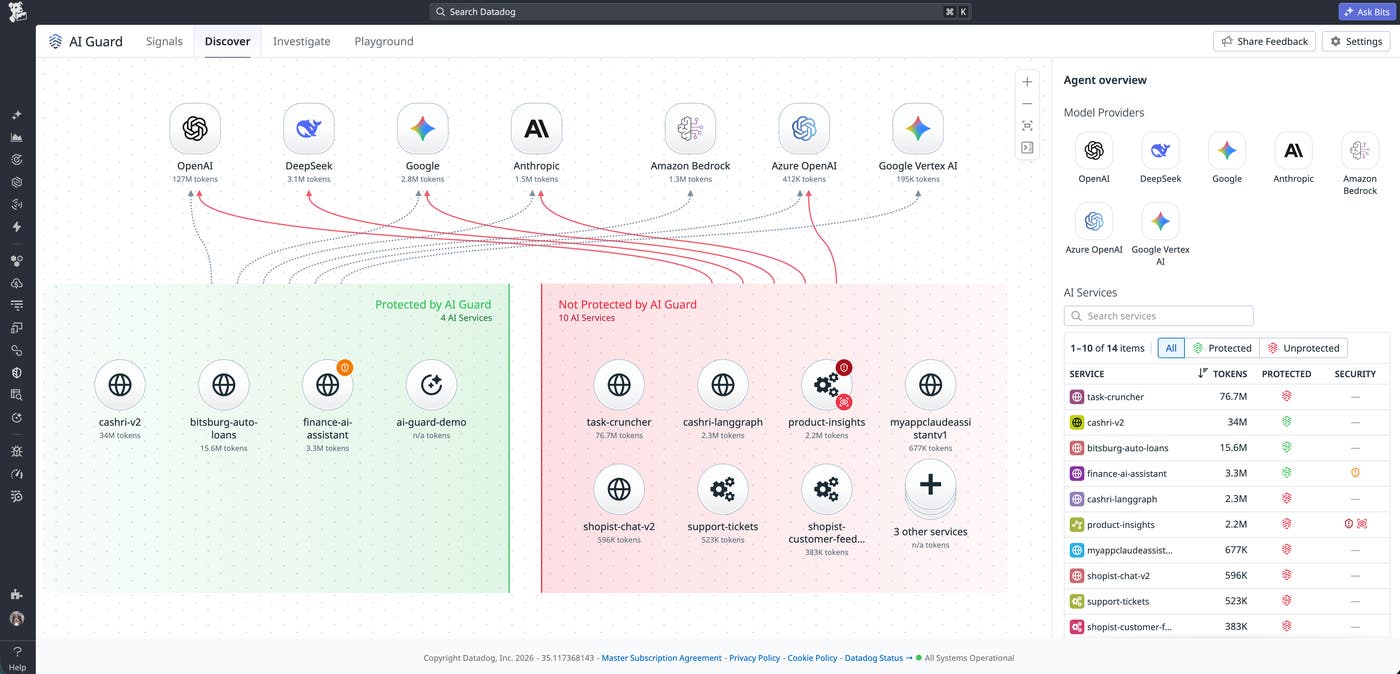
AI Guard showing all protected and unprotected AI services

Those same protections extend to your development environment. AI Guard is expanding its capabilities to help improve the security of coding agents against malicious skills, scripts, configurations, and packages. AI Guard sits inline with the agent to block indirect prompt injections, backdoor attacks, and other OWASP Top 10 threats, so your teams can use coding agents while protecting development pipelines. 
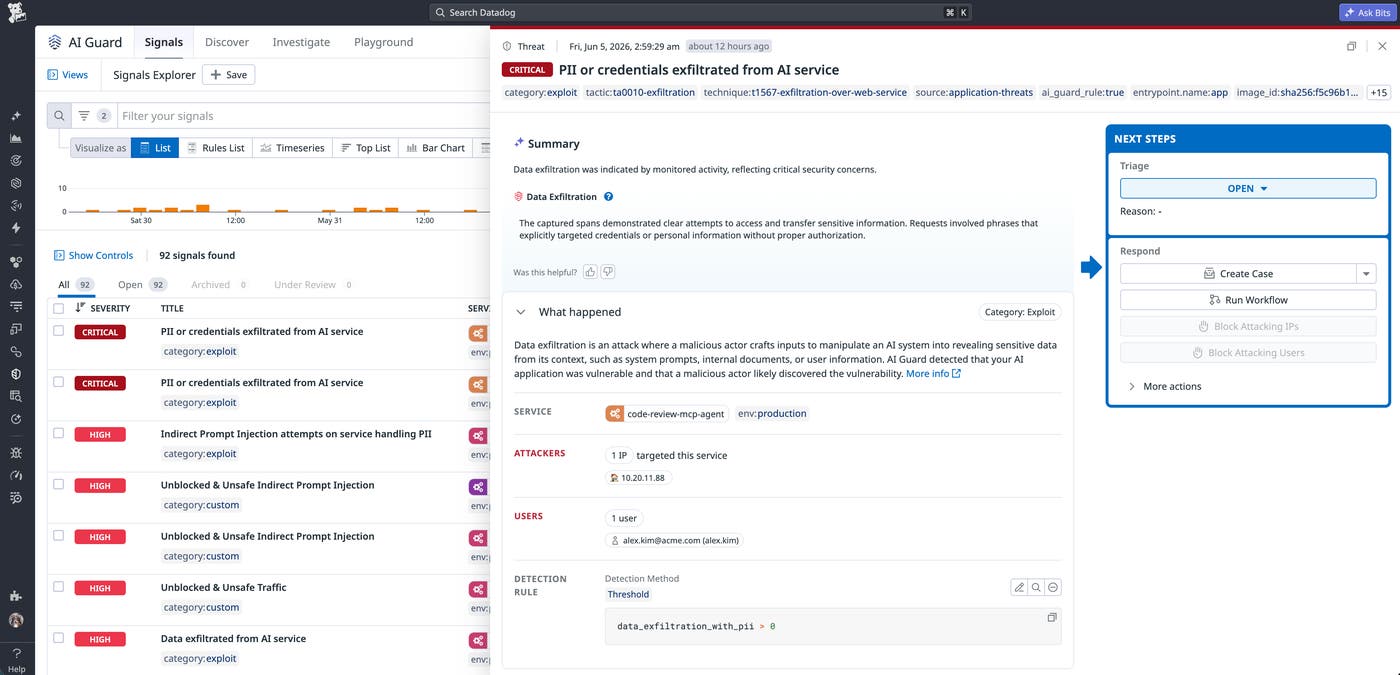
AI Guard critical signal showing PII was exfiltrated from an AI service

Detect, investigate, and contain threats with agentic defenses

Preventing exposure reduces your attack surface, but you also need to detect and respond when threats get through. Datadog provides AI-assisted threat detection and automated triage to help your team maintain a clear picture of the entire system as incidents unfold.

Bits Security Analyst enhances detection and investigation with deep behavioral insight and real-time context. It correlates signals across infrastructure, apps, identity, and network activity to surface threats the moment they emerge. Instead of your security analysts manually stitching together signals after the fact, Bit Security Analyst gives them a complete, continuously updated picture of an attack as it develops. Bits Security Analyst is now generally available as part of Datadog Cloud SIEM, and as of DASH, we’re expanding availability so you can deploy it on third-party SIEMs without disrupting existing workflows.  
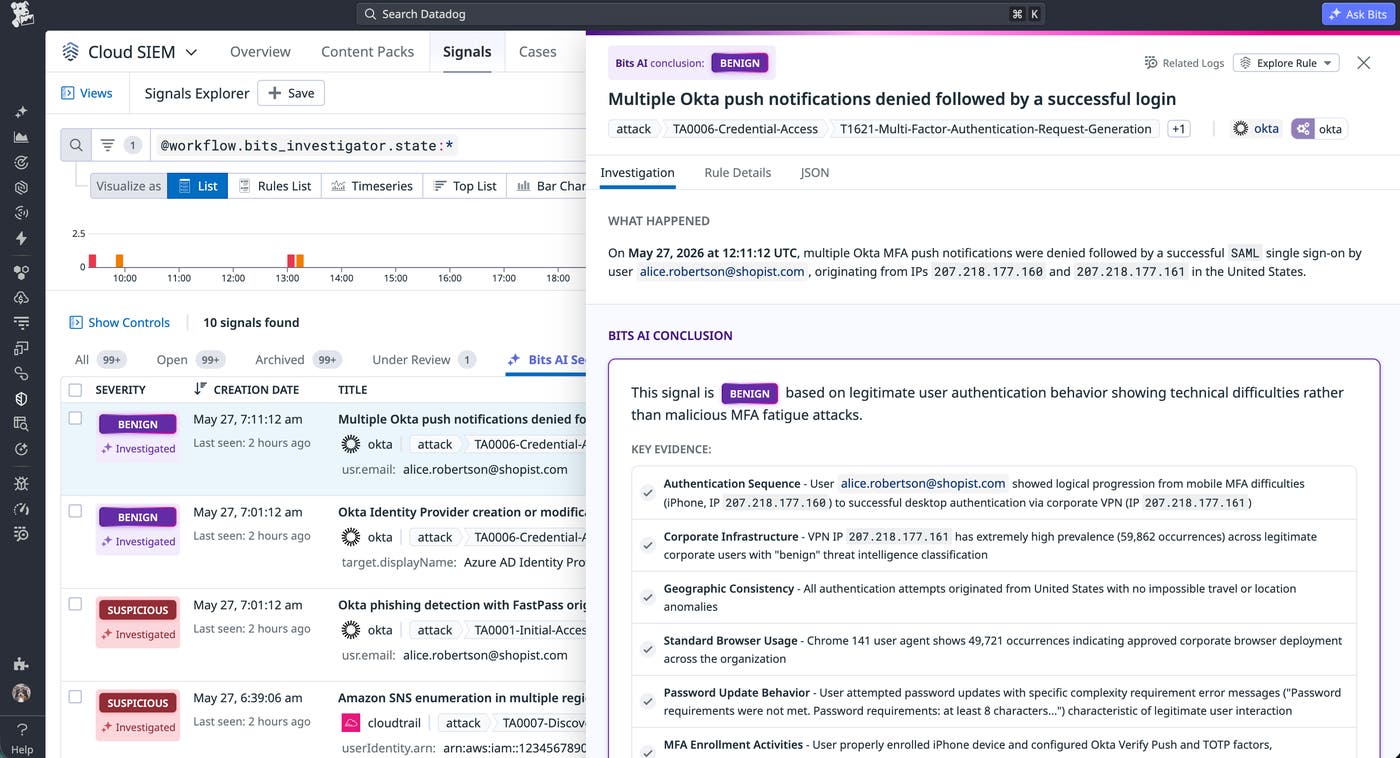
Bits Security Analyst signal in Cloud SIEM marking an Okta MFA fatigue signal as benign.

For proactive defense, Bits Threat Hunting—now available in Preview—lets your team surface anomalous behavior and uncover attack patterns before they escalate. When a threat is identified, Datadog isolates only the affected service, workload, identity, or agent and contains the blast radius without disrupting broader systems. Bits Threat Hunting is also linked to case management and incident response workflows, so your team can quickly move from detection to remediation, with every step captured from initial signal to closed case.
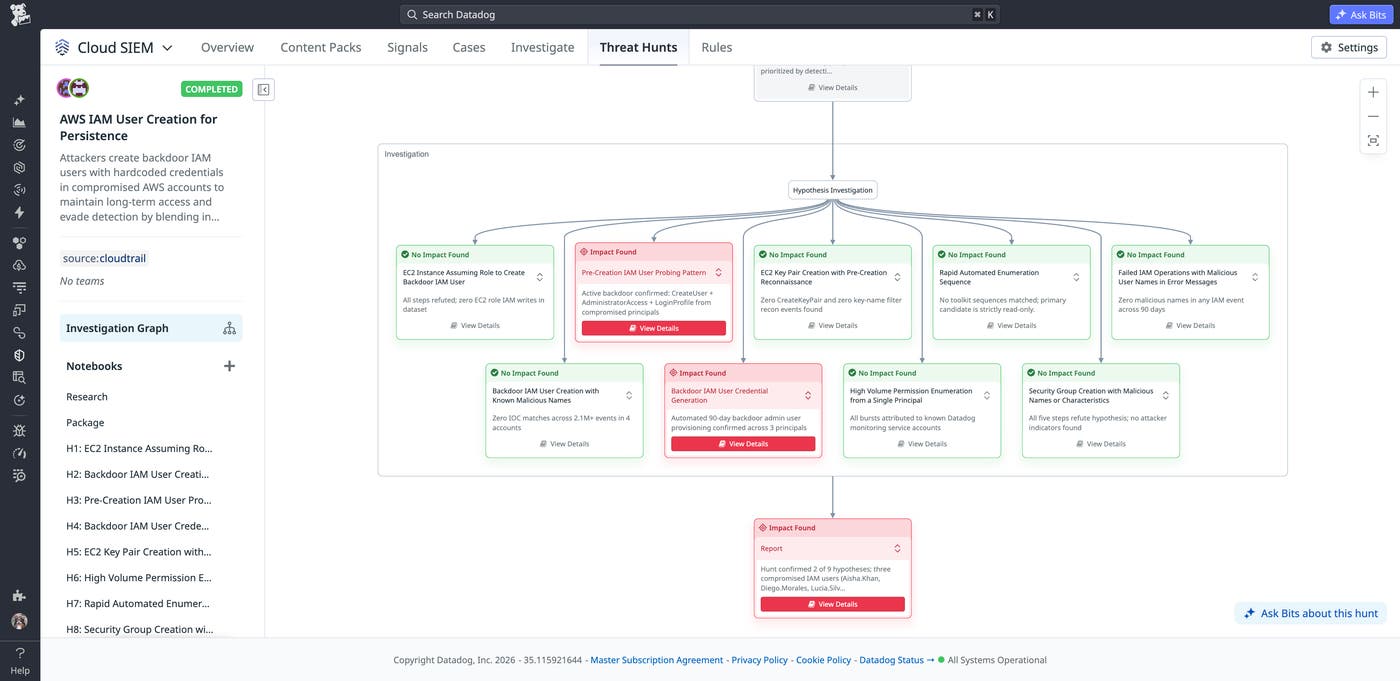
Bits Threat Hunting map showing results for the AWS IAM user creation for persistence scenario

Security that’s built for the way teams want to operate

The gap between how fast threats move and how fast teams can respond has been the defining problem in security for the last several years. That gap exists because security tooling has historically been siloed from the rest of the observability stack, forcing teams to manually correlate context across systems that have no visibility into each other. 

Datadog Security is built on an observability platform that ingests and correlates telemetry data across your tech stack, including infrastructure, applications, logs, identities, APIs, AI workloads, and more. Instead of aggregating signals from disparate systems, Datadog preserves the relationships between entities and maps them to behavior for a continuously updated view of your environment. For the teams that own the systems, that means fewer handoffs, less manual triage, and a security posture that improves as your environment evolves. For teams building on AI, Datadog provides the visibility and guardrails needed to adopt agentic workflows safely. The same unified data layer that powers security detection also gives agents production-grade context, enabling observable and secure agentic operations from development to the SOC. 

See what the Datadog security platform can do for your team, and sign up for a free 14-day trial if you’re new to Datadog.