惯性聚合 高效追踪和阅读你感兴趣的博客、新闻、科技资讯
阅读原文 在惯性聚合中打开

推荐订阅源

月光博客
月光博客
钛媒体:引领未来商业与生活新知
钛媒体:引领未来商业与生活新知
人人都是产品经理
人人都是产品经理
IT之家
IT之家
Cyberwarzone
Cyberwarzone
T
Troy Hunt's Blog
有赞技术团队
有赞技术团队
阮一峰的网络日志
阮一峰的网络日志
T
Threat Research - Cisco Blogs
S
SegmentFault 最新的问题
Apple Machine Learning Research
G
GRAHAM CLULEY
cs.CL updates on arXiv.org
博客园 - 叶小钗
Last Week in AI
Last Week in AI
C
CERT Recently Published Vulnerability Notes
The Hacker News
The Hacker News
Jina AI
Jina AI
T
Tor Project blog
V
Vulnerabilities – Threatpost
酷 壳 – CoolShell
酷 壳 – CoolShell
Spread Privacy
Spread Privacy
博客园_首页
C
Cybersecurity and Infrastructure Security Agency CISA
Threat Intelligence Blog | Flashpoint
freeCodeCamp Programming Tutorials: Python, JavaScript, Git & More
Simon Willison's Weblog
Security Latest
Security Latest
cs.CV updates on arXiv.org
cs.AI updates on arXiv.org
博客园 - 司徒正美
V2EX - 技术
V2EX - 技术
I
Intezer
The Cloudflare Blog
Cisco Talos Blog
Cisco Talos Blog
SecWiki News
SecWiki News
博客园 - 【当耐特】
奇客Solidot–传递最新科技情报
奇客Solidot–传递最新科技情报
L
Lohrmann on Cybersecurity
Scott Helme
Scott Helme
Google Online Security Blog
量子位
The Last Watchdog
The Last Watchdog
AI
AI
Application and Cybersecurity Blog
S
Security Affairs
P
Palo Alto Networks Blog
S
Secure Thoughts
OSCHINA 社区最新新闻
OSCHINA 社区最新新闻
Attack and Defense Labs

Datadog | The Monitor blog

Introducing our open source AI-native SAST Instrument and monitor Boomi integration flows with OpenTelemetry and Datadog Not all index scans are equal: How we cut query latency by over 99% Platform engineering metrics: What to measure and what to ignore Integrate Recorded Future threat intelligence with Datadog Cloud SIEM CI/CD security: threat modeling using a MITRE-style threat matrix CI/CD security: How to secure your GitHub ecosystem Ingress NGINX is EOL: A practical guide for migrating to Kubernetes Gateway API Operating agentic AI with Amazon Bedrock AgentCore and Datadog LLM Observability: Lessons from NTT DATA Introducing the Datadog Code Security MCP Capture and analyze custom heatmaps in Session Replay Understand session replays faster with AI summaries and smart chapters Monitor ClickHouse query performance with Datadog Database Monitoring How we designed empathetic alert sounds for on-call engineers Search and act across Datadog to resolve issues faster with Bits Assistant Measure the business impact of every product change with Datadog Experiments Analyzing round trip query latency Configuring JavaScript caches for better performance Introducing Bits AI Dev Agent for Code Security Datadog achieves ISO 42001 certification for responsible AI Monitor Nutanix clusters, hosts, and VMs with Datadog Monitor Juniper Mist in Datadog A new Host Map for modern infrastructure Annotate traces to improve LLM quality with Datadog LLM Observability What’s new in Cloud SIEM: AI-powered investigations, enhanced threat intelligence, and scalable security operations Explore Kubernetes with native OpenTelemetry data Monitor Oracle Fusion Cloud Applications with Datadog Announcing the Datadog Terraform provider v4.0.0 Scaling Kubernetes workloads on custom metrics How to design cloud environments for AI-powered threat analysis Monitor Aruba Central in Datadog How we centralize and remediate risks with Datadog Case Management Accelerate incident response with Datadog and ServiceNow Monitor your application and network load balancer logs Understanding Karpenter architecture for Kubernetes autoscaling Tools for collecting metrics and logs from Karpenter Monitor Karpenter with Datadog What your product data is actually saying Key metrics for monitoring Karpenter Securing Datadog’s platform in the AI age: The role of observability data Four ways engineering teams use the Datadog MCP Server to power AI agents Approaching your observability migration with the right mindset Meet the new Bits AI SRE: Deeper reasoning, twice as fast Key learnings from the 2026 State of DevSecOps study Use plain English to query your multi-cloud infrastructure in Resource Catalog Simplifying troubleshooting across the user journey with Datadog Synthetic Monitoring Protect your OCI resources with Datadog Cloud Security This Month in Datadog - February 2026 Amazon EC2 security: How misconfigured and public AMIs expand your cloud attack surface Enable end-to-end visibility into your Java apps with a single command Measure and improve mobile app startup performance with Datadog RUM Evaluating our AI Guard application to improve quality and control cost Identify untested code across every level of your codebase Make use of guardrail metrics and stop babysitting your releases Monitor Versa Networks SD-WAN performance in Datadog Improve performance and reliability with APM Recommendations Remediate transitive vulnerabilities faster with Datadog Software Composition Analysis Generate audit-ready vulnerability and compliance reports with Datadog Sheets Monitor Fortinet FortiManager performance in Datadog Improve test coverage across codebases with Datadog Code Coverage Move fast, don’t break things: Consistent testing standards at scale Enrich logs with ServiceNow CMDB context before routing to any SIEM or logging tool Monitor Lustre with Datadog Make faster, better product decisions with Datadog Product Analytics Surface and remediate runtime posture issues with Workload Protection Findings Protect agentic AI applications with Datadog AI Guard How to optimize JavaScript code with CSS Trace Google Pub/Sub workloads in Cloud Run with Datadog Detect human names in logs with ML in Sensitive Data Scanner How we cut our NLQ agent debugging time from hours to minutes with LLM Observability Debug PostgreSQL query latency faster with EXPLAIN ANALYZE in Datadog Database Monitoring Datadog acquires Propolis Unify and correlate frontend and backend data with retention filters Scale compliance across global frameworks with Datadog Cloud Security Monitor Arista VeloCloud SD-WAN performance with Datadog Building reliable dashboard agents with Datadog LLM Observability Simplify log collection and aggregation for MSSPs with Datadog Observability Pipelines Mitigation for Node.js denial-of-service vulnerability affecting Datadog APM Automate flaky test fixes with the Bits AI Dev Agent and Test Optimization How we built an AI SRE agent that investigates like a team of engineers Datadog integrations 2025 recap: Observability for AI, security, and hybrid cloud Design effective executive dashboards with Datadog Implement dbt data quality checks with dbt-expectations Bring faster visibility into AWS Lambda functions with remote instrumentation Troubleshoot faster with the GitLab Source Code integration in Datadog How Cambia Health Solutions saved $30,000 monthly with Cloud Cost Management and the Datadog Resource Catalog Normalize any logs for Cloud SIEM with Datadog's OCSF processor Optimizing Datadog at scale: Cost-efficient observability at Zendesk Detect, diagnose, and resolve network issues easily with CNM Network Health Connect engineering errors to user impact in early-stage products Cilium configuration for Kubernetes operations at scale Designing feedback loops for progressive delivery Ship features faster and safer with Datadog Feature Flags Choosing the right OpenTelemetry Collector distribution Route your monitor alerts with Datadog monitor notification rules Automate Cloud SIEM investigations with Bits AI Security Analyst Cloud threat detection: How to identify risky activity across control and data planes Collecting Kafka performance metrics Monitoring Kafka with Datadog Monitoring Kafka performance metrics
Build and run secure cloud applications with Datadog App and API Protection
Lucas Masson · 2022-02-03 · via Datadog | The Monitor blog

Editor’s note: Application Security Management (ASM) has been renamed App and API Protection (AAP) to better reflect its expanded capabilities. All references have been updated accordingly.

Securing modern-day production systems is expensive and complex. Teams often need to implement extensive measures, such as secure coding practices, security testing, periodic vulnerability scans and penetration tests, and protections at the network edge. Even when organizations have the resources to deploy these solutions, they still struggle to keep pace with software teams, especially as they accelerate their release cycles and migrate to distributed systems and microservices. Unscalable, piecemeal approaches to application security have fostered insecure applications that offer an easy target for attackers, putting customer data and company infrastructure at risk.

Datadog App and API Protection (AAP) is a new offering within the Security Platform that empowers security, operations, and development teams to build and run secure applications together—all from within the same platform they use every day.

In this post, we’ll explore how AAP can help you:

  • Get alerted when threats target your production services’ business logic

  • Identify authenticated bad actors taking aim at your applications

  • Assess the impact of attacks and get code-level insights for remediation

  • Reconstruct the attack vector across the stack with the Security Platform

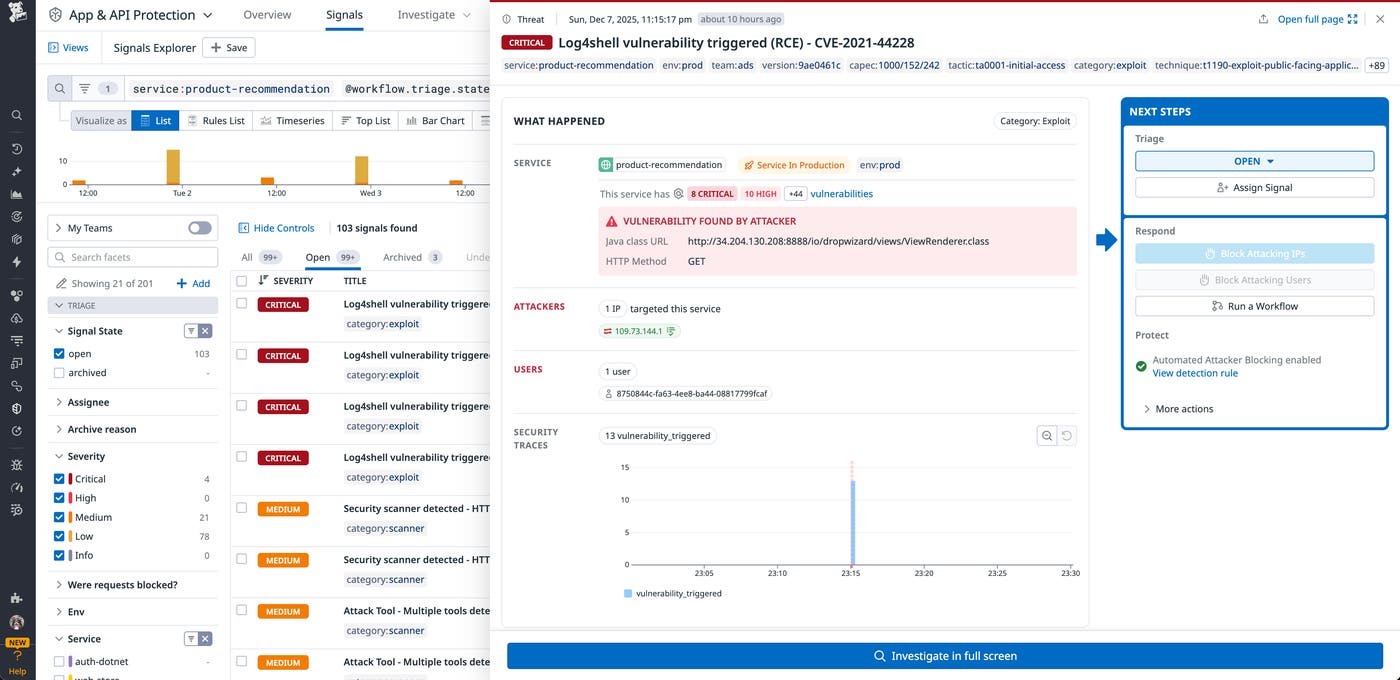
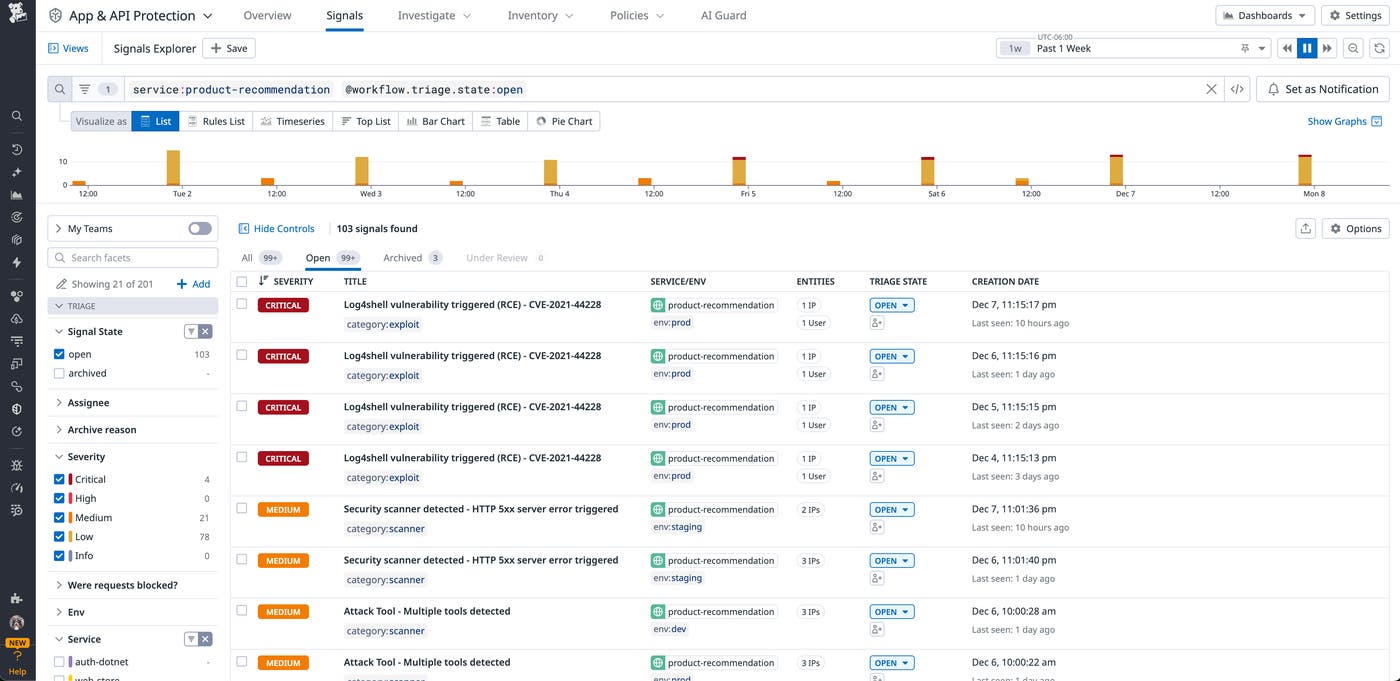
Datadog AAP generates Security Signals that can alert your team whenever threats actually exploit code-level vulnerabilities or target your application’s business logic.

Get alerted when threats target the business logic of your production services

Companies are targeted with thousands of attacks every day, making it incredibly challenging for security and operations teams to focus on the threats that matter to their business. Most threats are not immediately harmful, such as bots and scanners that do not trigger anything in downstream services. However, their sheer volume can easily mask the most important threats (i.e., those that hit production services’ business logic), leaving them in danger of going undetected for days at a time.

Because Datadog collects observability and network data, as well as application runtime data, it can pinpoint and alert security and engineering teams to meaningful attacks. AAP generates Security Signals that can alert your team whenever threats actually exploit code-level vulnerabilities or target your applications’ business logic.

The severity of each Security Signal is defined based on the full execution context provided by the distributed trace, allowing your teams to easily disregard basic security scans that didn’t succeed in targeting any real application routes. Instead, you can quickly take action on the threats that matter most, such as attackers attempting to exploit a Log4Shell vulnerability.

Because AAP collects observability and network data, as well as application runtime data, it can alert security and engineering teams to meaningful attacks. like SSRF attempts.

Our product offers coverage for a dozen classes of vulnerabilities, including SSRF, cross-site scripting (XSS), SQL injections (SQLi), and many more. This allows you to get visibility into most of the OWASP Top 10 attacks—and we plan to extend this coverage to reflect even more types of vulnerabilities in the future.

Identify authenticated bad actors taking aim at your applications

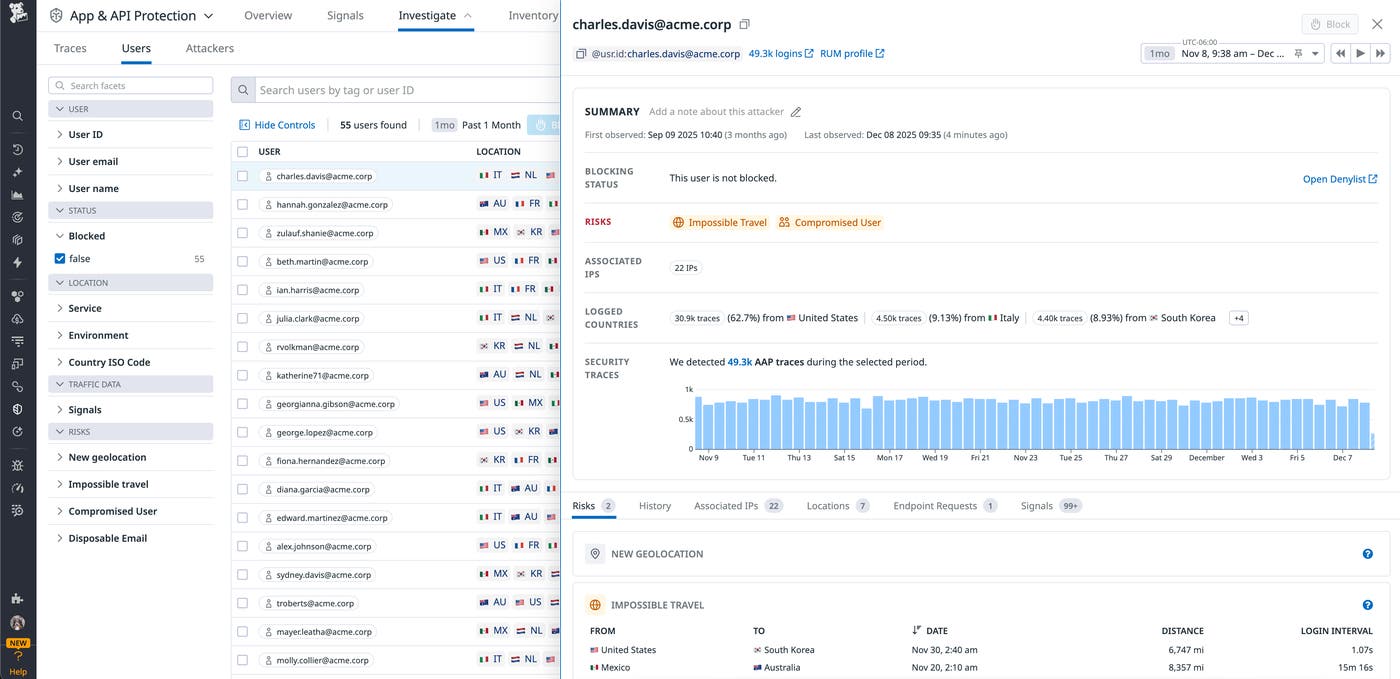
When targeting web applications and APIs, attackers will often perform an initial vulnerability discovery, usually through a standard security scan. While unlikely to expose security vulnerabilities in your application, this scan can provide attackers with an initial overview of your application’s topology, which includes your authentication endpoints. Unauthenticated users have very limited access to applications. Attackers will therefore either try to create accounts or gain access to existing accounts. Gaining authenticated access allows the attacker to benefit from a much wider attack surface, with the ability to query most of the endpoints. For security teams, being able to identify whether attacks are performed by non-authenticated actors or authenticated users is key for prioritizing which attacks require a response. Unauthenticated attacks are generally unharmful, while authenticated attacks are more likely to be sophisticated and targeted at sensitive parts of your application.

Datadog AAP provides the ability to link attacks to the authentication context through custom instrumentation of your authentication service. Any resulting Security Signals are enriched with this context so that teams can easily focus on authenticated attacks. This also allows teams to take precise actions to respond to the threat. Blocking an IP can come at a high risk—for example, doing so might inadvertently block all of the traffic from a data center or corporate IP. AAP enables security teams to identify which user accounts are suspicious, helping them take more granular actions like resetting the user password or revoking API keys.

Automatically enrich detected attacks with the authenticated user data.

Perimeter-based security solutions provide visibility into flat and edge attack traffic. This limited scope makes it difficult for teams to assess the potential impact of attacks, find out if something needs to be remediated, and determine who should be looped into any response efforts.

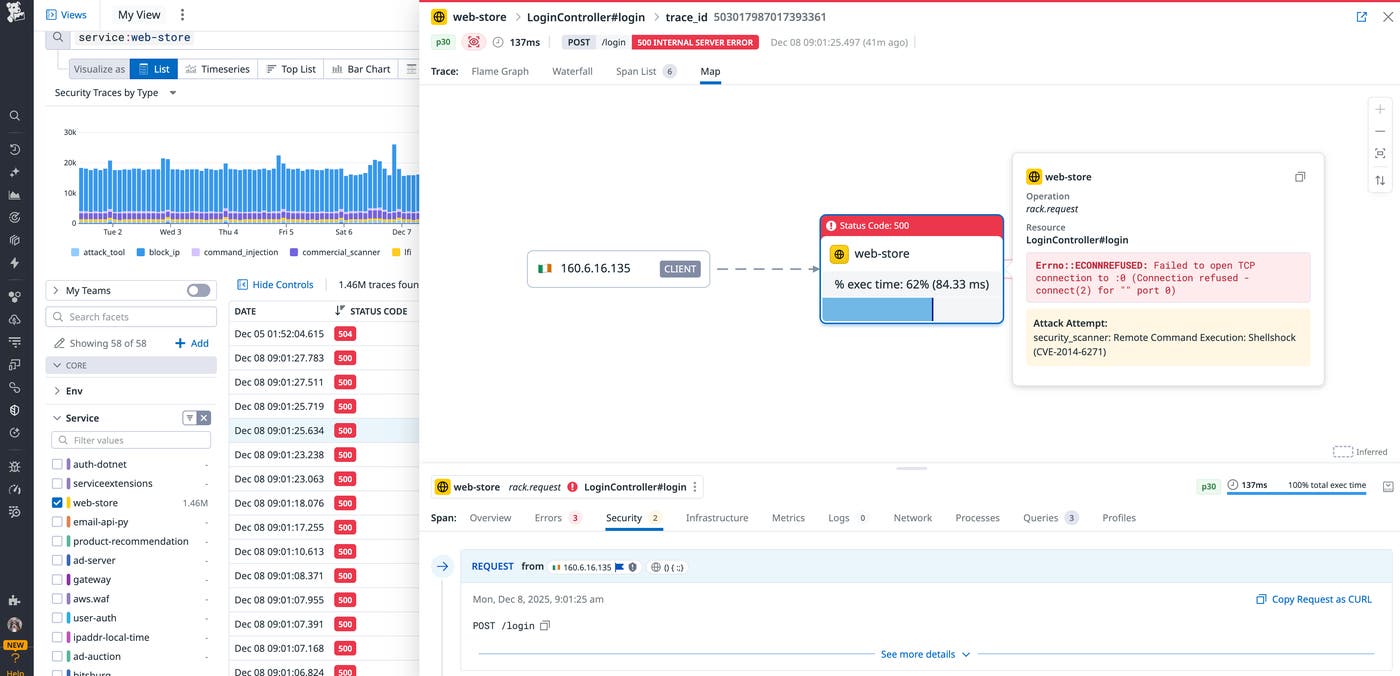
Datadog AAP leverages APM to trace the flow of attacks and attackers across distributed services, giving teams insight into how their applications, APIs, and databases reacted to threats. This means that security teams can now answer questions like:

  • Did this attack make it down to my PCI-compliant cluster?

  • What database queries have been executed with these suspicious requests?

  • Which public IP did this attack on an internal service originate from?

  • Did this SSRF attack trigger any calls to internal AWS services?

Datadog AAP leverages APM to trace the flow of attacks and attackers across distributed services, giving teams observability into how their applications, APIs, and databases reacted to threats.

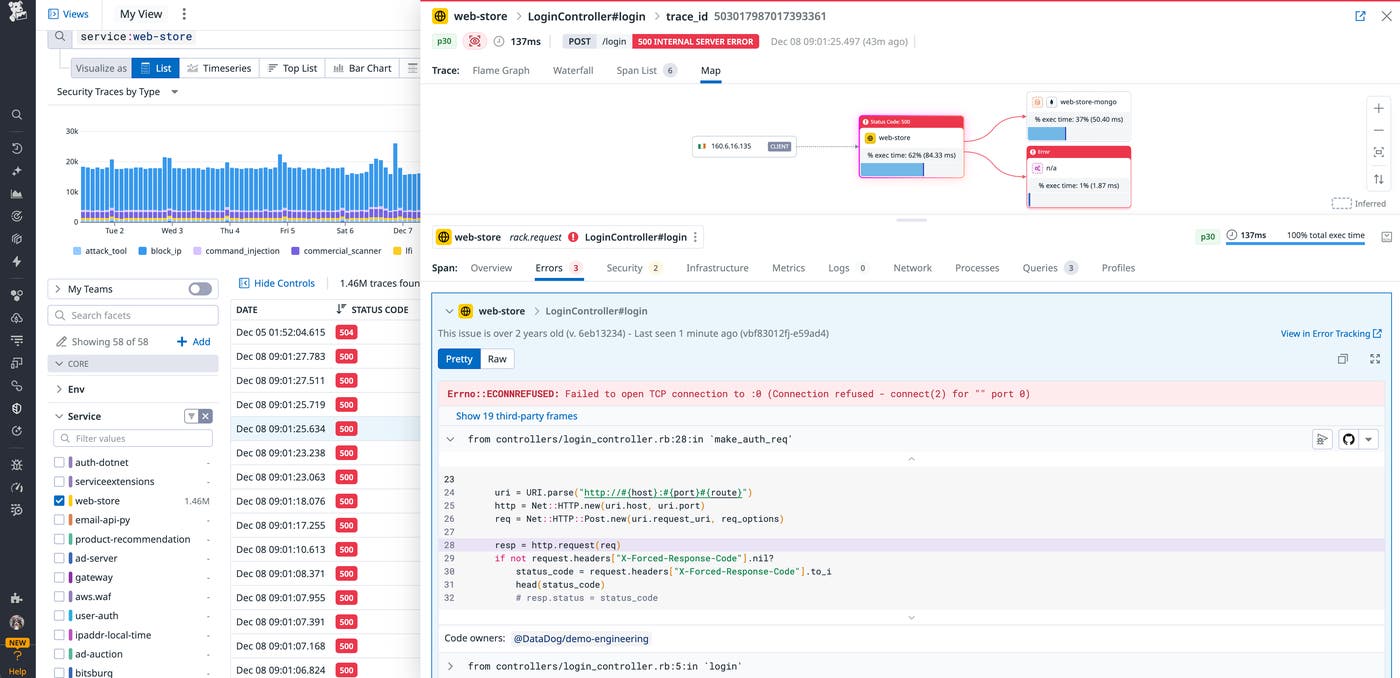
Datadog APM and AAP also work together to surface errors, which are often the first step toward finding vulnerabilities. Datadog AAP provides visibility into related errors, all the way down to the stacktrace and even the exact piece of code affected, thanks to our source code integration, as shown below. But it also goes even further by gathering the runtime execution context from the trace, so you can quickly identify which attacks actually triggered code-level vulnerabilities. With these actionable insights, security teams can now collaborate with engineering teams to strengthen their code together.

Datadog AAP gathers the runtime execution context from traces, so you can quickly identify which attacks actually triggered code-level vulnerabilities.

Reconstruct the attack vector across the stack with the Security Platform
As the cloud attack surface expands, attackers have more opportunities to target the weakest link of your stack, whether that lies in your applications, workloads, or infrastructure. Swiveling across multiple security point solutions for each of these layers wastes precious time during investigation. Because AAP is fully integrated with Datadog Security, teams can rely on a single source of truth to reconstruct the full attacker journey across the stack, get visibility into application vulnerabilities, and understand how attackers took control of the underlying infrastructure with Workload Protection and Cloud SIEM or exploited a cloud infrastructure misconfiguration with Cloud Security Misconfigurations.

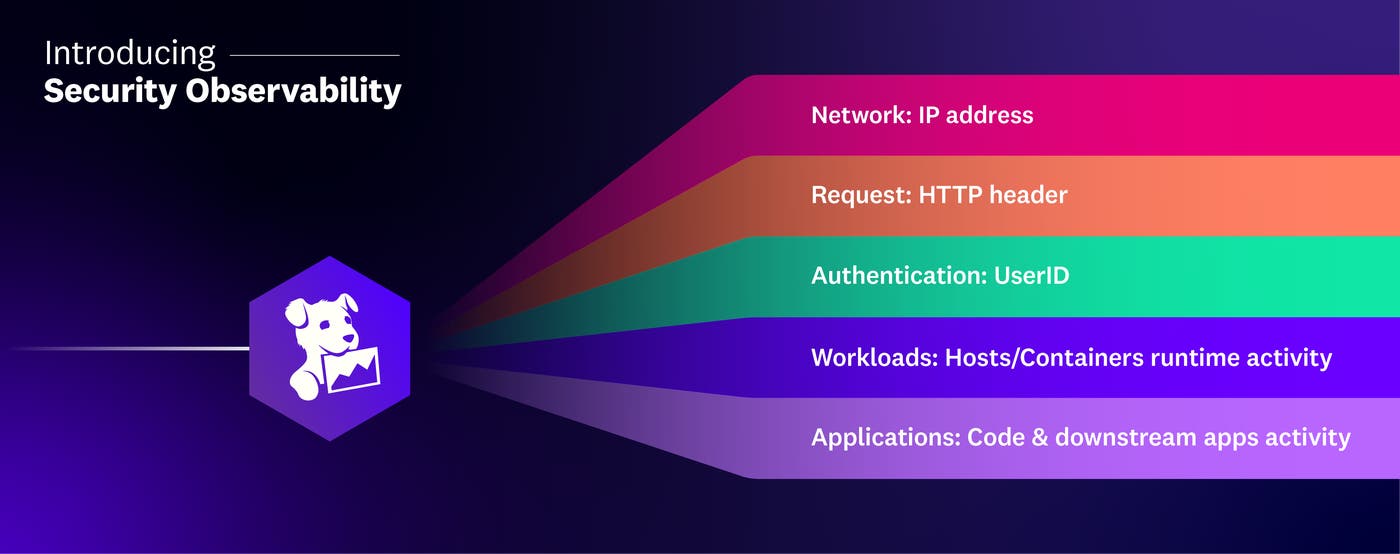
Datadog AAP is fully integrated with Datadog Security.

For more information about AAP’s capabilities, check out our guides on protecting apps from zero-day attacks, mitigating account takeovers, blocking attackers directly in-app, and identifying attack patterns.

Secure your applications with Datadog

Getting started with Datadog App and API Protection is easy and frictionless since it leverages the same libraries that have already been deployed in any service that you are currently monitoring with APM. Simply add an environment variable and restart the application—no need to deploy yet another agent or redirect your traffic. See our documentation for more details.

If you’re already a Datadog customer, you can get started with AAP today. Otherwise, sign up for a 14-day free trial.