




👋 Welcome to Climate Drift: your cheat-sheet to climate. Each edition breaks down real solutions, hard numbers, and career moves for operators, founders, and investors who want impact. For more: Community | Accelerator | Open Climate Firesides | Deep Dives
Hey there! 👋
Skander here.
Welcome back to Follow the Money, our monthly capital flows briefing with Jarek Dmowski.
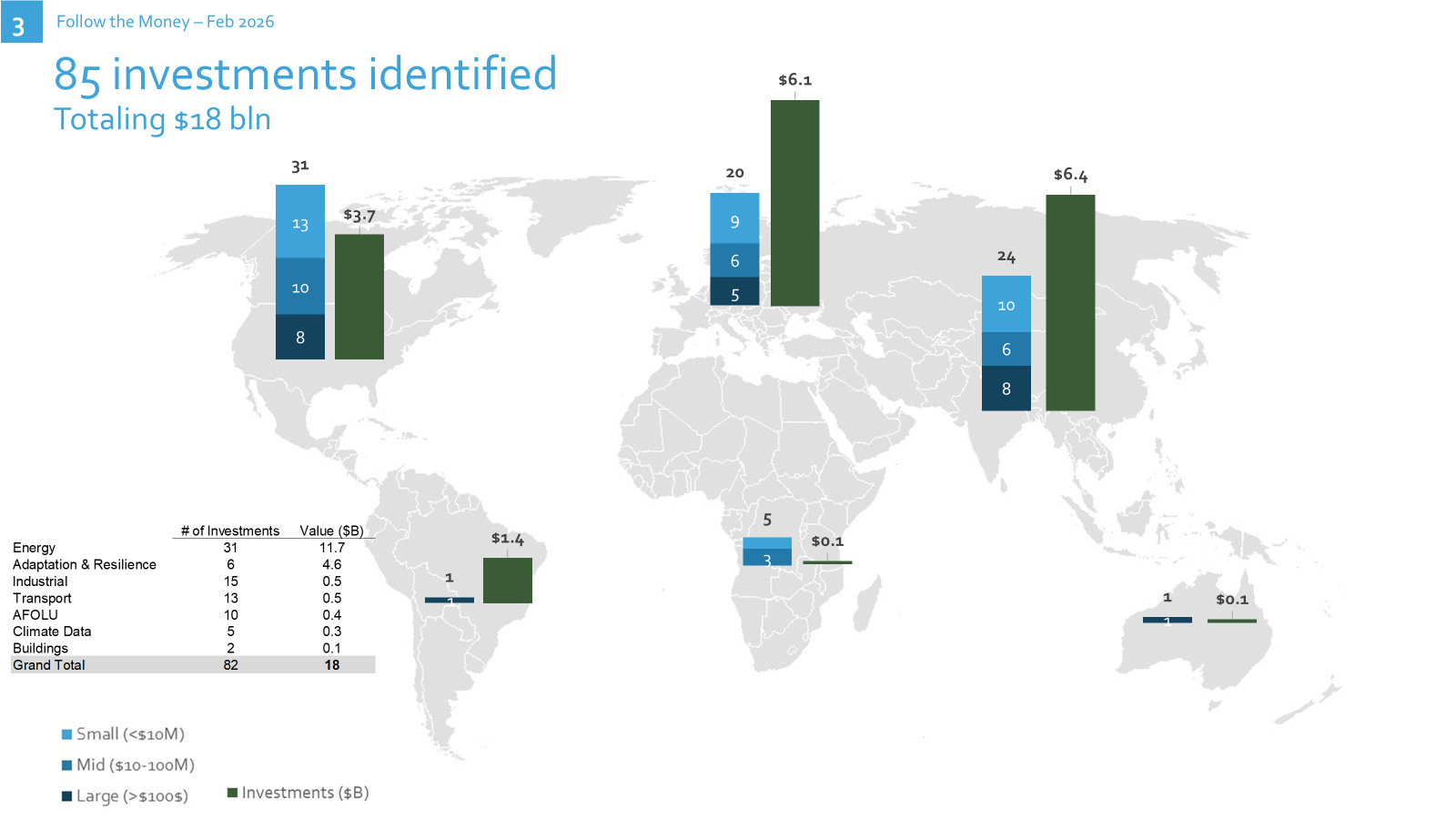
February confirmed what January hinted at: 2026 is shaping up differently. $18 billion across 85 tracked deals, and the geography of climate capital is shifting in ways worth paying attention to.
Asia led for the second straight month at $6.4 billion. Europe came in close behind at $6.1 billion. North America, despite 31 deals (the highest count), trailed both at $3.7 billion. The US is putting serious money into fusion and advanced nuclear. The rest of the world is building solar, wind, and storage at scale. Two very different theories of how you decarbonize a grid, playing out in real time.
A few signals Jarek flags that we think are especially worth tracking: the EIB’s €3 billion facility to prepare European households for carbon pricing before it hits in 2027. Five robotics deals (mostly in China) that point to automation as a climate play, not just an industrial one. And India’s EV ecosystem, which is now attracting capital across buses, three-wheelers, charging, and fleet leasing in a single month.
🌊Jarek breaks it all down below, region by region, theme by theme.
But first: Who is Jarek?
Jarek Dmowski is a global transformation leader who partners with high-growth companies with positive climate impact. He combines industry and climate finance expertise with a strong track record of driving growth—across PE/VC-backed scaleups, ABN AMRO, and BCG.
He scaled a data-driven technology company ~2.5x to ~$25M in revenue and led post-merger integrations that enabled ~6x accelerated growth. At a global financial institution, he spearheaded a $2B capital reallocation toward new energy and mobility. He also developed a comprehensive climate plan that translated the Paris Agreement into actionable targets across sectors and established a $250M program to drive efficiency gains and reduce emissions at an energy utility.
Jarek is passionate about how the climate transition reshapes economies and business models, creating significant opportunities for multi-country growth and impact.

Welcome to the next edition of “Follow the Money” - a monthly briefing on the capital flows shaping the climate transition.
February didn’t slow down, confirming a strong start to 2026.
One theme continues to build momentum: nuclear’s breakout year is accelerating. In the US, five fusion and fission ventures raised a combined $840M in February — including Inertia Enterprises’ $450M Series A to develop Thunderwall, a next-generation grid-scale fusion system. The story is no longer just policy ambition — it’s early-stage capital flowing into hardware with clear pathways to scale.
In Europe, the signal came from policy-backed capital. The European Investment Bank launched a €3 billion ETS2 pre-financing facility, aimed at preparing households and energy systems for the EU’s upcoming residential carbon market in 2027 — a reminder that transition financing is increasingly about enabling adoption, not just innovation.
Meanwhile in Asia, capital is flowing into robotics as a climate enabler. Companies like Spirit AI and AI² Robotics raised a combined $435M, reflecting growing conviction that automation — from industrial processes to logistics — will be critical to scaling climate solutions.
Explanation of the approach and source data: The investment list was developed based on disclosures, newsletter monitoring and review of climate news. Although not exhaustive, 85 climate-related investment deals were tracked—amounting to roughly $18 billion (all data in US$), covering all continents and different life stages of companies and development finance programs. Data skew toward early-stage companies and investments, as well as development financing programs. We are continuously working to expand the data sources and coverage of investments.
So, where did the money flow in February 2026?
Asia — for the second month in a row — led with ~$6.4 billion across 24 deals, closely followed by Europe at ~$6.1 billion (20 deals). North America trailed at ~$3.7 billion (31 deals), while activity across other regions remained more limited at ~$1.6 billion (6 deals).
Energy once again dominated, accounting for ~$12 billion across 31 deals — by far the largest category month after month. Adaptation & resilience emerged as a clear #2 (~$4.6 billion, 6 deals), followed by Industrial, Transport, and AFOLU. Buildings remained undercapitalized (~$0.1B), continuing a persistent gap in the transition.
AI’s influence is becoming structural. Nine AI-enabled climate solutions raised capital in February, reinforcing the role of artificial intelligence as an accelerator of deployment, optimization, and cost reduction across sectors.
Robotics, a new tracked category, saw five investments in February, particularly in China, underscoring its growing industrial and climate-adaptation roles.
Venture capital activity remained resilient. We tracked 49 venture and growth investments (Seed through Series F), with an average round size of ~$64 million. North America led with 18 deals, followed by Europe and Asia with 14 deals each — indicating a relatively balanced early-stage innovation landscape.
Public and development finance continued to anchor the market. Multilateral institutions and government programs supported ~$3.7 billion across ~18 deals, with a strong focus on infrastructure and adaptation. Notably, February also saw the largest blue bond issuance to date.
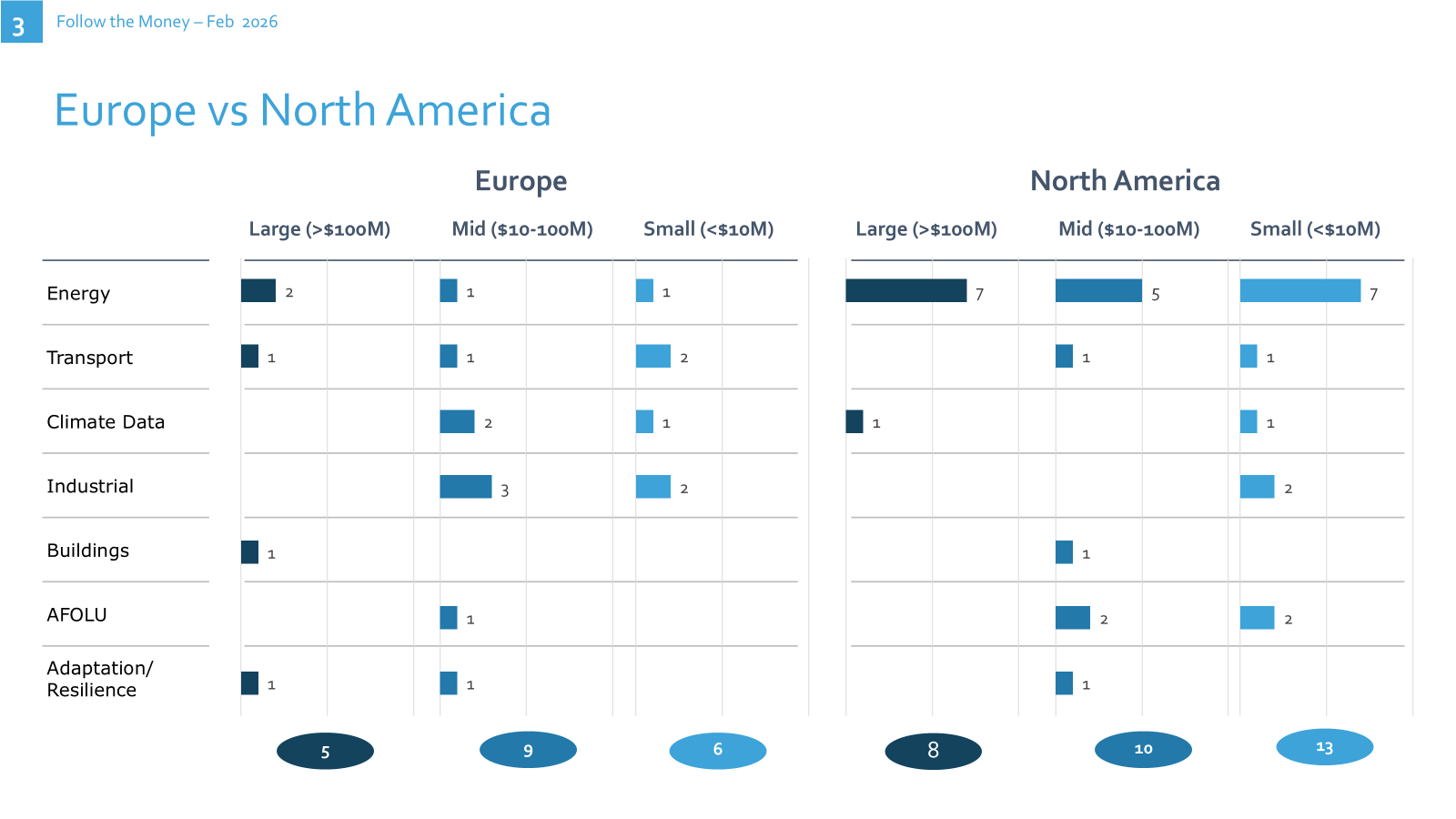
Let’s now dive deeper into 2026 watchlist themes (please refer to our December perspective for more details) and across regions to highlight technologies with real scaling potential over the next 3–5 years.
Which (of our 2026) themes were most strongly visible in February?
U.S: Nuclear and Geothermal vs. RoW: Solar and Wind
February reinforced a divergence already visible in January. In North America, capital concentrated in dispatchable, next-generation energy systems — spanning fusion, advanced nuclear, and grid hardware. Notable raises included Inertia Enterprises ($450M), SHINE Technologies ($240M), Heron Power ($140M), DG Matrix ($60M), and Utility Global ($100M).
By contrast, Europe and Asia deployed capital into proven, scalable infrastructure — solar, wind, storage and pumped hydro. Large-ticket investments included multi-GW solar projects in Turkey (~$2.0B), Samruk Energy’s renewables expansion (~$2.0B), Prime Infrastructure Capital’s pumped hydro portfolio (~$1.3B), EnBW’s €1.04B hybrid bond, and the Andalusian Green Hydrogen Valley (~$1.15B).
Geothermal was quieter in February than in January, but the underlying U.S. appetite for dispatchable clean power still looks intact.
“Solarpunk” Continues
February was a landmark month for the ‘EVs beyond cars’ narrative - particularly in emerging markets.
In India alone, multiple platforms raised capital across the ecosystem: Drivn ($80M; electric buses and trucks), Euler Motors ($30.5M; electric three-wheelers), Turno ($5.2M; intercity buses), Statiq ($18M), and Exponent Energy ($20M; ultra-fast charging). In Africa, momentum is building around two- and three-wheeler electrification: Spiro ($50M; motorcycle battery-swapping) and GoCab ($45M, EV ride-hailing).
The pattern is clear: cheap batteries + localized mobility models = rapid electrification, particularly in markets where two- and three-wheelers dominate transport demand.
In February, a distinct cluster of dual-use investments emerged, linking climate tech with security, resilience, and compute infrastructure.
In Europe, Frankenburg Technologies ($32.7M Series A) is explicitly positioned around sovereign resilience, while FlyFocus (€4.8M) and Farsighted Vision ($7.9M) develop autonomous systems with both civil-defense and climate-adjacent applications. In the U.S., DG Matrix and Heron Power are building solid-state transformer technologies critical for both grid modernization and data center resilience.
The blurring of climate tech, energy security, and defence applications is one of the defining features of Europe’s 2026 investment landscape.
February tracked five robotics-focused investments, reinforcing robotics as an emerging climate enabler.
China led with scale: Spirit AI ($290M) and AI² Robotics ($145M) are advancing industrial and logistics humanoids — with direct implications for manufacturing efficiency and energy intensity. Elsewhere, robotics is being deployed in high-impact, climate-relevant use cases: EyeROV ($1.5M; offshore inspection) and Apeiron Labs ($9.5M; marine monitoring).
The common thread: robotics is being deployed in climate-relevant operational contexts — offshore energy, precision agriculture, industrial logistics — at increasing frequency and scale.
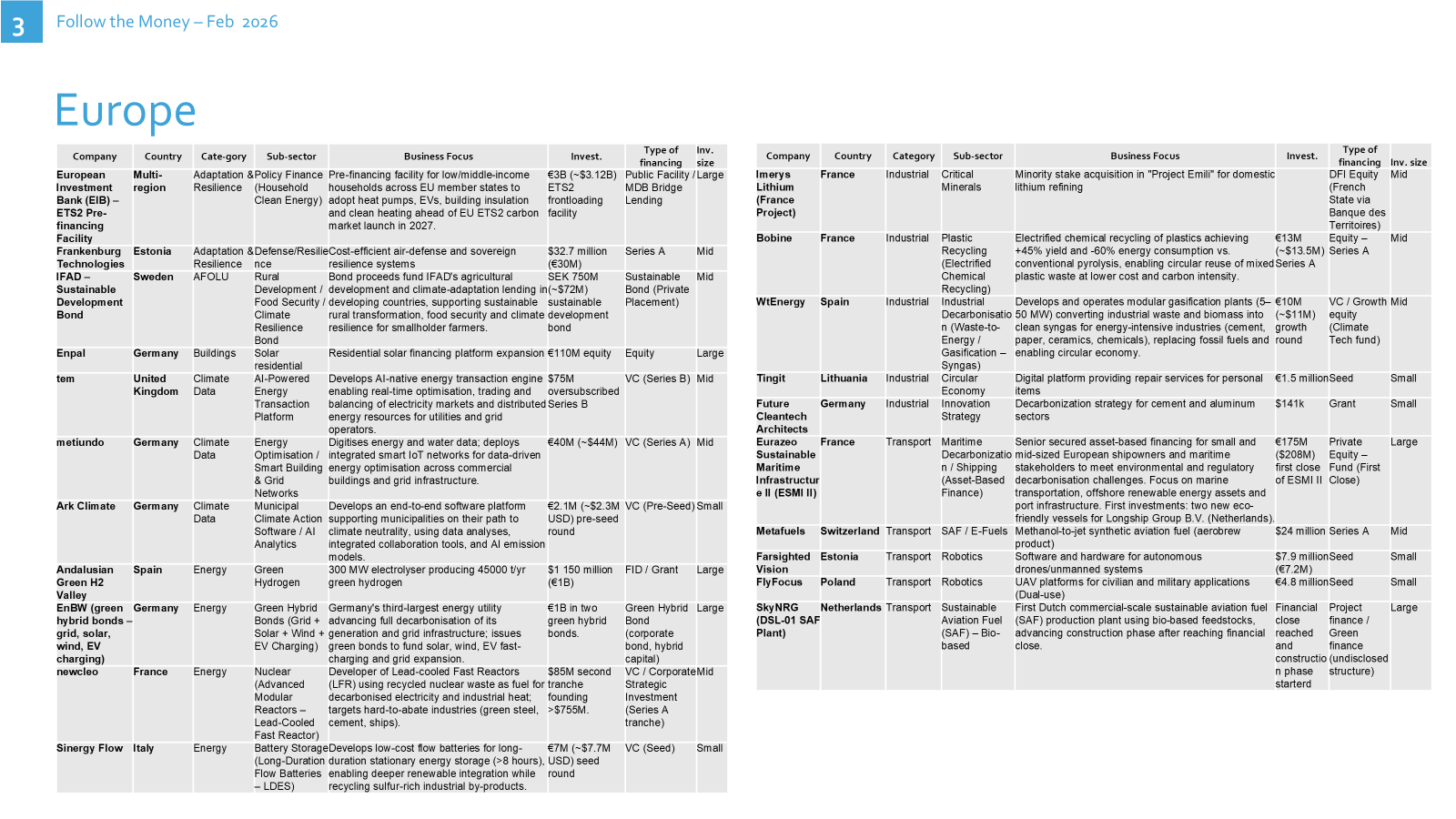
Europe recorded 20 deals totaling ~$6.1 billion, combining large-scale public financing with venture and growth capital across energy infrastructure, nuclear, maritime decarbonisation, electrification, and circularity.
The most consequential move was structural. The European Investment Bank launched a €3 billion ETS2 pre-financing facility — bridge capital to support households ahead of the EU’s residential carbon market in 2027. The facility reflects an important innovation: using public finance to reduce the shock of carbon pricing on residential consumers, accelerating the shift to heat pumps and clean heating before the cost signal arrives.
Selected highlights:
newcleo (France) - $88M - advancing lead-cooled fast reactors capable of using recycled nuclear fuel. With pilots planned in the UK and Italy, regulatory progress will be a key test for Europe’s nuclear competitiveness.
Tem (UK) - $75M Series B - AI-powered energy trading platform enabling real-time optimisation in increasingly volatile, renewables-heavy grids - sitting at the intersection of AI, grid flexibility, and climate data.
Metiundo (Germany) - €40M - software platform linking buildings and grid networks to unlock demand-side flexibility.
Metafuels (Switzerland) - $24M - advancing methanol-to-jet fuels, highlighting Europe’s continued push to build viable pathways for aviation decarbonisation despite challenging economics.
Bobine (France) - €13M Series A - developing electrochemical plastic recycling with potential for lower-energy, higher-purity circularity - a possible breakthrough if scalable.
Frankenburg Technologies, FlyFocus and Farsighted Vision - smaller rounds, but strategically relevant. They reflect the increasing overlap between resilience, autonomous systems, and climate-adjacent infrastructure security.
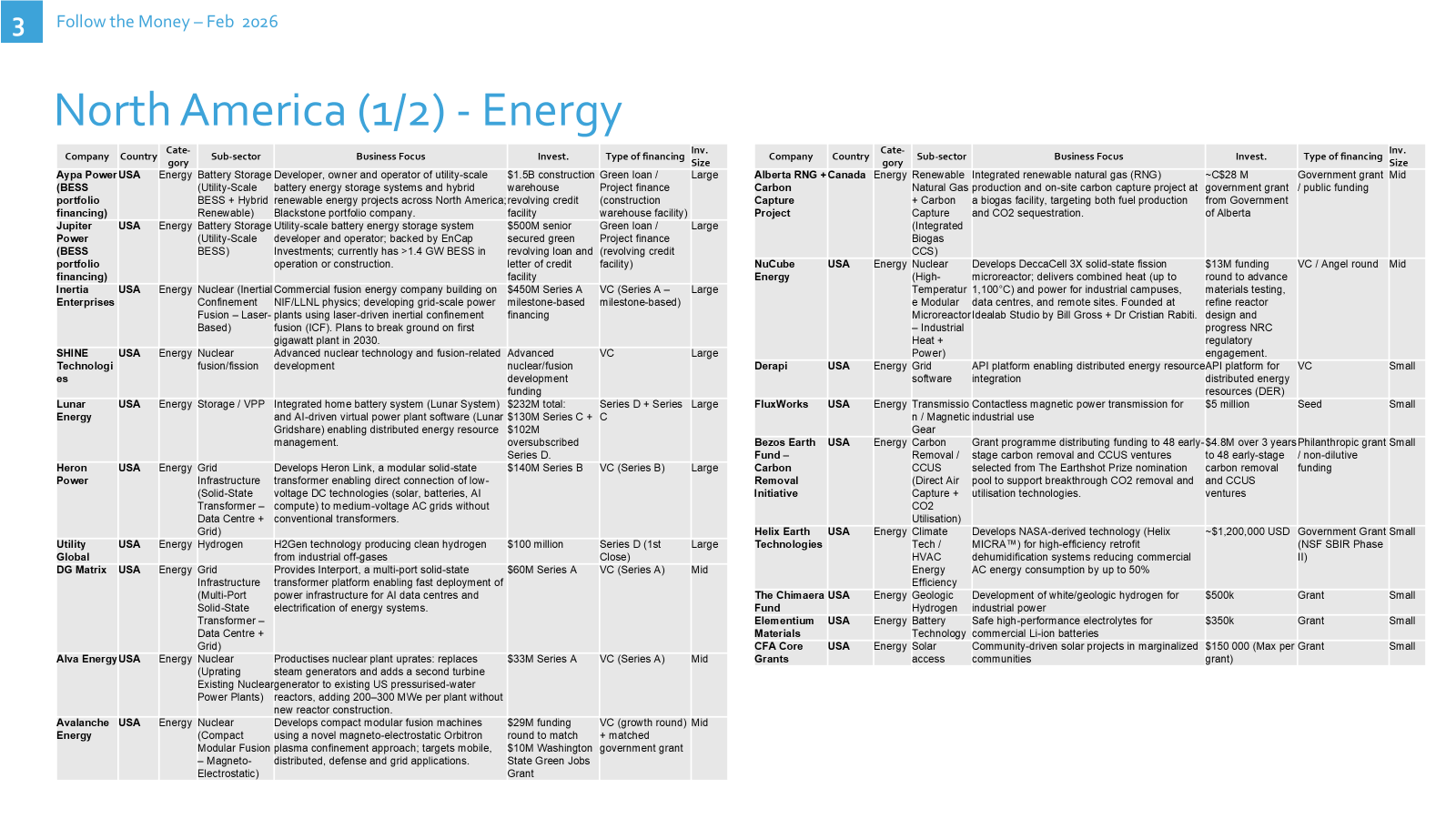
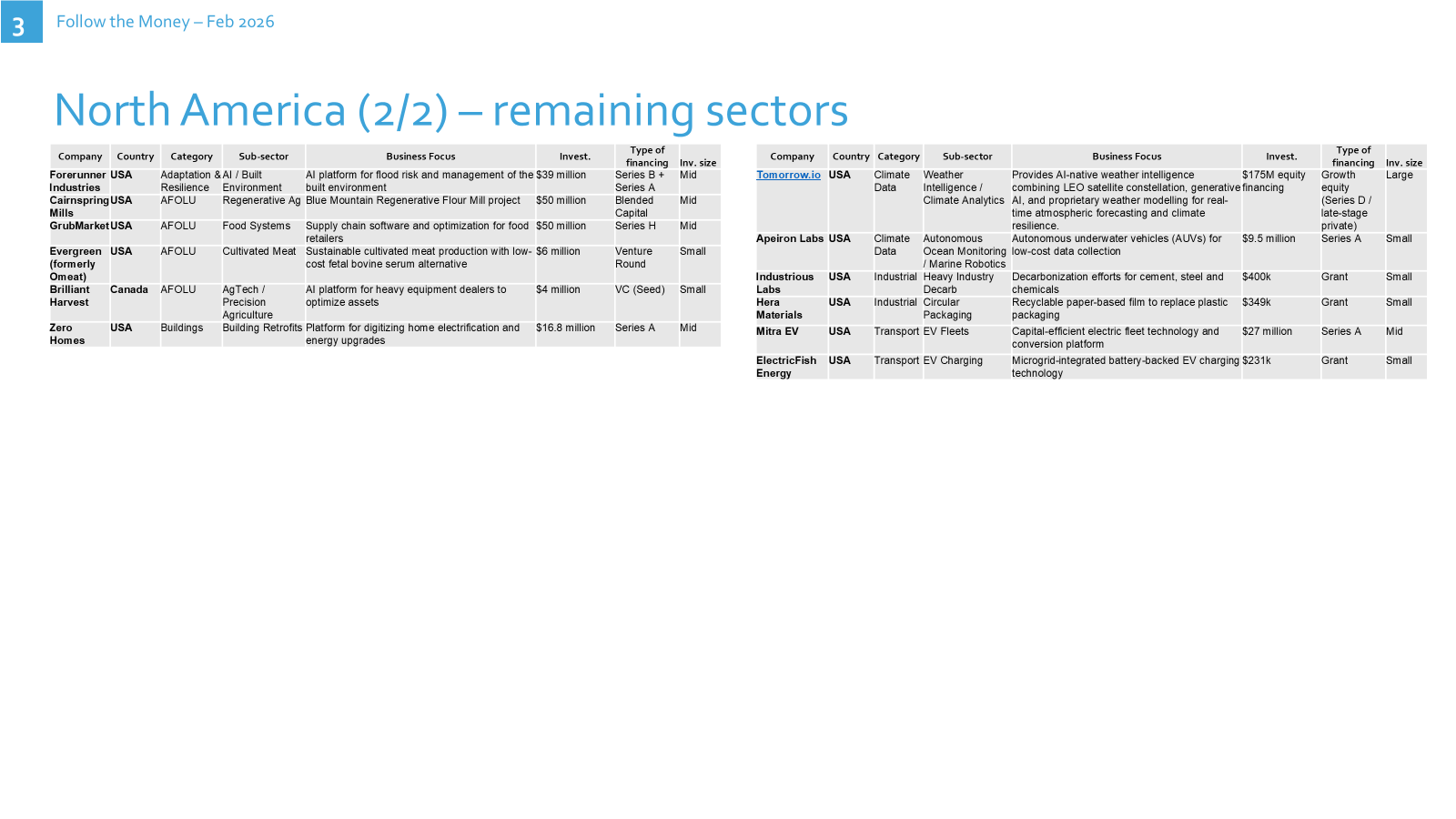
North America recorded ~$3.7 billion across 31 deals in February 2026. The defining narrative was clear: the U.S. is doubling down on firm, dispatchable clean power — particularly nuclear, fusion, and advanced grid technologies — at a pace and concentration not seen before. Alongside this, grid infrastructure and virtual power plants (VPPs) continued to attract meaningful capital.
Selected highlights:
Inertia Enterprises - $450M Series A - a milestone-based raise to develop Thunderwall, a grid-scale inertial confinement fusion system. The structure - tying capital to technical milestones - signals growing investor confidence in fusion while actively managing risk.
SHINE Technologies - $240M - already generating revenue from fusion-based medical isotopes, SHINE combines near-term commercial viability with long-term fusion optionality, materially reducing technology risk versus pure-play fusion.
Avalanche Energy - $29M (+$10M grant) - developing compact fusion reactors for industrial and maritime use. If successful, small-form fusion could unlock entirely new applications beyond utility-scale power.
Alva Energy - $33M Series A - focused on nuclear uprates (the process of increasing the licensed power output of existing nuclear plants) - one of the fastest and lowest-cost pathways to expand baseload capacity across the existing U.S. fleet.
Heron Power - $140M Series B and DG Matrix - $60M Series A. Both are scaling solid-state transformer technologies, critical for data centres and renewable grid integration.
Lunar Energy - $232M Series C+D - a leading home battery and VPP platform, with its Gridshare network aggregating distributed assets into grid services.
Utility Global - $100M - producing hydrogen from industrial off-gases - a capital-efficient pathway to decarbonise hard-to-abate sectors.
Tomorrow.io - $175M - building an AI-native weather platform with its own satellite constellation. As climate volatility increases, proprietary data infrastructure becomes a strategic moat.
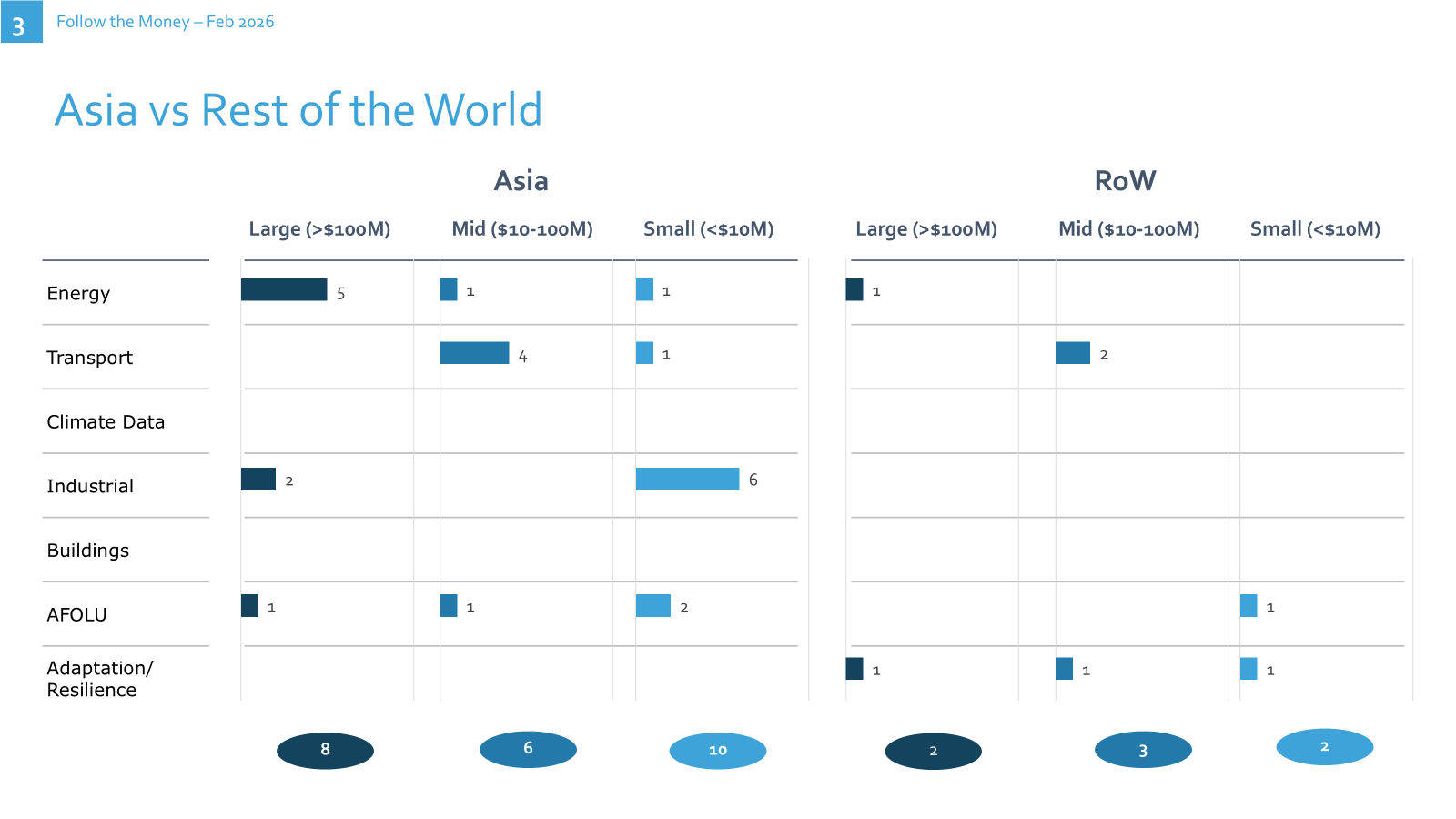
Asia recorded ~$6.4 billion across 24 deals in February 2026 — marking a second consecutive month of strong capital deployment.
Large-scale solar and renewables investments in Turkey and Kazakhstan drove headline volumes, while India reinforced its position as the most dynamic EV ecosystem globally. At the same time, China continued its aggressive push into industrial robotics, with growing relevance for climate-critical supply chains and manufacturing efficiency.
Key highlights from Asia:
Spirit AI (China)- $290M - developing humanoid robots for industrial use. Robotics is becoming critical for clean-tech manufacturing and industrial efficiency.
AI² Robotics (China) - $145M - logistics and warehouse automation. Improves supply chain efficiency and energy use, including in EV and battery ecosystems.
Octopus Energy (China JV) - Octopus is scaling its Kraken platform and energy retail model into China via a joint venture, signalling growing interest in software-led optimisation of power systems.
Drivn (India) - $80M - leasing model for electric buses and trucks, unlocking fleet electrification by removing upfront capex barriers.
Euler Motors (India) - $30.5M - focused on last-mile transport, one of the highest-impact EV segments by volume.
Radiance Renewables (India) - $100M - 926 MW solar, wind, and storage portfolio, a strong example of blended finance mobilising institutional capital.
Statiq (India) - $18M - expanding fast-charging infrastructure.
Exponent Energy (India) - $20M - ultra-fast charging for fleets, potentially to reshape EV economics in logistics markets.
EBRD leading $195.5M solar + BESS financing in Uzbekistan - a template for de-risking clean energy in emerging markets.
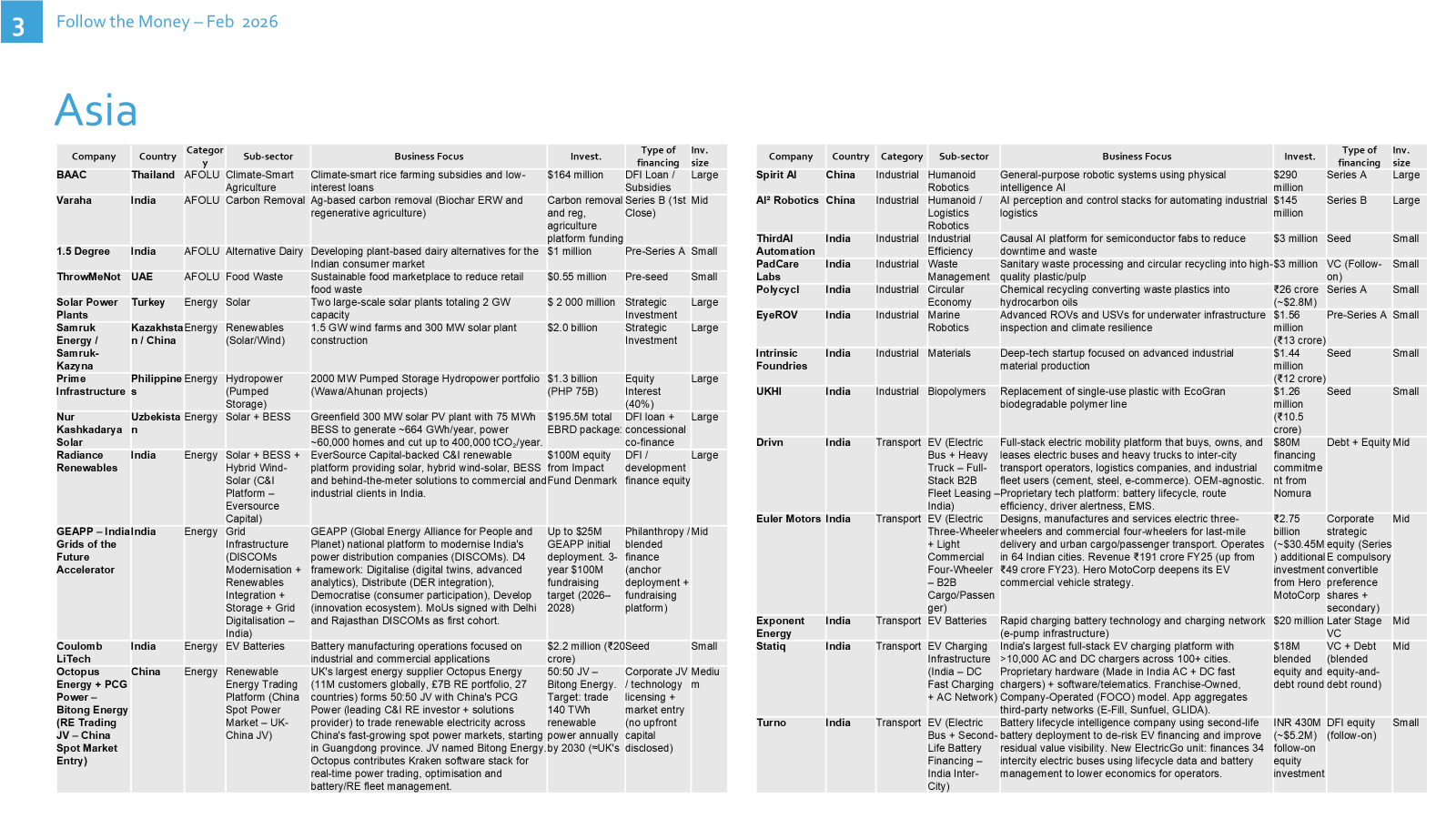
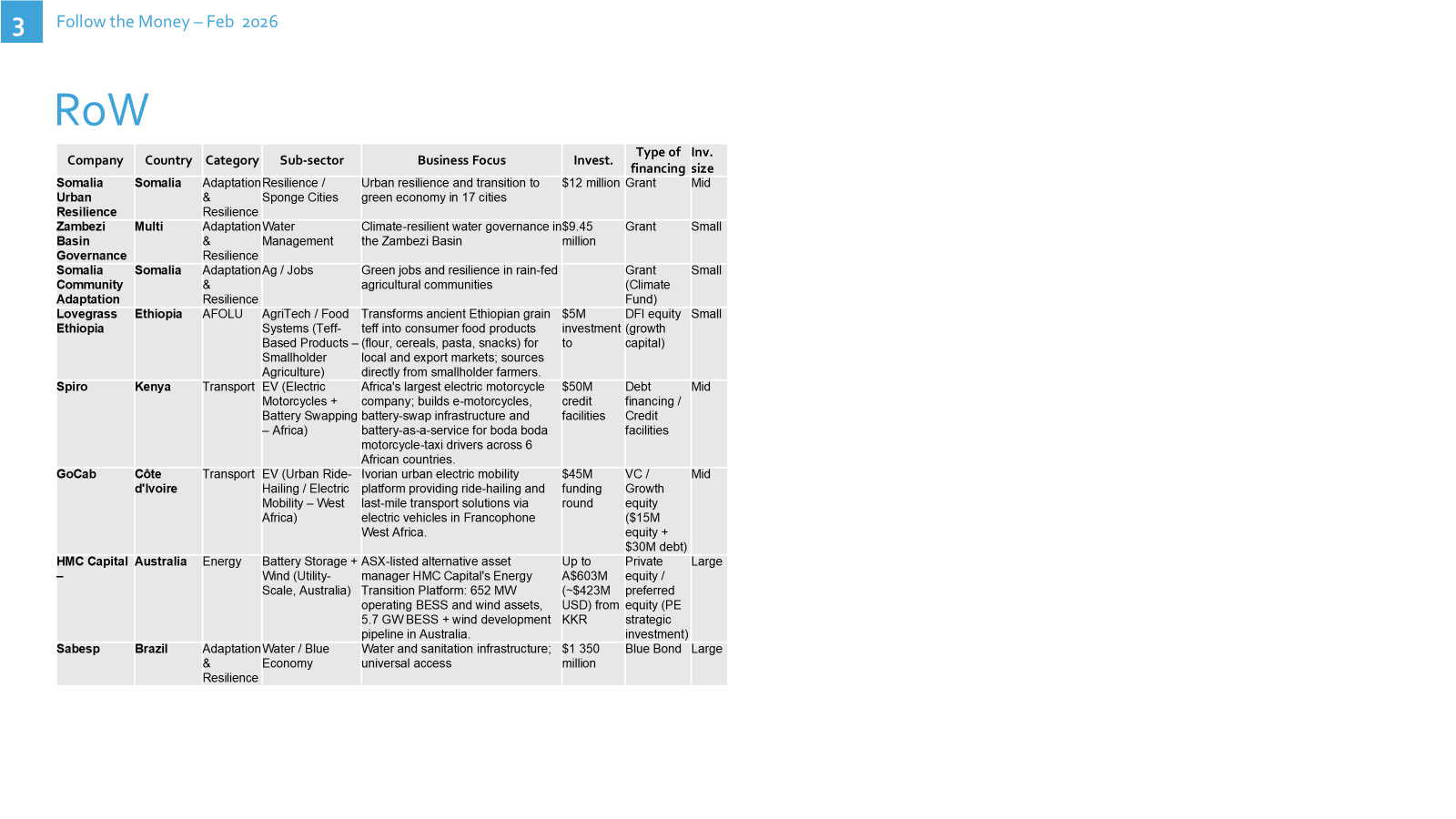
The Rest of the World accounted for ~$1.9 billion across 7 deals in February 2026.
Brazil’s Sabesp water infrastructure financing dominated volumes, while Africa continued to scale e-mobility and resilience infrastructure. Australia, meanwhile, attracted significant private equity into utility-scale clean energy, reinforcing its role as a key deployment market.
Key highlights:
Sabesp (Brazil) - $1.35B Blue Bond - financing water infrastructure and climate resilience in São Paulo. A landmark deal highlighting water as a core climate adaptation priority.
HMC Capital (Australia) - $423M from KKR - funding utility-scale BESS and wind. Signals growing private equity entry into Australian clean energy infrastructure.
Spiro (Kenya) - $50M debt financing - expanding battery-swapping for electric motorcycles.
GoCab (Côte d’Ivoire) - $45M - scaling EV ride-hailing, targeting rapidly urbanising markets.
Varaha (India) - $20M - platform for carbon removal and regenerative agriculture at the intersection of nature-based solutions, AFOLU, and carbon markets.
Bank for Agriculture and Agricultural Cooperatives (Thailand) - $164M - supporting climate-smart agriculture and focused on smallholder resilience and productivity.
January set the tone; February reinforced it.
The U.S. is making explicit bets on advanced nuclear and fusion — with private capital, not just public funding, now leading the charge. Europe is deploying policy-backed finance to bridge the gap to mass adoption. Asia continues to scale utility-scale renewables at an unmatched speed. And emerging markets are building the EV, resilience, and nature-based infrastructure that will define the next phase of the climate economy.
March will test whether this momentum sustains. We will be watching whether the themes identified in December continue to deepen:
U.S.: Nuclear and Geothermal vs. Rest of World: Solar and Wind
“Solarpunk” Momentum — electrification beyond cars, powered by cheap batteries
Dual-Use Innovation: Climate + Defense, Supply Chain, Compute
CapEx-Intensive Mid-Stage Tech and the “Valley of Death”
Industrial Heat Electrification
Nature-Based Solutions for Carbon and Biodiversity
AFOLU Innovation — including climate adaptation, robotics, and alternative proteins
The Rise of Climate Robotics
Stay tuned for next month’s edition as we continue to follow the capital shaping the climate transition.