





👋 Welcome to Climate Drift: your cheat-sheet to climate. Each edition breaks down real solutions, hard numbers, and career moves for operators, founders, and investors who want impact. For more: Community | Accelerator | Open Climate Firesides | Deep Dives
Hey there! 👋
Skander here.
You know how most carbon removal works? You raise a bunch of money, you build a plant, and that plant captures X tonnes of CO2 per year. Want 2X? Raise more money, build another plant. Want 10X? Ten more plants. It’s linear. Capital in, tonnes out, repeat … forever.
Now imagine a system where the thing you’re growing becomes the factory that grows more of itself.
Sound like science fiction? It’s not. It’s biology. It’s how every tree on earth already works: leaves photosynthesize, return chemicals to the branch, branch grows more leaves.
One guy in New England is trying to apply that principle to carbon removal at industrial scale. His lab is in his basement. His company incorporated this week. His website is, in his own words, “a joke.”
He’s at the very beginning. Pre-revenue, pre-brand, pre-everything. And he’s sharing his work publicly before the polish, because he’s looking for collaborators, multi-disciplinary experts, and early believers.
He is a driftie, so I asked him to write a challenge on it.
Meet Angus Shaw. He’s building nonlinear CDR: a carbon removal company designed around a species of seaweed that can double its biomass every six days.
Today we’re looking at:
Why growing seaweed on land (not in the ocean) changes the economics of algae-based CDR.
How self-scaling infrastructure turns the effect of project finance from linear to exponential
What’s actually been proven in the lab — and what hasn’t
The honest cost economics: from a $500/tonne prototype to a $50/tonne target
What Angus needs to make this real
🌊 Let’s dive in.
BTW, this is the things we do in our exec program. Want to work with us on a challenge too? Learn more here:
But first, who is Angus?
Angus Shaw has spent over 30 years chasing a single question: how do we remove and store enough CO₂ to actually restore our climate? Along the way, he’s built the operational muscle to back it up, managing large-scale technical deployments across networking, energy, and enterprise software.
His expertise spans program management, product delivery, and client services at scale. At Juniper Networks, he designed an agile-waterfall hybrid deployment model that took datacenter software from FOAK through 12 NOAK customers. At Lightcast, he built a client services operation supporting 800+ global customers and launched a consulting practice that generated over $800K in revenue.
He’s also consulted on major utility grid projects, including vendor management for a $16M implementation and ARRA applications that helped secure $204M for smart grid and renewables.
Hi, I’m Angus — it’s spelled and pronounced the same way as the beef, and I grew up in Scotland (I have the accent). Following an undergrad in science, I’ve spent 30-plus years diving deep into entrepreneurial ventures, picking up transferable skills and ideas along the way. I’ve done creative design in investment banks during the dot-com boom, technical project and product management across organizations of every size and led client services and customer success teams. I’m a project management professional (PMP) and I’m comfortable creating progress in almost every type of difficult situation.
I now live with my family in New England, and I’ve just started a company to capture, and durably store, carbon.
I have a lot to learn about many subjects I know almost nothing about — many of which I haven’t even thought of yet. I’m sharing this work publicly because I believe in ‘learning out loud’ and because the problems I’m trying to solve are too big for one person in a basement. Which is, quite literally, where my lab is.
Let me start with the biology, because the biology is the whole bet.
There’s a genus of macroalgae called Ulva — you’d know it as sea lettuce. In optimal conditions, Ulva can grow at rates exceeding 40% per day. For comparison, corn grows at about 6% per day. Even at a conservative 12% daily growth rate, you’re doubling biomass every six days.
The purpose of nonlinear CDR is to facilitate the conversion of Ulva, consistently grown at high rates, into a solid char that can be used in agriculture, construction materials, or securely and durably stored. That’s the basic CDR use case: grow seaweed, capture carbon through the Ulva’s natural photosynthesis process, convert it to a stable form, and permanently store it.
But here’s where it gets interesting.
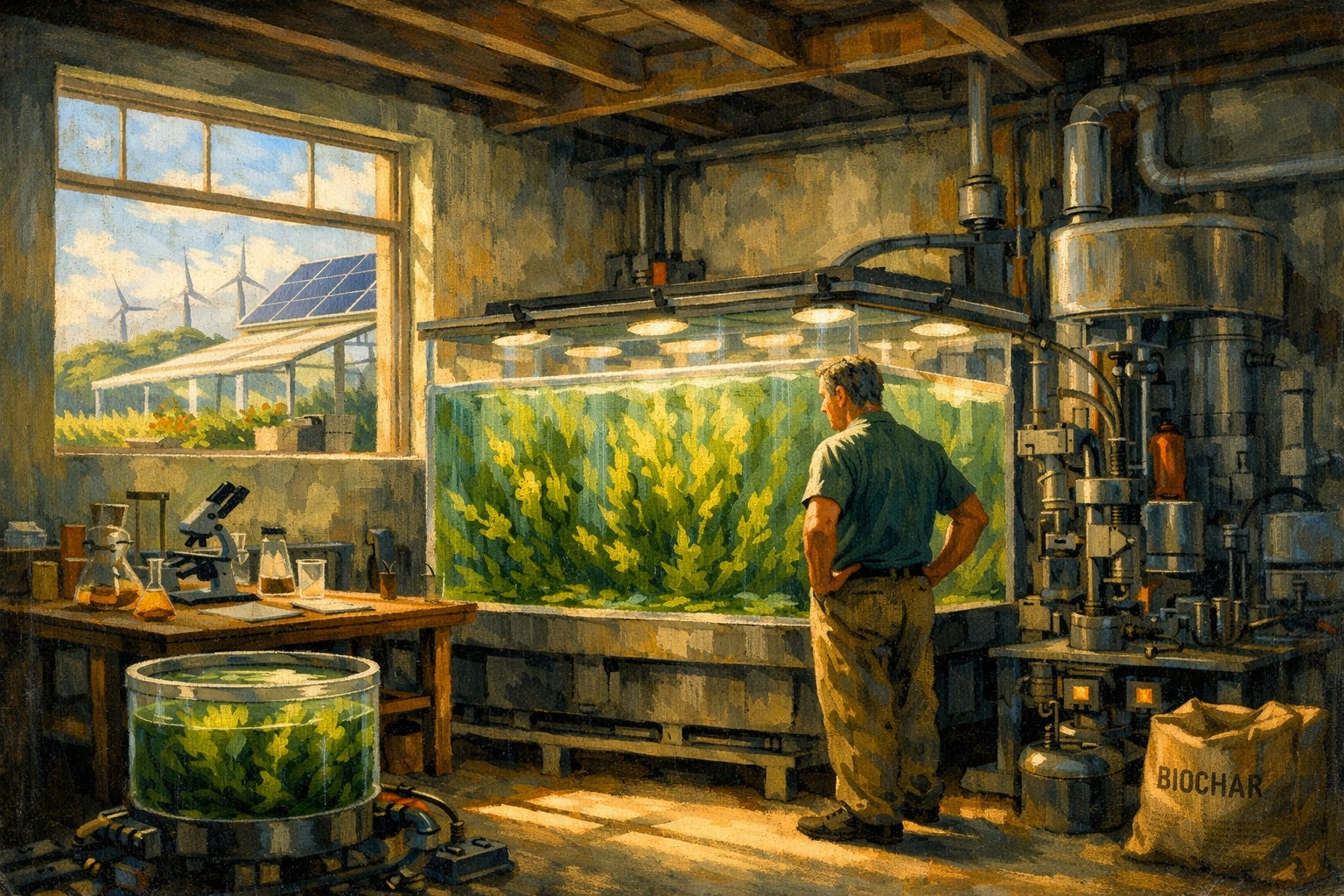
To maintain optimal conditions, Ulva growth must take place on land, in tank systems — not in the open ocean where you’re at the mercy of the seasons, the storms, and the inevitably variable nutrition. And to achieve the necessary scale, harvested Ulva must be used to make the tanks where more Ulva will be grown.
That’s the self-scaling mechanism, and it’s the reason the company is called nonlinear CDR.
How self-scaling works:
The concept is borrowed from how almost all plants function naturally. A leaf grows, photosynthesizes, returns useful chemicals to the branch, which supports the growth of more leaves the following year. I’m applying that same principle to CDR infrastructure.
Harvested Ulva is processed in a biorefinery to synthesize bioplastics. These bioplastics are fabricated into more tank systems. Those new tanks grow more Ulva. The new Ulva is processed to produce more bioplastic. Which becomes more tanks. The waste from the process and the excess Ulva is charred. The quantity of biochar produced increases every year according to a compounding formula.
In most CDR approaches, project finance is a first-order stimulus. You build a direct air capture plant, it costs X, and it reliably delivers Y metric tons every year. Year 2 looks the same as year 10. It’s linear.
In our approach, project finance functions as a second-order stimulus. The CAPEX component builds the synthesis and fabrication facility, installs renewable generation, charring, and nutrient management. Then the system expands outward from that core. Every year, more tanks, more Ulva, more biochar.
There’s a catch: OPEX grows too. You need more farmers, more monitoring, more nutrient recycling as the farm expands. The compounding benefit is real, but it’s net of those first-order costs. I’ve worked in environments where we’ve realized efficiencies of scale as we have become more experienced. I expect our learnings to contribute to cost efficiencies here as well. But I’m honest that optimizing these economics requires operational learnings I haven’t acquired yet.
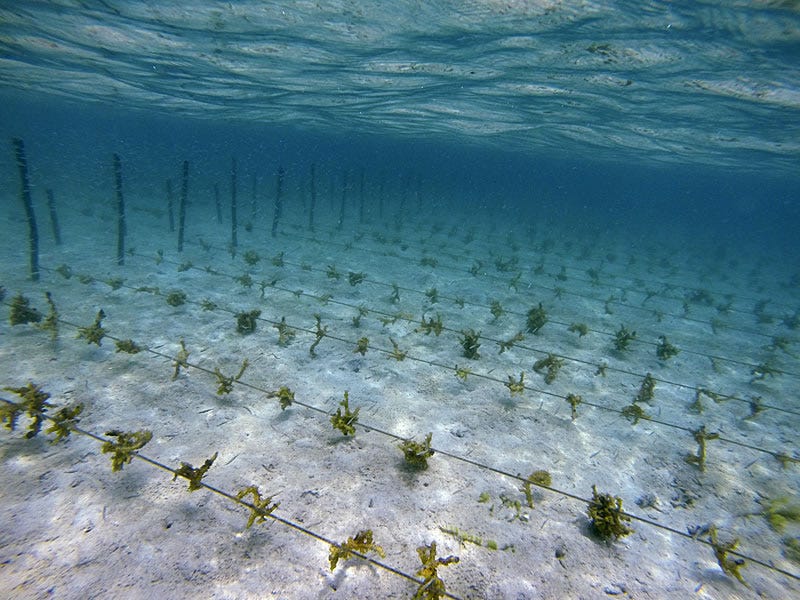
This is the question I get most often. Several companies are already doing sea-based seaweed-to-biochar — MacroCarbon and CarbonKapture among them. Why go through the trouble of building tank systems on land?
The answer comes down to control.
Ocean-based farming means a limited growing season with variable nutrition. You’re subject to weather, currents, and whatever the ocean delivers that week. You can’t optimize growth rates because you can’t control the environment.
On land, in tanks, I can monitor salinity — which is one of my key metrics — and replace the water when the salinity exceeds a level that supports optimal growth. I can track pH, alkalinity, water temperature, light intensity, and the concentrations of specific anions and cations. I can optimize nutrition in real time.
One issue that plagues every open-air, land-based algal farm is evaporation. Evaporation only removes fresh water from the system and leaves behind an increasingly saline brine. Our tank system design allows us to monitor this and intervene before growing conditions degrade. It sounds unglamorous, but this kind of unsexy engineering is what determines whether a system works at scale or collapses.
There’s a broader point here: Along the path to scale, there are techniques to increase the photosynthetic uptake of bicarbonate from seawater, to increase the efficiency of energy consumption, to optimize the synthesis of bioplastics and their fabrication into tank systems, to efficiently install and commission those systems, to char the resulting Ulva, and to store the biochar in a way that can be effectively monitored, verified, and reported on. Some of these are novel, and the ones that are, are being patented. Some are relevant immediately, and others will become relevant as certain scales of production are achieved. I can say more about each of these once IP priority dates have been secured.
I didn’t design this system in isolation. I learn something in almost every conversation I have or paper I read, and I’m always looking for ways to improve the process. nonlinear CDR has been designed by noticing issues that other CDR entities and technology companies have experienced and proactively working to engineer around those challenges and leverage the learnings.
The competitive landscape, as I see it, is represented by companies like:
Nellie Technologies, which uses microalgae to produce biochar. Their use of fungi may resolve the separation issue, but my decision to use Ulva — a macroalgae — comes directly from watching what happened to the “Oilgae” companies between 2008 and 2012. They spent years trying to separate microalgae from water at commercial scale. Most found it to be very energy intensive. I didn’t want to inherit that problem.
Sinkco Labs operates a biorefinery that converts macroalgae into specialty chemicals, possibly for cosmetics and pharmaceuticals. This is a pathway I’m emulating but for bioplastic synthesis. There may be other valuable specialty chemicals we can expand our biorefinery to produce, but our priority is CDR.
RubisCO2 harvests sargassum from the Atlantic blooms that arrive on Caribbean beaches and converts it to biochar. As I understand it, they aren’t intentionally growing that macroalgae for that purpose — they’re cleaning up what washes ashore. I’m purpose-growing my feedstock in controlled conditions, which gives me the consistency and scalability their model doesn’t provide.
MacroCarbon and CarbonKapture are both sea-based seaweed companies producing biochar. I expect they will experience limited growing seasons with variable nutrition. That’s exactly why I’m doing this on land, in tanks, with process controls.
One thing I’m navigating carefully: isometric.com currently excludes purpose-grown feedstocks from their list of eligible BiCRS feedstocks. I’m early in discussions with them about how to secure a possible exception. I know Nellie Technologies would face this same issue — they’re working with puro.earth and have successfully sold an offtake, so alternate registry paths exist.
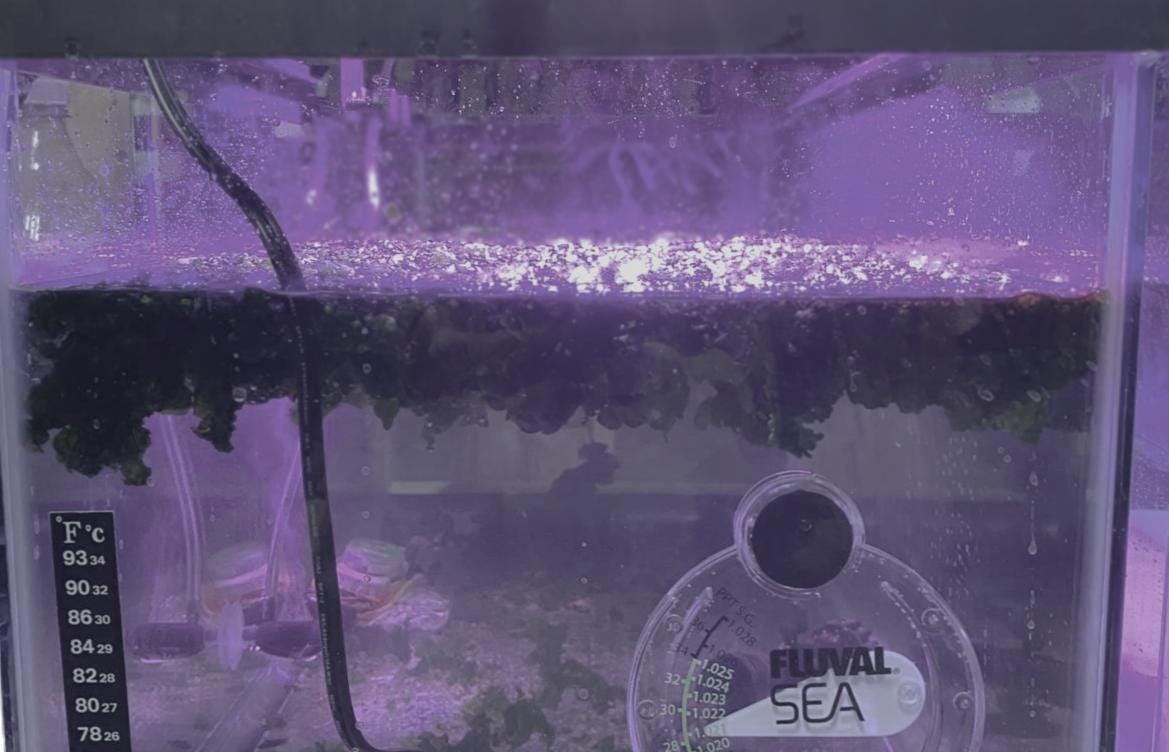
Let me be completely transparent here. My lab is in my basement, at home. It lacks many of the features of a commercial lab environment, so the results I’m about to share are subject to confirmation in more precise conditions.
That said, the results are encouraging.
Lab data:
I placed 112.4 grams of wet Ulva in a 20-gallon tank containing 10 gallons of artificial seawater on December 4, 2023. By January 3, 2024, it had grown to 529.1 grams — a daily growth rate of 12.36%.
For reference, one of the studies that introduced me to the relevance of Ulva to CDR (Marenvres, 2022) observed a 12.8% daily growth rate in open-sea conditions and 44.94% in their controlled lab environment.
My basement results are generally consistent with the open-sea benchmark. With further work, in more precise conditions, I expect to achieve growth rates closer to the published lab figures of >40%.
However, even operating at 12% per day, you still get to very large numbers quickly. In six days, you’re doubling. It isn’t as good as 44%, obviously, but the math still works. The difference between 12% and 44% represents the optimization opportunity — and the core technical risk.
The single most important unknown that could make this approach fail: we need to validate that the reported growth rate is in fact achievable, and that we can sustain optimal growth conditions in outdoor land based tanks. Everything else is contingent on that.
I name this risk clearly because I think it’s important. If the biology doesn’t work outside the lab, no amount of clever engineering saves you. That’s the bet.
One thing that doesn’t get enough attention in CDR is end-of-life. What happens to all this equipment when its useful life is over?
I’m starting with the end in mind. The chosen bioplastic for the tank system was derived from a recognized need to minimize the end-of-life footprint. The goal is to make every part of the tank system char-able, compostable, or biodegradable. By choosing a bioplastic that can be composted or charred, and using biodegradable polymer additives, we’re building disposal into the design from day one.
Co-benefits extend beyond the equipment. At the project level, we expect to employ local community members to run farm operations, and some of the biochar can be used for agricultural soil remediation. While we’d obviously look to maximize the benefits experienced by communities where these projects operate, I don’t assume to know what those benefits are before we engage each unique community. I expect to discover a lot working alongside these communities and learning how we can best serve them.
2026 — Prototype – probably in New England. The short-term prototype consists of at least 12 tank systems that, due to a fabrication constraint at this scale, will be about half the size of eventual production-scale tanks. This prototype won’t be used to demonstrate self-scaling — all harvested Ulva will be charred to validate the basic CDR use case. I’m looking at securing coastal access in New England for direct seawater supply.
The growing season be about 8 weeks in summer and fall. The Ulva to be grown will be harvested from natural sources locally. On-site electric service will come from my own solar panels and battery storage. Due to the specifics of the tank system design, we anticipate a lot of efficiencies around the energy required for the flow and nutrition of seawater.
Objective: one gross tonne of CO2 removed, and an LCA that tells us where the carbon losses are coming from.
2027 — Expanded deployment with different objectives. Potentially a first-of-a-kind (FOAK) production deployment, depending on 2026 results. The 2027 phase will also involve simulating different deployment environments by varying nutritional inputs. This lets us learn which environmental conditions are optimal for the hectare-scale FOAK, without having to physically deploy in multiple countries first.
What I’m trying to learn with the prototype
Validate that the scientifically reported growth rate is achievable in outdoor field conditions
Learn the minimum collection of tests and optimal frequency of testing needed to maintain consistent tank nutrition in the field, and how to automate gathering that data
Select a biochar method and optimize it for our Ulva feedstock
Learn how to tune biochar quality to fulfill customer specifications
Learn lessons on where each step in the full cycle can be optimized: fabrication, installation, commissioning, operation, decommissioning, and cleanup
Simulate a variety of possible deployment environments to identify optimal FOAK geographies
Begin the process of certifying credits with a chosen registry
Budgetary estimate: ~$500 per tonne. This is a marginal cost that excludes amortization of capital equipment costs. It includes utilities, consumables, land lease, transportation, and prototype operator expenses. This is expensive, but it’s a prototype and there are no economies of scale here. The objective is learning, not efficiency.
This in an important point to set the stage and derives from the organizational structure. Cost per tonne numbers are project specific, not technology specific. We’re targeting $50 per tonne cost of CO2 removed and durably stored by specific projects in specific geographies and aspire to reduce costs sufficiently so that this becomes a published price for future offtakes. We’re exploring the production of valuable specialty chemicals co-produced either in the biorefinery or in the charring process, which would allow common process equipment costs to be split thereby reducing the financial burden per installed tank system, and per tonne of captured carbon.
For context: Current DACCS project costs range from $400-1,000+ per tonne of CO2, and biochar projects typically land between $50-200 per ton of CO2. If nonlinear CDR hits its commercial targets, it’s competitive at the low end of the market — and it scales differently than anything else.
People ask me this, so I’ll address it directly.
Venture capital is a specific financial tool for growing a company. The incentives it creates are poorly aligned with what I need right now, which is an optimized project delivery protocol. A grant allows me to focus on the process without the distractions of premature company scaling, and without being required to justify why artificial intelligence is not a prominent part of my offering.
Strategic investment is similarly specific and more suitable for a mature project protocol where much of the derisking has been completed. That comes later.
Right now, grant-style catalytic capital is the right tool. It accelerates us toward a FOAK deployment without distorting the priorities.
Assuming the technology works, the hardest obstacle to scaling that I can see is permitting. Within the US and EU, getting a biorefinery permitted in the same land parcel as a farm is going to slow us down. And it needs to be close to the farm to minimize the embodied carbon associated with transportation. There are two strategies I’m considering:
First, accept it — biogas plants are commonplace in the EU, and we can emulate their approach to permitting. Second, avoid the risk entirely by deploying the FOAK in a jurisdiction where those that are impacted by the effects of climate change have control over their ability to permit the deployment of a solution. I’m already exploring possible locations in Latin and South America, and in some island communities. The prototype’s simulated deployment environments will inform the choice of geography from a seawater suitability perspective, and the plan is to overlay the permitting landscape on top of that data to arrive at some workable alternatives.
I’m not credible in this space yet, I know that. I have only just learned that I need to put my IP and my implementation projects in different operating entities, so I’m incorporated, but only this week. My website needs to be built from scratch by a competent storyteller, and I’ve been running experiments in my basement with two very willing and very junior assistants.
And I’ve identified something real. The lab data aligns with peer-reviewed science. The self-scaling mechanism is structurally different from anything else in the CDR market. I’ve studied the failure modes of adjacent companies and designed around them. I’ve identified the strengths of those same adjacent companies and incorporated them, when possible, into what I’m doing. And I know exactly what my biggest risk is and I’m not hiding from it.
Technical expertise and collaborators. I’m looking for expertise in the design and construction of modular biorefineries and biochar plants, nutrient recycling, CNC routing, how to test and apply biodegradable bioplastic additives, and technical storytelling/translation for grant and investor communities. If you’ve worked on any of these, I want to compare notes.
Early-stage funding and grants. Catalytic capital that lets me validate the science without the distractions of premature scaling. $50-200k over the next 12-18 months gets me from basement to field prototype.
Partnerships and conversation. If you’re working in adjacent CDR spaces, have permitting experience in Latin America, or British Overseas Territories, or have insights on credit certification pathways — let’s talk. I learn something from almost every conversation, and I mean that literally. And I’m happy to give as much, if not more, than what I’m trying to receive.
If this resonates, please reach out: linkedin.com/in/angus-shaw-pmp
Feedback: In order to accelerate progress, I will be sharing my ‘preliminary estimate’ technoeconomic model and analysis (TEM/TEA) on March 6 and, beginning March 9, I will be hosting a call every two weeks to walk through it, to unpack the assumptions and formulas, to learn from, and to gather feedback from the community and to iterate until the solution fulfills its purpose.
Thank you.