








👋 Welcome to Climate Drift: your cheat-sheet to climate. Each edition breaks down real solutions, hard numbers, and career moves for operators, founders, and investors who want impact. For more: Community | Accelerator | Open Climate Firesides | Deep Dives
Hey there! 👋
Skander here.
January didn’t ease into 2026. It kicked the door open. We tracked 105 climate investments totaling $26 billion. That’s nearly three times December’s volume and the biggest month since we started this series.
The headline: China broke ground on the world’s first nuclear cogeneration plant, an $8.5 billion facility designed to replace coal-fired steam in heavy industry. The U.S. responded with $2.7 billion to rebuild domestic uranium enrichment capacity and Meta committed to 6.6 GW of nuclear power, the boldest clean energy deal any tech company has ever made. Two superpowers, two very different nuclear strategies, both moving fast.
Beyond nuclear, Asia led all regions for the first time at $11 billion. Geothermal kept its momentum with $212 million flowing to two enhanced geothermal companies. And in Africa, the Miombo Restoration Alliance launched over $1 billion in nature-based carbon removal across four countries. It’s the largest AFOLU commitment we’ve ever recorded.
2026 is not messing around.
Join our community discussion, we’d love to hear your take.
🌊 Over to you, Jarek!
But first: Who is Jarek?
Jarek Dmowski is a global transformation leader who partners with high-growth companies with positive climate impact. He combines industry and climate finance expertise with a strong track record of driving growth—across PE/VC-backed scaleups, ABN AMRO, and BCG.
He scaled a data-driven technology company ~2.5x to ~$25M in revenue and led post-merger integrations that enabled ~6x accelerated growth. At a global financial institution, he spearheaded a $2B capital reallocation toward new energy and mobility. He also developed a comprehensive climate plan that translated the Paris Agreement into actionable targets across sectors and established a $250M program to drive efficiency gains and reduce emissions at an energy utility.
Jarek is passionate about how the climate transition reshapes economies and business models, creating significant opportunities for multi-country growth and impact.

Welcome to the next edition of “Follow the Money” — a monthly briefing exploring the capital flows shaping the climate transition.
What a way to start 2026. January came in hot — $26 billion tracked across 105 deals, setting an energetic pace for the year ahead. Energy led the way, with over $22 billion in financing across all continents, reinforcing many of the key themes to watch in 2026.
The biggest story? Nuclear and China — or more precisely, China and nuclear. Not just because of the scale of capital flowing into nuclear globally, but because of how China is driving. On January 16th, construction began on the Xuwei Nuclear Heating & Power project in Jiangsu Province — the world’s first to pair Hualong One PWR and HTGR technologies in a single cogeneration plant. This is more than a new reactor. It’s a $8.5 billion industrial-scale bet on using nuclear steam to replace coal-fired heat in heavy industry. Looking ahead, China also signaled that the Linglong One SMR is expected to enter commercial operation in H1 2026 — a milestone that could reshape global narratives around SMR bankability.
Across the Pacific, the U.S. fired back with its own nuclear signals: $2.7 billion in Department of Energy awards to restart domestic uranium enrichment capacity, and Meta’s commitment to 6.6 GW of nuclear energy — the boldest clean power deal ever by a tech company. Both America and China are betting big on nuclear — but they’re running very different races.
Explanation of the approach and source data: The investment list was developed based on disclosures, newsletter monitoring and review of climate news. Although not exhaustive, 105 climate-related investment deals were tracked—amounting to roughly $26 billion (all data in US$), covering all continents and different life stages of companies and development finance programs. Data skew toward early-stage companies and investments, as well as development financing programs. We are continuously working to expand the data sources and coverage of investments.
So, where did the money flow in January 2026?
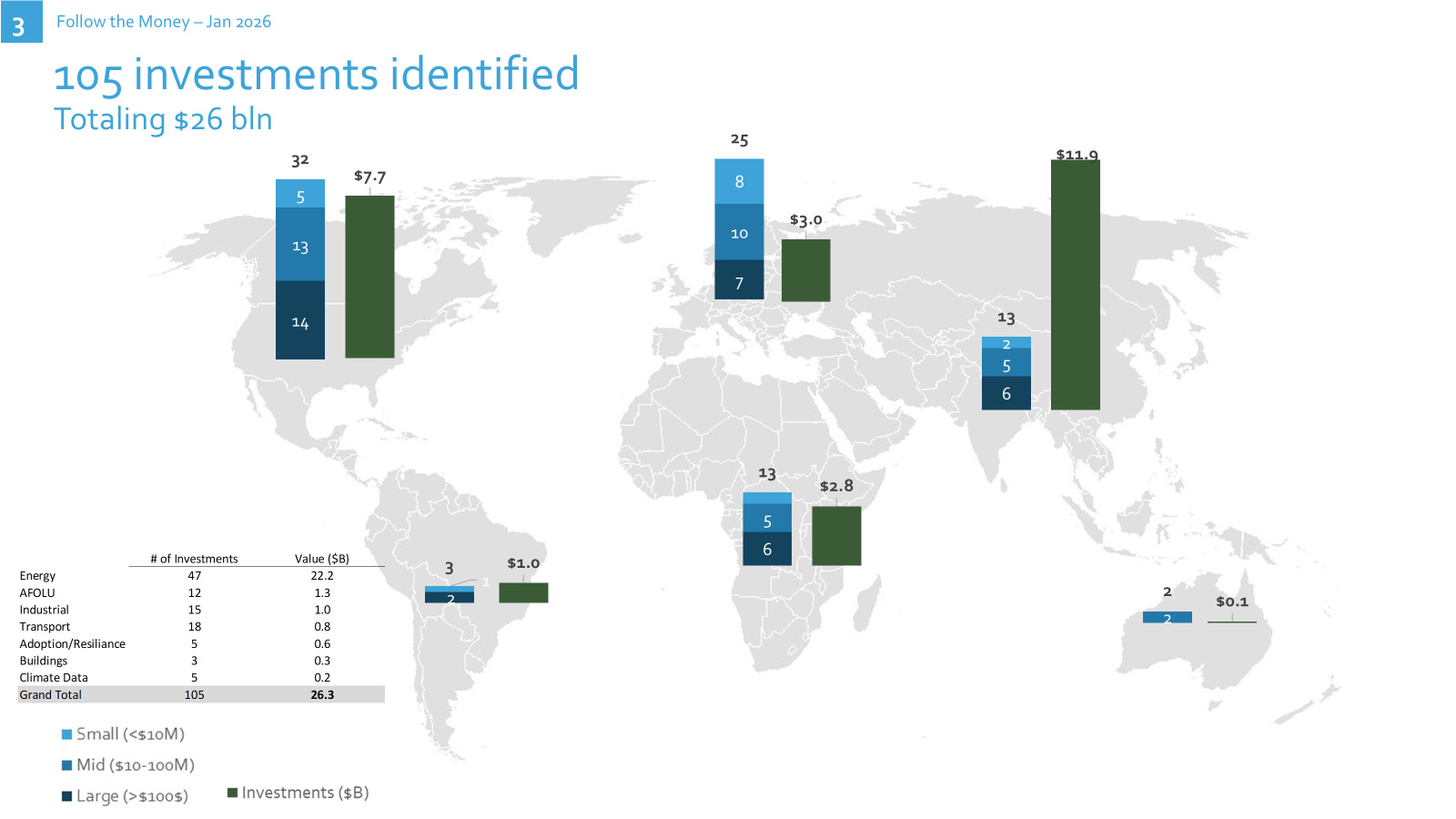
For the first time, Asia took a lead with approximately $11 billion (13 deals), followed by North America at ~$7.7 billion (32 deals). Europe with lower volumes at ~$3 billion (25 deals). Africa attracted around $2.8 billion, while South America saw roughly $1.5 billion. This geographical spread shows significant deployments in both developed and emerging markets.
Energy projects dominated, accounting for over $22 billion (47 deals) – by far the top sector each month. AFOLU was the second-largest segment (~$1.3 billion, 12 deals), reflecting sustained investment in this space, followed by Industrial solutions (~$1 billion, 15 deals) and Transport (~$0.8 billion, 18 deals). Lower-volume sectors included Buildings (~$0.3B) and Climate Data (~$0.2B).
AI’s influence was unmistakable. Eleven AI-enabled climate solutions secured funding in January, underscoring the growing role of artificial intelligence in accelerating climate innovation.
In Robotics (a newly tracked subcategory), we observed three investments in January.
Venture capital activity remained resilient. We tracked 47 venture/growth investments (Seed through Series F and growth equity), averaging roughly $58 million per round. Europe saw 16 venture deals, at par with North America’s 11 deals. Asia contributed 11 venture deals.
Public and development finance continued to play a pivotal role. Multilateral development banks and government programs anchored several large deals, totalling ~$15B (~27 deals), emphasizing climate infrastructure and adaptation.
Let’s now dive deeper into 2026 watchlist themes (please refer to our December perspective for more details) and across continents to highlight a selection of promising technologies with the potential to scale in the years ahead.
Which (of our 2026) themes were most strongly visible in January?
U.S: Nuclear and Geothermal vs. RoW: Solar and Wind
January shows the U.S. doubling down on nuclear fuel-cycle capacity and dispatchable clean power, while much of the capital outside the U.S. focuses on solar scale-up and grid buildout (interestingly, strong traction of solar and BESS projects for the US is also visible). Key highlights:
U.S. nuclear fuel / security of supply: The U.S. Department of Energy announced $2.7B in task orders intended to restore domestic uranium enrichment capacity for both LEU (Low-Enriched Uranium) and HALEU,(High-Assay Low-Enriched Uranium) reducing reliance on Russian supply.
U.S. nuclear scaling enablers: Standard Nuclear raised $140M Series A and announced the start of advanced HALEU fuel production—exactly the kind of supply-chain investment needed to unlock advanced reactor deployment timelines.
Fusion alone attracted $116M in January with Avalanche Energy ($29M), and Type One Energy ($87M).
Geothermal with strong momentum: Two US geothermal companies — Sage Geosystems ($97M Series B) and Zanskar ($115M Series C) — raised a combined $212M in dedicated enhanced geothermal system development.
“Solarpunk” Continues
“Solarpunk” is showing up as electrification spilling into everything that moves (buses, trucks, ships, planes) and into homes (heat pumps + financing):
Commercial EV supply chains: $130M battery plant partnership between BYD and Kim Long Motor to support commercial EV battery production in Vietnam.
Electric buses (systems deployment, not prototypes): GreenCell Mobility secured $89M mezzanine financing to expand operations—helping to solve the bottleneck to increase fleet scale and provide financing.
Beyond cars into shipping: Fleetzero raised $43M Series A to scale hybrid/electric marine propulsion systems (and autonomy), a meaningful step toward decarbonising hard-to-electrify freight segments.
Nature-Based Solutions
The highlight was the Miombo Restoration Alliance launched $1B+ in nature-based carbon removal across four African countries — the largest AFOLU commitment we’ve seen in a single month. Nature-based finance showed both mega-scale blended restoration and infrastructure for integrity (standards and MRV).
Also, Equitable Earth announced a €12.6M round to scale certification standards for nature-based carbon projects, and Gigablue announced a $20M Series A first close to scale ocean-based carbon removal—still controversial as a category, but clearly attracting growth capital.
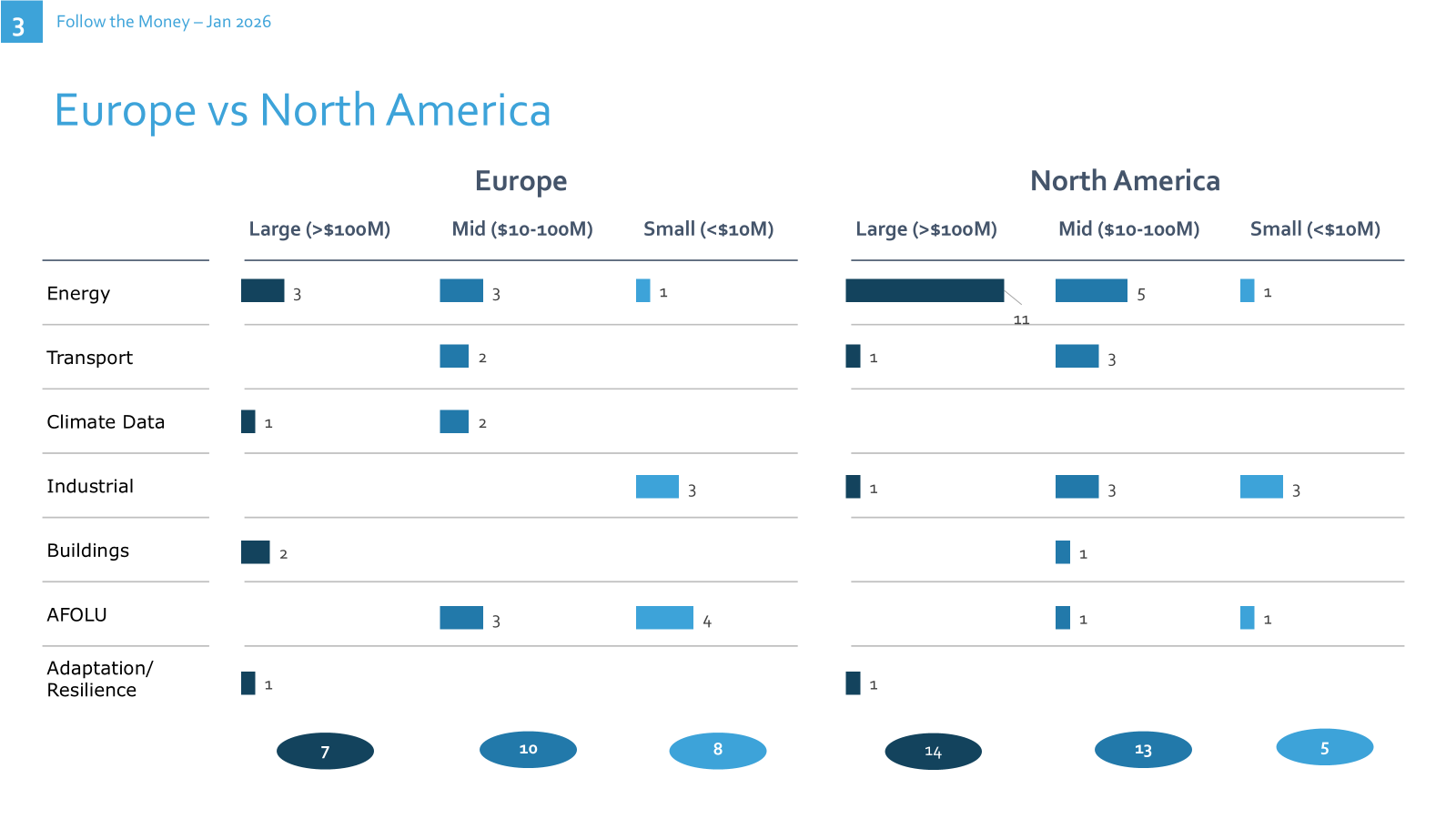
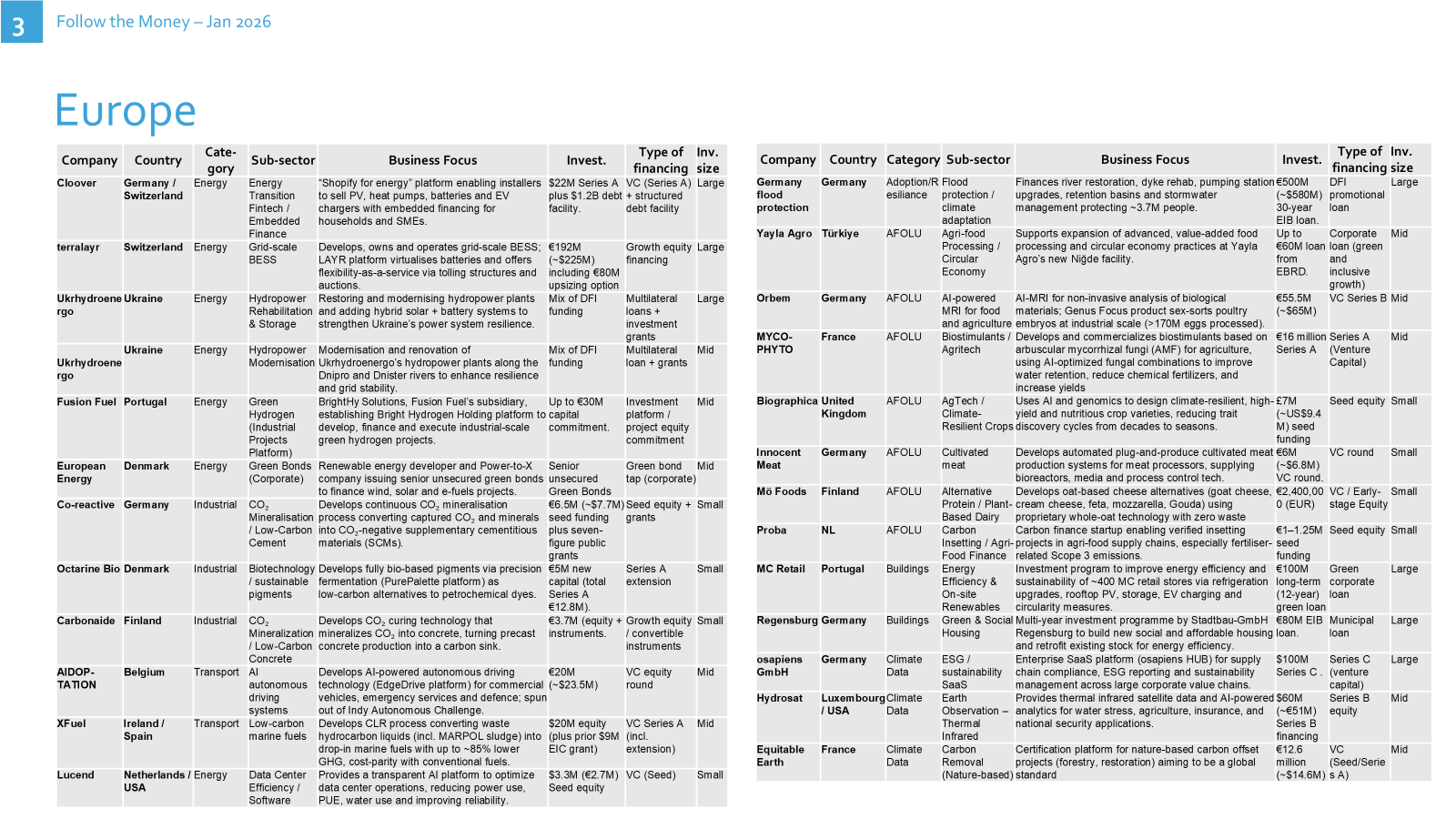
Europe recorded 25 deals totaling approximately $3.0 billion in disclosed financing, blending large-scale public investments in climate resilience infrastructure with meaningful venture and growth rounds across energy software, agri-deeptech, and grid flexibility platforms. Selected January financings include:
Cloover (Germany) raised a landmark €1.2 billion — combining a $22 million Series A with a €1.2 billion debt commitment — to scale its embedded energy transition finance platform. Cloover integrates financing, insurance, and installation for heat pumps, solar panels, and EV chargers directly into the purchase journey. This marks the largest climate fintech round in European history, positioning Cloover alongside the UK’s Kraken as a flagship of Europe’s emerging energy software stack.
terralayr (Switzerland) secured €225 million in growth equity to develop grid-scale battery energy storage systems (BESS) across Europe. As solar and wind penetration intensifies, platforms like terralayr — with strong site pipelines and grid interconnection rights — are well positioned to serve growing grid-balancing needs.
osapiens GmbH (Germany) raised €100 million in Series C funding for its SaaS platform for ESG and sustainability data management. With EU regulatory frameworks like CSRD and CSDDD driving mandatory reporting, osapiens — which serves clients in manufacturing, retail, and finance — is on track to become a core layer of Europe’s sustainability compliance infrastructure.
Orbem (Germany) closed a €65 million Series B for its AI-powered MRI platform for food and agriculture. Orbem’s compact scanners enable non-destructive quality assessment of eggs, seeds, batteries, and industrial materials, reducing waste and enabling precision agriculture at scale.
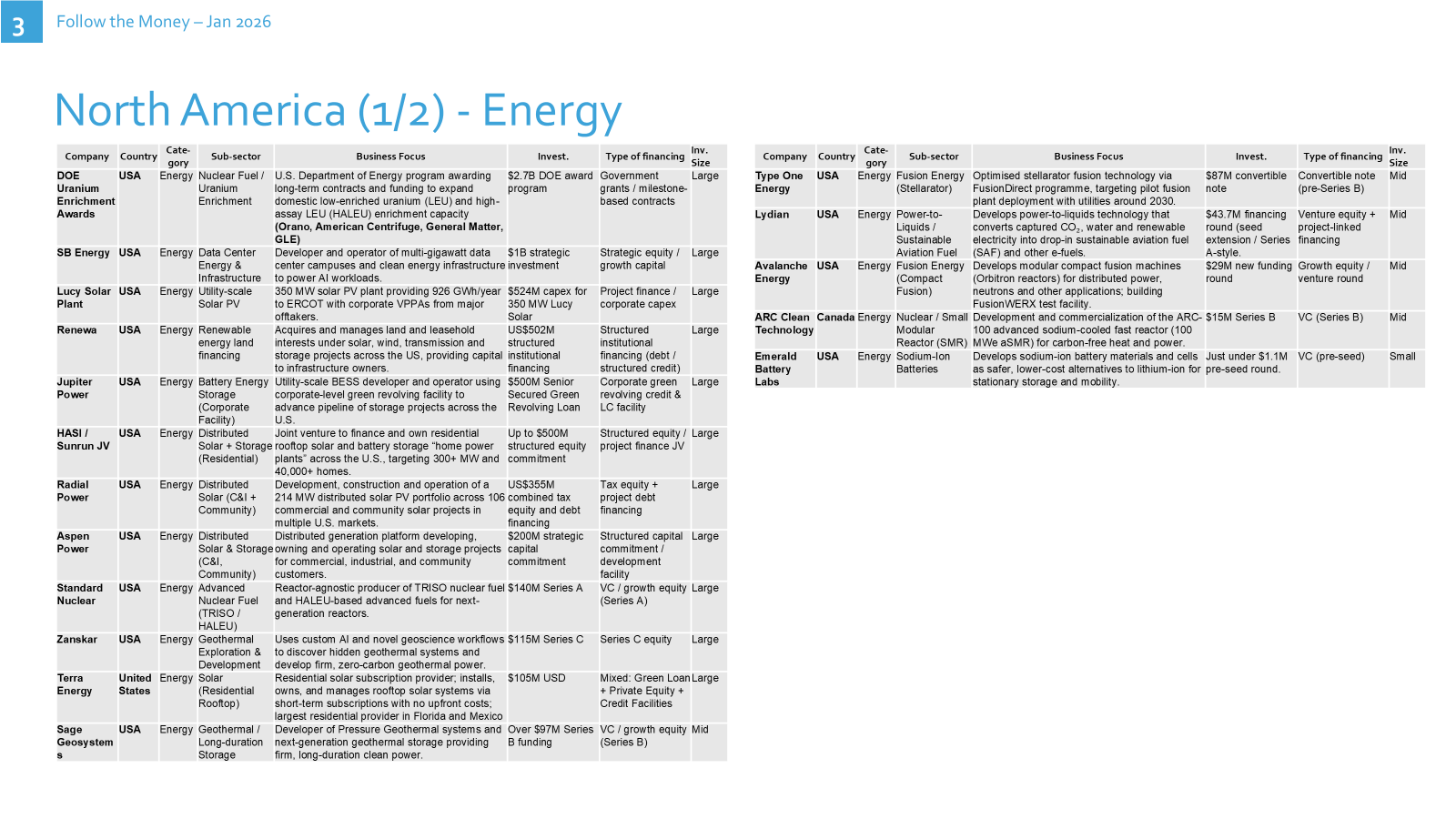
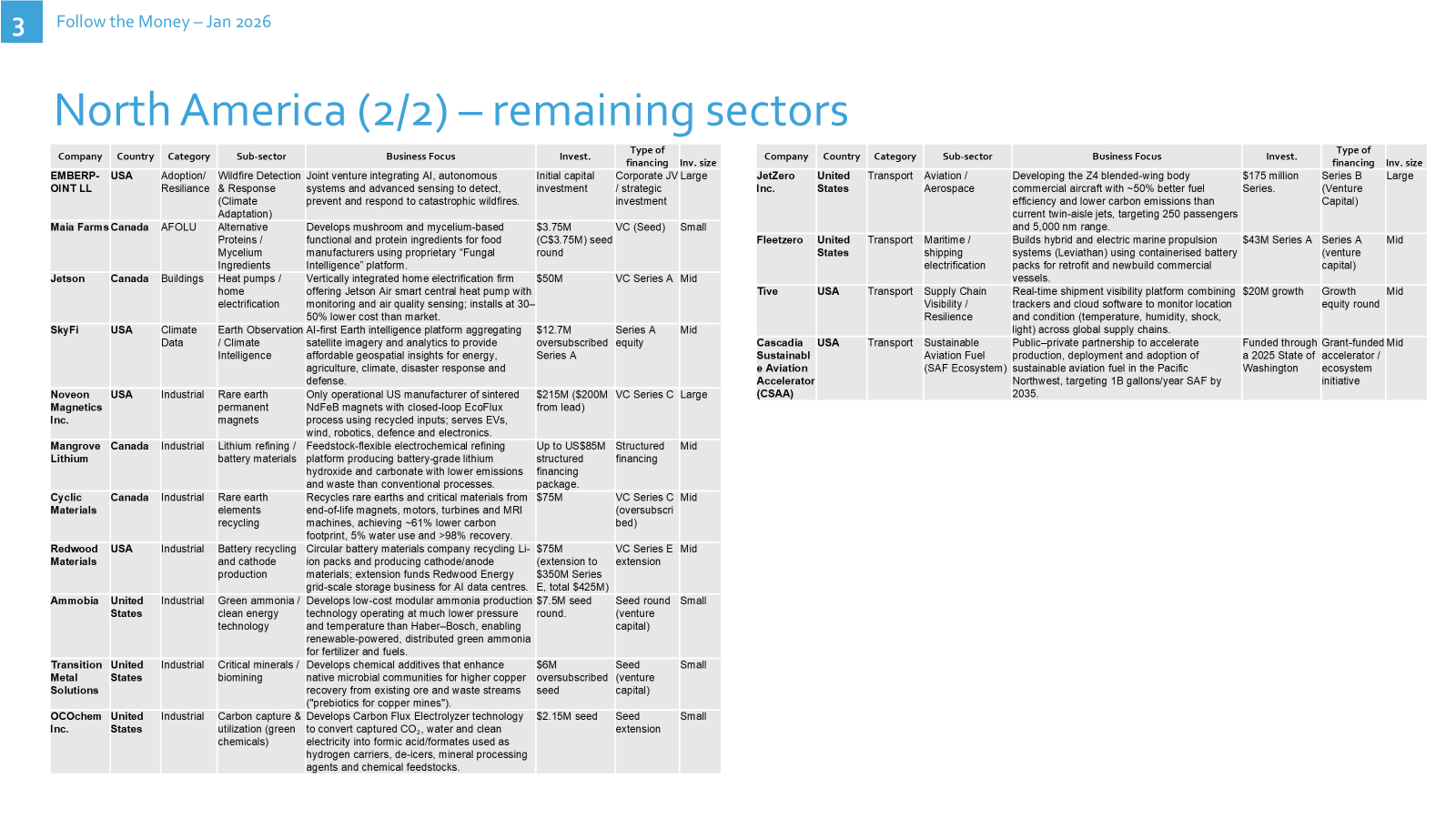
North America recorded $7.7 billion across 32 deals in January 2026, with a defining theme: investors are doubling down on firm, dispatchable clean power. Nuclear (conventional and advanced), geothermal, and battery storage represented nearly 60% of capital deployed, while distributed solar, critical minerals, and sustainable aviation fuel (SAF) rounded out the landscape. Key highlights include:
The U.S. Department of Energy awarded $2.7 billion in long-term contracts to rebuild domestic uranium enrichment capacity — split evenly among American Centrifuge Operating, General Matter, and Orano Federal Services ($900M each), with Global Laser Enrichment receiving $28M. This marks a historic reversal of post–Cold War decline and aims to reduce reliance on Russian imports.
Standard Nuclear (USA) raised $140M Series A to scale TRISO fuel fabrication, a critical enabler for next-gen reactors like TerraPower and X-energy. ARC Clean Technology (Canada) raised $15M Series B to advance its 100 MW sodium-cooled SMR, targeting industrial heat and remote power with parallel licensing efforts in Canada and the U.S.
Type One Energy (USA) raised $87M in convertible notes ahead of a larger Series B to develop its stellarator-based fusion reactor — a next-gen, superconducting twist on the tokamak alternative, backed by Bill Gates.
Zanskar (USA) secured $115M Series C, the largest geothermal exploration round to date, to expand its AI-driven subsurface discovery platform. As geothermal scales under the DOE’s Enhanced Geothermal Shot, Zanskar’s low-cost, data-first approach to site identification is a major enabler.
Sage Geosystems (USA) raised $97M Series B for its closed-loop geothermal storage technology, using engineered fractures to deliver 24/7 power in non-traditional geothermal regions. Its first commercial system is underway in Texas.
SB Energy (USA) announced a $1 billion strategic investment from OpenAI and SoftBank, underscoring how electricity scarcity is now a critical bottleneck for AI infrastructure — pulling major tech capital directly into energy development.
JetZero (USA) raised $175M to build its blended wing body aircraft, a radical design claiming up to 50% fuel burn reduction.
Jetson (Canada) raised $50M Series A to expand heat-pump-driven home electrification, explicitly targeting cost and install friction.
Lydian (USA) secured $43.7M for power-to-liquids SAF production, and the Cascadia SAF Accelerator (USA) closed a $10M grant round to develop an SAF innovation ecosystem in the Pacific Northwest — signaling rising momentum in decarbonizing aviation.
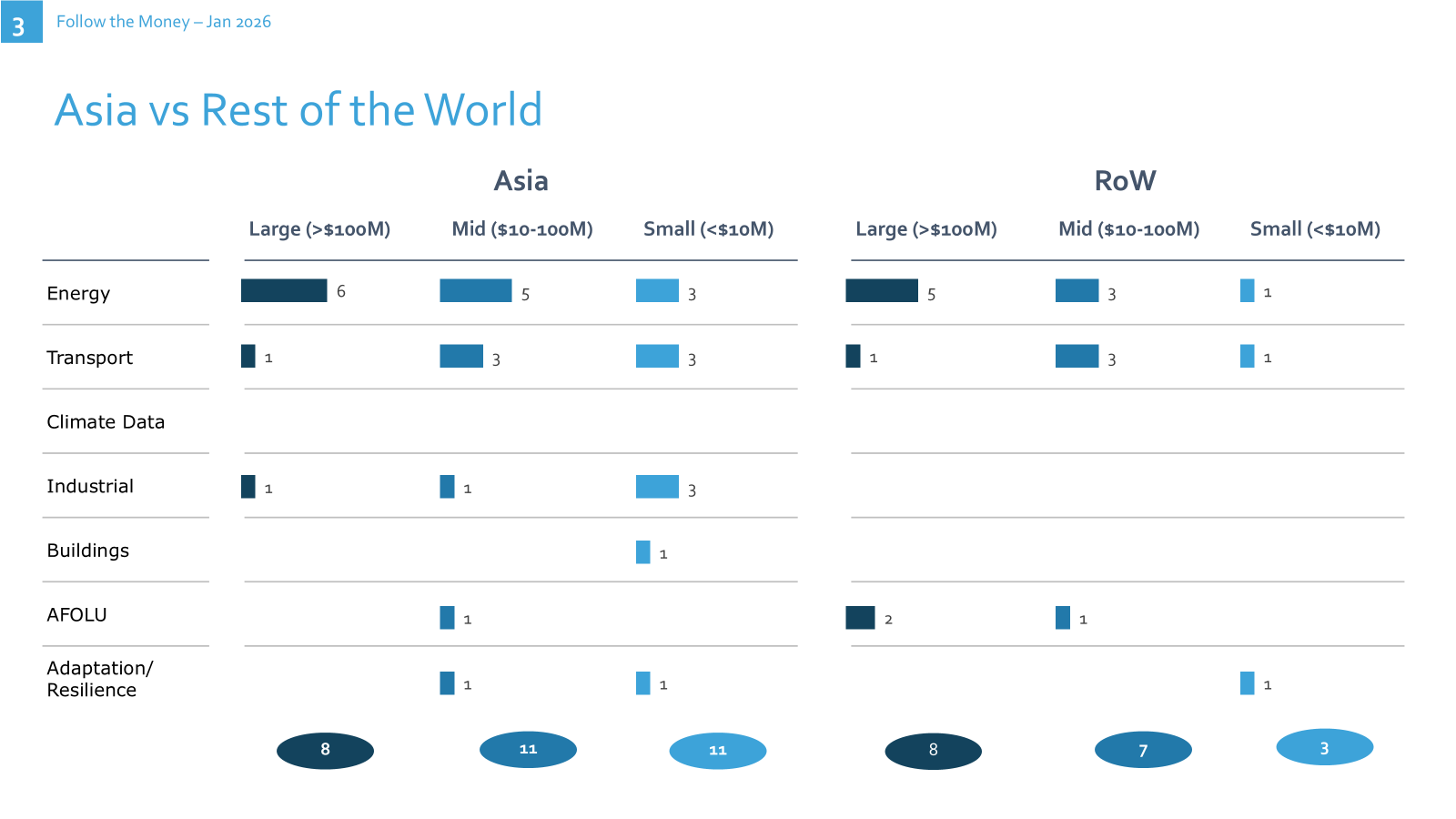
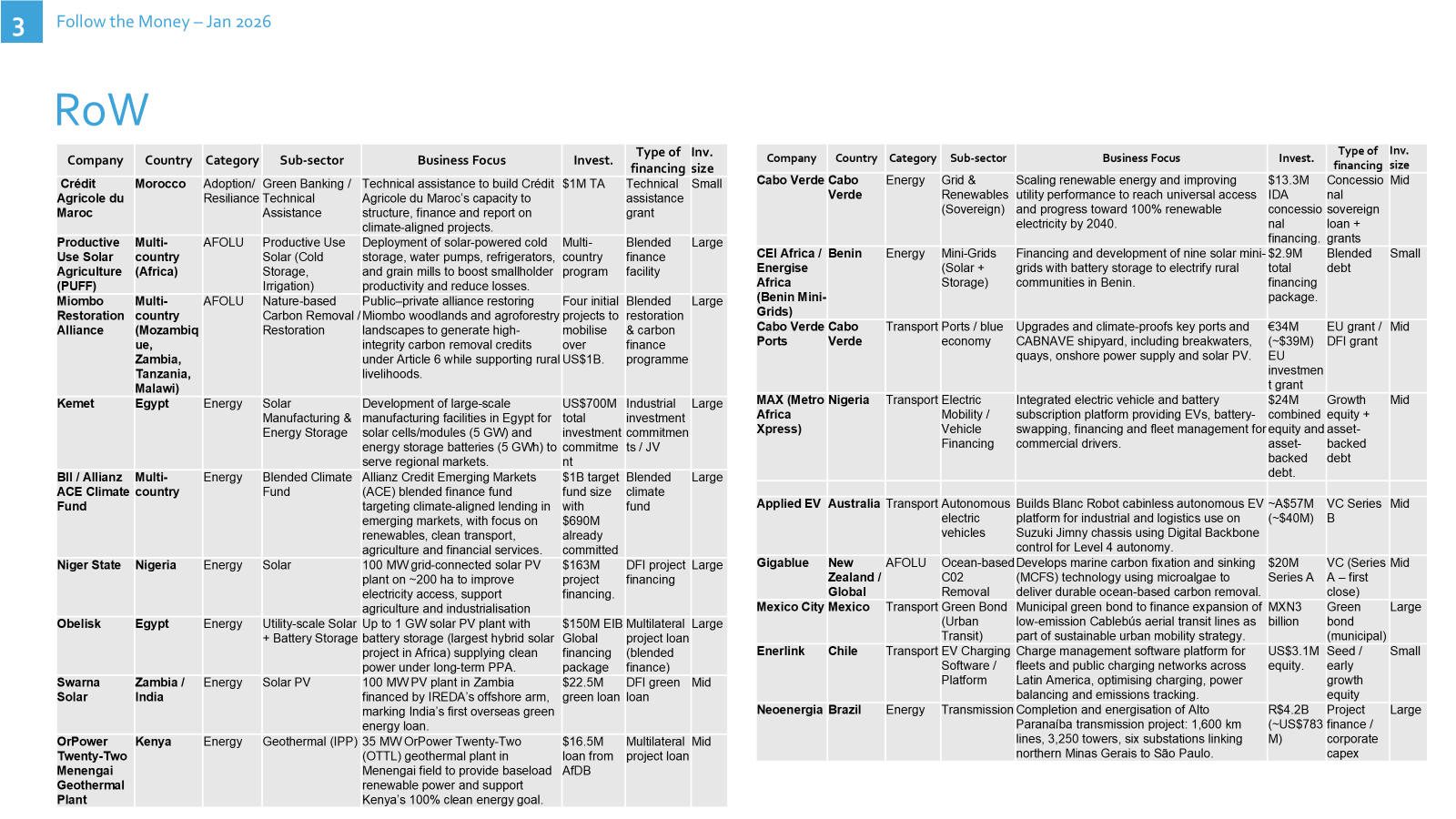
In January, climate investment activity remained strong across Asia and the rest of the world, led by strategic energy and infrastructure financing.
Asia recorded 13 deals totaling approximately $11 billion, driven by China’s expanding nuclear program, large-scale energy storage and industrial supply chain investments, and continued solar and wind deployment across the region.
Africa, Latin America, and Oceania saw 18 deals totaling ~$3.8 billion, with capital focused on solar refinancing, transmission infrastructure, blended finance mechanisms in emerging markets, and nature-based carbon removal.
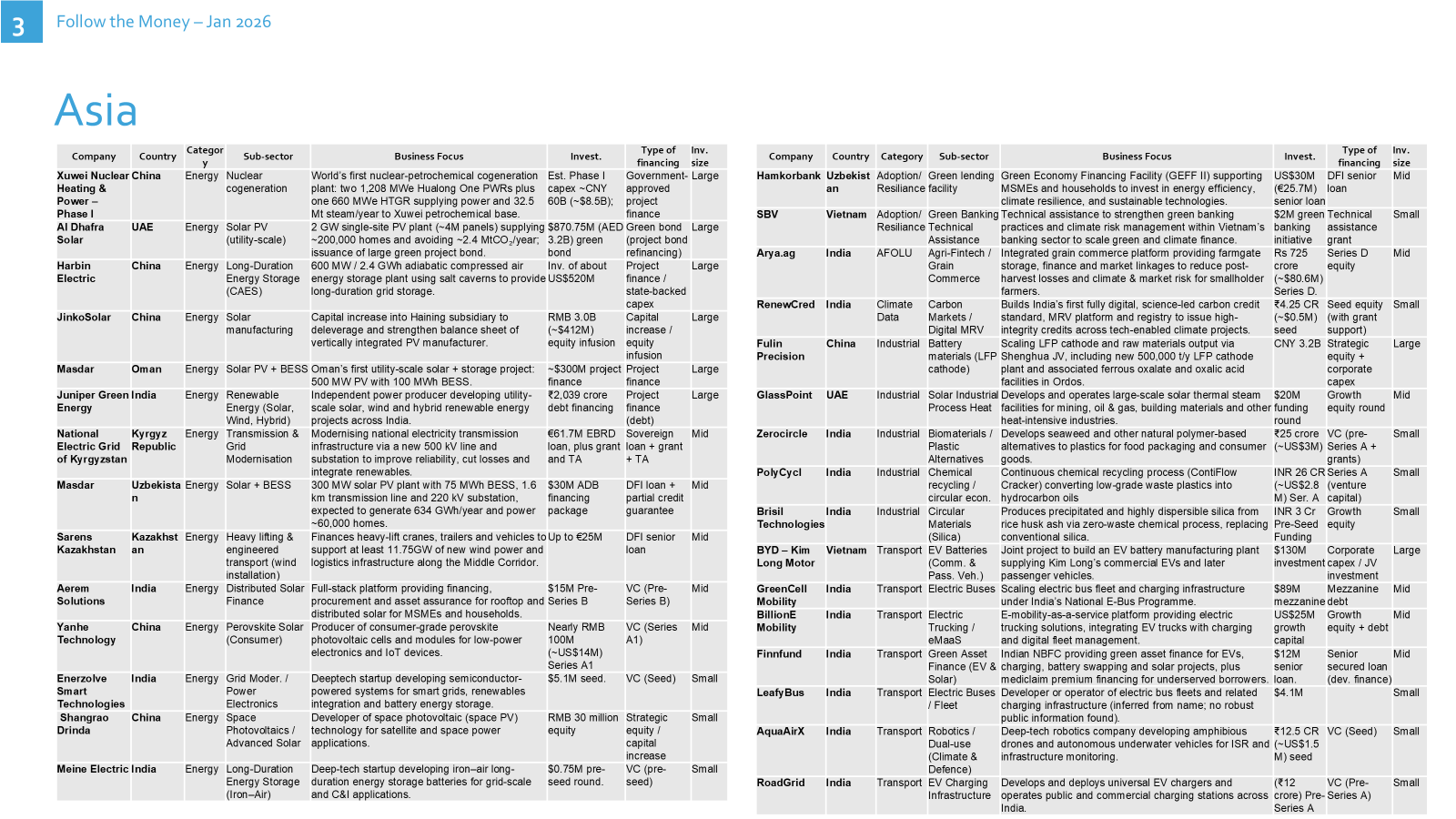
Key highlights from Asia:
Xuwei Nuclear Heating & Power Plant (China) secured $8.5B for Phase I of its nuclear cogeneration facility, which will supply both industrial steam and electricity.
Harbin Electric (China) received $520M to build a 600 MWh Compressed Air Energy Storage (CAES) facility — the largest CAES project in the world.
GreenCell Mobility (India) raised $89M to expand its fleet of electric intercity buses, becoming a major player in electrifying India’s state-run transport systems. BillionE Mobility raised $25M to scale electric trucking.
Juniper Green Energy (India) secured $225M in structured growth capital to expand its pipeline of utility-scale solar, wind, and hybrid projects, cementing its position as one of India’s most active mid-size independent power producers.
BYD + Kim Long Motor (Vietnam) announced a $130M battery plant for commercial EVs. This investment signals Southeast Asia’s accelerating transition toward local EV production — especially in buses and trucks.
GlassPoint (MENA) raised $20M to deploy its concentrated solar process heat systems for oil and gas operations. The technology delivers industrial steam with up to 80% less gas, making it a strong example for decarbonisation in hard-to-abate fossil sectors.
Key highlights:
The Miombo Restoration Alliance (Mozambique, Zambia, Tanzania, Malawi) launched over $1 billion in funding for four large-scale nature-based carbon removal projects spanning 675,000 hectares. Backed by Trafigura and developed under Paris Agreement Article 6, the projects aim to restore native Miombo woodlands and remove 50+ million tonnes of CO₂e over 40 years. Revenue-sharing agreements are expected to benefit around 100,000 local community members. This is the largest AFOLU commitment ever recorded in our tracker.
Kemet (Pan-African) raised $700 million to build a vertically integrated solar manufacturing and energy storage platform serving Sub-Saharan Africa. While details remain limited, the investment signals a major push toward localising the solar value chain — from module production to storage deployment and energy services.
OrPower Twenty-Two Menengai (Kenya) secured $16.5 million in project financing for its geothermal independent power project (IPP). Kenya continues to lead Africa in geothermal development, with the East African Rift Valley standing out as the continent’s most important baseload renewable resource.
Applied EV (Australia) raised $40M to advance its autonomous electric vehicle platform.
January 2026 set a strong tone for the year ahead: $26 billion across 105 deals, a historic nuclear breakthrough in China, a uranium revival in the U.S., and a billion-dollar commitment to African forests. Climate capital is accelerating — not despite global uncertainty, but often in direct response to it.
February will test whether these trends deepen or shift. We’ll be watching how key 2026 themes continue to unfold:
U.S.: Nuclear and Geothermal vs. Rest of World: Solar and Wind
“Solarpunk” Momentum — electrification beyond cars, powered by cheap batteries
Dual-Use Innovation: Climate + Defense, Supply Chain, Compute
CapEx-Intensive Mid-Stage Tech and the “Valley of Death”
Industrial Heat Electrification
Nature-Based Solutions for Carbon and Biodiversity
AFOLU Innovation — including climate adaptation, robotics, and alternative proteins
The Rise of Climate Robotics
Stay tuned for next month’s edition as we continue to follow the capital shaping the climate transition.