
惯性聚合 高效追踪和阅读你感兴趣的博客、新闻、科技资讯
阅读原文 在惯性聚合中打开

推荐订阅源

The GitHub Blog
The GitHub Blog
V2EX - 技术
V2EX - 技术
T
Threat Research - Cisco Blogs
Threat Intelligence Blog | Flashpoint
T
Tor Project blog
Project Zero
Project Zero
cs.CL updates on arXiv.org
C
Cybersecurity and Infrastructure Security Agency CISA
T
Tenable Blog
P
Privacy & Cybersecurity Law Blog
AWS News Blog
AWS News Blog
Scott Helme
Scott Helme
C
Cisco Blogs
Application and Cybersecurity Blog
O
OpenAI News
P
Privacy International News Feed
Google Online Security Blog
SecWiki News
SecWiki News
The Last Watchdog
The Last Watchdog
NISL@THU
NISL@THU
Attack and Defense Labs
G
GRAHAM CLULEY
Security Latest
Security Latest
Help Net Security
Help Net Security
C
Cyber Attacks, Cyber Crime and Cyber Security
Hugging Face - Blog
Hugging Face - Blog
月光博客
月光博客
让小产品的独立变现更简单 - ezindie.com
OSCHINA 社区最新新闻
OSCHINA 社区最新新闻
A
Arctic Wolf
Security Archives - TechRepublic
S
Security @ Cisco Blogs
腾讯CDC
S
Secure Thoughts
WordPress大学
WordPress大学
P
Proofpoint News Feed
H
Help Net Security
Simon Willison's Weblog
小众软件
小众软件
M
MIT News - Artificial intelligence
博客园 - 叶小钗
IT之家
IT之家
G
Google Developers Blog
博客园 - 聂微东
Google DeepMind News
Microsoft Security Blog
Hacker News - Newest:
Hacker News - Newest: "LLM"
Google DeepMind News
N
News and Events Feed by Topic
N
News and Events Feed by Topic

Replicate's blog

How to make remarkable videos with Seedance 2.0 – Replicate blog How to prompt Seedream 5.0 – Replicate blog Recraft V4: image generation with design taste – Replicate blog Run Isaac 0.1 on Replicate – Replicate blog Run FLUX.2 on Replicate – Replicate blog How to prompt Nano Banana Pro – Replicate blog Retro Diffusion's pixel art models are now on Replicate – Replicate blog Replicate is joining Cloudflare – Replicate blog Extract text from documents and images with Datalab Marker and OCR – Replicate blog How to prompt Veo 3.1 – Replicate blog IBM's Granite 4.0 is now on Replicate – Replicate blog Which image editing model should I use? – Replicate blog Introducing our new search API – Replicate blog Torch compile caching for inference speed – Replicate blog Announcing Replicate's remote MCP server – Replicate blog How to prompt Veo 3 with images – Replicate blog Open source video is back – Replicate blog Generate consistent characters – Replicate blog Bria is now on Replicate – Replicate blog How we optimized FLUX.1 Kontext [dev] – Replicate blog Compare AI video models – Replicate blog The FLUX.1 Kontext hackathon – Replicate blog How to prompt Veo 3 for the best results – Replicate blog Get the most from Google Veo 3 – Replicate blog FLUX.1 Kontext from the community – Replicate blog Use FLUX.1 Kontext to edit images with words – Replicate blog Generate incredible images with Google's Imagen 4 – Replicate blog Run OpenAI’s latest models on Replicate – Replicate blog NVIDIA H100 GPUs are here – Replicate blog Run 30,000+ LoRAs on Hugging Face with Replicate – Replicate blog Ideogram 3.0 on Replicate – Replicate blog Run MiniMax Speech-02 models with an API – Replicate blog Easel AI is now on Replicate – Replicate blog Stylized video with Wan2.1 – Replicate blog Creative roundup: avatars, lightsabers, and LoRA tricks – Replicate blog Wan2.1: generate videos with an API – Replicate blog Wan2.1 parameter sweep – Replicate blog You can now fine-tune open-source video models – Replicate blog Generate short videos with the Replicate playground – Replicate blog AI video is having its Stable Diffusion moment – Replicate blog FLUX fine-tunes are now fast – Replicate blog FLUX.1 Tools – Control and steerability for FLUX – Replicate blog NVIDIA L40S GPUs are here – Replicate blog Ideogram v2 is an outstanding new inpainting model – Replicate blog Stable Diffusion 3.5 is here – Replicate blog FLUX is fast and it's open source – Replicate blog FLUX1.1 [pro] is here – Replicate blog Using synthetic training data to improve Flux finetunes – Replicate blog Fine-tune FLUX.1 with an API – Replicate blog Fine-tune FLUX.1 to create images of yourself – Replicate blog Replicate Intelligence #12 – Replicate blog Replicate Intelligence #11 – Replicate blog Fine-tune FLUX.1 with your own images – Replicate blog Replicate Intelligence #10 – Replicate blog FLUX.1: First Impressions – Replicate blog Replicate Intelligence #9 – Replicate blog Run FLUX with an API – Replicate blog Replicate Intelligence #8 – Replicate blog Run Meta Llama 3.1 405B with an API – Replicate blog Replicate Intelligence #7 – Replicate blog Replicate Intelligence #6 – Replicate blog Replicate Intelligence #5 – Replicate blog How to get the best results from Stable Diffusion 3 – Replicate blog Run Stable Diffusion 3 on your Apple Silicon Mac – Replicate blog Push a custom version of Stable Diffusion 3 – Replicate blog Replicate Intelligence #4 – Replicate blog Run Stable Diffusion 3 on your own machine with ComfyUI – Replicate blog H100s are coming to Replicate – Replicate blog Run Stable Diffusion 3 with an API – Replicate blog Replicate Intelligence #3 – Replicate blog Replicate Intelligence #2 – Replicate blog Replicate Intelligence #1 – Replicate blog Shared network vulnerability disclosure – Replicate blog Run Snowflake Arctic with an API – Replicate blog Run Meta Llama 3 with an API – Replicate blog Run Code Llama 70B with an API – Replicate blog How to create an AI narrator for your life – Replicate blog Clone your voice using open-source models – Replicate blog Businesses are building on open-source AI – Replicate blog How to run Yi chat models with an API – Replicate blog Scaffold Replicate apps with one command – Replicate blog Using open-source models for faster and cheaper text embeddings – Replicate blog Generate images in one second on your Mac using a latent consistency model – Replicate blog How to use retrieval augmented generation with ChromaDB and Mistral – Replicate blog Fine-tune MusicGen to generate music in any style – Replicate blog Jet-setting with Llama 2 + Grammars – Replicate blog How to run Mistral 7B with an API – Replicate blog Make smooth AI generated videos with AnimateDiff and an interpolator – Replicate blog Fine-tuned models now boot in less than one second – Replicate blog Painting with words: a history of text-to-image AI – Replicate blog We're cutting our prices in half – Replicate blog A guide to prompting Llama 2 – Replicate blog Streaming output for language models – Replicate blog Fine-tune SDXL with your own images – Replicate blog Run Llama 2 with an API – Replicate blog Run SDXL with an API – Replicate blog A comprehensive guide to running Llama 2 locally – Replicate blog Fine-tune Llama 2 on Replicate – Replicate blog What happened with Llama 2 in the last 24 hours? 🦙 – Replicate blog Make any large language model a better poet – Replicate blog
Generate music from chord progressions and text prompts with MusicGen-Chord – Replicate blog
2023-11-08 · via Replicate's blog

Posted November 8, 2023 by

MusicGen-Chord is a model that generates music in any style based on a text prompt, a chord progression, and a tempo. It is based on Meta’s MusicGen model, where we have changed the melody input to accept chords as text or audio.

For example, here are three different generations, each with the repeating chord progression “F:maj7 G E:min A:min”:

”90s euro trance, uplifting, ibiza” in 140bpm

“british jangle pop, the smiths, 1980s” in 113 bpm:

“sacred chamber choir, choral”, based on a fine-tuned model:

How does it work?

MusicGen-Chord is built on top of Meta’s MusicGen-Melody model. MusicGen-Melody conditions the generation on both a text prompt and an audio file.

In MusicGen-Melody, the audio file is source separated to remove drums and bass, and the melody is extracted by picking the most prominent pitch in the chromagram for each time step. This results in a matrix of one-hot encoded chroma vectors (i.e. vectors where each element is 0 except a single 1).
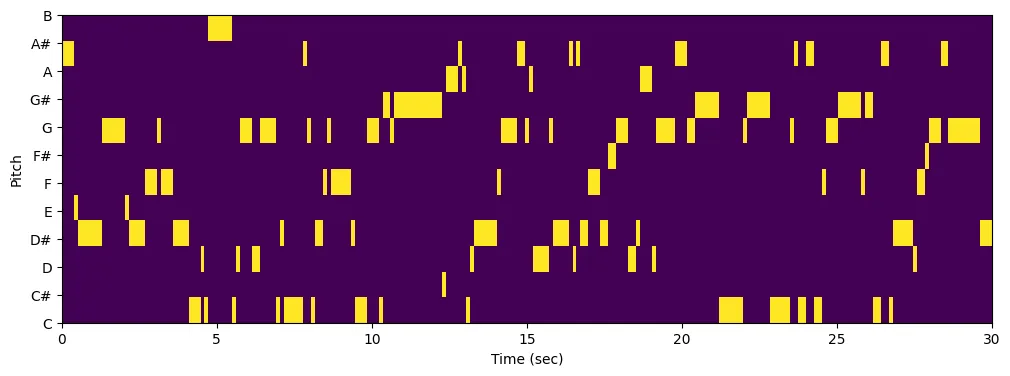
One-hot melody chromagram matrix. Yellow bins are 1, purple bins are 0.

MusicGen-Chord repurposes the melody input to pass in “multi-hot” encoded chord vectors. At each time step, the pitches belonging to the desired chord are set to 1, and the remaining pitches are 0. For example, in the chromagram below there is an Eb chord (Eb, G, Bb) followed by a G chord (D, G, B), followed by a C minor chord (C, Eb, G), etc.
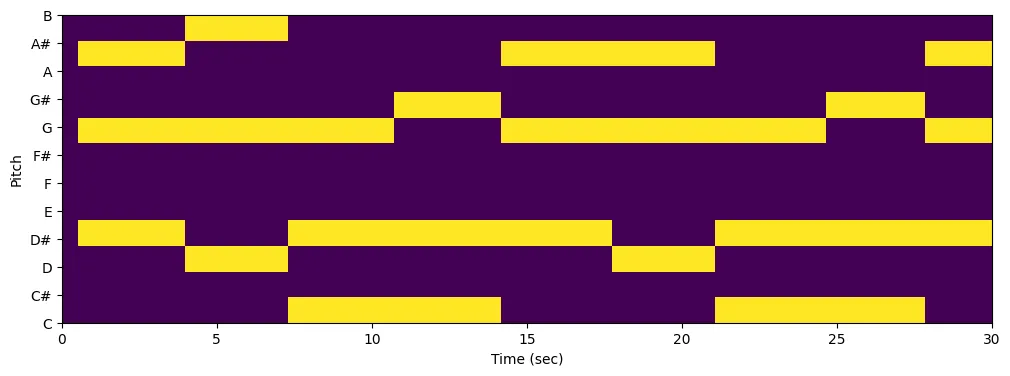
Multi-hot chord chromagram matrix. Yellow bins are 1, purple bins are 0.

As in MusicGen-Melody, MusicGen-Chord passes the chromagram as additional conditioning along with the text prompt to MusicGen. Somewhat surprisingly, this “trick” works remarkably well — MusicGen is able to render chord progressions that are consistent with the style given by the prompt.

Chord input formats

You can input chords either as text (e.g. C D:min G:7 C) or audio. If you input chords as text you also have control over tempo and time signature.

The syntax for the text_chords input is a list of chords separated by spaces. Each chord lasts for a single bar, but you can add multiple chords in a bar by separating them with commas. A chord is defined by ROOT:TYPE. Valid chord types are maj, min, dim, aug, min6, maj6, min7, minmaj7, maj7, 7, dim7, hdim7, sus2 and sus4. If you omit the chord type it defaults to major. For example:

  • B:min G F# E:min (listen)
  • G:maj7 D:min7,G:7 C:maj7 F:7 B:min7,Bb:7 A:min7,D:7 (listen)

When you pass an input audio file, chords are recognized using A Bi-Directional Transformer for Musical Chord Recognition.

Run MusicGen-Chord

You can run MusicGen-Chord using Replicate’s API. Here’s an example using the replicate Python client:

And of course you can run it on the web as well, at replicate.com/sakemin/musicgen-chord.

We’d love to hear what you create with MusicGen-Chord, whether you use it to generate new music, as a backing track for vocals, for remixes, or something completely different.

Let us know what you make on X or Discord.