


惯性聚合 高效追踪和阅读你感兴趣的博客、新闻、科技资讯
阅读原文 在惯性聚合中打开

推荐订阅源

Blog — PlanetScale
Blog — PlanetScale
Webroot Blog
Webroot Blog
T
Troy Hunt's Blog
S
Secure Thoughts
S
Security @ Cisco Blogs
S
Security Affairs
Forbes - Security
Forbes - Security
W
WeLiveSecurity
H
Hacker News: Front Page
T
Threatpost
Google Online Security Blog
S
Schneier on Security
有赞技术团队
有赞技术团队
WordPress大学
WordPress大学
www.infosecurity-magazine.com
博客园 - Franky
腾讯CDC
IT之家
IT之家
博客园 - 聂微东
L
LINUX DO - 最新话题
罗磊的独立博客
Hacker News - Newest:
Hacker News - Newest: "LLM"
freeCodeCamp Programming Tutorials: Python, JavaScript, Git & More
博客园 - 三生石上(FineUI控件)
Hacker News: Ask HN
Hacker News: Ask HN
C
CXSECURITY Database RSS Feed - CXSecurity.com
C
Cybersecurity and Infrastructure Security Agency CISA
C
CERT Recently Published Vulnerability Notes
Know Your Adversary
Know Your Adversary
V
Vulnerabilities – Threatpost
cs.CV updates on arXiv.org
博客园_首页
奇客Solidot–传递最新科技情报
奇客Solidot–传递最新科技情报
Cisco Talos Blog
Cisco Talos Blog
S
SegmentFault 最新的问题
酷 壳 – CoolShell
酷 壳 – CoolShell
Hugging Face - Blog
Hugging Face - Blog
L
LINUX DO - 热门话题
美团技术团队
G
GRAHAM CLULEY
T
The Exploit Database - CXSecurity.com
AI
AI
Application and Cybersecurity Blog
Jina AI
Jina AI
Help Net Security
Help Net Security
N
News | PayPal Newsroom
月光博客
月光博客
Spread Privacy
Spread Privacy
K
KPMG report finds enterprise disconnect between AI and its ROI | CIO
N
News and Events Feed by Topic

Replicate's blog

How to make remarkable videos with Seedance 2.0 – Replicate blog How to prompt Seedream 5.0 – Replicate blog Recraft V4: image generation with design taste – Replicate blog Run FLUX.2 on Replicate – Replicate blog How to prompt Nano Banana Pro – Replicate blog Retro Diffusion's pixel art models are now on Replicate – Replicate blog Replicate is joining Cloudflare – Replicate blog Extract text from documents and images with Datalab Marker and OCR – Replicate blog How to prompt Veo 3.1 – Replicate blog IBM's Granite 4.0 is now on Replicate – Replicate blog Which image editing model should I use? – Replicate blog Introducing our new search API – Replicate blog Torch compile caching for inference speed – Replicate blog Announcing Replicate's remote MCP server – Replicate blog How to prompt Veo 3 with images – Replicate blog Open source video is back – Replicate blog Generate consistent characters – Replicate blog Bria is now on Replicate – Replicate blog How we optimized FLUX.1 Kontext [dev] – Replicate blog Compare AI video models – Replicate blog The FLUX.1 Kontext hackathon – Replicate blog How to prompt Veo 3 for the best results – Replicate blog Get the most from Google Veo 3 – Replicate blog FLUX.1 Kontext from the community – Replicate blog Use FLUX.1 Kontext to edit images with words – Replicate blog Generate incredible images with Google's Imagen 4 – Replicate blog Run OpenAI’s latest models on Replicate – Replicate blog NVIDIA H100 GPUs are here – Replicate blog Run 30,000+ LoRAs on Hugging Face with Replicate – Replicate blog Ideogram 3.0 on Replicate – Replicate blog Run MiniMax Speech-02 models with an API – Replicate blog Easel AI is now on Replicate – Replicate blog Stylized video with Wan2.1 – Replicate blog Creative roundup: avatars, lightsabers, and LoRA tricks – Replicate blog Wan2.1: generate videos with an API – Replicate blog Wan2.1 parameter sweep – Replicate blog You can now fine-tune open-source video models – Replicate blog Generate short videos with the Replicate playground – Replicate blog AI video is having its Stable Diffusion moment – Replicate blog FLUX fine-tunes are now fast – Replicate blog FLUX.1 Tools – Control and steerability for FLUX – Replicate blog NVIDIA L40S GPUs are here – Replicate blog Ideogram v2 is an outstanding new inpainting model – Replicate blog Stable Diffusion 3.5 is here – Replicate blog FLUX is fast and it's open source – Replicate blog FLUX1.1 [pro] is here – Replicate blog Using synthetic training data to improve Flux finetunes – Replicate blog Fine-tune FLUX.1 with an API – Replicate blog Fine-tune FLUX.1 to create images of yourself – Replicate blog Replicate Intelligence #12 – Replicate blog Replicate Intelligence #11 – Replicate blog Fine-tune FLUX.1 with your own images – Replicate blog Replicate Intelligence #10 – Replicate blog FLUX.1: First Impressions – Replicate blog Replicate Intelligence #9 – Replicate blog Run FLUX with an API – Replicate blog Replicate Intelligence #8 – Replicate blog Run Meta Llama 3.1 405B with an API – Replicate blog Replicate Intelligence #7 – Replicate blog Replicate Intelligence #6 – Replicate blog Replicate Intelligence #5 – Replicate blog How to get the best results from Stable Diffusion 3 – Replicate blog Run Stable Diffusion 3 on your Apple Silicon Mac – Replicate blog Push a custom version of Stable Diffusion 3 – Replicate blog Replicate Intelligence #4 – Replicate blog Run Stable Diffusion 3 on your own machine with ComfyUI – Replicate blog H100s are coming to Replicate – Replicate blog Run Stable Diffusion 3 with an API – Replicate blog Replicate Intelligence #3 – Replicate blog Replicate Intelligence #2 – Replicate blog Replicate Intelligence #1 – Replicate blog Shared network vulnerability disclosure – Replicate blog Run Snowflake Arctic with an API – Replicate blog Run Meta Llama 3 with an API – Replicate blog Run Code Llama 70B with an API – Replicate blog How to create an AI narrator for your life – Replicate blog Clone your voice using open-source models – Replicate blog Businesses are building on open-source AI – Replicate blog How to run Yi chat models with an API – Replicate blog Scaffold Replicate apps with one command – Replicate blog Using open-source models for faster and cheaper text embeddings – Replicate blog Generate music from chord progressions and text prompts with MusicGen-Chord – Replicate blog Generate images in one second on your Mac using a latent consistency model – Replicate blog How to use retrieval augmented generation with ChromaDB and Mistral – Replicate blog Fine-tune MusicGen to generate music in any style – Replicate blog Jet-setting with Llama 2 + Grammars – Replicate blog How to run Mistral 7B with an API – Replicate blog Make smooth AI generated videos with AnimateDiff and an interpolator – Replicate blog Fine-tuned models now boot in less than one second – Replicate blog Painting with words: a history of text-to-image AI – Replicate blog We're cutting our prices in half – Replicate blog A guide to prompting Llama 2 – Replicate blog Streaming output for language models – Replicate blog Fine-tune SDXL with your own images – Replicate blog Run Llama 2 with an API – Replicate blog Run SDXL with an API – Replicate blog A comprehensive guide to running Llama 2 locally – Replicate blog Fine-tune Llama 2 on Replicate – Replicate blog What happened with Llama 2 in the last 24 hours? 🦙 – Replicate blog Make any large language model a better poet – Replicate blog
Run Isaac 0.1 on Replicate – Replicate blog
2025-11-26 · via Replicate's blog

Posted November 26, 2025 by

Isaac 0.1 model example

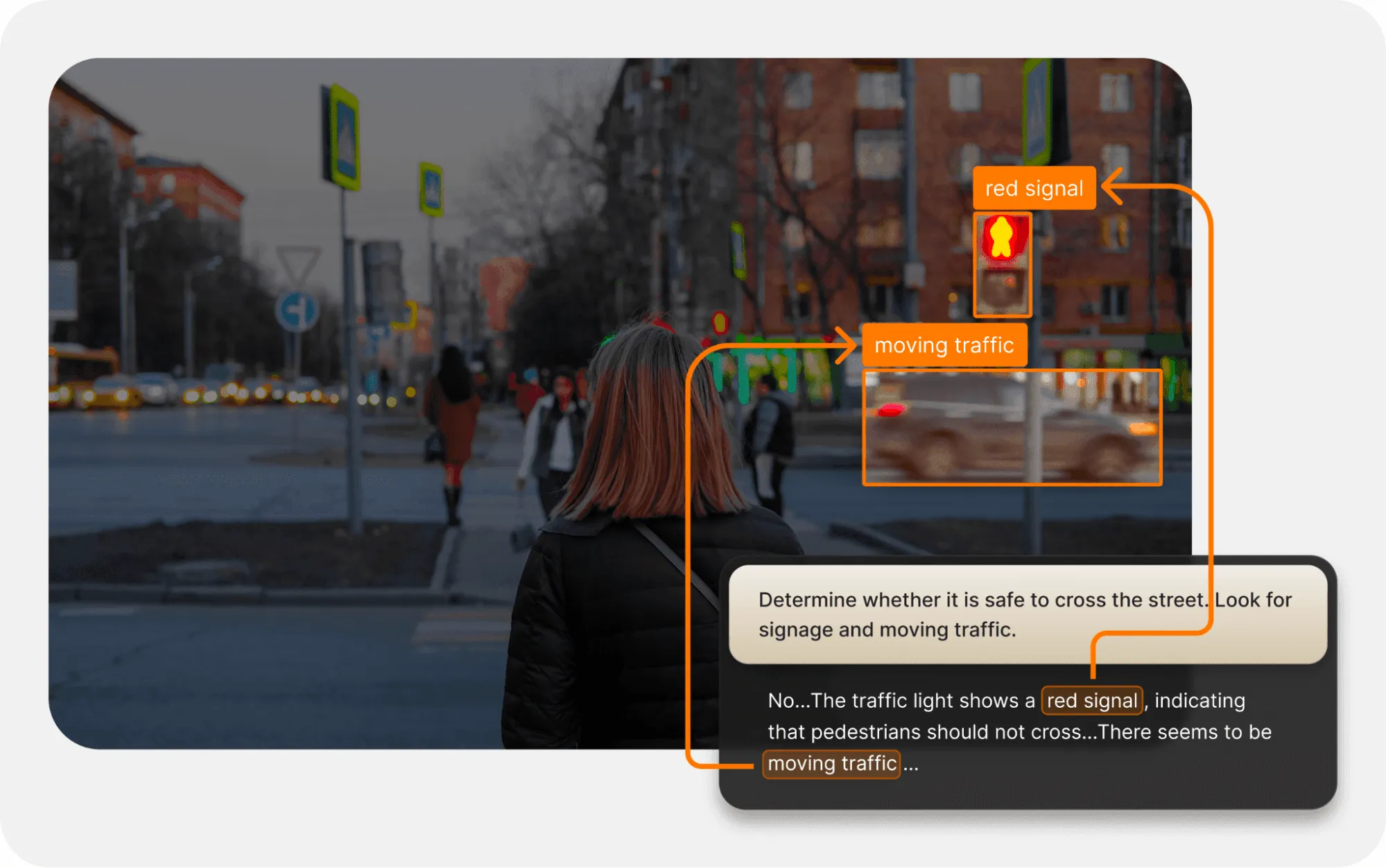
Perceptron AI has released Isaac 0.1, a 2B-parameter, open-weight vision-language model built for grounded perception. Isaac answers questions about images, reasons about spatial relationships, reads text in cluttered environments, and points to where its answers come from.

Despite its small size, Isaac rivals models many times larger at OCR, object recognition, and visual reasoning.

What makes Isaac 0.1 special

Grounded visual reasoning

Isaac not only describes a scene, but can explain why its answers are correct, returning bounding boxes or regions tied to each claim. This helps you build applications that need transparency, traceability, or step-by-step evidence.
Isaac 0.1 model example

Strong OCR in real-world conditions

The model reads small or partially obstructed text on signs, labels, packaging, and documents. It combines OCR with contextual understanding, so you can ask questions like: “What’s the return address?” or “How much time is left in the game?”.

Spatial awareness for physical environments

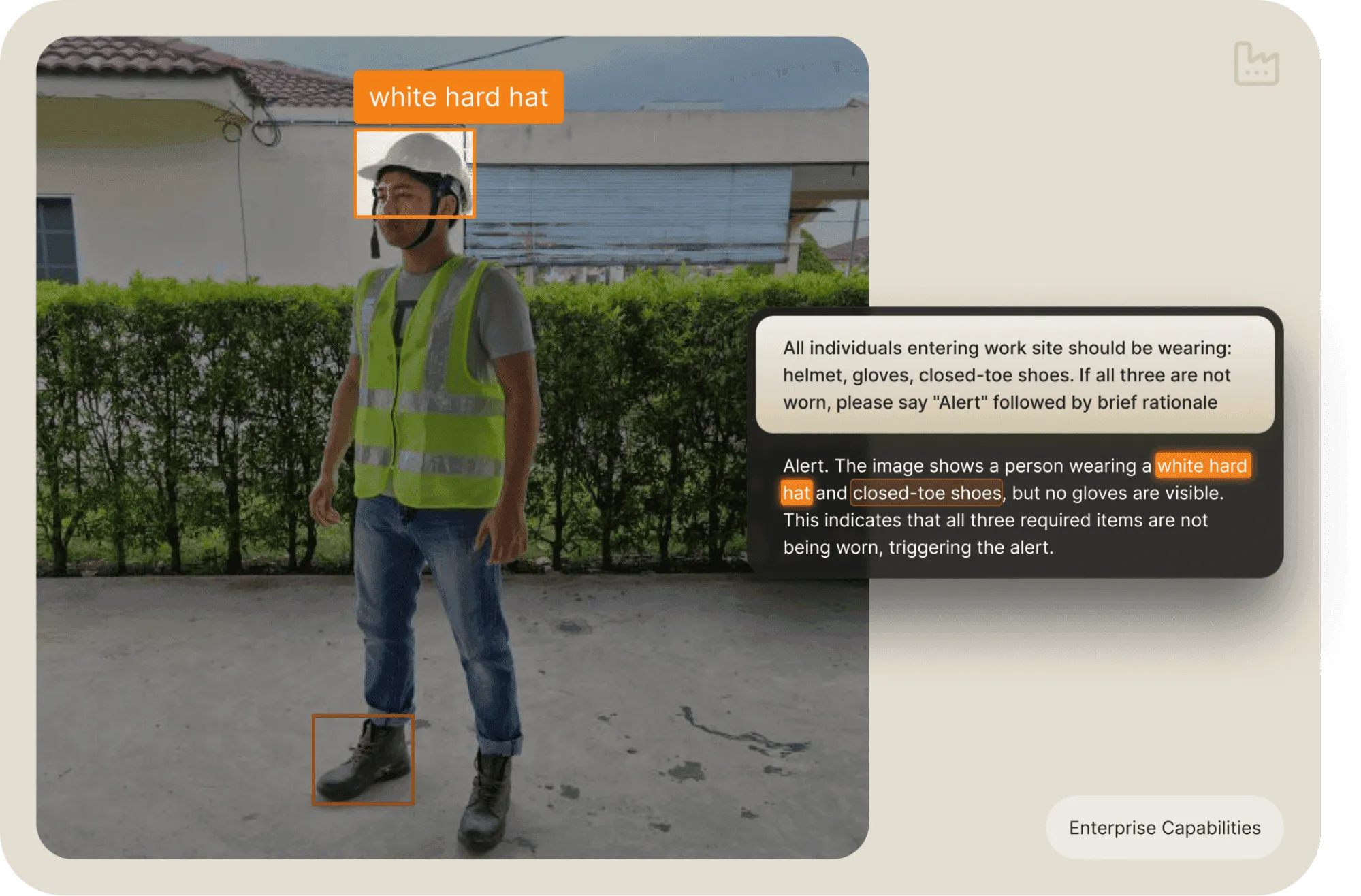
Isaac understands how objects relate to each other: where they are, how they interact, and when something is out of place. This makes it useful for tasks like identifying misaligned components, spotting broken parts, or determining which bin or location an item belongs to.
Isaac 0.1 model example

Learns new tasks from examples

Show Isaac a few annotated examples of the defects, components, or conditions you care about, and it adapts immediately, without the need to fine-tune.

Built for efficiency

At just 2B parameters, Isaac is fast enough for real-time or edge-constrained applications. It’s practical for robotics, manufacturing, visual inspection, and document workflows at scale.

Getting started with the API

Here’s how to run Isaac 0.1 using JavaScript and the Replicate API: