

惯性聚合 高效追踪和阅读你感兴趣的博客、新闻、科技资讯
阅读原文 在惯性聚合中打开

推荐订阅源

Apple Machine Learning Research
OSCHINA 社区最新新闻
OSCHINA 社区最新新闻
G
Google Developers Blog
博客园 - 司徒正美
J
Java Code Geeks
aimingoo的专栏
aimingoo的专栏
A
About on SuperTechFans
博客园 - 三生石上(FineUI控件)
WordPress大学
WordPress大学
T
The Blog of Author Tim Ferriss
D
Docker
大猫的无限游戏
大猫的无限游戏
D
DataBreaches.Net
腾讯CDC
V
Visual Studio Blog
freeCodeCamp Programming Tutorials: Python, JavaScript, Git & More
C
Check Point Blog
M
MIT News - Artificial intelligence
Jina AI
Jina AI
I
InfoQ
雷峰网
雷峰网
The Cloudflare Blog
美团技术团队
Engineering at Meta
Engineering at Meta

Keep the gradient flowing

Policy Gradients Part 1: The REINFORCE Estimator On the Link Between Optimization and Polynomials, Part 6. Optimization Nuggets: Stochastic Polyak Step-size, Part 2 Optimization Nuggets: Stochastic Polyak Step-size On the Convergence of the Unadjusted Langevin Algorithm The Russian Roulette: An Unbiased Estimator of the Limit Notes on the Frank-Wolfe Algorithm, Part III: backtracking line-search On the Link Between Optimization and Polynomials, Part 5 Optimization Nuggets: Implicit Bias of Gradient-based Methods Optimization Nuggets: Exponential Convergence of SGD On the Link Between Optimization and Polynomials, Part 4 On the Link Between Optimization and Polynomials, Part 3 On the Link Between Optimization and Polynomials, Part 2 On the Link Between Polynomials and Optimization, Part 1 How to Evaluate the Logistic Loss and not NaN trying Notes on the Frank-Wolfe Algorithm, Part II: A Primal-dual Analysis Three Operator Splitting Notes on the Frank-Wolfe Algorithm, Part I Optimization inequalities cheatsheet A fully asynchronous variant of the SAGA algorithm Hyperparameter optimization with approximate gradient Lightning v0.1 scikit-learn-contrib, an umbrella for scikit-learn related projects. On the consistency of ordinal regression methods Holdout cross-validation generator IPython/Jupyter notebook gallery PyData Paris - April 2015 Data-driven hemodynamic response function estimation Plot memory usage as a function of time Surrogate Loss Functions in Machine Learning
SAGA algorithm in the lightning library
Fabian Pedregosa · 2016-02-22 · via Keep the gradient flowing

Recently I've implemented, together with Arnaud Rachez, the SAGA[1] algorithm in the lightning machine learning library (which by the way, has been recently moved to the new scikit-learn-contrib project). The lightning library uses the same API as scikit-learn but is particularly adapted to online learning. As for the SAGA algorithm, its performance is similar to other variance-reduced stochastic algorithms such as SAG[3] or SVRG[2] but it has the advantage with respect to SAG[3] that it allows non-smooth penalty terms (such as $\ell_1$ regularization). It is implemented in lightning as SAGAClassifier and SAGARegressor.

We have taken care to make this implementation as efficient as possible. As for most stochastic gradient algorithms, a naive implementation takes 3 lines of code and is straightforward to implement. However, there are many tricks that are time-consuming and error-prone to implement but make a huge difference in efficiency.

A small example, more as a sanity check than to claim anything. The following plot shows the suboptimality as a function of time for three similar methods: SAG, SAGA and SVRG. The dataset used in the RCV1 dataset (test set, obtained from the libsvm webpage), consisting of 677.399 samples and 47.236 features. Interestingly, all methods can solve this rather large-scale problem within a few seconds. Within them, SAG and SAGA have a very similar performance and SVRG seems to be reasonably faster.
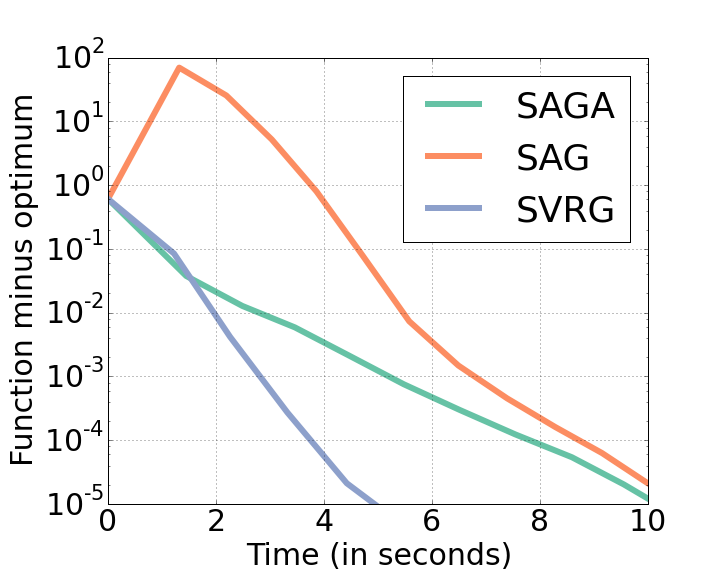
A note about the benchmarks: it is difficult to compare fairly stochastic gradient methods because at the end it usually boils down to how you choose the step size. In this plot I set the step size of all methods to 1/(3L) , where L is the Lipschitz constant of the objective function, as I think this is a popular choice. I would have prefered 1/L but SVRG was not converging for this step size. The code for the benchmarks can be found here.