

惯性聚合 高效追踪和阅读你感兴趣的博客、新闻、科技资讯
阅读原文 在惯性聚合中打开

推荐订阅源

WordPress大学
WordPress大学
G
Google Developers Blog
M
MIT News - Artificial intelligence
Vercel News
Vercel News
freeCodeCamp Programming Tutorials: Python, JavaScript, Git & More
GbyAI
GbyAI
B
Blog RSS Feed
Blog — PlanetScale
Blog — PlanetScale
Microsoft Security Blog
V
Visual Studio Blog
Stack Overflow Blog
Stack Overflow Blog
雷峰网
雷峰网
The Cloudflare Blog
钛媒体:引领未来商业与生活新知
钛媒体:引领未来商业与生活新知
F
Fortinet All Blogs
L
LangChain Blog
OSCHINA 社区最新新闻
OSCHINA 社区最新新闻
A
About on SuperTechFans
T
The Blog of Author Tim Ferriss
B
Blog
J
Java Code Geeks
Hugging Face - Blog
Hugging Face - Blog
I
InfoQ
让小产品的独立变现更简单 - ezindie.com

Keep the gradient flowing

Policy Gradients Part 1: The REINFORCE Estimator On the Link Between Optimization and Polynomials, Part 6. Optimization Nuggets: Stochastic Polyak Step-size, Part 2 Optimization Nuggets: Stochastic Polyak Step-size On the Convergence of the Unadjusted Langevin Algorithm The Russian Roulette: An Unbiased Estimator of the Limit Notes on the Frank-Wolfe Algorithm, Part III: backtracking line-search On the Link Between Optimization and Polynomials, Part 5 Optimization Nuggets: Implicit Bias of Gradient-based Methods Optimization Nuggets: Exponential Convergence of SGD On the Link Between Optimization and Polynomials, Part 4 On the Link Between Optimization and Polynomials, Part 3 On the Link Between Optimization and Polynomials, Part 2 On the Link Between Polynomials and Optimization, Part 1 How to Evaluate the Logistic Loss and not NaN trying Notes on the Frank-Wolfe Algorithm, Part II: A Primal-dual Analysis Three Operator Splitting Notes on the Frank-Wolfe Algorithm, Part I Optimization inequalities cheatsheet A fully asynchronous variant of the SAGA algorithm Hyperparameter optimization with approximate gradient Lightning v0.1 scikit-learn-contrib, an umbrella for scikit-learn related projects. SAGA algorithm in the lightning library On the consistency of ordinal regression methods Holdout cross-validation generator IPython/Jupyter notebook gallery PyData Paris - April 2015 Data-driven hemodynamic response function estimation Plot memory usage as a function of time
Handwritten digits and Locally Linear Embedding
Fabian Pedregosa · 2011-05-04 · via Keep the gradient flowing

I decided to test my new Locally Linear Embedding (LLE) implementation against a real dataset. At first I didn't think this would turn out very well, since LLE seems to be somewhat fragile, yielding largely different results for small differences in parameters such as number of neighbors or tolerance, but as it turns out, results are not bad at all. The idea is to take a handwritten digit, stored as a 8x8 pixel image and flatten it into a an array of 8x8 = 64 floating-point values.

image0

Then each handwritten digit can be seen as a point in a 64-dimensional space. Of course, visualizing in 64-dimensional spaces is not easy, and that's where Locally Linear Embedding comes handy. We'll use this method to reduce the dimension from 64 to 2 with the hope of preserving most of the underlying manifold structure. The following is a plot of the handwritten digits {0, 1, 2, 3, 4} after performing locally linear embedding. As you can see, some groups are nicely clustered, notably the 0 is isolated while other like {4, 5} are closer, precisely those that are more similar.
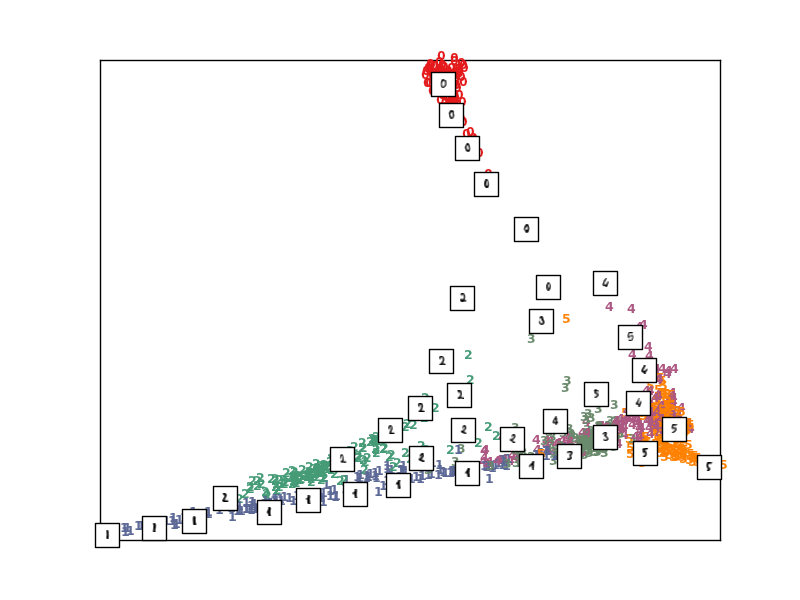
image1

Source code for this example can be found here but relies on my manifold branch of scikit-learn.