






In most people's minds, asteroid strikes are associated with destruction and carnage. They can correctly point to the Chicxulub impactor that wiped out the dinosaurs, even if they don't know the impactor's name. Contemplating the crater-saturated surfaces of the Moon, Mercury, and other worlds only strengthens the link between impacts and destruction.
But increasingly, scientists are thinking differently about impacts. There's growing evidence that early in Earth's history, impacts may have played a role in the appearance of life. They may have kickstarted the generation of life's building blocks, and eventually life itself.
There is clear evidence that prebiotic molecules — including amino acids — exist on asteroids and comets. During impacts, these substances were likely delivered to Earth. There, on the young Earth, these chemical building blocks could've eventually formed living cells.
There's more detail in this line of thinking. Powerful impacts not only deliver chemistry to Earth, they strike with an enormous amount of energy. These impactors, depending on their size and their impact velocity, also created vast subterranean regions of shattered, porous rock, through with hot water flows. Taken together, it all paints a picture of a long-lasting hydrothermal honeycomb where chemicals, minerals, and hot water interact.
This chemical kitchen could be where life started.
New research in AGU Advances digs deeper into this issue. It's titled "Widespread Impact-Induced Crustal Permeability on the Early Earth," and the first author is Amanda Alexander. Alexander is a planetary scientist in the Department of Space Studies at the Southwest Research Institute (SwRI).
The researchers focused on Earth's two earliest eons, the Archean and the Hadean, from 2.5–4.0 and 4 to 4.5 billion years ago, respectively. Impacts were frequent during these times, and are even referred to as bombardments. Scientists know that some of these impacts created long-lived hydrothermal systems in the Earth's crust that endured for millions of years. In this work, they wanted to understand the parameters of these impacts and how they affected the Earth's crust. They used a shock physics code to conduct "... the first comprehensive study to quantify impact-generated permeable volumes into the upper crust of the early Earth for a suite of environmental (e.g., geothermal gradient, crustal thickness, presence of an ocean) and impact conditions (e.g., impactor velocity and size)," the researchers write.
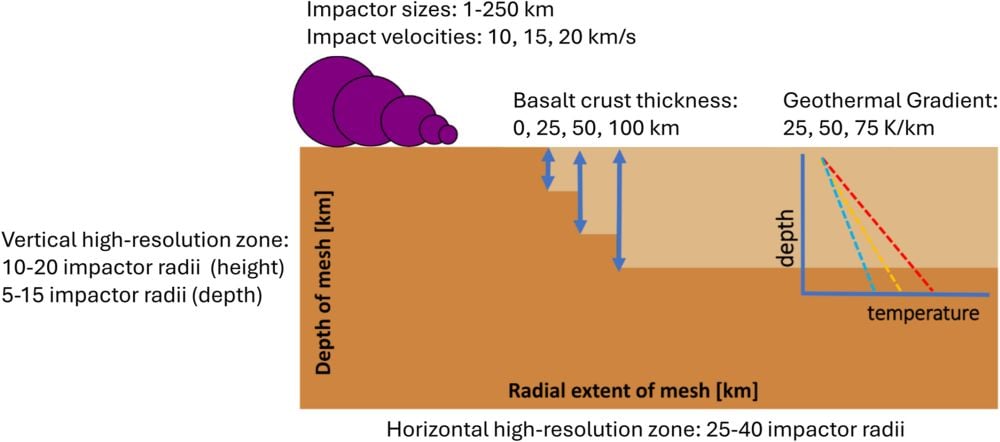 *This figure shows the different impact conditions and Hadean environments explored in this work. There were a total of 37 different simulations. Image Credit: Alexander et al. 2026. AGU Advances https://doi.org/10.1029/2025AV002097*
“This modeling is both novel and crucial for understanding the earliest environments life may have emerged from,” first author Alexander said in a press release. “While often considered catastrophic in the context of dinosaur extinction, impact bombardment was also likely critical for creating environments for prebiotic chemistry.”
There are several large hydothermal fields on modern Earth, including in Yellowstone National Park in the USA and the Taupo Volcanic Zone in New Zealand. But these are small when compared to the hydrothermal systems created by massive impacts. Some of the impacts in this work created systems more than 100 times larger than Yellowstone. In fact, the repeated impacts may have made the crust almost unrecognizable. "We estimate that the upper 8 km shell of the Earth's crust may have been made highly permeable by impacts prior to 4.3 Ga, and that a significant portion of this volume would have been permeable until 3.5 Ga," the authors write.
The Yellowstone hydrothermal system has a volume of approximately 10,000 cubic km. The authors compare that to the volume of the system created by the Chicxulub impactor, which is about 1million cubic km. "All 10 km impactor cases result in permeable volume similar to what we estimated for the Chicxulub system," the authors explain. "The 50, 100, and 250 km impactor sizes all generate permeable volumes 2–4 orders of magnitude larger than what we estimated for Chicxulub."
When striking an ocean rather than exposed crust, the impact-created system is smaller. "The inclusion of a 5 km ocean stunts the development of permeable space," the authors write. The fragmentation of the crust covers a smaller region and is also less intense.
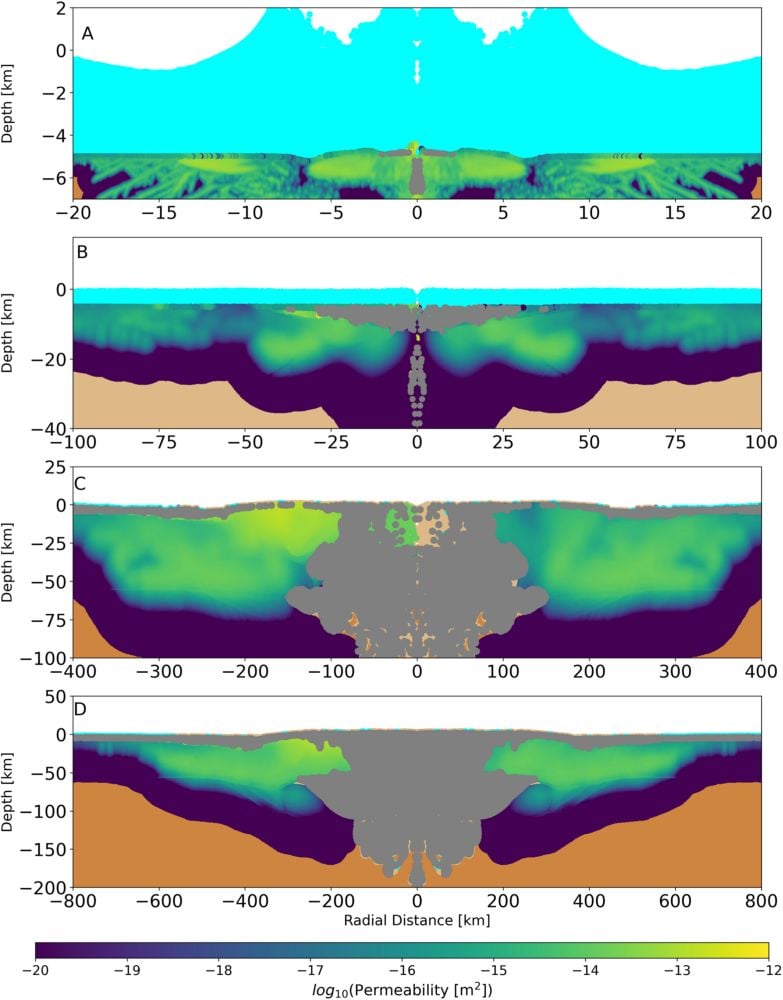 *In these crater cross-sections from the simulations, light brown is crust, dark brown is mantle, and cyan is ocean. The color bar shows permeability. The deeper the ocean is, the smaller and less intense the region of permeability. Image Credit: Alexander et al. 2026. AGU Advances https://doi.org/10.1029/2025AV002097*
“Using a bombardment history model to infer the cumulative effects of recurring impacts, we estimate that the upper 5-mile (8-kilometer) shell of the Earth’s crust likely was highly permeable 4.3 billion years ago and that a significant portion of this volume may have remained permeable until 3.5 billion years ago,” Alexander said. “These results show that impacts were instrumental in driving hydrothermal changes to the early Earth’s crust, with important consequences for the geochemical evolution of near-surface environments.”
According to the authors, theirs is the "first comprehensive study of impact-generated permeability for a suite of early Earth crustal environments." It's a difficult thing to model, and the researchers acknowledge that it's by nature based on some assumptions. They used a model for permeability based on other, separate research, and it doesn't include compaction. So the length of time that an impact remained permeable is likely an overestimate. "As a result, a reduction in permeable magnitude, particularly several crater radii beyond the crater rim, would be reduced," the authors write.
There is also no current way to model shearing, especially from the collapse of a crater's central uplift. The grinding effect would actually increase permeability by creating smaller fragments of rock. "Smaller fragment sizes would subsequently result in higher overall permeability values," the researchers explain.
While the specific sizes of the permeable areas and the degree of permeability can be refined and debated, the overall conclusion is clear. Earth's crust suffered extensive episodes of impacts that created vast hydrothermal systems. "The early Earth experienced frequent bombardment during the Archean and Hadean eons," the authors write. "The findings from this study emphasize that each impact would have imparted significant permeable space into the upper crust."
The result was a network of hydrothermal systems in ancient Earth's primitive basaltic crusts.
“Because life could have originated or evolved in hydrothermal environments, it is important to understand and quantify the generation of these systems by impacts on the early Earth,” Alexander emphasized.
"These shallow permeable networks generated by recursive impacts during the Hadean may have served as crucibles for prebiotic chemistry," the authors conclude.
此内容由惯性聚合(RSS阅读器)自动聚合整理,仅供阅读参考。 原文来自 — 版权归原作者所有。