







Here's something that might surprise you. Despite being our closest companion in space, despite the missions, the moonwalks, and the decades of study, we still don't have a complete map of what the Moon's surface is made of. We only know bits and pieces. The Apollo samples gave us remarkable chemical snapshots, but they came from just six locations. The Moon has a surface area of nearly 38 million square kilometres so that's like trying to understand an entire continent from a handful of soil samples collected within a few kilometres of each other.
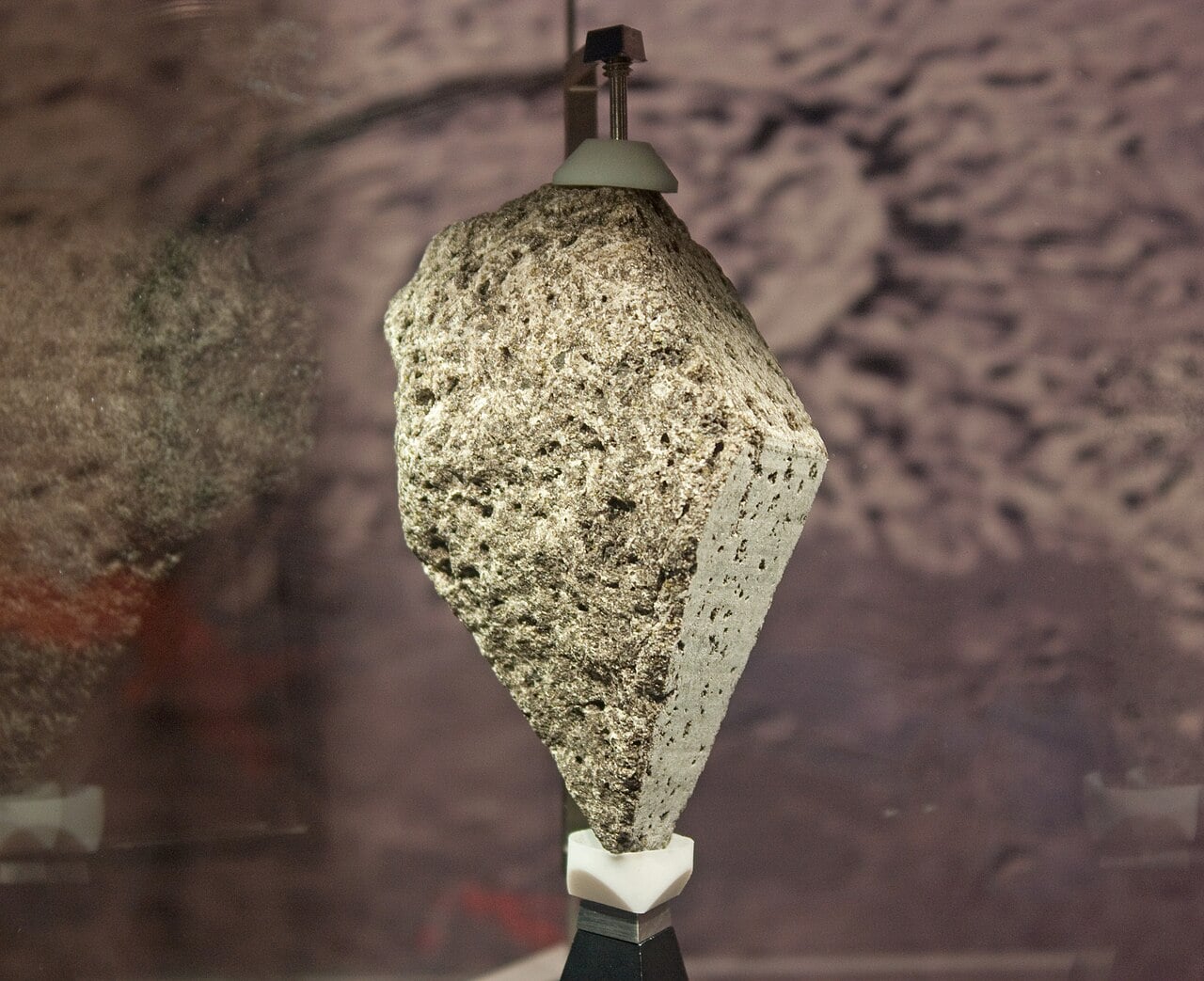 Olivine basalt collected from the rim of Hadley Rille by the crew of Apollo 15 (Credit : NASA)
So the question has long been focussed on somehow mapping the chemistry of a whole world when you can't land everywhere? The answer, it turns out, might be in the use of X-rays.
When solar X-rays slam into the lunar surface, the atoms in the rock fire back their own characteristic X-rays in a process called X-ray fluorescence. Each element has its own unique signature, as distinctive as a fingerprint. Detect those signatures from orbit, and you can work out what's down there without ever touching the ground.
Previous missions have tried this. Apollo and Chandrayaan both made partial maps but they were always incomplete, hampered by weak solar illumination at the poles and the gradual degradation of the detectors over time. The Moon's vast polar regions, which may hold the most scientifically interesting geology, have remained blank on the map.
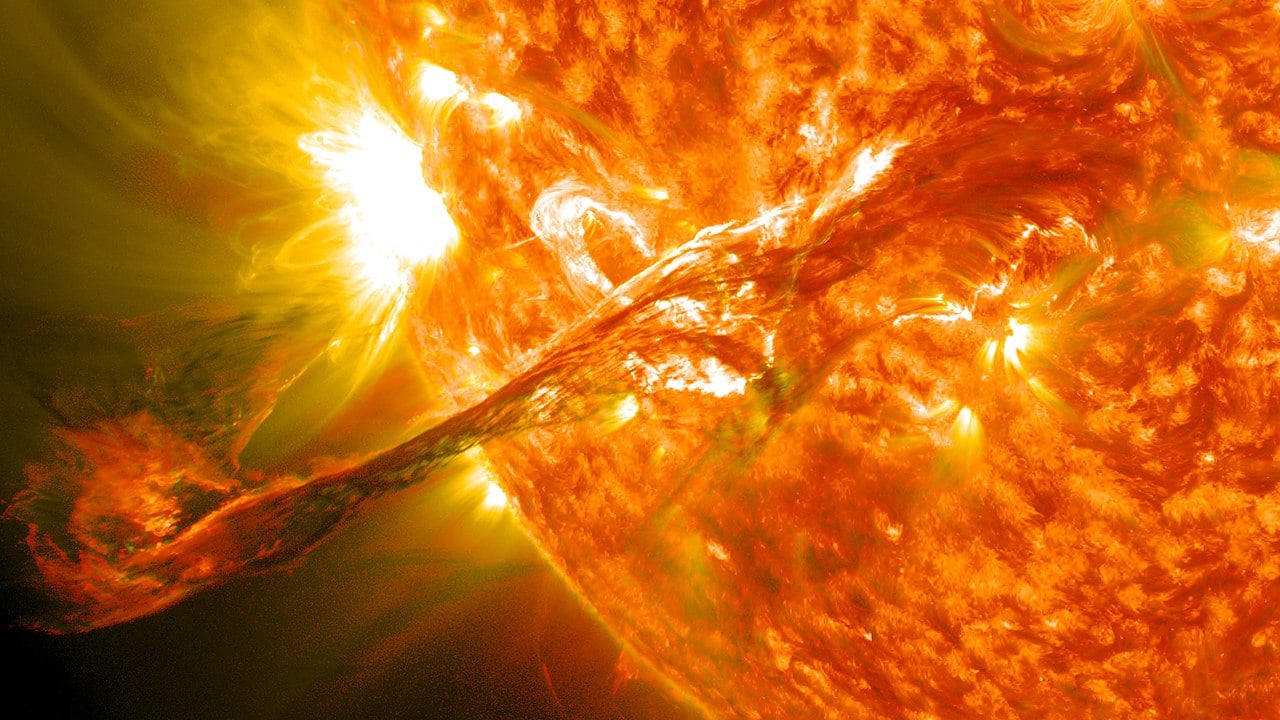 On August 31, 2012 a long filament of solar material that had been hovering in the sun's atmosphere, the corona, erupted out into space at 4:36 p.m. EDT. Flares like these can bathe the lunar surface in X-rays leading to X-ray fluorescence which helps to map the composition of the lunar surface (Credit : NASA)
Now, researchers at Tokyo Metropolitan University think they've finally cracked it. Their solution is a compact X-ray telescope weighing in at less than ten kilograms making it lightweight enough to fly on a long term satellite mission and rugged enough to survive the radiation environment of lunar orbit. Simulations show that a single telescope, catching the X-ray bursts during roughly 300 solar flares per year, could map five key elements across the entire surface in just two years. Scale that up to a five by five array of twenty five telescopes on one satellite, and the mission time drops to a year, with a finer resolution of 30 by 30 kilometres per grid square.
Five elements; oxygen, iron, magnesium, aluminium, silicon mapped globally for the first time. It doesn't sound terribly dramatic until you consider what it would tell us. The distribution of these elements is a record of how the Moon formed, how its interior evolved, and how billions of years of bombardment have churned its surface. A complete geochemical map wouldn't just fill in a gap. It would give planetary scientists an entirely new lens through which to read lunar history.
Source : X-ray telescopes on a satellite can map the Moon's surface chemistry in a few years
此内容由惯性聚合(RSS阅读器)自动聚合整理,仅供阅读参考。 原文来自 — 版权归原作者所有。