







Think about a census. You could photograph every house in the country and produce a beautiful map, but without knocking on doors and asking questions, you'd know almost nothing about the people living in them. Astronomy finds itself in exactly this situation. Surveys like Euclid and the Vera Rubin Observatory will soon catalogue over 30 billion galaxies, an almost incomprehensible number. But converting those images into real scientific knowledge means measuring the light spectrum of each galaxy individually such as its redshift, its chemistry, its velocity. And that takes time, a lot of time.
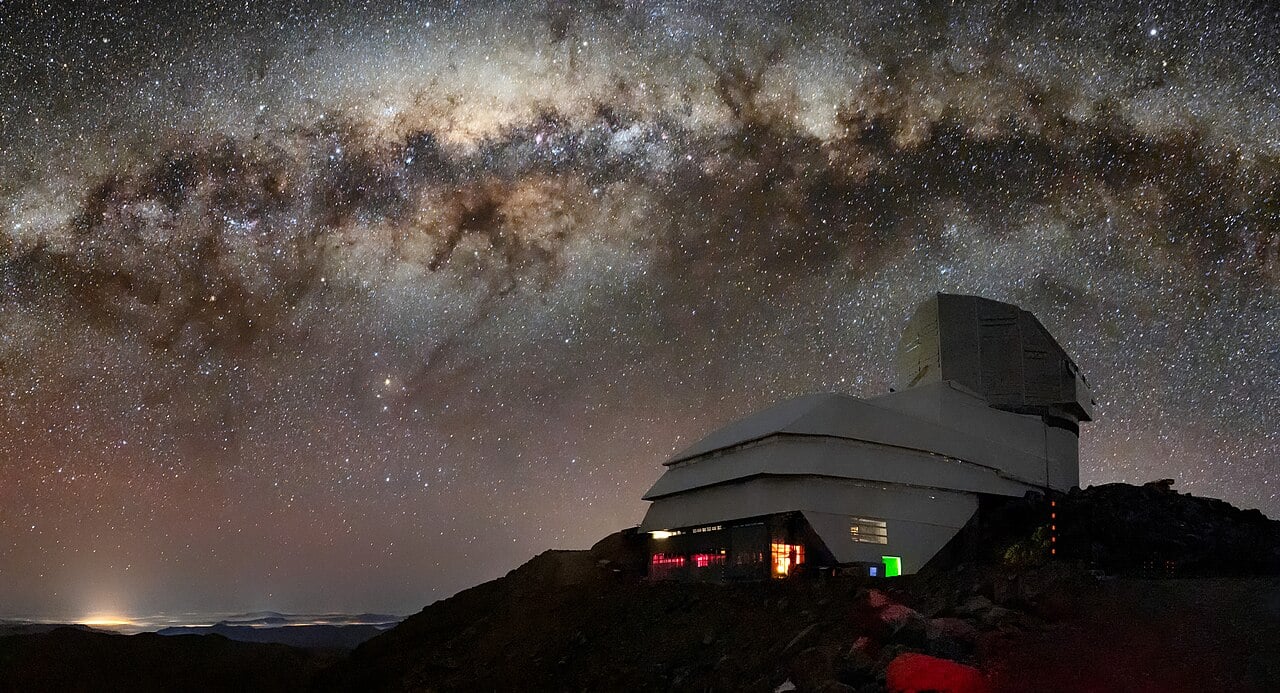 Installations like the Rubin Observatory will be cataloguing billions of galaxies (Credit : Vera Rubin Observatory)
Right now, the best spectroscopic survey instrument on the planet is DESI, the Dark Energy Spectroscopic Instrument, operating in Arizona. It can capture the spectra of 5,000 objects simultaneously and has already built the largest 3D map of the universe ever made. Impressive, but against a catalogue of tens of billions of galaxies, it's a little like trying to drain an ocean with a bucket and a small one at that!
Enter MUST. The MUltiplexed Survey Telescope, led by Tsinghua University and currently under construction at a 4,380 metre peak in Qinghai province, China, is designed to do something extraordinary. Sitting at its Cassegrain focus will be a focal plane bristling with over 20,000 robotic fibre positioners, each one a tiny, independently steerable arm capable of locking onto a different galaxy in just seconds. That's four times as many fibres as DESI, covering a patch of sky roughly 20 times the area of the full moon in a single exposure. In survey efficiency terms, MUST will be ten times more powerful than anything operating today.
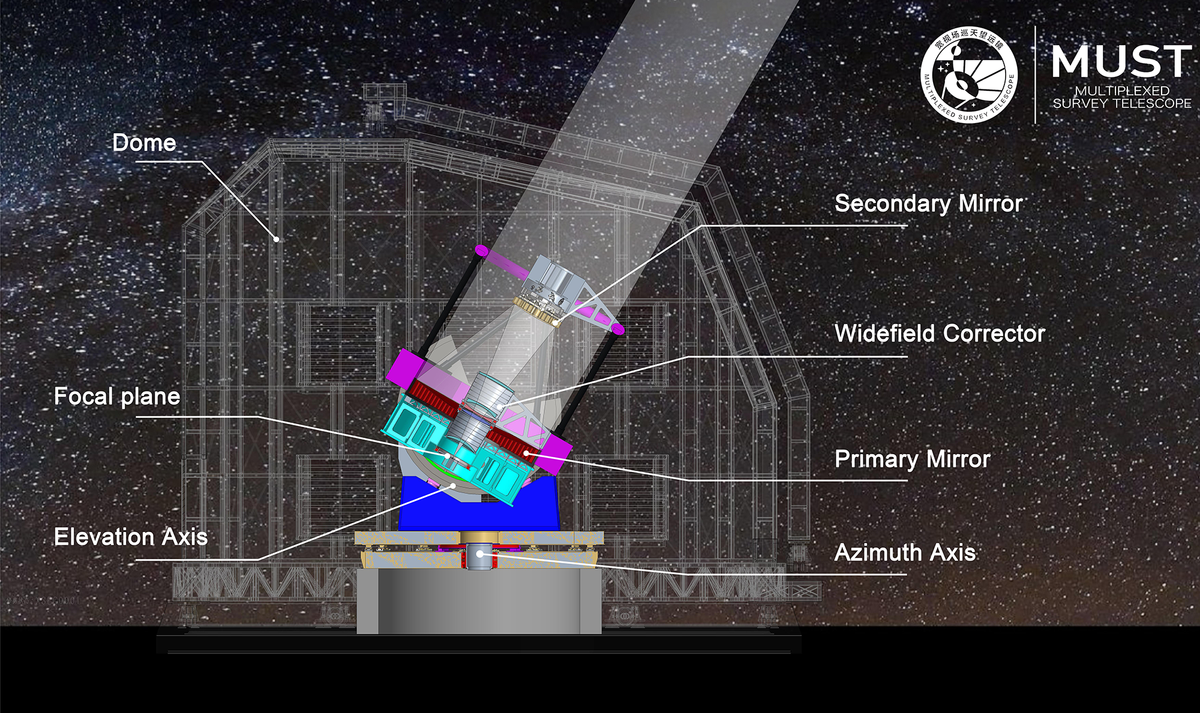 Illustration of the MUltispectral Survey Telescope (Credit : Yifan Zhang, Haijiao Jiang, Stephen Shectman, Dehua Yang and Zheng Cai)
Over an eight year campaign beginning in the early 2030s, MUST aims to measure the redshifts of more than 100 million galaxies and quasars, building the most detailed three dimensional map of the universe ever assembled. That map won't just be pretty. It will probe some of the deepest questions in physics — the true nature of dark energy, the mass of the neutrino, whether Einstein's general relativity holds across cosmic scales, and what the universe looked like in the first billion years after the Big Bang.
The telescope itself is a feat of engineering. Its primary mirror stretches 6.5 metres across, and its five lens wide-field corrector, topped by the largest aspheric lens ever manufactured delivers extraordinarily sharp images across its entire field of view. With 20,000 fibres to feed, there's no margin for error. When MUST opens its eyes on the universe in the 2030s, a new chapter in cosmology begins and one where, at last, we stop just photographing it and start truly understanding it.
Source : From Large Telescopes to the MUltiplexed Survey Telescope (MUST)
此内容由惯性聚合(RSS阅读器)自动聚合整理,仅供阅读参考。 原文来自 — 版权归原作者所有。