







It’s June 2027, and you’re fresh off defending your PhD studying the direct imaging of exoplanets while starting your postdoctoral journey at NASA Jet Propulsion Laboratory. The trauma of eating ramen and living off a sub-living wage for the last five years of your life is still fresh in your brain. But you’re excited to finally get your real career started with funding you received for viewing time on the much-anticipated Nancy Grace Roman Space Telescope (Roman for short). You begin to download the first set of data as your eyes tear up knowing your entire journey in research and academia is about to be worth it.
This potential near future scenario could be made possible with NASA recently completing its final inspection of the primary mirror on the Roman telescope, which measures 2.4 meters (7.9 feet) in diameter and containing a layer of silver hundreds of times thinner than a human hair at 400 nanometers. The primary mirror will serve to accomplish the mission objectives of Roman using near-infrared light, which will include studying dark matter and dark energy, discovering exoplanets through direct imaging and gravitational microlensing, and galaxy formation, evolution, and star populations.
“The Roman engineering team laid eyes on the telescope for the final time before it, in turn, becomes the eyes of humanity, revealing the wonders of the cosmos,” said J. Scott Smith, who is Roman’s Optical Telescope Assembly Manager at NASA Goddard Space Flight center. “It is a profoundly humbling moment to witness the culmination of hard work from so many dedicated individuals, teams, and partner organizations, including L3Harris.”
With this final inspection complete, NASA will now prepare to ship Roman to NASA’s Kennedy Space Center for a slated launch of September 2026. Once launched, Roman will travel to the Sun-Earth Lagrange point 2 (L2), which is approximately 1.5 million kilometers (1 million miles) directly behind the Earth from the Sun. For context, our Moon is approximately 384,000 kilometers (239,000 miles) from Earth, and L2 is where NASA’s James Webb Space Telescope (JWST) currently orbits while conducting groundbreaking research in a variety of scientific fields, including exoplanet atmospheres, first galaxies, and star and planet formation and evolution.
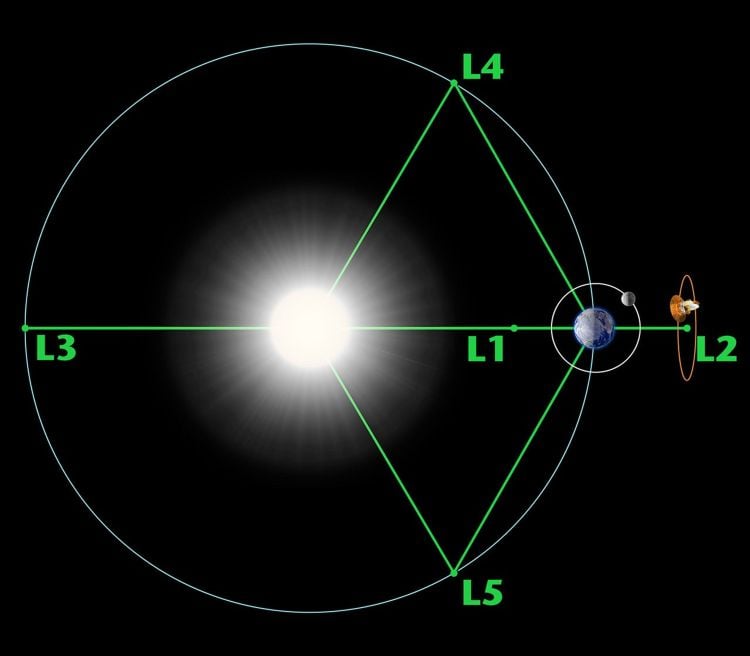 *Credit: NASA/WMAP Science Team*
Lagrange points are gravitationally stable locations in space produced by two gravitationally large objects. Using Lagrange points has become a common practice in space exploration since it reduces the amount of fuel a spacecraft requires to maintain its position. Instead, the spacecraft stays within this region with very little adjustments required. In the case of the Earth and the Sun, there are five Lagrange points, with L1-L5, with L1-L3 known as “saddle” points and L4-L5 known as “hilltop” points. While saddle points curve up in some regions they curve down in others, hilltop points have a high point and a spacecraft that falls down the “hill” speeds up. While both types of Lagrange points require fuel to maintain their positions, this is substantially smaller than trying to keep a spacecraft in a fixed position alone.
Named after the NASA Chief of Astronomy, Dr. Nancy Grace Roman (1925-2018), the Roman telescope has been in development since 2014 and was initially named the Wide-Field Infrared Survey Telescope (WFIRST). While Roman has an estimated total cost of almost $4 billion, this is more than half the total cost of JWST. Additionally, Roman has faced several financial and logistical hurdles during its development, but this final inspection is a testament to the tireless dedication NASA displays for pushing the boundaries of groundbreaking science.
What new insights about our universe will the Nancy Grace Roman Space Telescope teach scientists in the coming years and decades? Only time will tell, and this is why we science!
As always, keep doing science & keep looking up!
此内容由惯性聚合(RSS阅读器)自动聚合整理,仅供阅读参考。 原文来自 — 版权归原作者所有。