








Saturn's largest moon, Titan, is a unique environment in our Solar System. It is the only moon (or body beyond Earth) to have a dense, nitrogen-rich atmosphere, and its methane cycle is very similar to Earth's hydrological cycle, in which solid and liquid methane evaporates to form clouds and returns to the surface as precipitation. In addition, its prebiotic surface environment and rich organic chemistry make it a prime destination for astrobiology missions, such as NASA's Dragonfly mission (set to launch no earlier than July 2028).
And as Robert Zubrin said in his book, Entering Space: Creating a Spacefaring Civilization, Saturn's moons could become the "Persian Gulf" of the Solar System, with Titan being a major one because of its rich resource environment. In a recent NASA-supported study, a team of researchers compiled an inventory of Titan's resources and their potential use by future generations of humans. When comparing this satellite to other destinations (i.e., the Moon and Mars), they conclude that Titan offers several potential benefits for human settlement.
The research was led by Conor A. Nixon, an astronomer and planetary scientist with the Solar System Exploration Division (SSED) at the NASA Goddard Space Flight Center and the Associate Laboratory Chief of their Planetary Systems Laboratory. He was joined by Ye Lu, a Professor of Aerospace Engineering at the Worcester Polytechnic Institute, and Jennifer E. Ruliffson, a Professor of Materials Science and Engineering at the University of Florida. The preprint of their paper has recently appeared online and is under review for publication in *Acta Astronautica*.
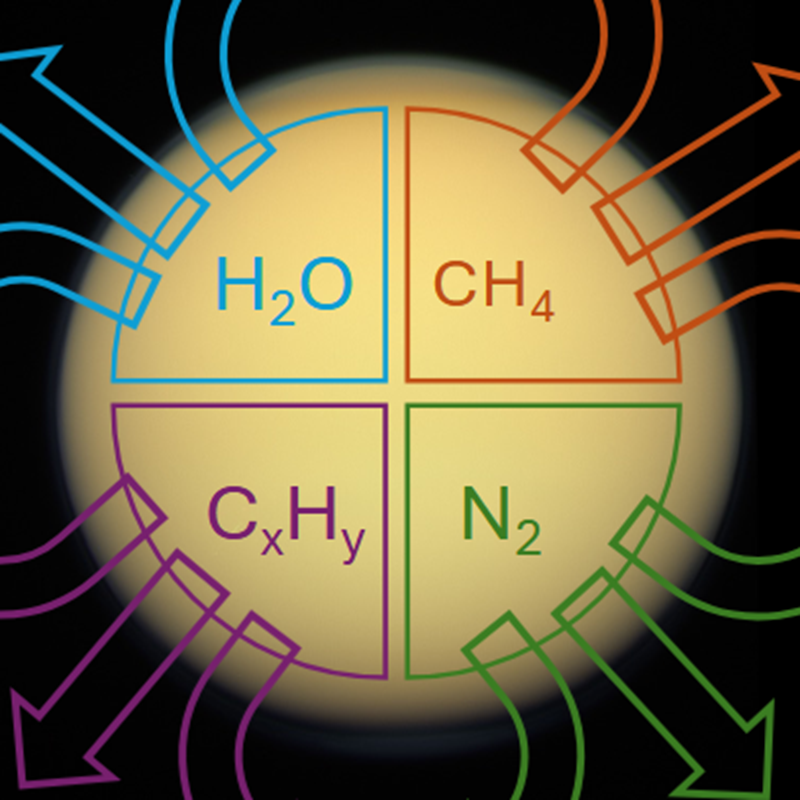 Artistic representation of Titan's abundant resources and their possible uses. Credit: Nixon, C.A. et al (2026)
ISRU is a major aspect in all plans for long-duration missions to the Moon, Mars, and other locations far beyond Earth. To date, the vast majority of studies have focused on leveraging lunar and Martian resources to sustain crewed missions and eventual human settlement. With the exception of a recently proposed Titan ISRU Sample Return (TISR) mission, Titan has received considerably less attention, despite the possibilities this moon offers.
This includes opportunities for ISRU that would enable the construction of long-term habitats on the surface. In addition, they could also lead to Titan becoming a base for resupply missions traveling to and from the outer Solar System. Similarly, Titan could facilitate the exploration of Saturn's other satellites, particularly the "Ocean Worlds" of Enceladus and Mimas, both of which are also rich in resources. Finally, its resources and products fashioned from them could be exported to other locations in the Solar System.
This includes fuel, feedstock, and basic necessities like food, water, nitrogen fertilizers, oxygen gas, and more. As Nixon told Universe Today via email:
Titan is gushing with hydrocarbons - what we call oil and natural gas on Earth. In the atmosphere, it has about 5% methane (what we call LNG and use in home heating and cooking). On the surface, we can find heavier hydrocarbons, such as propane used in BBQ tanks, butane used in lighters, and heavier liquids like kerosene and gasoline. Besides burning these hydrocarbons, we can also make a lot of products from them: plastics, synthetic rubber, and feedstocks for everything from solvents to pharmaceuticals, and even foods.
The previous study, led by Geoffrey Landis and the Compass Lab team from NASA's John Glenn Research Center, looked at ISRU at Titan for one purpose: liquifying methane and producing liquid oxygen (LOX) and liquid hydrogen (LH2) from water to create propellant for a sample-return mission. Nixon and his colleagues cast a much wider net, looking further ahead by examining the many possible uses of all of Titan's resources.
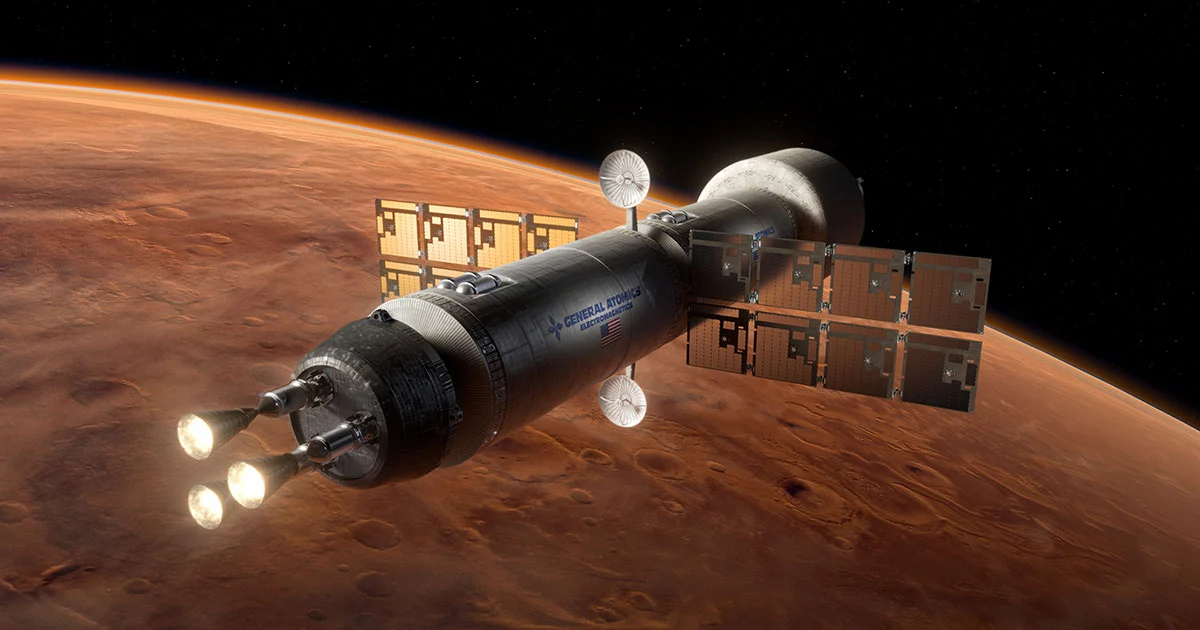 *A rendering of a notional spacecraft powered by nuclear thermal propulsion. Credit: General Atomics*
They also considered how a rich resource base could be used for a wider range of mission profiles. These include missions that need to return to Earth, as well as missions that plan to explore beyond Saturn. To this end, refueling stations on the surface could be accessed by landers from a larger spacecraft that would take on fuel and supplies. Alternately, refueling depots could be built in orbit - similar to what SpaceX is investigating for the Starship - that spacecraft would rendezvous on their way to other destinations.
And as Nixon noted, there's the possibility of harvesting resources to build long-term settlements on Titan's surface:
Basically you could envision either ‘refueling' at Titan (in the manner of the Oleson/Landis study), or using the resources to sustain a more permanent settlement. [And] regarding refueling, it doesn’t just have to be for a return trip to Earth: it could be refueling a ship just arrived from the inner Solar System to go further out, say to Uranus or Neptune, or to explore the Saturnian moons. Or it could just be refueling a regular shuttle that traverses around the Saturn system between colonies on different moons.
Also, we can widen the definition from just ‘fuel’ to resources for a wide variety of purposes. So let’s imagine a permanent station on Titan that refines hydrocarbons and stores them as a variety of feedstocks and raw materials: everything from printer ink to fertilizer. Then, when a visiting ship comes to ‘refuel,’ it is restocking not just fuel but raw ingredients for food, perhaps for 3D printers used to make spare parts, textiles, utensils, and more.
There's also the large volume of water on Titan, which accounts for 50% of its mass (the rest being rocky material in its core) and exists in both solid and liquid states. The liquid portion exists largely beneath the surface, where ammonia and salinity (two natural antifreeze compounds) maintain its liquid state. Water also exists in abundance as surface ice, which could be harvested and used to provide everything from drinking water to hydrogen fuel, oxygen gas, and (as noted) to manufacture LOX/LH2 propellant.
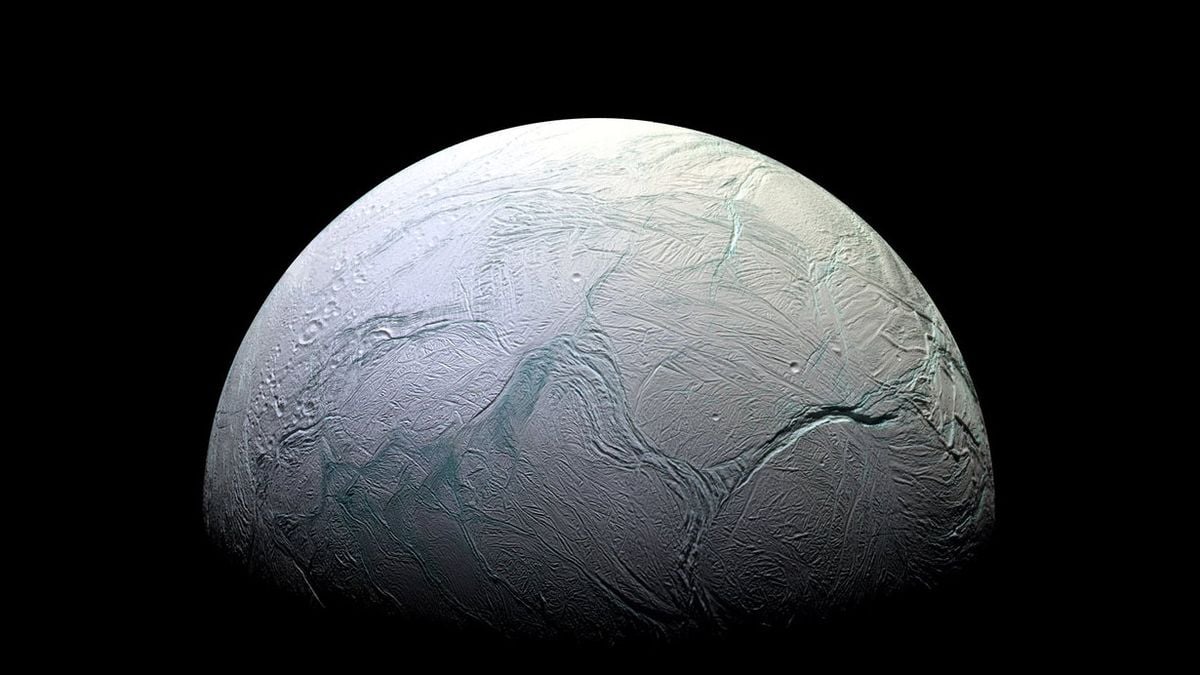 *This mosaic of Saturn's moon Enceladus was created with images captured by NASA's Cassini spacecraft. Credit: NASA/JPL/Space Science Institute*
After considering Titan's resource base and the opportunities for resupply, settlement, and exploration, Nixon and his colleagues compared Titan with the Moon, Mars, and several NEAs. They determined that while Titan is much more distant and would require nuclear propulsion to enable transits, its potential is unrivaled. "There is simply no other world (that we know of) like Titan," said Nixon. "Titan is unique in multiple respects: it’s the only moon with an atmosphere, and it’s the only planet/moon other than Earth to have hydrocarbons available in the atmosphere and on the surface."
While the idea of crewed missions to Titan, or the settlement of this and other Cronian moons, is a far-off prospect, the potential is obvious. By establishing infrastructure and outposts in and around Saturn's moons, humanity would have access to a huge resource base. Beyond Titan, Saturn's atmosphere contains massive reserves of the rare isotope helium-3 (³He), considered the ideal fuel for fusion reactors and fusion propulsion. With so much water, hydrocarbons, and precious gases available, Saturn could very well become the "Persian Gulf" of the Solar System.
But as Nixon indicated, the benefits go far beyond refueling and include the means to build a manufacturing base capable of meeting all the needs of a human population. With the abundant plastics, feedstock for 3-D printers, fuel, and food that could be produced in-situ, a human settlement on Titan could endure for generations. It may be a far-off possibility, but it's good to know that it's there and could be fulfilled someday as part of humanity becoming an interplanetary civilization.
Further Reading: arXiv
此内容由惯性聚合(RSS阅读器)自动聚合整理,仅供阅读参考。 原文来自 — 版权归原作者所有。