

惯性聚合 高效追踪和阅读你感兴趣的博客、新闻、科技资讯
阅读原文 在惯性聚合中打开

推荐订阅源

Cloudbric
Cloudbric
E
Exploit-DB.com RSS Feed
SecWiki News
SecWiki News
Forbes - Security
Forbes - Security
N
News | PayPal Newsroom
S
Security @ Cisco Blogs
Schneier on Security
V
V2EX - 技术
S
Secure Thoughts
W
WeLiveSecurity
Google DeepMind News
C
CERT Recently Published Vulnerability Notes
NISL@THU
NISL@THU
S
Securelist
S
Security Archives - TechRepublic
Know Your Adversary
Know Your Adversary
V
Vulnerabilities – Threatpost
Security Latest
Security Latest
Recent Commits to openclaw:main
G
GRAHAM CLULEY
H
Hacker News: Front Page
Microsoft Azure Blog
I
Intezer
Google Online Security Blog
美团技术团队
阮一峰的网络日志
阮一峰的网络日志
T
The Exploit Database - CXSecurity.com
钛媒体:引领未来商业与生活新知
钛媒体:引领未来商业与生活新知
Webroot Blog
Webroot Blog
Jina AI
Jina AI
Engineering at Meta
Engineering at Meta
P
Proofpoint News Feed
The Cloudflare Blog
I
InfoQ
L
LangChain Blog
U
Unit 42
P
Proofpoint News Feed
S
Schneier on Security
S
Security Affairs
Y
Y Combinator Blog
T
Tenable Blog
N
News and Events Feed by Topic
MyScale Blog
MyScale Blog
量子位
Google DeepMind News
Cyberwarzone
Cyberwarzone
博客园 - 聂微东
D
Darknet – Hacking Tools, Hacker News & Cyber Security
GbyAI
GbyAI
AWS News Blog
AWS News Blog

Universe Today

Reading the Galaxy's Past The Shape of a Black Hole Written in Rock Titan's Hidden Blanket Did Life Start When Impacts Created Vast Hydrothermal Systems in Earth's Crust? Meet REMORA: The Autonomous Space Fleet Built to Tag and Track Asteroids Watch the Moon Occult Venus in the Daytime for North America on June 17th Astrochemical Model Digs Into the Universe's Missing Sulfur On The Hunt For Cosmic Dawn And The Universe’s Very First Stars David Kipping Has a New Take on the Existence of Advanced Life in the Universe... and the Numbers are Not Encouraging! This is How Supermassive Black Holes Feed Themselves NASA’s Proposed EVE Mission Aims to Solve the Radius Valley Mystery Where Not to Look in the Search for ET Reading the Moon in X-rays Astronomers Find a Four-Carbon Sugar in Deep Space Why Can't the Universe Be Cyclic? Part 4: When a Good Idea Meets Bad Data Orbiting Stars Give Clues to a Quiescent Black Hole's Mass Magnetic Fields Help Binary Stars Form and Black Holes Merge A Rare Meteorite Just Revealed a Lost, Mars-Sized Planet from the Dawn of the Solar System Neptune’s Weirdest Moon Nereid Might Be the Lone Survivor of an Ancient "Moonpocalypse" Space Telescopes Are Now Overwhelmed by Satellite Trails Why Can't the Universe Be Cyclic? Part 3: The Ekpyrotic Universe and Its Bouncing Branes Catch Comet 220P McNaught in Outburst The Hidden Physics Complicating Interstellar Lightsails Student Astronomer Identifies Source of Mysterious Cosmic Signals Why Can't the Universe Be Cyclic? Part 2: The Awkward Triumph of Inflation The SETI Institute Releases Technosignature Report on 3I/ATLAS Why Can't the Universe Be Cyclic? Part 1: The Lure of the Eternal Universe A “Green” Dual-Mode Engine is About to Give CubeSats the Best of Both Worlds SETI Panel Revises Recommendations for Dealing With 'Disclosure Day' NASA Bids Farewell to MAVEN Mars Mission in Public Teleconference Astronomers Make "Live" Observation of a Nearby Protoplanetary Disk's Rotation The Cosmic Web Like You've Never Seen it Before They've Been Searching for the Milky Way's Black Hole Wind for 50 Years and Finally Found It What Happens to a Star That Captures A Primordial Black Hole? New Cloud-Detecting Method Will Help Astronomers Characterize Exoplanets Even Without A Magnetosphere, Mars Can Still Deflect Some Solar Wind The Unexpected Brightness 'Gap' in an Ancient Globular Cluster Cosmic Tryst: Venus Meets Jupiter at Dusk A Brief-ish History of SETI. Part IX: What Have We Found? A New Map of Stars Shows That the Small Magellanic Cloud is Expanding Here's Why So Many Massive Galaxies in the Early Universe Stop Forming Stars Exoplanetary Weather Watchers Find Strong Evidence of Magnetic Fields Asteroid Dirt is "Fluffier" Than We Thought Blue Origin Issues Official Statement on New Glenn Explosion Astronomers Uncover Statistical Evidence for Recoiling Supermassive Black Holes The Next-Generation Very Large Array Prototype (ngVLA) Gathers its First Light Flash-Melted Glass from Chang'e-5 Reveals a High Levels of Iron on the Moon How Early Earth's Unlikely Chemical Hero Appeared Mars Hid its Warm, Wet Crystals Underground Could the Milky Way’s Missing Mass Be Hiding in a Swarm of Interstellar Comets? Ceres’ Surface Is Much More Complex Than Previously Thought Are the JWST's Early Overrmassive Black Holes Just Normal-Range Outliers? Astrobiology's Looming Statistical Crisis The Filamentary Funnels That Form Stars How Heavy Can a Neutron Star Get? Jupiter Created the Birthplace of Rocky Bodies in the Early Solar System How a Giant Moon and a Steam Atmosphere Built the Recipe for Life A Faster Way To Forecast Alien Weather Longest-period young transiting exoplanets discovered Roman Telescope's massive infrared mirror is ready to fly JWST Finds Methane Atmosphere on Temperate Exoplanet Blue Origin's Lunar Lander Just Passed Its Toughest Test Yet The Loudest Planet Wins A Brief-ish History of SETI. Part VIII: Paradox? What Paradox? The Galaxy That Forgot to Spin Did We Invent Dark Energy for Nothing? It Took a Cosmic Village to Shape Early Galaxies Lasers at the Lunar Poles Could Help Astronauts Navigate Who You Send to the Moon Matters More Than You Think MAVEN Spacecraft Finds New Plasma Squeezing at Mars The Sun is Changing and We Don’t Know Why ESA Selects Two New Scout-Class Missions 20,000 Eyes on the Universe The Flash Memory That Space Can't Destroy We Can Now Weigh Galaxies Using Dead Stars As Scales JWST Studies a Dark and Airless Super-Earth Earthly Hors d'oeuvres For Hungry Red Dwarfs The Name N159 Doesn't Do This Brilliant Star-Forming Region Justice An Orbiting Satellite Triad Reveals Motions Inside Earth Just Like Stars, Open Clusters Can Form Binary Pairs Astrophysical Calibration Could "Autotune" Gravitational Wave Detection Something Just Passed Between Us and a Distant Star. When Spacetime Crystallises, a Black Hole is Born The Weirdness of Early Universe SMBHs Gets Even Weirder A Natural Chemistry Laboratory in Protostar Shock Waves A New Model Helps Astronomers Study How Merging Black Holes Ring Why the Second Full Moon of May is a ‘Blue Minimoon’ NASA TESS Reveals Epic All-Sky Map of Distant Worlds Astronomers Observe the Most Chemically Primitive Galaxy in the Early Universe Where Are All the Intermediate Mass Black Holes? Microlensing Fast Radio Bursts Might Reveal Them When the Sun Tries to Explode and Fails The Sun Just Did Something Nobody Expected and it Kept Going For 19 Days Three Stars, One Extraordinary System and a Drama Still to Come The Definitive Census of Multiple Star Systems Within 10 Parsecs Are Satellite Megaconstellations Accidentally Geoengineering the Earth? The Risk of Stellar Flybys and GJ 710 How Mars Can Help Us Understand 'Marginal' Exoplanets Ultrahigh-energy Cosmic Rays May Be Ultraheavy in Origin NASA's Next-Generation AI Processor Passes Early Testing
Building in Space With Laser "Origami"
Matthew Williams · 2026-06-11 · via Universe Today

Between NASA's Artemis Program, the Russo-China plans for an International Lunar Research Station (ILRS), and the ESA's long-term goal of establishing a Moon Village, the message is clear: We're going back to the Moon, and this time, to stay! For NASA especially, things are ramping up after the successful flight of the Artemis II mission and NASA Administrator Jared Isaacman's recent announcement that NASA will build a Moon Base by the 2030s.

The challenges of building on the lunar surface are well known, and this has led to some creative solutions. A popular approach is sintering, a form of 3-D printing in which lasers fuse feedstock (in this case, lunar regolith) into building materials. At the University of Florida, researchers are exploring how lasers could help astronauts turn the local soil into glass and ceramic, which would then be used to build a lunar base. Their approach has earned the nickname "origami" because of how it folds materials without needing additional machinery.

The work is led by Victoria M. Miller, Ph.D., an associate professor in the Herbert Wertheim College of Engineering and researcher with the UF Astraeus Space Institute. Her team consists of Nathan Fripp, Tianchen Wei, and Benjamin A. Begley, researchers from the UF Department of Materials Science and Engineering. Their research paper, "Controlling the Pre-bending Delay During Laser Sheet Metal Forming Under Different Atmospheres," appeared in late April in the journal *Springer Nature Link*.
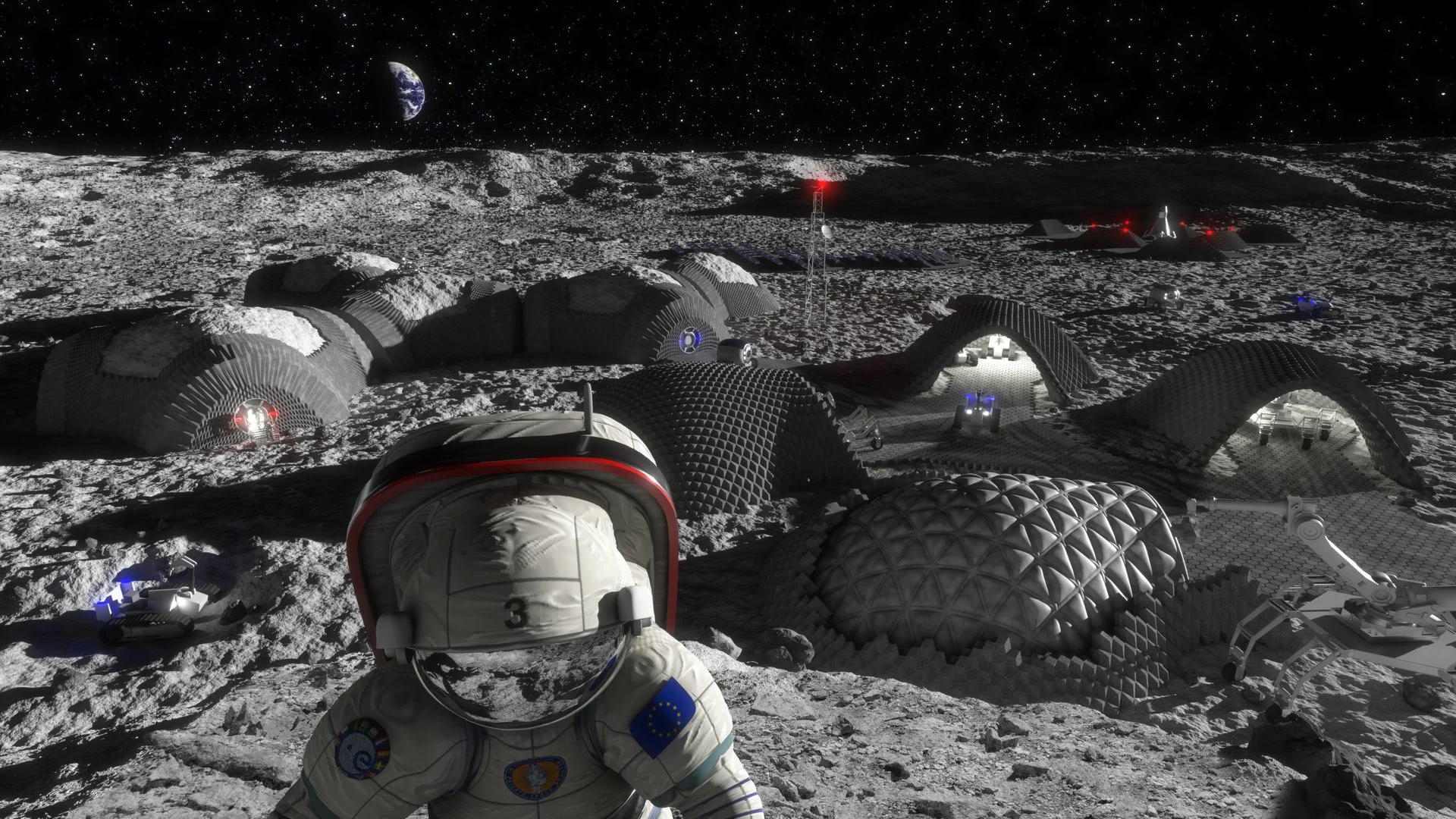
A vision of a future Moon base that could be produced and maintained using 3D printing. Credit: ESA/RegoLight/Liquifer Systems Group *A vision of a future Moon base that could be produced and maintained using 3D printing. Credit: ESA/RegoLight/Liquifer Systems Group*

The team recently completed a DARPA-funded research phase focused on a manufacturing process known as laser forming. This process uses lasers to bend materials without physical contact, and the team investigated how atmospheric conditions would affect its performance. This is a vital question, given that the technology is part of a larger effort to establish space manufacturing in orbit and on other celestial bodies with very tenuous atmospheres (such as the Moon).

Laser forming offers many opportunities for building in space because it is lightweight and flexible, thereby reducing the cost of launching components. In short, the process uses concentrated infrared lasers (heat) to bend materials into new shapes without molds, heavy machinery, or direct physical force. During the research phase, the team tested the technology on lunar regolith and rock simulant, which proved highly successful in bending lunar glass.

As Miller stated in a UF News release, this helps overcome the limitations of conventional construction, which are far more significant in space:

So when we build things on Earth, we have machinery. And just massive amounts of machinery and weight and volume are not really constraints when we’re doing conventional manufacturing on Earth. If we have to take tools, tools are heavy, and they are big, and it costs a ton of money and a ton of resources just to get stuff into space. One of the experiments that we did, was having a collaborator make a piece of glass out of lunar soil simulant. And then we used our laser bending technology to bend the lunar glass.

This technology is very much in line with the philosophy of In-Situ Resource Utilization (ISRU), where local resources are leveraged to reduce reliance on heavy payloads and resupply missions. With laser forming and other 3-D printing methods, astronauts would be able to fabricate building materials on-site rather than sending heavy prefabricated structures from Earth. The team is also exploring how laser forming could expand manufacturing possibilities beyond traditional materials.
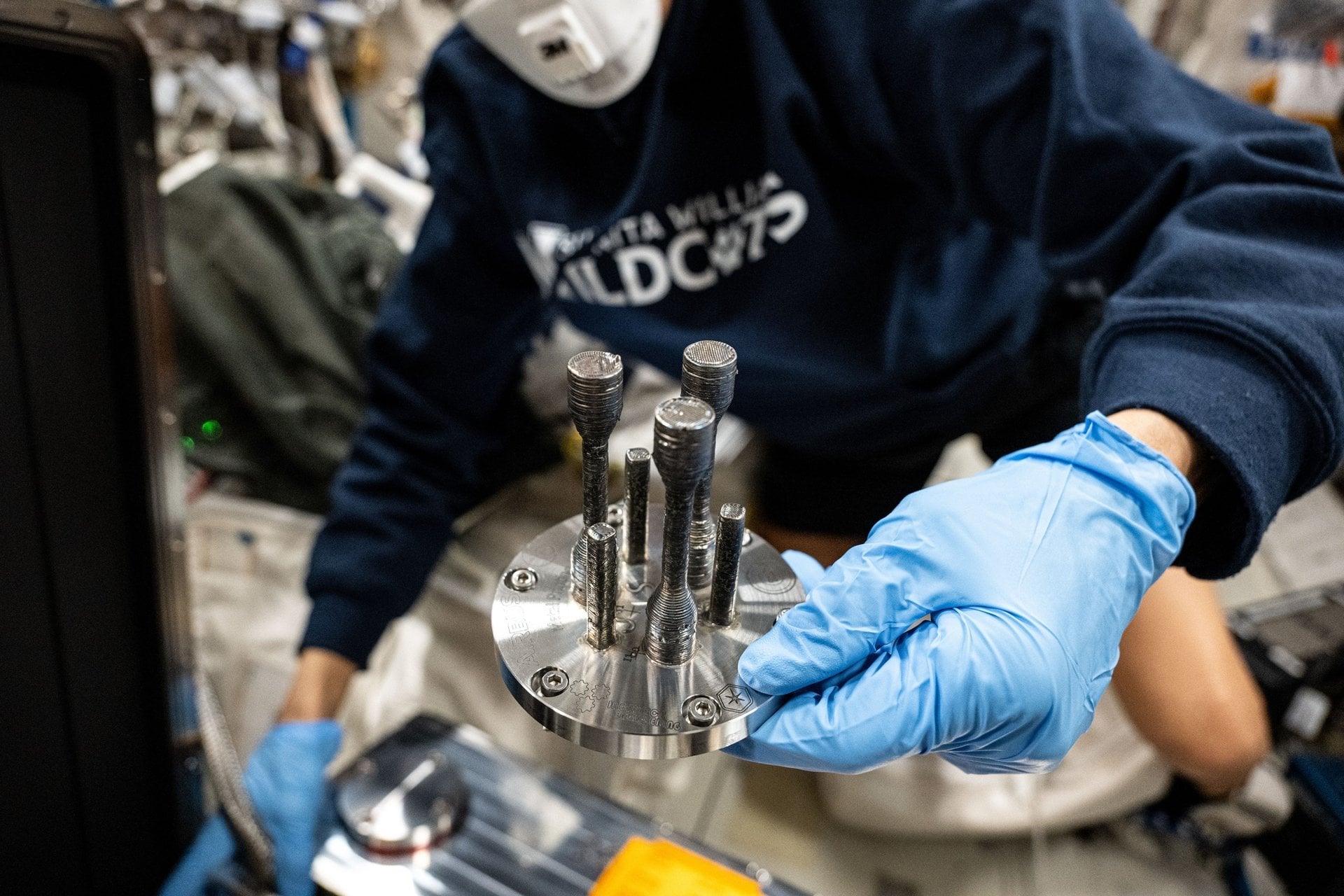
In 2024, the ESA's Metal 3D Printer aboard ISS produced the first metal part ever created in space. Credit: ESA *In 2024, the ESA's Metal 3D Printer aboard ISS produced the first metal part ever created in space. Credit: ESA*

Such capabilities could present new opportunities for in-space manufacturing, where traditional tools are impractical. According to Miller, the project reflects the University's expanding role in space research and a broader, collaborative, future-oriented vision:

The thing that I’m most excited about is that we can bend basically anything. I haven’t found a material that we can’t bend yet, even glass. I think that this research reflects the direction of space research at UF because it is collaborative and future-looking. Looking at how we can build things on the moon, build things on Mars, and how we can actually make sure that astronauts stay safe and healthy.

Laser forming could also allow astronauts to manufacture tools and replacement parts in orbit or on the Moon, eliminating the need for transporting large amounts of both from Earth. As astronauts who have lived and worked aboard the International Space Station (ISS) will attest, if something breaks down in space, it is burdensome to carry multiple spares for every part. The same applies to tools, which are required for regular maintenance and are sorely missed when they break and run out.

In keeping with the philosophy that "Solving for space solves for Earth," the technology also has applications beyond space exploration, potentially supporting flexible manufacturing on Earth. As Miller indicated, the UF team is also focused on flexible manufacturing for defense applications, but that is only one of many possible uses for the technology. Quite literally, any form of manufacturing could benefit from this technology, including housing construction.

Amid continued population growth and the specter of Climate Change, lightweight, flexible forms of fabrication that are also more efficient than traditional methods would be a boon for all concerned.

Related: - Laser-Based 3D Printing Could Build Future Bases on the Moon - Metal is 3D Printed on the Space Station, - 3-D Printing on the Moon. From Regolith to Paste to Useful Objects and Structures - NASA Tests Prototype 3D Printed Titanium Spring in Space

Further Reading: UF News