
惯性聚合 高效追踪和阅读你感兴趣的博客、新闻、科技资讯
阅读原文 在惯性聚合中打开

推荐订阅源

H
Hackread – Cybersecurity News, Data Breaches, AI and More
让小产品的独立变现更简单 - ezindie.com
V
V2EX
T
The Blog of Author Tim Ferriss
腾讯CDC
Hugging Face - Blog
Hugging Face - Blog
雷峰网
雷峰网
爱范儿
爱范儿
GbyAI
GbyAI
H
Help Net Security
I
InfoQ
罗磊的独立博客
酷 壳 – CoolShell
酷 壳 – CoolShell
钛媒体:引领未来商业与生活新知
钛媒体:引领未来商业与生活新知
cs.AI updates on arXiv.org
人人都是产品经理
人人都是产品经理
J
Java Code Geeks
Microsoft Security Blog
Threat Intelligence Blog | Flashpoint
N
Netflix TechBlog - Medium
Last Week in AI
Last Week in AI
宝玉的分享
宝玉的分享
云风的 BLOG
云风的 BLOG
Project Zero
Project Zero
P
Privacy & Cybersecurity Law Blog
A
Arctic Wolf
Know Your Adversary
Know Your Adversary
G
Google Developers Blog
freeCodeCamp Programming Tutorials: Python, JavaScript, Git & More
T
Tor Project blog
V
Vulnerabilities – Threatpost
Y
Y Combinator Blog
WordPress大学
WordPress大学
V
Visual Studio Blog
博客园_首页
G
GRAHAM CLULEY
K
Kaspersky official blog
T
Tailwind CSS Blog
T
Threat Research - Cisco Blogs
博客园 - Franky
D
Docker
Security Latest
Security Latest
I
Intezer
有赞技术团队
有赞技术团队
Application and Cybersecurity Blog
博客园 - 【当耐特】
B
Blog RSS Feed
T
The Exploit Database - CXSecurity.com
cs.CV updates on arXiv.org
OSCHINA 社区最新新闻
OSCHINA 社区最新新闻

News and Events Feed by Topic

Back to Basics: Foundational Cybersecurity Practices for Small Businesses Securing AI Data Center: Architecture, Security Posture, and Emerging Standards New NCCoE Project: Asset Management and Visibility for Operational Technology (OT) Environments NIST Guidelines for Secure Remote Access in Water and Wastewater Systems NIST Workshop on Hardware CPE and CVSS Updates NCCoE Two-Pager Now Available: Effective OT Backup Management The Department of Commerce’s CHIPS Program Announces a Letter of Intent with Coherent for up to $50 Million to Expand Indium Phosphide Production Now Available: Practical Guidelines for Preventing and Mitigating Ransomware NIST NCCoE Genomic Data PETs Testbed & Dioptra Webinar NIST Mathematical Proof Supports Transition to a Continuous-Monitor-and-Update Security Model for AI Systems NCCoE Cybersecurity Connections Event: Accelerating the Adoption of Mobile Driver's Licenses NIST Expands AI Consortium’s Scope, Calls for New Members Now Available: NIST SP 1800-41, Responding to and Recovering from a Cyber Attack NCCoE Manufacturing Project Update NIST NCCoE Cyber AI Profile Virtual Working Session Series: Usability of the Profile Draft PNT Profile Updated to Align with NIST CSF 2.0 NIST NCCoE Cyber AI Profile Virtual Working Session Series: Extending the Technical Content CAISI Signs Agreements Regarding Frontier AI National Security Testing With Google DeepMind, Microsoft and xAI NIST NCCoE Cyber AI Profile Virtual Working Session Series: Updates to Profile Elements and Contents NICE Releases NICE Framework Components v2.2.0 Adoption of Mobile Driver’s Licenses for Financial Institutions Webinar NIST Updates NVD Operations to Address Record CVE Growth New Publication: Automation of the NIST Cryptographic Module Validation Program NIST Workshop on AI Incident Management Cybersecurity for IoT Workshop: Future Directions New Live Guidelines for Secure Software Development, Security, and Operations Practices Workshop on Blockchain and Distributed Ledger Technologies Improving the Nation’s Cybersecurity - an Open Forum NIST Guidelines on Implementing Mobile Driver’s Licenses for Financial Institutions NICE Webinar: Beyond Technical Skills - The Human Element of a Cyber Career Artificial Intelligence (AI) for Manufacturing Workshop Safeguarding Health Information: Building Assurance through HIPAA Security 2026 Workshop on Blockchain and Distributed Ledger Technologies 2026 Time and Frequency Seminar NCCoE Project Portfolio Webinar MLXN: Machine Learning for X-ray and Neutron Scattering Comment Now: Draft Guidelines on Data Classification Practices Technologies and Use Cases for Smart Standards NIST Allocates Over $3 Million to Small Businesses Advancing AI, Biotechnology, Semiconductors, Quantum and More Building the Strategic Supply Chain Network Iris Experts Group Annual Meeting New Concept Paper on Identity and Authority of Software Agents SUSHI@NIST: Rolling Next-Generation Secure Hardware into Standards Now Available! Transit Cybersecurity Framework Community Profile Now Available: NIST NCCoE Project Portfolio Cyber AI Workshop #2 NIST Launches Centers for AI in Manufacturing and Critical Infrastructure Apply on USAJobs: Open CAISI Position for an AI Research Scientist Securing Smart Speakers for Home Health Care: NIST Offers New Guidelines Secure Software Development Framework (SSDF) Version 1.2 is Available for Public Comment Just Published! Final NIST Telehealth Smart Home Integration Cybersecurity White Paper Draft NIST Guidelines Rethink Cybersecurity for the AI Era Comment & Save the Date Now! NIST Cyber AI Profile Preliminary Draft & Workshop Final NCCoE IoT Secure Onboarding Publications Now Available! Mobile Driver’s License Project Update Webinar NCCoE Cybersecurity Connections – Strengthening the Cybersecurity Workforce New Draft White Paper | PQC Migration: Mappings to Risk Framework Docs Now Available: NIST Final SP 1800-37, Addressing Visibility Challenges with TLS 1.3 NIST Awards More Than $3 Million to Support Cybersecurity Workforce Development Across 13 States Feedback Requested: NIST Cryptographic Module Validation Program White Paper New NIST NCCoE Mobile Drivers Licenses Project Resources Now Available! CSF 2.0 Webinar Series: Deep-Dive into the CSF 2.0 Govern Function to Improve Cybersecurity Final Publication Available: NIST IR 8523, Multi-Factor Authentication for Criminal Justice Information Systems Federal Investments in IoT Infrastructure Offer 10-20x Return, NIST Study Finds Final NIST IR 8349 Released: Characterize & Secure Your IoT Devices NIST Revises Security and Privacy Control Catalog to Improve Software Update and Patch Releases We Want Your Feedback! Developing a Transit Cybersecurity Framework Community Profile Advances in Automation of Quantum Dot Devices Control NIST Awards Over $1.8 Million to Small Businesses Advancing AI, Semiconductors, Additive Manufacturing and More NIST Researchers Demonstrate that Superconducting Neural Networks Can Learn on Their Own STPPA8: Special Topics on Privacy and Public Auditability — Event 8: Experimenting with Privacy-Enhancing Cryptography (PEC) Implementations NIST Finalizes ‘Lightweight Cryptography’ Standard to Protect Small Devices NIST Releases Test Tools to Accelerate Adoption of Emerging Route Leak Mitigation Standards Second Seminar on Building an In-Space Circular Economy Lessons Learned from the Consortium: Tool Use in Agent Systems
Empowering Future Innovators: NIST CTL Connects Cybersecurity Students with Real-World Research
2025-08-19 · via News and Events Feed by Topic
Empowering Future Innovators: NIST CTL Connects Cybersecurity Students with Real-World Research

As digital infrastructure increasingly influences our daily lives, the National Institute of Standards and Technology (NIST) is committed to advancing cybersecurity research while also inspiring the next generation of STEM talent. Recently, the NIST Communications Technology Laboratory (CTL) hosted high school students from the St. Vrain Valley School District Innovation Center in Longmont, Colorado, offering them a unique behind-the-scenes tour of the federal research environment that is shaping the future of secure communications.

These students, enrolled in a dedicated cybersecurity track at the Innovation Center, are tackling real-world challenges by applying the NIST Cybersecurity Framework (CSF) to help local businesses strengthen their cybersecurity readiness. Their visit to the NIST Boulder campus served as a capstone experience bridging the gap between classroom learning and the tangible applications of cybersecurity science.
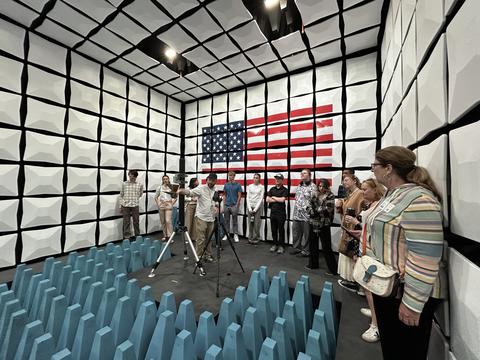
STEM Students in the National Broadband Interoperability Testbed (NBIT)

During their visit, students explored the breadth and complexity of CTL cybersecurity research. A highlight of the day was a hands-on demonstration in the National Broadband Interoperability Testbed (NBIT), a radio frequency anechoic chamber run by CTL. There, researcher Lee Evans showcased how CTL uses the chamber to simulate and study wireless environments to detect anomalies that may indicate performance issues or security threats. The session provided a clear link between theoretical concepts and experimental work, highlighting how CTL research directly supports public safety, national standards, and scalable cybersecurity solutions.

Beyond technology, the visit underscored the human dimension of research. CTL staff shared personal career journeys and highlighted how students can pursue internships, research apprenticeships, and entry-level positions at NIST. For many students, this was their first exposure to the idea that federal research institutions like NIST are accessible, collaborative, and committed to developing early-career talent.

The collaboration with the Innovation Center reflects the CTL mission to advance secure, interoperable communications while cultivating curiosity and understanding in emerging areas of science and technology. By engaging students in real-world research settings, CTL helps illuminate the pathways from classroom learning to scientific discovery, encouraging young minds to explore the role they might play in shaping the future of cybersecurity.

As the cybersecurity landscape becomes more complex, initiatives like this are essential. These engagements offer students meaningful insight into how scientific research informs real-world solutions, highlighting the broader significance of their academic interests. CTL continues to demonstrate how research, mentorship, and public service can converge to create meaningful impact by opening its doors to the next generation of innovators. 

To learn more, visit the  NIST Cybersecurity Framework (CSF) webpage.