


惯性聚合 高效追踪和阅读你感兴趣的博客、新闻、科技资讯
阅读原文 在惯性聚合中打开

推荐订阅源

B
Blog
C
Check Point Blog
The GitHub Blog
The GitHub Blog
Y
Y Combinator Blog
SecWiki News
SecWiki News
有赞技术团队
有赞技术团队
Latest news
Latest news
D
DataBreaches.Net
Blog — PlanetScale
Blog — PlanetScale
Project Zero
Project Zero
H
Help Net Security
Cyber Security Advisories - MS-ISAC
G
GRAHAM CLULEY
Engineering at Meta
Engineering at Meta
T
Threat Research - Cisco Blogs
腾讯CDC
P
Proofpoint News Feed
L
LINUX DO - 热门话题
C
Cisco Blogs
P
Palo Alto Networks Blog
Vercel News
Vercel News
P
Privacy International News Feed
爱范儿
爱范儿
Scott Helme
Scott Helme
L
Lohrmann on Cybersecurity
MyScale Blog
MyScale Blog
K
Kaspersky official blog
B
Blog RSS Feed
美团技术团队
Microsoft Security Blog
O
OpenAI News
博客园 - 叶小钗
量子位
T
Tenable Blog
C
Cybersecurity and Infrastructure Security Agency CISA
J
Java Code Geeks
Application and Cybersecurity Blog
Hacker News: Ask HN
Hacker News: Ask HN
OSCHINA 社区最新新闻
OSCHINA 社区最新新闻
L
LINUX DO - 最新话题
F
Fortinet All Blogs
N
News | PayPal Newsroom
The Hacker News
The Hacker News
C
CXSECURITY Database RSS Feed - CXSecurity.com
cs.CV updates on arXiv.org
博客园 - 【当耐特】
N
News and Events Feed by Topic
V
Visual Studio Blog
Google DeepMind News
Last Week in AI
Last Week in AI

VMware Blogs

Diagnostics for VMware Cloud Foundation (VCF) 9.1 with Old Versions of VCF Components Mastering Infrastructure Policies in VMware Cloud Foundation Automation 9.1 Modernizing the Private Cloud: Why VCF 9.1 Lifecycle Management is a Game Changer Announcing the VMware Cloud Foundation 9.1 Upgrade Planning Tool VCF Breakroom Chats Episode 86 – Containers Made Easy: The New “Container-as-a-Service” in VCF 9.1 Securing Your VCF 9.1 Infrastructure with the Symantec Identity Security Platform Virtually Speaking: The AI Reality Check with Dave Linthicum Zero Touch Provisioning: Activating Edge Sites with VMware Cloud Foundation Edge 9.1 VCF Breakroom Chats Episode 85 – Cloning Success at Scale: Inside VCF 9.1’s App Stack Formation VMware Cloud on AWS の使用状況を確認できる API Unlocking the Full Potential of Programmable Infrastructure with VMware Cloud Foundation 9.1 – New Features and Capabilities Smarter Patching at Scale: Vulnerability Assessment and Remediation with VMware Tanzu Platform Encrypted vMotion Offload to Intel QAT in VMware Cloud Foundation 9.1 Deepen Your Expertise: Four Key Benefits of Attending Increase Deployment Flexibility with VCF Edge Automation 1.0.3 Avi Advantage: Automating Certificate Management of VCF Workloads More Memory, Less Effort: Configuring Memory Tiering in VCF 9.1 VCF 9.1 Licensing: Programmatic, Centralized, and Built to Scale Why APJ Networking Professionals Need Private Cloud Expertise VCF 9.1 Networking: Simpler VPC Connectivity Control VCF 9.1 Networking: Exploring Network Services for Virtual Private Clouds VCF Networking 9.1: Seamless DDI Integration with Infoblox The Open Source Advantage: Building from Source for Ultimate Security Expand Shared VMDKs with Clustered Applications in VMware vSAN for VCF 9.1 Monetizing Zero-Trust Security with VCF 9.1 and VMware vDefend VMware vSAN Protection and Recovery Enhancements for VCF 9.1 Deliver Production SQL Server DBaaS with VMware Data Services Manager 9.1 Maximizing Profitability: VCF 9.1 Cost-Focused Approach for VMware Cloud Service Providers Modernizing Your Infrastructure: Introducing VMware Cloud Foundation 9.1 to VCSPs VCF 9.1 is Available: Explore the New Features in Hands-on Labs What’s New with vSphere in VMware Cloud Foundation 9.1? Resizing VMware vCenter in VMware Cloud Foundation 9 Non-Disruptive VMware vCenter Patching in VMware Cloud Foundation 9.1 VMware vCenter Virtual Hardware Gets an Upgrade in vSphere with VCF 9.1 AI Has Changed the Threat Landscape. Is Your Infrastructure Ready? Simplifying Storage with the New Effective Capacity View in VMware vSAN for VCF 9.1 Auto-RAID in VMware vSAN for VCF 9.1 – Comprehensive System-Managed Data Resilience Introducing VMmark 4.1: Enhanced Power Efficiency Benchmarking for Private Cloud Infrastructure Advanced Memory Tiering Enhancements in VMware Cloud Foundation 9.1 VCF 9.1 Is Here. See It in Action. 博通發布 VMware Cloud Foundation 9.1 How Broadcom Is Helping Enterprises Win the AI Security Sprint How to Prepare for the World of AI Driven Exploits Avi Innovations for VCF 9.1: Powering Kubernetes, Agentic AI and VPC Workloads Announcing VCF 9.1: Modern Private Cloud Built for Efficiency and Resilience Announcing VMware Cloud Foundation Edge 9.1: A Scalable, Autonomous Edge Platform Accelerate, Streamline, and Control Your Self-Service Private Cloud with VMware Cloud Foundation 9.1 Deploy Modern Apps Faster, Scale Smarter, and Lower Your TCO with VMware vSphere Kubernetes Service in VCF 9.1 Scale Smarter, Save More: Redefining Infrastructure Economics with VMware vSphere in VCF 9.1 AI with VCF 9.1 on AMD GPUs: Build with open frameworks and simplify management, at a lower TCO Streamline, Simplify and Protect all your AI workloads with VCF 9.1 Simplify Workload Connectivity and Enhance Network Scale and Performance with VCF 9.1 VMware and CrowdStrike Deliver New Integration for Cyber Recovery Workflows How Many Users Can Your LLM Server Really Handle? From Infrastructure to Agents: A Hands-On Guide to Secure Private AI with Broadcom – Part 2 The New Frontier: Leading the Cloud-Native Evolution Replicating VMware vSphere Configuration Profile Desired State Webinar Recap: Design and Architecture Considerations for VMware vSphere Kubernetes Service on VMware Cloud Foundation Kubernetes 1.36: What Actually Changed for Enterprise Platforms Enhance Lateral Security and Ingress Load Balancing for Kubernetes Workloads Avi Load Balancer Analytics: Root Cause Application Performance Issues in Minutes Analyst Insight Series #3: Policy-Driven Governance and Multi-Tenant Control Post-Quantum Readiness on VMware Cloud Foundation Registration Is Live for Las Vegas | $ave with Early-Bird May 21, 2026: What’s New in VMware Tanzu Data Intelligence 10.4 From Infrastructure to Agents: A Hands-On Guide to Secure Private AI with Broadcom – Part 1 Stop Guessing: Advanced Monitoring and Troubleshooting for Data Services CPU, Disk, Network, and Memory Workload Profiles for DVD Store Database Testing How VMware Salt Automates Compliance Across Private Cloud Analyst Insight Series #2: Operational Scalability and Lifecycle Management MCP vs. APIs: Why You Need Both for AI Applications The Real Constraint on Enterprise AI isn’t GPUs; It’s Power Deploying Harbor Service in Air-Gapped VMware Cloud Foundation 9.0 Why Enhanced DirectPath Wins for High-Performance Apps Bridging the (.Local) Gap: A Split-Domain Design for VMware Cloud Foundation Deployment Observability on VMware vSphere Kubernetes Service VMware Cloud on AWS: Introducing the Usage Report APIs Converging VMware vSphere to VMware Cloud Foundation 9.0: The Top 10 Questions Answered May 6, 2026: What’s New in Tanzu Platform 10.4: Powering Agentic Apps at Scale VMware Tanzu RabbitMQ Powers the Modern Data Lakehouse with New Spark Integration and Enterprise Tooling Tanzu Data Intelligence 10.4 Delivers AI-Driven Analytics, Unified Real-Time Operations, and Sovereign Resilience Enterprise-Ready Agents Made Simple & Safe with VMware Tanzu Platform Agent Foundations Introducing Tanzu Platform 10.4: Extending Platform as a Service to Agentic Applications How AI-Assisted Analytics in Tanzu Data Intelligence Can Help Remove the SQL Bottleneck From Prototype to Production: Securing Database MCP at Enterprise Scale The Compelling Case for a Private Cloud Data Intelligence Platform The Unification Dividend: Consolidating Database Operations on VMware Cloud Foundation The Modern Spring Workflow Is Enterprise-Ready and AI-Boosted [TAM Blog] セキュアブート証明書の有効期限切れに関する注意点と対応について Accelerate Lateral Security and Ingress Load Balancing for Kubernetes Workloads From Platform to Data: Building a Cloud-Native Developer Experience On-Prem with VMware Cloud Foundation How VMware Cloud Foundation (VCF) Training Helps Keep Top Tech Talent in APJ Build Your Case for Attending VMware Explore 2026 Spring 開発元が提供する商用サポート「VMware Tanzu® Spring Essentials」とは VMware Cloud on AWS より i7i.metal-24xl インスタンスの提供開始 VMware Advanced Memory Tiering Tips for Success VMware Cloud Foundation Edge 9.0: Two-Host Edge Site Deployment with Brownfield Import Your Database Is About to Become an AI Tool. Is It Ready? Applying GitOps Principles to Maintain Desired State Configuration using VMware vSphere Configuration Profile – Part 3 Webinar Recap: Converging VMware vSphere to VMware Cloud Foundation 9.0
VCF 9.1: The Secure, Cost-Effective Private Cloud Platform for Production AI
sabina anja · 2026-05-05 · via VMware Blogs

Today, Broadcom announced VMware Cloud Foundation (VCF) 9.1, the next milestone in the evolution of the industry’s most widely deployed private cloud platform. 

VCF 9.1 is a focused release with a clear ambition: to be the most cost-effective and secure foundation for production AI, modern applications, and traditional workloads—operated under a single control plane, on infrastructure the enterprise owns and governs.

This release arrives at a moment when the demands on enterprise infrastructure have rarely been higher, or more contradictory. Understanding why VCF 9.1 works the way it does requires a brief look at the forces shaping every IT roadmap in 2026, and at the architectural choices those forces now demand.
Three Forces Reshaping IT in 2026

Three forces are defining and even redefining an IT operating environment for which VCF 9.1 was purposely built.

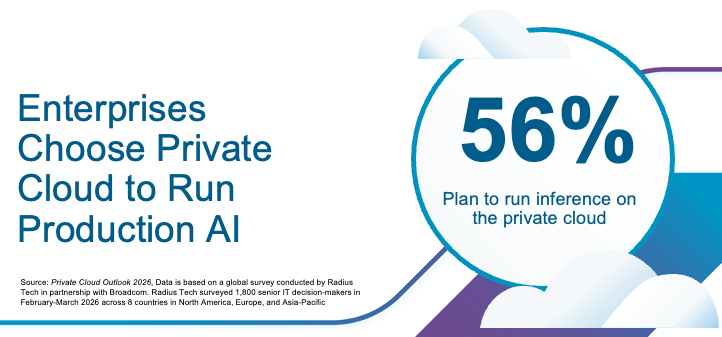
The first is AI demand, which is now being embedded in many day to day applications and operations. IDC forecasts worldwide AI spending will grow at a 31.9% CAGR through 2029, reaching $1.3 trillion and exceeding 26% of total worldwide IT spending. This is a structural reallocation of the enterprise technology budget toward AI-enabled applications and the platforms that run them. PwC’s 2025 Global AI Jobs Barometer, based on analysis of close to a billion job ads across six continents, finds that productivity growth in industries most exposed to AI has nearly quadrupled since 2022.

The second is geopolitical gravity which compounds AI security issues. Data sovereignty regulations, export controls on accelerators, and fragmented regional compliance regimes have made workload location a board-level question. Default reliance on a public cloud, and a public cloud-only infrastructure is a questionable choice in 2026.

The third is budget compression. AI leaders achieve meaningful cost reductions precisely because they treat infrastructure efficiency as a first-class discipline. The rest of the market is being asked to fund AI ambitions out of flat or shrinking operating budgets.
VMware Cloud Foundation 9.1 at a Glance

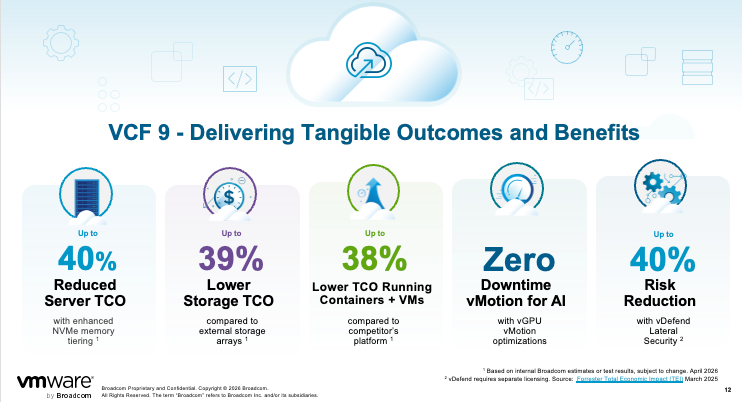
VMware Cloud Foundation 9.1 is engineered to address these market pressures: a private cloud platform designed to run production AI at the lowest cost per workload, under enterprise sovereignty, without compromising security or delivery velocity.

Efficient Infrastructure and Operations at Scale

Customers are running denser, more demanding workloads—AI inference, GPU pipelines, large in-memory databases—while being asked to do more with the same infrastructure budget. VCF 9.1 responds on two fronts: drive down cost per workload, and make operating at scale less painful.

To reduce cost, Enhanced NVMe Memory Tiering extends effective memory pools by intelligently tiering DRAM and NVMe—a direct answer to memory-bound AI and database workloads. Extended vSAN Dedup and Compression lowers cost per usable terabyte, Topology Aware Scheduling places workloads with NUMA and accelerator locality in mind, and Ubuntu OS Enterprise Support broadens the workload ecosystem without added overhead.

On the operations side, Real-Time Operational Observability turns telemetry into action, increased VMware vSphere Kubernetes Service (VKS) scale raises the Kubernetes ceiling, vSphere Elastic Provisioning enables zero-touch fleet expansion, and expanded Fleet Size and Upgrade Scale let a single VCF instance govern larger estates with fewer maintenance windows. 

Our feature blogs will cover the full 9.1 payload in detail.

The overall outcome: more workloads per rack, fewer operators per thousand workloads, and a measurable reduction in cost-to-serve.

High-Velocity Application Delivery

A modern platform in the AI era is tasked to deliver VMs, containers, AI services, and data services with equal fluency. VCF 9.1 closes that gap and delivers this important requirement.

VKS and VM Fast-Deploy materially shortens time-to-running for both Kubernetes and VM workloads. Simplified Container-as-a-Service turns VKS into a true self-service surface for application teams. Native Object Storage (tech preview in version 9.1.x) brings S3-compatible storage natively into the platform Tanzu Marketplace integration provides a curated path to certified middleware and data services, and SQL Server DBaaS elevates the most-deployed enterprise database to a first-class citizen of the private cloud control plane.

For AI specifically, Private AI Model and GPU Metrics expose the telemetry platform and MLOps teams require: utilization, memory pressure, and model-level visibility on the same console as the rest of the estate. Live Application Stack Blueprints enable teams to version and redeploy entire application topologies as code.

The outcome: one platform and one operating model—from a legacy three-tier application to a RAG pipeline running on the latest AMD GPUs.

Cyber Resilience and Data Security

In VCF 9.1, resilience is treated as an architectural property. vSAN for Recovery and On-prem Ransomware Recovery provide a sovereign, in-platform path to recover from destructive attacks without dependence on external escrow. Encrypted vMotion with Intel QAT offloads cryptography to dedicated silicon, removing the historical performance tax on end-to-end encryption in motion. Continuous Compliance Enforcement transforms compliance from a quarterly audit exercise into a runtime guarantee.

On platform security, Live Patching for TPM-Enabled Hosts eliminates one of the largest sources of unplanned downtime in large estates. Self-Service Lateral Security and Automated Load Balancing place micro-segmentation and traffic management in application-team hands, governed by central guardrails. The CrowdStrike EDR integration for Ransomware Recovery gives customers additional choice for endpoint detection  in the recovery workflow.

The outcome: recovery, patching, and compliance shift from periodic events on the operations calendar to continuous properties of the platform. This is incredibly important when you are running sensitive data and high-value AI models and need security by design, not by exception.
Open Platform and Ecosystem Flexibility

Ecosystem integration is incredibly important in VCF 9.1. It is a transversal design principle. No enterprise of meaningful scale runs a single-vendor estate, therefore, VCF 9.1 is engineered to make the customer’s existing hardware, fabric, and framework choices interoperate under one operating model. Three capabilities in this release make that posture concrete.

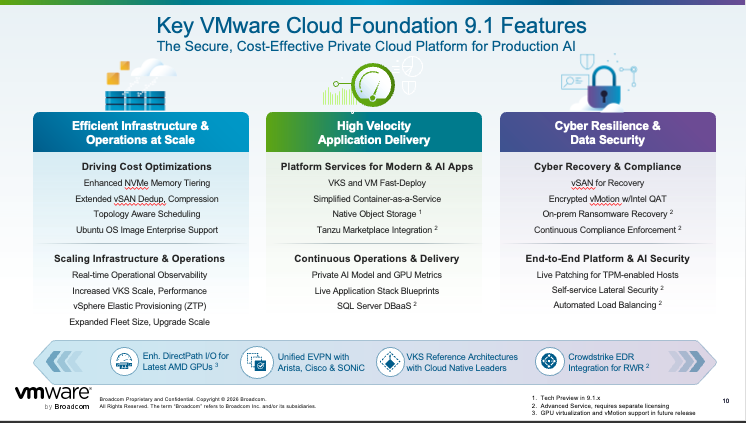
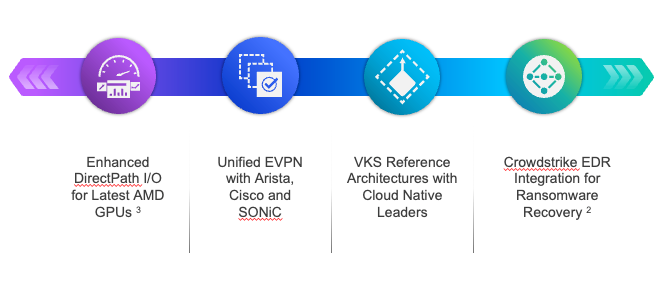
Enhanced DirectPath I/O for the latest AMD GPUs extends near-bare-metal accelerator performance to the newest generation of AMD silicon.

Unified EVPN with Arista, Cisco, and SONiC delivers a consistent overlay fabric across the three dominant data center networking stacks—including the open-source option that hyperscalers have legitimized for the enterprise. Network teams get one operating model regardless of which switch vendor sits in which rack, which materially shortens the time required to onboard new sites or absorb acquired estates. 

And finally, the new VKS Reference Architectures with cloud-native ISVs give platform teams a validated starting point.
Next Steps

With VCF 9.1, customers on VCF 9.0 can move via a supported in-place upgrade path; the VCF 9.1 Upgrade Guide and compatibility matrix on the Broadcom support portal are the recommended starting points. Customers earlier in the journey should begin with the VCF 9.1 Reference Architecture library for validated AI, container, and traditional workload designs.

To go deeper:

  • Register to watch the launch webinar starting at 08:00 PST at for an end-to-end walkthrough of the three pillars and a live demonstration of Private AI Model and GPU Metrics.
  • Request an executive briefing to map VCF 9.1 capabilities to enterprise AI and sovereignty roadmaps.
  • Follow the VCF 9.1 technical deep-dive series covering NVMe Memory Tiering, Native Object Storage, On-Prem Ransomware Recovery, and much more.

Discover more from VMware Cloud Foundation (VCF) Blog

Subscribe to get the latest posts sent to your email.