

惯性聚合 高效追踪和阅读你感兴趣的博客、新闻、科技资讯
阅读原文 在惯性聚合中打开

推荐订阅源

T
Threatpost
CTFtime.org: upcoming CTF events
T
The Blog of Author Tim Ferriss
S
SegmentFault 最新的问题
OSCHINA 社区最新新闻
OSCHINA 社区最新新闻
博客园 - 司徒正美
T
Tailwind CSS Blog
The Cloudflare Blog
The Last Watchdog
The Last Watchdog
PCI Perspectives
PCI Perspectives
博客园 - 聂微东
Stack Overflow Blog
Stack Overflow Blog
TaoSecurity Blog
TaoSecurity Blog
云风的 BLOG
云风的 BLOG
C
Cybersecurity and Infrastructure Security Agency CISA
O
OpenAI News
Recorded Future
Recorded Future
GbyAI
GbyAI
www.infosecurity-magazine.com
Y
Y Combinator Blog
D
Darknet – Hacking Tools, Hacker News & Cyber Security
量子位
博客园 - 叶小钗
V
Vulnerabilities – Threatpost
F
Full Disclosure
Recent Announcements
Vercel News
Vercel News
S
Schneier on Security
H
Heimdal Security Blog
Cisco Talos Blog
Cisco Talos Blog
V2EX - 技术
V2EX - 技术
cs.AI updates on arXiv.org
B
Blog RSS Feed
宝玉的分享
宝玉的分享
Exploit-DB.com RSS Feed
P
Privacy & Cybersecurity Law Blog
T
Threat Research - Cisco Blogs
G
Google Developers Blog
C
Cyber Attacks, Cyber Crime and Cyber Security
爱范儿
爱范儿
IT之家
IT之家
大猫的无限游戏
大猫的无限游戏
C
Check Point Blog
N
Netflix TechBlog - Medium
S
Security @ Cisco Blogs
cs.CV updates on arXiv.org
Microsoft Azure Blog
H
Hackread – Cybersecurity News, Data Breaches, AI and More
Threat Intelligence Blog | Flashpoint
Cyberwarzone
Cyberwarzone

VMware Blogs

Diagnostics for VMware Cloud Foundation (VCF) 9.1 with Old Versions of VCF Components Mastering Infrastructure Policies in VMware Cloud Foundation Automation 9.1 Modernizing the Private Cloud: Why VCF 9.1 Lifecycle Management is a Game Changer Announcing the VMware Cloud Foundation 9.1 Upgrade Planning Tool VCF Breakroom Chats Episode 86 – Containers Made Easy: The New “Container-as-a-Service” in VCF 9.1 Securing Your VCF 9.1 Infrastructure with the Symantec Identity Security Platform Virtually Speaking: The AI Reality Check with Dave Linthicum Zero Touch Provisioning: Activating Edge Sites with VMware Cloud Foundation Edge 9.1 VCF Breakroom Chats Episode 85 – Cloning Success at Scale: Inside VCF 9.1’s App Stack Formation VMware Cloud on AWS の使用状況を確認できる API Unlocking the Full Potential of Programmable Infrastructure with VMware Cloud Foundation 9.1 – New Features and Capabilities Smarter Patching at Scale: Vulnerability Assessment and Remediation with VMware Tanzu Platform Encrypted vMotion Offload to Intel QAT in VMware Cloud Foundation 9.1 Deepen Your Expertise: Four Key Benefits of Attending Increase Deployment Flexibility with VCF Edge Automation 1.0.3 Avi Advantage: Automating Certificate Management of VCF Workloads More Memory, Less Effort: Configuring Memory Tiering in VCF 9.1 VCF 9.1 Licensing: Programmatic, Centralized, and Built to Scale Why APJ Networking Professionals Need Private Cloud Expertise VCF 9.1 Networking: Simpler VPC Connectivity Control VCF 9.1 Networking: Exploring Network Services for Virtual Private Clouds VCF Networking 9.1: Seamless DDI Integration with Infoblox The Open Source Advantage: Building from Source for Ultimate Security Expand Shared VMDKs with Clustered Applications in VMware vSAN for VCF 9.1 Monetizing Zero-Trust Security with VCF 9.1 and VMware vDefend VMware vSAN Protection and Recovery Enhancements for VCF 9.1 Deliver Production SQL Server DBaaS with VMware Data Services Manager 9.1 Maximizing Profitability: VCF 9.1 Cost-Focused Approach for VMware Cloud Service Providers Modernizing Your Infrastructure: Introducing VMware Cloud Foundation 9.1 to VCSPs VCF 9.1 is Available: Explore the New Features in Hands-on Labs What’s New with vSphere in VMware Cloud Foundation 9.1? Resizing VMware vCenter in VMware Cloud Foundation 9 Non-Disruptive VMware vCenter Patching in VMware Cloud Foundation 9.1 VMware vCenter Virtual Hardware Gets an Upgrade in vSphere with VCF 9.1 AI Has Changed the Threat Landscape. Is Your Infrastructure Ready? Simplifying Storage with the New Effective Capacity View in VMware vSAN for VCF 9.1 Auto-RAID in VMware vSAN for VCF 9.1 – Comprehensive System-Managed Data Resilience Introducing VMmark 4.1: Enhanced Power Efficiency Benchmarking for Private Cloud Infrastructure Advanced Memory Tiering Enhancements in VMware Cloud Foundation 9.1 VCF 9.1 Is Here. See It in Action. 博通發布 VMware Cloud Foundation 9.1 How Broadcom Is Helping Enterprises Win the AI Security Sprint How to Prepare for the World of AI Driven Exploits Avi Innovations for VCF 9.1: Powering Kubernetes, Agentic AI and VPC Workloads VCF 9.1: The Secure, Cost-Effective Private Cloud Platform for Production AI Announcing VCF 9.1: Modern Private Cloud Built for Efficiency and Resilience Announcing VMware Cloud Foundation Edge 9.1: A Scalable, Autonomous Edge Platform Accelerate, Streamline, and Control Your Self-Service Private Cloud with VMware Cloud Foundation 9.1 Deploy Modern Apps Faster, Scale Smarter, and Lower Your TCO with VMware vSphere Kubernetes Service in VCF 9.1 Scale Smarter, Save More: Redefining Infrastructure Economics with VMware vSphere in VCF 9.1 AI with VCF 9.1 on AMD GPUs: Build with open frameworks and simplify management, at a lower TCO Streamline, Simplify and Protect all your AI workloads with VCF 9.1 Simplify Workload Connectivity and Enhance Network Scale and Performance with VCF 9.1 VMware and CrowdStrike Deliver New Integration for Cyber Recovery Workflows How Many Users Can Your LLM Server Really Handle? From Infrastructure to Agents: A Hands-On Guide to Secure Private AI with Broadcom – Part 2 The New Frontier: Leading the Cloud-Native Evolution Replicating VMware vSphere Configuration Profile Desired State Webinar Recap: Design and Architecture Considerations for VMware vSphere Kubernetes Service on VMware Cloud Foundation Kubernetes 1.36: What Actually Changed for Enterprise Platforms Enhance Lateral Security and Ingress Load Balancing for Kubernetes Workloads Avi Load Balancer Analytics: Root Cause Application Performance Issues in Minutes Analyst Insight Series #3: Policy-Driven Governance and Multi-Tenant Control Post-Quantum Readiness on VMware Cloud Foundation Registration Is Live for Las Vegas | $ave with Early-Bird May 21, 2026: What’s New in VMware Tanzu Data Intelligence 10.4 From Infrastructure to Agents: A Hands-On Guide to Secure Private AI with Broadcom – Part 1 Stop Guessing: Advanced Monitoring and Troubleshooting for Data Services CPU, Disk, Network, and Memory Workload Profiles for DVD Store Database Testing How VMware Salt Automates Compliance Across Private Cloud Analyst Insight Series #2: Operational Scalability and Lifecycle Management MCP vs. APIs: Why You Need Both for AI Applications The Real Constraint on Enterprise AI isn’t GPUs; It’s Power Deploying Harbor Service in Air-Gapped VMware Cloud Foundation 9.0 Why Enhanced DirectPath Wins for High-Performance Apps Bridging the (.Local) Gap: A Split-Domain Design for VMware Cloud Foundation Deployment Observability on VMware vSphere Kubernetes Service VMware Cloud on AWS: Introducing the Usage Report APIs Converging VMware vSphere to VMware Cloud Foundation 9.0: The Top 10 Questions Answered May 6, 2026: What’s New in Tanzu Platform 10.4: Powering Agentic Apps at Scale VMware Tanzu RabbitMQ Powers the Modern Data Lakehouse with New Spark Integration and Enterprise Tooling Tanzu Data Intelligence 10.4 Delivers AI-Driven Analytics, Unified Real-Time Operations, and Sovereign Resilience Enterprise-Ready Agents Made Simple & Safe with VMware Tanzu Platform Agent Foundations Introducing Tanzu Platform 10.4: Extending Platform as a Service to Agentic Applications How AI-Assisted Analytics in Tanzu Data Intelligence Can Help Remove the SQL Bottleneck From Prototype to Production: Securing Database MCP at Enterprise Scale The Unification Dividend: Consolidating Database Operations on VMware Cloud Foundation The Modern Spring Workflow Is Enterprise-Ready and AI-Boosted [TAM Blog] セキュアブート証明書の有効期限切れに関する注意点と対応について Accelerate Lateral Security and Ingress Load Balancing for Kubernetes Workloads From Platform to Data: Building a Cloud-Native Developer Experience On-Prem with VMware Cloud Foundation How VMware Cloud Foundation (VCF) Training Helps Keep Top Tech Talent in APJ Build Your Case for Attending VMware Explore 2026 Spring 開発元が提供する商用サポート「VMware Tanzu® Spring Essentials」とは VMware Cloud on AWS より i7i.metal-24xl インスタンスの提供開始 VMware Advanced Memory Tiering Tips for Success VMware Cloud Foundation Edge 9.0: Two-Host Edge Site Deployment with Brownfield Import Your Database Is About to Become an AI Tool. Is It Ready? Applying GitOps Principles to Maintain Desired State Configuration using VMware vSphere Configuration Profile – Part 3 Webinar Recap: Converging VMware vSphere to VMware Cloud Foundation 9.0
The Compelling Case for a Private Cloud Data Intelligence Platform
2026-04-15 · via VMware Blogs

For the better part of a decade, the enterprise technology mantra was simple and absolute: “Cloud first.” IT leaders were incentivized to migrate everything to the public cloud. However, as the dust settles on this initial rush, a massive pendulum swing is underway. Instead of defaulting to public infrastructure, enterprises are driving a significant wave of workload repatriation directly back to the private cloud and bare-metal environments. 

An article from IDC[1] mentioned that “as the cloud landscape matures, many organizations are finding that the reality of cloud adoption does not always align with their expectations. This in turn has led to a growing trend of repatriating workloads back to on-premises or private cloud environments.”

Why the sudden shift? This strategy we feel is driven by three unavoidable realities.

Unpredictable economics at scale: The variable, egress-heavy billing models of public hyperscalers have strained IT budgets. For persistent, data-heavy workloads—especially those running 24×7—the predictable, fixed-cost nature of private clouds has become highly attractive.

Strict sovereign control and compliance: With tightening global regulations (like GDPR and DORA in the EU, HIPAA in healthcare, and localized data residency laws worldwide), housing critical intellectual property and customer data on third-party multitenant infrastructure can carry immense compliance risk.

Data gravity and sovereign AI: The most valuable enterprise data, decades of transaction logs, customer behavior, and proprietary IP is already sitting on premises. As organizations rush to build agentic, generative AI and retrieval-augmented generation (RAG) applications, they are realizing a hard truth. Moving petabytes of data across the wire to the public cloud to feed an AI model is prohibitively slow, expensive, and a security non-starter.

The new enterprise mandate is clear: Stop moving data! Instead of exporting massive, sensitive datasets to external AI engines, enterprises must run their AI models directly on top of their secure data. In an era of strict regulations and intellectual property risks, establishing robust data intelligence entirely within the private cloud is less of a technical upgrade and more of a strategic necessity.

The demand for a private cloud data lakehouse

To outpace agile, modern-day competitors, enterprises need the agility, self-service capabilities, and unified governance typically associated with public cloud data platforms. But they need it executed strictly behind their own corporate firewalls.

This requires a paradigm shift toward a unified data lakehouse architecture. A private cloud lakehouse blends the massive scale, flexibility, and low-cost storage of a data lake (capable of holding unstructured text, images, and logs) with the high performance, ACID compliance, and advanced querying capabilities of a traditional data warehouse. 

More importantly, it provides a unified federated layer where structured, semi-structured, and unstructured data can be queried in place, minimizing the ETL needs and eliminating the need to constantly move data around to make sense of it.

Confronting unpredictable economics, strict compliance mandates, and data fragmentation requires a new approach and that’s where the private cloud data strategy fundamentally changes. That’s where VMware Tanzu Data Intelligence can help.
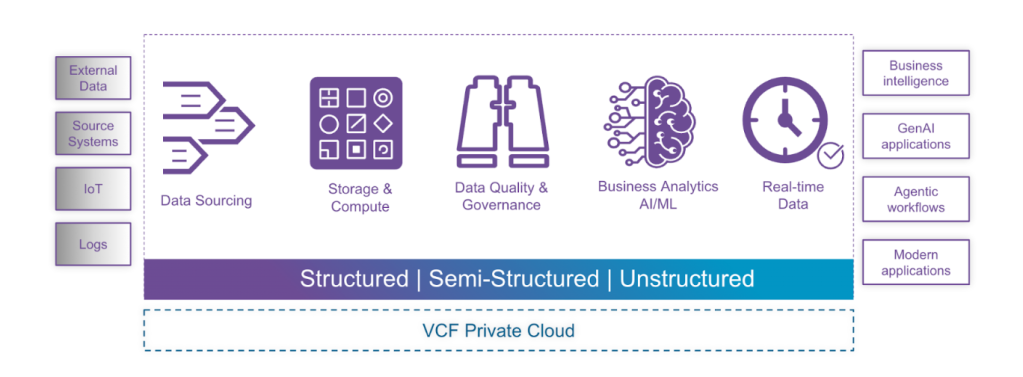
Tanzu Data Intelligence is based on a modern lakehouse architecture

Engineered to work hand in glove on VMware Cloud Foundation (VCF), Tanzu Data Intelligence seamlessly ingests and processes all types of data, whether structured, semi-structured, or unstructured. It works across operational silos by bringing together critical capabilities such as data sourcing, scalable storage, and high-performance compute, along with rigorous data quality and governance. By bridging the gap between real-time data streams and advanced business analytics and AI/ML, Tanzu Data Intelligence serves as the data engine for even the most demanding workloads. Whether you are driving traditional BI, deploying cutting-edge GenAI apps, orchestrating complex agentic workflows, or scaling fast-paced modern apps, Tanzu Data Intelligence delivers the platform required to innovate more securely.

Tanzu Data Intelligence creates the right foundational tools for a unified data intelligence platform. Here are its core components:

  • VMware Tanzu Greenplum – More than just a traditional data warehouse, Tanzu Greenplum is a massively parallel processing (MPP) powerhouse. As the foundation of Tanzu Data Intelligence, it serves as the advanced analytics engine, capable of querying massive datasets and handling complex vector embeddings. Through powerful federated querying, it transforms isolated databases into a single, unified data storage. Your teams can now query data seamlessly across your existing systems without ever having to move it, creating a centralized intelligence layer over your entire fragmented estate.
  • VMware Tanzu GemFire – An ultra-low-latency, in-memory data grid. In the age of AI, Tanzu GemFire acts as the high-speed feature store, serving data to machine learning models in sub-milliseconds. This extreme speed significantly improves the performance of mission-critical applications, enabling business-critical processes such as real-time credit card fraud detection to execute instantly, and helping high-throughput transactional apps keep customers waiting less.
  • VMware Tanzu RabbitMQ and VMware Tanzu Data Flow – The central nervous system for data in motion. Beyond standard messaging, Tanzu RabbitMQ and Tanzu Data Flow together orchestrate complex, real-time streaming pipelines to reduce the latency between operational events and analytical insights. The moment an event occurs, be it a financial transaction or an IoT sensor spike, it is more securely, reliably, and quickly routed to analytics engines and AI models/apps for immediate action.
  • VMware Tanzu for Postgres/VMware Tanzu for MySQL – The rock-solid, enterprise-hardened transactional backbone for mission-critical applications. Under Tanzu Data Intelligence, Tanzu for Postgres and Tanzu for MySQL deliver automated lifecycle management, built-in high availability, and robust disaster recovery. They handle rigorous, high-throughput operational workloads while seamlessly feeding that transactional data upstream into the broader analytical layer.
  • VMware Tanzu Data Lake – The foundational, highly scalable object storage layer designed to capture an enterprise’s entire data footprint. By leveraging open table formats like Apache Iceberg and separating compute from storage, Tanzu Data Lake works across rigid data silos. It acts as the single source of truth, natively accessible by Tanzu Greenplum to train next-generation AI models without relying on fragile, complex ETL pipelines.

Tanzu Data Intelligence can provide the federated query services, security, and governance required to operate multiple data engines as a single system so organizations can make better business decisions. 

Driving strategic use cases in the private cloud

When organizations unify their fragmented analytical engines under Tanzu Data Intelligence, the resulting business outcomes can be entirely transformative. For organizations balancing rapid innovation with strict compliance, this unified approach can unlock unprecedented capabilities. 

With built-in compute services for vector analysis, developers can gain immediate access to the unified data required for next-generation AI use cases and applications. A financial institution, for instance, can securely feed highly sensitive trading histories into a localized LLM to generate instant market insights. Because the platform delivers public-cloud agility while maintaining total sovereign control on VMware Cloud Foundation infrastructure or bare metal, critical intellectual property remains secure with you.

This strategic agility extends directly to the transactional frontline. By combining Tanzu Data Intelligence’s powerful engines, a credit card processor can stream live transaction data, instantly cross-reference massive historical fraud patterns, and execute an authoritative approve-or-deny decision entirely in memory, all before the retail terminal registers the swipe.

Crucially, achieving this sub-millisecond execution does not require ballooning IT budgets. By rationalizing disjointed database sprawl into a single platform, organizations can realize a sizeable reduction in total cost of ownership by slashing third-party licensing costs, minimizing infrastructure overhead, and greatly reducing the administrative toil of custom ETL pipelines.

The path forward

The era of simply managing databases in the data center is over. To escape unpredictable cloud economics, the future belongs to enterprises that can harness true, unified data intelligence behind their own firewalls. 

Tanzu Data Intelligence provides the architectural blueprint to modernize your private cloud and bring compute directly to your data’s center of gravity. By uniting trusted, enterprise data engines under one strategic umbrella, Tanzu Data Intelligence can break down decades of data silos and build the foundation for secure, cost-effective, and powerful AI outcomes – on your terms.

Sources:[1] IDC Blog, Storm Clouds Ahead: Missed Expectations in Cloud Computing, October 28, 2024