



惯性聚合 高效追踪和阅读你感兴趣的博客、新闻、科技资讯
阅读原文 在惯性聚合中打开

推荐订阅源

云风的 BLOG
云风的 BLOG
C
CERT Recently Published Vulnerability Notes
阮一峰的网络日志
阮一峰的网络日志
G
Google Developers Blog
奇客Solidot–传递最新科技情报
奇客Solidot–传递最新科技情报
P
Privacy International News Feed
N
News and Events Feed by Topic
博客园 - Franky
Spread Privacy
Spread Privacy
P
Privacy & Cybersecurity Law Blog
T
Tor Project blog
博客园_首页
Cyber Security Advisories - MS-ISAC
Hugging Face - Blog
Hugging Face - Blog
P
Proofpoint News Feed
博客园 - 叶小钗
S
Securelist
Stack Overflow Blog
Stack Overflow Blog
The Cloudflare Blog
H
Hackread – Cybersecurity News, Data Breaches, AI and More
V
Vulnerabilities – Threatpost
量子位
D
Docker
NISL@THU
NISL@THU
让小产品的独立变现更简单 - ezindie.com
美团技术团队
cs.CL updates on arXiv.org
Engineering at Meta
Engineering at Meta
小众软件
小众软件
F
Fortinet All Blogs
Cisco Talos Blog
Cisco Talos Blog
N
News | PayPal Newsroom
F
Full Disclosure
cs.AI updates on arXiv.org
B
Blog RSS Feed
博客园 - 三生石上(FineUI控件)
WordPress大学
WordPress大学
Apple Machine Learning Research
有赞技术团队
有赞技术团队
Martin Fowler
Martin Fowler
T
Threat Research - Cisco Blogs
Threat Intelligence Blog | Flashpoint
H
Heimdal Security Blog
L
Lohrmann on Cybersecurity
IT之家
IT之家
Webroot Blog
Webroot Blog
P
Palo Alto Networks Blog
cs.CV updates on arXiv.org
Cloudbric
Cloudbric
Blog — PlanetScale
Blog — PlanetScale

VMware Blogs

Diagnostics for VMware Cloud Foundation (VCF) 9.1 with Old Versions of VCF Components Mastering Infrastructure Policies in VMware Cloud Foundation Automation 9.1 Modernizing the Private Cloud: Why VCF 9.1 Lifecycle Management is a Game Changer Announcing the VMware Cloud Foundation 9.1 Upgrade Planning Tool VCF Breakroom Chats Episode 86 – Containers Made Easy: The New “Container-as-a-Service” in VCF 9.1 Securing Your VCF 9.1 Infrastructure with the Symantec Identity Security Platform Virtually Speaking: The AI Reality Check with Dave Linthicum Zero Touch Provisioning: Activating Edge Sites with VMware Cloud Foundation Edge 9.1 VCF Breakroom Chats Episode 85 – Cloning Success at Scale: Inside VCF 9.1’s App Stack Formation VMware Cloud on AWS の使用状況を確認できる API Unlocking the Full Potential of Programmable Infrastructure with VMware Cloud Foundation 9.1 – New Features and Capabilities Smarter Patching at Scale: Vulnerability Assessment and Remediation with VMware Tanzu Platform Encrypted vMotion Offload to Intel QAT in VMware Cloud Foundation 9.1 Deepen Your Expertise: Four Key Benefits of Attending Increase Deployment Flexibility with VCF Edge Automation 1.0.3 Avi Advantage: Automating Certificate Management of VCF Workloads More Memory, Less Effort: Configuring Memory Tiering in VCF 9.1 VCF 9.1 Licensing: Programmatic, Centralized, and Built to Scale Why APJ Networking Professionals Need Private Cloud Expertise VCF 9.1 Networking: Simpler VPC Connectivity Control VCF 9.1 Networking: Exploring Network Services for Virtual Private Clouds VCF Networking 9.1: Seamless DDI Integration with Infoblox The Open Source Advantage: Building from Source for Ultimate Security Expand Shared VMDKs with Clustered Applications in VMware vSAN for VCF 9.1 Monetizing Zero-Trust Security with VCF 9.1 and VMware vDefend VMware vSAN Protection and Recovery Enhancements for VCF 9.1 Deliver Production SQL Server DBaaS with VMware Data Services Manager 9.1 Maximizing Profitability: VCF 9.1 Cost-Focused Approach for VMware Cloud Service Providers Modernizing Your Infrastructure: Introducing VMware Cloud Foundation 9.1 to VCSPs VCF 9.1 is Available: Explore the New Features in Hands-on Labs What’s New with vSphere in VMware Cloud Foundation 9.1? Resizing VMware vCenter in VMware Cloud Foundation 9 Non-Disruptive VMware vCenter Patching in VMware Cloud Foundation 9.1 VMware vCenter Virtual Hardware Gets an Upgrade in vSphere with VCF 9.1 AI Has Changed the Threat Landscape. Is Your Infrastructure Ready? Simplifying Storage with the New Effective Capacity View in VMware vSAN for VCF 9.1 Auto-RAID in VMware vSAN for VCF 9.1 – Comprehensive System-Managed Data Resilience Introducing VMmark 4.1: Enhanced Power Efficiency Benchmarking for Private Cloud Infrastructure Advanced Memory Tiering Enhancements in VMware Cloud Foundation 9.1 VCF 9.1 Is Here. See It in Action. 博通發布 VMware Cloud Foundation 9.1 How Broadcom Is Helping Enterprises Win the AI Security Sprint How to Prepare for the World of AI Driven Exploits Avi Innovations for VCF 9.1: Powering Kubernetes, Agentic AI and VPC Workloads VCF 9.1: The Secure, Cost-Effective Private Cloud Platform for Production AI Announcing VMware Cloud Foundation Edge 9.1: A Scalable, Autonomous Edge Platform Accelerate, Streamline, and Control Your Self-Service Private Cloud with VMware Cloud Foundation 9.1 Deploy Modern Apps Faster, Scale Smarter, and Lower Your TCO with VMware vSphere Kubernetes Service in VCF 9.1 Scale Smarter, Save More: Redefining Infrastructure Economics with VMware vSphere in VCF 9.1 AI with VCF 9.1 on AMD GPUs: Build with open frameworks and simplify management, at a lower TCO Streamline, Simplify and Protect all your AI workloads with VCF 9.1 Simplify Workload Connectivity and Enhance Network Scale and Performance with VCF 9.1 VMware and CrowdStrike Deliver New Integration for Cyber Recovery Workflows How Many Users Can Your LLM Server Really Handle? From Infrastructure to Agents: A Hands-On Guide to Secure Private AI with Broadcom – Part 2 The New Frontier: Leading the Cloud-Native Evolution Replicating VMware vSphere Configuration Profile Desired State Webinar Recap: Design and Architecture Considerations for VMware vSphere Kubernetes Service on VMware Cloud Foundation Kubernetes 1.36: What Actually Changed for Enterprise Platforms Enhance Lateral Security and Ingress Load Balancing for Kubernetes Workloads Avi Load Balancer Analytics: Root Cause Application Performance Issues in Minutes Analyst Insight Series #3: Policy-Driven Governance and Multi-Tenant Control Post-Quantum Readiness on VMware Cloud Foundation Registration Is Live for Las Vegas | $ave with Early-Bird May 21, 2026: What’s New in VMware Tanzu Data Intelligence 10.4 From Infrastructure to Agents: A Hands-On Guide to Secure Private AI with Broadcom – Part 1 Stop Guessing: Advanced Monitoring and Troubleshooting for Data Services CPU, Disk, Network, and Memory Workload Profiles for DVD Store Database Testing How VMware Salt Automates Compliance Across Private Cloud Analyst Insight Series #2: Operational Scalability and Lifecycle Management MCP vs. APIs: Why You Need Both for AI Applications The Real Constraint on Enterprise AI isn’t GPUs; It’s Power Deploying Harbor Service in Air-Gapped VMware Cloud Foundation 9.0 Why Enhanced DirectPath Wins for High-Performance Apps Bridging the (.Local) Gap: A Split-Domain Design for VMware Cloud Foundation Deployment Observability on VMware vSphere Kubernetes Service VMware Cloud on AWS: Introducing the Usage Report APIs Converging VMware vSphere to VMware Cloud Foundation 9.0: The Top 10 Questions Answered May 6, 2026: What’s New in Tanzu Platform 10.4: Powering Agentic Apps at Scale VMware Tanzu RabbitMQ Powers the Modern Data Lakehouse with New Spark Integration and Enterprise Tooling Tanzu Data Intelligence 10.4 Delivers AI-Driven Analytics, Unified Real-Time Operations, and Sovereign Resilience Enterprise-Ready Agents Made Simple & Safe with VMware Tanzu Platform Agent Foundations Introducing Tanzu Platform 10.4: Extending Platform as a Service to Agentic Applications How AI-Assisted Analytics in Tanzu Data Intelligence Can Help Remove the SQL Bottleneck From Prototype to Production: Securing Database MCP at Enterprise Scale The Compelling Case for a Private Cloud Data Intelligence Platform The Unification Dividend: Consolidating Database Operations on VMware Cloud Foundation The Modern Spring Workflow Is Enterprise-Ready and AI-Boosted [TAM Blog] セキュアブート証明書の有効期限切れに関する注意点と対応について Accelerate Lateral Security and Ingress Load Balancing for Kubernetes Workloads From Platform to Data: Building a Cloud-Native Developer Experience On-Prem with VMware Cloud Foundation How VMware Cloud Foundation (VCF) Training Helps Keep Top Tech Talent in APJ Build Your Case for Attending VMware Explore 2026 Spring 開発元が提供する商用サポート「VMware Tanzu® Spring Essentials」とは VMware Cloud on AWS より i7i.metal-24xl インスタンスの提供開始 VMware Advanced Memory Tiering Tips for Success VMware Cloud Foundation Edge 9.0: Two-Host Edge Site Deployment with Brownfield Import Your Database Is About to Become an AI Tool. Is It Ready? Applying GitOps Principles to Maintain Desired State Configuration using VMware vSphere Configuration Profile – Part 3 Webinar Recap: Converging VMware vSphere to VMware Cloud Foundation 9.0
Announcing VCF 9.1: Modern Private Cloud Built for Efficiency and Resilience
pete flecha · 2026-05-05 · via VMware Blogs

Infrastructure teams face a paradox: environments are growing more complex while budgets and headcount remain flat. VMware Cloud Foundation (VCF) 9.1 will address this head-on with innovations that improve efficiency, accelerate application delivery, and strengthen cyber resilience while maintaining operational simplicity.

Over the past few years, the conversation around infrastructure has shifted. It is no longer just about where workloads run, but how efficiently they run, how quickly they can be delivered, and how resilient they are against an increasingly complex threat landscape. Organizations are operating large, complex environments that have evolved over time, spanning virtual machines, containers, and increasingly AI-driven workloads. At the same time, teams face pressure to move faster, reduce costs, and strengthen security without adding operational overhead.

VMware Cloud Foundation 9.1 is built for this reality. This release will evolve the private cloud into a platform that scales efficiently, delivers applications with consistent performance, and builds resilience directly into the infrastructure.
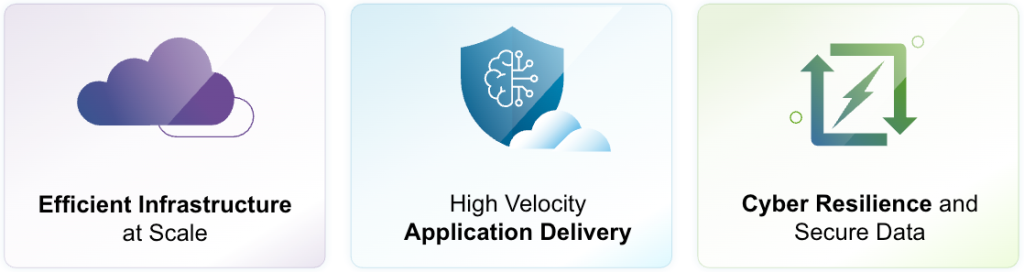
What’s New in VCF 9.1 Across the Platform

VMware Cloud Foundation 9.1 will introduce innovations across three key areas of the platform to improve efficiency, application performance, and resilience. 
As environments grow, the challenge is not just adding more capacity. It is operating that capacity efficiently without increasing cost or complexity. VCF 9.1 will introduce several enhancements that improve how infrastructure is utilized, provisioned, and managed at scale.

Enhanced NVMe memory tiering will introduce a unified memory model where hot data remains in DRAM and colder pages are offloaded to NVMe, increasing effective memory capacity without impacting application behavior. VCF 9.1 will improve performance, add native software mirroring, and simplify deployment, enabling higher consolidation ratios and up to 40 percent lower total cost of ownership.

vSAN global deduplication and enhanced compression will reduce the amount of physical storage required across the cluster by eliminating redundant data and improving compression efficiency. These capabilities will operate continuously in the background and support encrypted environments, helping organizations lower storage costs without sacrificing performance.

vSphere Elastic Provisioning will simplify how hosts are brought online and assigned to workloads by enabling parallel imaging, automated discovery, and consistent configuration. This will reduce provisioning time and make it easier to scale or repurpose infrastructure as demand changes.

VMware vSphere Kubernetes Service (VKS) will continue to scale as a core part of the platform, enabling platform teams to run both traditional and modern workloads with a consistent operational model. VCF 9.1 will increase scalability to support up to 500 Kubernetes clusters per Supervisor, while also improving provisioning speed and operational efficiency. This scale is critical for organizations building multi-tenant platforms or isolating workloads for compliance, allowing platform teams to support hundreds of development teams from a single management backbone. These enhancements will make it easier to isolate workloads, reduce operational overhead, and support large-scale application and AI deployments without re-architecting infrastructure.

Together, these improvements will help organizations get more out of the infrastructure they already have, while reducing the operational effort required to manage it.

Additional capabilities in this area will include:
  • Support for up to 5,000 ESX hosts
  • Increased upgrade scale with parallel lifecycle operations across large environments
  • Topology-aware scheduling to improve performance on modern high core count processors
  • Real-time operational observability across infrastructure and workloads
  • Enterprise support for Ubuntu OS images

Modern applications, especially AI and data-intensive workloads, place very different demands on infrastructure. It is no longer just about running applications, but delivering them quickly, consistently, and at scale. VCF 9.1 will bring several improvements that help reduce operational friction while improving performance and deployment speed.

  • vMotion encryption offload will reduce the CPU overhead associated with secure workload mobility by offloading encryption processing to hardware. This can result in up to approximately 70 percent CPU savings during migrations, improving application performance during movement and allowing hosts to return to steady state faster.
  • VMware vSphere Kubernetes Service (VKS) enhancements will improve how modern applications are deployed and scaled across the platform. With faster provisioning and support for up to 500 clusters per Supervisor, platform teams can deploy applications more quickly while maintaining isolation and consistency across environments.
  • Native object storage will provide a built-in option for applications that require scalable, S3-compatible storage, simplifying how developers consume storage services without needing external platforms.
  • Live application stack blueprints will let platform teams capture a running application (complete with compute, networking, and storage configuration) and turn it into a reusable template. This means new environments can be deployed in minutes instead of hours, with zero manual configuration and perfect consistency across development, test, and production. For DevOps teams provisioning environments at scale, this will be a game-changer.

With these capabilities, organizations will be able to move from managing infrastructure to delivering applications with greater speed and predictability.

Additional capabilities in this area will include:

  • Simplified container-as-a-service experience for developers
  • Integration with Tanzu Marketplace for access to validated services and tooling
  • Private AI model and GPU observability

Security and recovery are no longer separate concerns. They are expected to be built into the platform itself. VCF 9.1 will strengthen cyber resilience by improving how organizations protect, recover, and operate their environments without adding complexity.

  • vSAN for Recovery will enable efficient replication of workloads and protection using native snapshot capabilities, providing a streamlined approach to both disaster recovery and ransomware recovery. By leveraging deep snapshot chains and integrated replication workflows, organizations can recover quickly while maintaining operational simplicity across environments.
  • Continuous compliance enforcement with Advanced Cyber Compliance (ACC) will provide automated assessment and remediation against security baselines such as VCF security guidelines and PCI DSS benchmarks. With built-in drift detection and centralized visibility across the stack, organizations can maintain a consistent security posture, reduce audit preparation time, and address compliance issues proactively rather than reactively.
  • Encrypted vMotion with hardware acceleration will improve the security of workload mobility while reducing the performance overhead traditionally associated with encryption. This will allow organizations to maintain secure operations without sacrificing efficiency during migrations.
  • Live patching enhancements will reduce the need for planned downtime by allowing critical security updates to be applied without disrupting running workloads. This will help organizations maintain compliance and security posture while minimizing the operational impact typically associated with patching cycles.

These capabilities will help organizations move from reactive security measures to a more proactive and resilient operational model.

Additional capabilities in this area will include:

  • Expanded support for secure workload mobility across environments
  • Improved visibility into security posture and operational state
  • Self-service security and automated load balancing

Open and Extensible Ecosystem

While much of the innovation in VCF 9.1 focuses on infrastructure efficiency, application performance, and cyber resilience, the platform will continue to expand through a growing ecosystem of integrations and partner solutions.

  • Networking ecosystem integrations with platforms such as Arista, Cisco, and SONiC will provide greater flexibility in how customers connect and extend their environments.
  • Advancing AI with AMD Instinct GPUs will introduce Enhanced DirectPath I/O support for MI350 Series GPUs, enabling virtualization for AI workloads with improved operational flexibility. Organizations can maintain uptime during maintenance with capabilities such as live patching and high availability, while also scaling resources dynamically to match demand. These enhancements will help reduce operational overhead and improve total cost of ownership for AI-driven environments.
  • Security ecosystem integrations, including CrowdStrike EDR integration for ransomware recovery workflows, will embed endpoint validation directly into the recovery process. Recovered workloads can be scanned in isolated clean room environments before being returned to production, helping reduce reinfection risk and accelerating safe recovery using existing security tools.

These integrations will give organizations the flexibility to build on top of VCF using the tools and services that best fit their operational model, while still maintaining a consistent platform foundation.

Go Deeper with the Virtually Speaking VCF 9.1 Series

To go beyond the feature overview, we put together a dedicated Virtually Speaking video series focused on VMware Cloud Foundation 9.1.

In this series, we sit down with the engineers, product leaders, and architects behind the release to break down what’s new, how it works, and where customers are seeing real impact. Each episode focuses on a specific area of the platform, from infrastructure efficiency and application delivery to cyber resilience and AI.

If you want a closer look at the details behind these capabilities, this is a great place to start.
Get Started

If you are evaluating how to simplify operations, improve performance, and strengthen resilience across your environment, this release is worth a closer look. Whether you are expanding existing environments or planning for modern workloads and AI, VCF 9.1 is designed to help you get there with less complexity.

Explore What’s New in More Detail

This post highlights the major updates in VMware Cloud Foundation 9.1, but there is a lot more to unpack across the platform.

For a deeper look at specific capabilities, check out the following blogs:


Discover more from VMware Cloud Foundation (VCF) Blog

Subscribe to get the latest posts sent to your email.